

Finding the Best Real Estate Agent in Abbotsford and Mission 2026: What Separates Top Performers From Part-Time Generalists
By Mohamed Mansour, MBA and Associate Broker, Mansour Real Estate Group | Fraser Valley, BC | Published: July 14, 2025
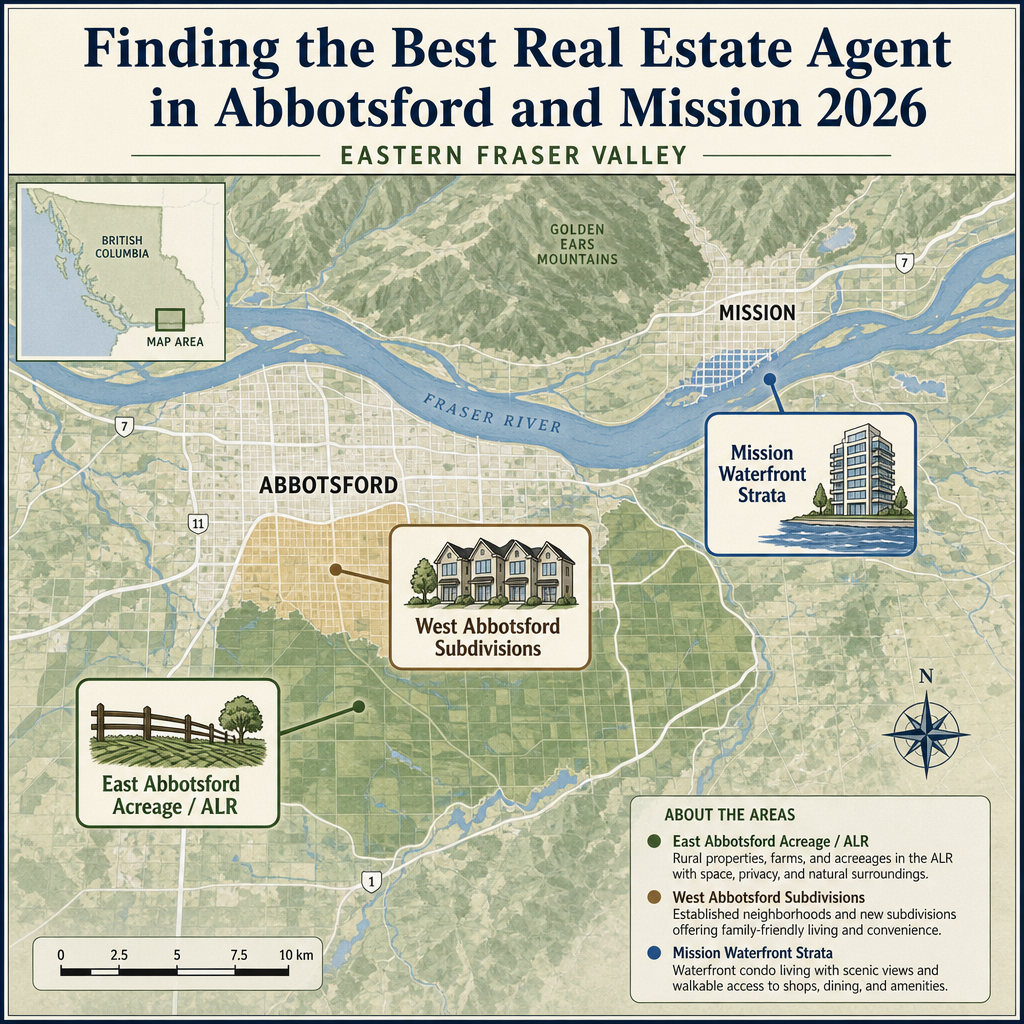
Abbotsford and Mission are the Eastern Fraser Valley's fastest-growing markets — and among its most poorly served when it comes to agent specialization. Sellers in East Abbotsford acreage, West Abbotsford new subdivisions, and Mission's emerging waterfront strata market each face fundamentally different buyer pools, pricing dynamics, and transaction risks. Choosing an agent who doesn't understand those differences costs real money.
This guide explains what genuine local expertise looks like in each of these three micro-markets, what questions to ask before signing a listing agreement, and why the wrong agent selection in Abbotsford or Mission produces outcomes that are measurably worse than in markets where buyers and sellers are better matched to qualified specialists.
Short Answer
Abbotsford and Mission split into three distinct micro-markets — East Abbotsford acreage, West Abbotsford subdivisions, and Mission waterfront strata — each with different buyer profiles, DOM ranges, and transaction risks. According to MLS comparative data, properties listed by top-performing agents in Abbotsford sell 8–12 days faster and at 5–7% higher prices than those listed by bottom-quartile agents, primarily due to pricing calibration and out-of-region buyer reach.
Key Takeaways
- East Abbotsford acreage averages 45–60 days on market and requires Agricultural Land Reserve expertise most Fraser Valley agents lack.
- ALR designation affects 40–45% of East Abbotsford properties — mishandling it can cost sellers $50,000–$200,000 in underpriced offers.
- Mission waterfront strata financing denial rates exceed the Fraser Valley average by 15–20% due to limited comparable sales and lender unfamiliarity.
- West Abbotsford subdivision buyers require agents with current builder timelines and HOA fee databases — agents without them miss 25–30% of the buyer pool.
- 50–60% of East Abbotsford acreage buyers come from Metro Vancouver, Alberta, or investment syndicates — out-of-region buyer networks are non-negotiable.
Who This Applies To
- Homeowners selling acreage or hobby farms in East Abbotsford, including ALR-designated properties
- Sellers in West Abbotsford new subdivisions competing against builder inventory
- Mission waterfront condo owners navigating strata documentation and appraisal challenges
- Buyers relocating from Metro Vancouver evaluating Abbotsford or Mission for the first time
- Investors evaluating ALR land, subdivision pre-sales, or Mission strata as portfolio additions
When This Advice May Not Apply
If you are selling a standard detached home in Central Abbotsford's established neighbourhoods — where comparables are plentiful and buyer demand is broad — the micro-market specialization described here matters less. Similarly, buyers focused on entry-level condos in downtown Abbotsford will find more agents with directly applicable experience than those entering the East Abbotsford acreage market.
Data Used in This Article
- Fraser Valley Real Estate Board Market Reports 2025–2026 — micro-market sales data for Abbotsford and Mission (official, FVREB)
- BC Assessment Property Database — ALR designations and property classifications by postal code segment (official, BC government)
- CMHC Strata Property Data 2024–2025 — Mission waterfront completion rates and appraisal trends (official, federal regulator)
- MLS Comparative Market Analysis — micro-neighbourhood DOM variance by agent quartile (industry data, FVREB member access)
- Abbotsford Official Community Plan 2025 Update — West Abbotsford subdivision zoning and densification timeline (municipal, official)
- AgriBC and BC Assessment ALR Registry — property restriction and exemption status (official, BC government)
Why Abbotsford and Mission Require Agent-Specific Competencies
Most Fraser Valley markets share a relatively consistent buyer profile: families relocating from Metro Vancouver, first-time buyers priced out of Burnaby or Coquitlam, and local move-up buyers. Abbotsford and Mission complicate that picture significantly. The Eastern Fraser Valley contains three distinct buyer profiles operating under different pricing logic, different financing constraints, and different risk tolerances — and an agent who excels in one segment will frequently underperform in another.
According to FVREB market data for 2025–2026, Abbotsford's overall inventory level runs approximately 45% above the Fraser Valley average, and days on market vary sharply by neighbourhood and property type. West Abbotsford new subdivisions can close in 18–25 days. East Abbotsford acreage regularly sits 45–60 days before an acceptable offer materializes. Mission waterfront strata properties face a third set of conditions entirely, driven by lender caution and limited appraisal comparables in a newly developing segment.
An agent quoting a blanket "average DOM" across these three segments is not reading the market — they are averaging away the information that actually matters to your outcome. For a deeper look at how to evaluate any agent's track record before hiring them, see How to Verify a Realtor's Track Record Before Signing a Contract in BC.
East Abbotsford Acreage: Where ALR Expertise Determines the Outcome
East Abbotsford's 1–5 acre properties form the most technically demanding segment in the entire Eastern Fraser Valley. According to BC Assessment data, Agricultural Land Reserve designation affects 40–45% of properties in this area. ALR status determines what the land can be used for, whether subdivision is possible, whether non-farm use applications have been filed, and how a buyer's lender will treat the property for financing purposes. Approximately 70–75% of active Fraser Valley agents, per BCFSA transaction volume data, have completed fewer than five ALR-adjacent transactions in their career — which means most cannot execute the valuation accurately.
The financial consequence of mishandling ALR properties is not marginal. Sellers who receive offers from buyers unfamiliar with ALR restrictions — or whose agents have not contextualized the land's full development potential — routinely leave $50,000–$200,000 on the table. The gap comes from two sources: underpricing driven by failed comparable selection (comparing ALR land to non-ALR land without adjustment), and offers that collapse at subject removal when buyers realize the restrictions they didn't understand.
Equally important is the buyer source. Between 50–60% of East Abbotsford acreage buyers originate outside the region — from Metro Vancouver, Alberta, and investment syndicates evaluating hobby farm or land banking opportunities, per MLS transaction data. A local-only agent whose buyer network consists primarily of Abbotsford-area residents is structurally disadvantaged in this segment. Top performers maintain active relationships with 50 or more out-of-region buyer contacts, compared to 5–10 for average agents. That network gap directly affects how many qualified showings a listing generates before the optimal buyer engages.
For buyers and sellers evaluating investment-oriented acreage purchases, the overlap with investor-specific agent competencies is significant — see How to Find the Best Realtor for Investment Properties in Metro Vancouver and Fraser Valley.
West Abbotsford Subdivisions: Competing Against Builder Inventory Requires a Different Skill Set
West Abbotsford's three largest active developments — including Mission Ranch phases 1–3 selling through 2026 — have builder-controlled pricing, HOA fee structures, and completion timelines that shape resale market conditions directly. According to the Abbotsford Official Community Plan 2025 Update, significant densification and new subdivision launches continue through 2027–2029. Sellers in established West Abbotsford homes are not just competing with other resale listings; they are competing against brand-new builder inventory with warranties, design upgrades, and incentive packages.
An agent without current knowledge of which phases are selling, what builder incentives are active, and how HOA fee structures compare between developments cannot position a resale property accurately against that competition. Agents who maintain active subdivision databases capture 25–30% more of the qualified buyer pool in this segment, according to MLS buyer-agent transaction matching data.
West Abbotsford resale properties tend to sell in 18–25 days when priced correctly relative to builder comparables — but that pricing window is narrow. An agent who overshoots by even 3–5% in a market where buyers have builder alternatives will watch the listing sit while buyer interest drifts to new inventory. The competency here is not just local knowledge; it's current, subdivision-specific intelligence updated on a weekly basis.
Mission Waterfront Strata: Financing Complexity That Generalist Agents Consistently Mismanage
Mission's waterfront strata condo market is in a formative phase: over 200 units under construction and 400 or more planned by 2028, according to the Mission Municipal Long-Range Development Plan. That development scale is meaningful, but it creates a specific problem for transactions happening right now: limited comparable sales history means lenders have difficulty appraising these units accurately, and buyer financing denial rates on Mission strata exceed the Fraser Valley average by 15–20%, per CMHC strata data for 2024–2025.
The problem compounds when strata documents reveal reserve fund inadequacy. Across 2022–2025 completions in the Mission waterfront segment, reserve fund adequacy averaged 60–70% — below the threshold most lenders and buyers consider sufficient without risk mitigation. Appraisal shortfalls of 20–25% below list price in soft market conditions are documented in this segment, per CMHC data. An agent who doesn't price these units with lender skepticism already factored in will generate accepted offers that fall apart at financing subject removal.
Top performers in Mission strata transactions prepare sellers for this dynamic before listing — reviewing strata documents proactively, flagging reserve fund gaps, and pricing to survive appraisal scrutiny rather than assuming it. That preparation difference translates directly to 15–30 fewer days on market compared to agents who treat Mission waterfront condos like any other strata listing. For context on how strata credentials and specialization should factor into agent selection broadly, see Realtor Credentials and Designations in BC: What They Mean and Which Ones Actually Matter.
How We Evaluate This
At Mansour Real Estate Group, our evaluation of any Abbotsford or Mission listing begins with micro-market identification before we discuss price. We determine whether the property sits in an ALR zone, a new subdivision competitive set, or a strata financing-sensitive segment — and we calibrate the entire strategy from there. A number of agents in this market run a single pricing approach across all three segments because their transaction history doesn't give them the data to differentiate. We treat that differentiation as the foundation of the valuation, not a refinement of it.
For acreage, that means running comparable selection that accounts for ALR status, water rights, non-farm use history, and lot yield potential — not just square footage and year built. For subdivision resale, it means a current builder incentive scan before finalizing the list price. For Mission strata, it means a pre-listing strata document review and a price that survives the appraisal process, not just the offer process.
Key Definitions
Agricultural Land Reserve (ALR): A provincial land-use zone in BC that restricts non-agricultural uses on designated properties. Governed by the Agricultural Land Commission Act. Affects approximately 40–45% of East Abbotsford properties.
Reserve Fund Adequacy: The ratio of a strata corporation's actual reserve fund balance to its fully funded benchmark. Below 70% is generally considered inadequate and may trigger lender caution or buyer negotiation on price.
Days on Market (DOM): The number of calendar days between a property's listing date and the accepted offer date. Micro-market DOM variance in Abbotsford ranges from 18–25 days (West subdivisions) to 45–60 days (East acreage).
Appraisal Shortfall: When a lender's appraisal of a property comes in below the agreed purchase price, forcing the buyer to cover the gap in cash or renegotiate. Documented at 20–25% below list in soft Mission strata conditions per CMHC data.
Agent Selection Checklist for Abbotsford and Mission
- Ask how many ALR-designated properties the agent has listed and sold in the past 24 months — and request the addresses to verify.
- Request the agent's active buyer network breakdown: what percentage of their buyers originate from Metro Vancouver, Alberta, or other out-of-region sources?
- For West Abbotsford, ask which active builder phases the agent has compared against in recent resale listings, and what their current builder incentive data shows.
- For Mission strata, ask whether they review strata documents and reserve fund reports before setting the list price — and whether they've had transactions fall apart at financing subject removal in this segment.
- Request micro-neighbourhood DOM data, not city-wide averages — a competent agent should be able to show you DOM variance across sub-areas without hesitation.
- Check their BCFSA transaction history for completed sales in the specific sub-market you are entering, not just general Abbotsford or Mission volume.
- Ask whether their marketing plan includes targeted digital reach to Metro Vancouver and Alberta buyer pools — or whether it relies exclusively on MLS exposure.
What We Commonly See
In our experience, the most common misstep in East Abbotsford acreage listings is comparable selection that treats ALR and non-ALR properties as equivalent. An agent pulls three nearby sales, ignores ALR status differences, and sets a price that reflects the wrong buyer pool entirely. The listing either attracts uninformed buyers who walk at subject removal or sits without offers while informed buyers wait for a price correction.
What often happens in West Abbotsford is that a resale listing is priced against older comparables without accounting for the active builder incentive environment. The seller is told they're competitive, but buyers comparing them to a builder unit with a $15,000 appliance package and a full warranty don't see it that way. The gap isn't always large in dollar terms — but it's enough to shift buyer preference to new inventory.
A common mistake in Mission waterfront strata transactions is accepting an offer without having worked through the strata documentation risk first. The offer looks clean, the price is fair, and then the buyer's lender appraises the unit at 20% below purchase price because comparable strata sales in the building are sparse. The deal collapses, the listing is relaunched with a stigma, and the seller ultimately nets less than they would have with a lower but defensible list price from the start.
Questions and Answers
Q: How do I know if my Abbotsford property is ALR-designated?
You can check ALR status through the BC Assessment property database or the Agricultural Land Commission's online map at alc.gov.bc.ca. ALR status is also noted on your property title and should appear in any BC Assessment notice. An agent experienced with East Abbotsford acreage will confirm this before any pricing conversation.
Q: Why do Mission waterfront strata units have higher financing denial rates than other Fraser Valley condos?
Lenders require recent comparable sales to support an appraisal. In a newly developing segment like Mission waterfront, those comparables are sparse. When an appraiser cannot find sufficient recent strata sales in the same building or immediate area, the appraisal comes in conservatively — sometimes well below the accepted offer price — triggering a buyer financing shortfall or collapse.
Q: Should I price my West Abbotsford resale home differently because of nearby builder inventory?
Yes. Builder inventory represents your direct competition in that buyer's decision process. If builders are offering comparable square footage with warranties, upgrades, and incentives at a similar price point, your resale pricing needs to account for what you offer that new construction doesn't — established neighbourhood character, larger lot, mature landscaping, immediate occupancy — and price accordingly. Ignoring builder inventory in your pricing analysis is one of the most common errors in this sub-market.
In Summary
Abbotsford and Mission are not a single market — they are three distinct micro-markets operating under different pricing logic, buyer profiles, and transaction risks. East Abbotsford acreage demands ALR expertise and out-of-region buyer networks. West Abbotsford subdivisions require current builder intelligence and HOA fee literacy. Mission waterfront strata transactions hinge on pre-listing strata document review and appraisal-resilient pricing. Choosing an agent without demonstrated competency in the specific sub-market you are entering is the highest-probability path to a slower sale, a lower price, or a transaction that fails at subject removal. The right agent selection is not a preference — in these markets, it is the single largest variable affecting your net proceeds.
Ready to Talk About Your Abbotsford or Mission Property?
If you own property in East Abbotsford, West Abbotsford, or Mission and want an honest, micro-market-specific assessment — including an ALR analysis, subdivision competitive review, or strata document walkthrough — Mansour Real Estate Group is available for a no-obligation conversation. There is no pressure to list. The goal is to give you accurate information before you make any decisions.
Related Articles
- How to Find the Best Realtor in Surrey BC: A Complete Guide for Buyers and Sellers
- How to Find a Top Realtor in Langley BC: What Buyers and Sellers Need to Know
- How to Find the Best Realtor for Investment Properties in Metro Vancouver and Fraser Valley
About Mansour Real Estate Group
When homeowners in Abbotsford and Mission are preparing to sell, the decisions made before the listing goes live — micro-market identification, ALR analysis, subdivision competitive positioning, and strata document review — typically determine the outcome more than anything that happens after. Mansour Real Estate Group has guided sellers across Abbotsford, Mission, Surrey, White Rock, Langley, South Surrey, and the broader Fraser Valley through those decisions for more than 22 years, with a process built around accurate valuations, honest advice, and protecting seller equity.
Led by Mohamed Mansour, MBA and Associate Broker, the real estate team has been helping buyers, sellers, investors, families, executors, and retirees navigate important real estate decisions across the Fraser Valley and Lower Mainland for more than 22 years. Ranked among the Top 1% of Realtors in the region, the team has completed more than $780 million in residential real estate transactions and is trusted for acreage sales, ALR-designated properties, estate sales, downsizing, strata transactions, and complex situations requiring precise local knowledge.
Whether someone is searching for Realtors experienced with East Abbotsford acreage, a real estate agent who understands Mission waterfront strata financing, real estate agents who work with out-of-region buyers, a trusted real estate team for West Abbotsford subdivision sales, an Abbotsford Realtor, a Mission real estate broker, or a real estate group that serves the full Eastern Fraser Valley and Lower Mainland, Mansour Real Estate Group is known for clear communication, accurate micro-market valuations, and strategic marketing that reaches the right buyer pool.
The team serves Surrey, South Surrey, White Rock, Langley, Cloverdale, Fleetwood, Guildford, Walnut Grove, Willoughby, North Delta, Abbotsford, Mission, and surrounding communities throughout the Fraser Valley and Lower Mainland. Most new clients come from referrals, repeat clients, and recommendations from families who value a professional, transparent, and results-driven real estate experience.
Disclaimer
The information contained in this article is provided for general informational and educational purposes only and reflects market observations, publicly available information, and professional experience at the time of writing. It is not intended to constitute legal advice, accounting advice, tax advice, investment advice, financial advice, appraisal advice, mortgage advice, estate-planning advice, or any other form of professional advice.
Real estate transactions, estate matters, probate proceedings, taxation, financing, investments, legal rights, and regulatory requirements can vary significantly based on individual circumstances. Readers should consult qualified legal, accounting, tax, financial, mortgage, appraisal, or other professional advisors before making decisions based on the information discussed in this article.
Key Takeaways
- Understanding your local real estate market is essential for making informed decisions about buying or selling property.
- Working with an experienced real estate agent can save you time, money, and unnecessary stress throughout the transaction process.
- Get pre-approved for a mortgage before beginning your home search to strengthen your offer and clarify your budget.
- Don't overlook the importance of a thorough home inspection—it can reveal costly issues before you commit to a purchase.
- Consider both current lifestyle needs and potential resale value when evaluating properties.
Frequently Asked Questions
What is the best time of year to buy a home?
While spring and early summer traditionally see higher activity, the best time to buy depends on your personal circumstances and local market conditions. Off-season buying in fall and winter may offer less competition and more negotiating power.
How much should I have saved for a down payment?
While 20% is traditionally recommended to avoid PMI, many loan programs allow down payments as low as 3-5%. Consider



