
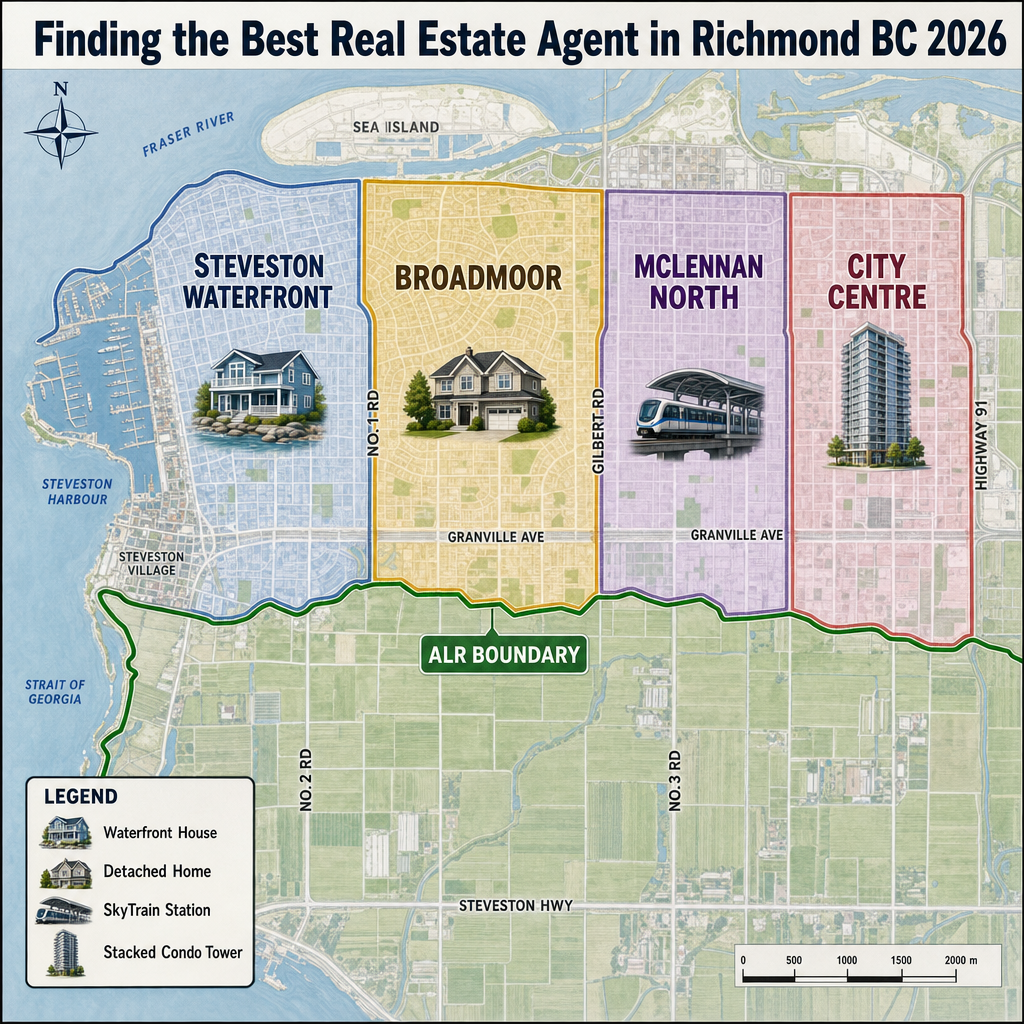

Finding the Best Real Estate Agent in Richmond BC 2026: What Separates Top Performers Across Steveston Waterfront, Broadmoor, McLennan North, and City Centre
By Mohamed Mansour, MBA and Associate Broker | Mansour Real Estate Group | Published: July 15, 2026 | Geography: Richmond, BC — Metro Vancouver and Lower Mainland | Topic: Agent Selection, Hyperlocal Market Expertise, Strata and ALR Complexity
Richmond is one of Metro Vancouver's most transacted real estate markets, but generic agent-selection guides almost never address what actually makes it different. The city's strata concentration, Agricultural Land Reserve boundaries, Steveston waterfront premiums, and post-2024 foreign ownership regulations create a specific set of competency requirements that a generalist agent — however experienced elsewhere — simply does not carry into a Richmond transaction.
This guide explains what separates capable Richmond agents from the rest, neighbourhood by neighbourhood, across four distinct market zones: Steveston Waterfront, Broadmoor, McLennan North, and City Centre.
Short Answer
The best real estate agents in Richmond BC in 2026 combine strata document fluency, Agricultural Land Reserve boundary knowledge, Steveston waterfront pricing expertise, and working familiarity with post-foreign-buyer-ban buyer qualification requirements. These are not optional competencies — they are baseline requirements for protecting a client's equity in one of Metro Vancouver's most complex local markets.
Key Takeaways
- Richmond's City Centre and transit corridors are 55–65% strata inventory, requiring Form B analysis and depreciation report interpretation as standard skills, not specializations.
- Steveston waterfront properties carry an estimated 15–25% premium over comparable inland Richmond homes, with distinct flood zone, moisture, and insurance considerations.
- Agricultural Land Reserve designations cover approximately 50% of Richmond's land, fundamentally changing how sellers evaluate developer offers, assemblies, and long-term hold decisions.
- The 2024 foreign buyer prohibition and 20% speculation tax require agents to verify exemptions, understand corporate purchaser structures, and correctly qualify international buyers — a competency set that did not exist pre-2024.
- Richmond's significant Asian-Canadian population and multigenerational ownership patterns shape negotiation styles and offer strategy in ways that require cultural fluency, not just transactional knowledge.
Who This Applies To
- Homeowners in Richmond considering selling a detached home in Broadmoor, Steveston, or McLennan North
- Condo and townhome sellers in City Centre or SkyTrain-adjacent strata buildings
- Buyers evaluating Richmond properties and trying to qualify agents before signing a contract
- Investors weighing ALR-adjacent land or development-potential properties
- Families navigating multigenerational ownership transfers within Richmond
When This Advice May Not Apply
If you are buying or selling outside the four neighbourhoods discussed here — in Terra Nova, Hamilton, or West Cambie, for example — some of the neighbourhood-specific guidance will differ. The strata and foreign ownership sections apply broadly across Richmond. ALR guidance is most relevant for properties south of Westminster Highway. Consult a Richmond-familiar real estate professional for property-specific analysis.
Data Used in This Article
- BC Assessment Richmond 2026 benchmark data (official, BC Assessment Authority)
- Greater Vancouver Realtors MLS historical sales data for Steveston, Broadmoor, McLennan North, City Centre 2024–2026 (industry board data)
- Statistics Canada 2021 Census Richmond demographic profile (official, Government of Canada)
- City of Richmond Official Community Plan and ALR boundary mapping (official, City of Richmond / ALC)
- BC Ministry of Attorney General foreign buyer prohibition and speculation tax amendments 2024 (official, Government of BC)
- CMHC Richmond market reports (official, Canada Mortgage and Housing Corporation)
Why Richmond Requires a Different Kind of Agent
Most Metro Vancouver agent-selection guides treat the region as a single market. Richmond is not. It is a city where a strata condo three blocks from the Canada Line, a waterfront property in Steveston, a detached estate in Broadmoor, and a farmhouse at the edge of the Agricultural Land Reserve can all be active listings simultaneously — each requiring a fundamentally different knowledge base to represent correctly.
Agents who have built careers in Burnaby, Surrey, or North Vancouver bring legitimate expertise to their home markets. What they often lack in Richmond is direct experience with ALR boundary decisions, strata buildings that carry SkyTrain-proximity special levy risk, Steveston flood zone insurance requirements, and the post-2024 buyer qualification process for foreign national exemptions. These are not minor details. They are the conditions under which Richmond transactions succeed or fail. For a broader look at what distinguishes high-performing agents across Metro Vancouver, the guide on what to look for in a top Metro Vancouver realtor provides a useful comparative framework.
Steveston Waterfront: Premiums, Flood Zones, and Lifestyle Buyer Dynamics
Steveston operates as a micro-market within Richmond. According to sales data tracked through the Greater Vancouver Realtors board, waterfront and near-waterfront properties in Steveston have historically commanded premiums of 15–25% over comparable inland Richmond homes, driven by lifestyle demand, heritage village character, and limited supply along the waterfront corridor.
What separates capable agents in Steveston is not just awareness of that premium — it is knowing how to document, defend, and sustain it through the offer process. Steveston properties near the Fraser River require flood zone mapping literacy, moisture inspection protocols suited to marine-adjacent construction, and insurance cost awareness. Buyers at this price point increasingly ask for documentation that a generalist agent may not know to prepare. An agent without direct Steveston transaction history will often price the premium incorrectly or fail to anticipate the documentation questions that arise during subject removal. This is also a neighbourhood where luxury real estate expertise intersects with hyperlocal knowledge — both matter at the upper end of the Steveston market.
City Centre Strata: Form B, Depreciation Reports, and SkyTrain Proximity Risk
City Centre and the transit corridor zones represent the highest concentration of strata inventory in Richmond. The Greater Vancouver Realtors board and CMHC data suggest strata properties account for 55–65% of active inventory in these zones. Selling or buying in this segment requires fluency with Form B disclosure statements, depreciation report interpretation, and contingency reserve fund adequacy assessment — skills that generalist detached-home agents do not use regularly.
A specific risk that Richmond City Centre agents should understand is special levy exposure in buildings with deferred major repairs or upcoming SkyTrain-adjacent infrastructure projects. Buyers and their agents have become more systematic in probing for undisclosed special levies since 2022. Sellers benefit from agents who identify these risks early — before listing — so they can either address them or price accordingly. An agent who discovers a pending $15,000 special levy during a buyer's subject removal period has lost the seller significant leverage. Understanding the difference between a solo agent and a real estate team matters here too — strata transactions generate significant document volume that a team handles more systematically than a single agent working alone.
Broadmoor and McLennan North: Detached Estates, School Catchments, and Pricing Nuance
Broadmoor is Richmond's most established detached home enclave. Properties here are larger, older on average, and often held by families for decades before going to market. The pricing challenge in Broadmoor is that two homes on the same street can carry materially different values based on lot dimensions, renovation status, and school catchment proximity — differences that BC Assessment does not always capture accurately. An experienced Broadmoor agent calibrates against recent comparables and buyer demand drivers, not assessed value alone.
McLennan North attracts a different buyer profile: younger families, often first- or second-time detached buyers moving up from strata, drawn by newer construction, transit access, and school zoning. Agents working McLennan North regularly navigate competing offer dynamics and need to understand what drives this buyer demographic's priorities — typically school catchment precision, commute corridor access, and mortgage qualification thresholds — to advise sellers on preparation, pricing, and offer timing correctly.
Agricultural Land Reserve: What Sellers Near ALR Boundaries Need to Understand
According to the Agricultural Land Commission, approximately 50% of Richmond's land base falls within the Agricultural Land Reserve. For most buyers and sellers in Richmond's urban core, this is background information. For owners of properties near ALR boundaries — or within the ALR — it is central to the property's value narrative.
Developers periodically approach ALR-adjacent landowners with assembly or rezoning proposals. Whether those offers reflect fair market value, and what conditions would need to be met for rezoning to be viable under Richmond's Official Community Plan, requires agent-level knowledge that most generalists cannot provide. An agent unfamiliar with ALC exclusion application processes, Richmond OCP policies, and assembly market pricing may inadvertently advise a client to accept or decline an offer without understanding its full implications. This is not legal advice — it is market literacy. ALR-adjacent sellers should ask candidates directly about prior experience with agricultural land boundary transactions before committing to a listing agreement.
Foreign Buyer Ban and Speculation Tax: Agent Competencies That Now Define Qualification
The 2024 amendments to BC's foreign buyer prohibition and the province's 20% speculation and vacancy tax created a new competency layer that Richmond agents, in particular, need to navigate. Richmond's historical profile as a high-activity international buyer market means these rules affect a larger share of transactions here than in most other Metro Vancouver cities.
A capable Richmond agent in 2026 understands which buyer categories qualify for exemptions under the prohibition, how to verify principal residence election documentation, what corporate purchaser structures require disclosure-wise, and when a buyer's situation requires referral to a real estate lawyer before an offer is accepted. Agents who are unclear on these requirements create risk for sellers — an accepted offer that collapses at subject removal because the buyer's qualification was never properly assessed costs sellers weeks and market momentum. According to BC Government guidance, the prohibition applies broadly with limited exemptions for Canadian citizens, permanent residents, and specific work permit holders. Confirming status before accepting offers is now standard practice for informed Richmond agents.
Cultural and Demographic Fluency: Why It Affects Negotiation and Marketing
According to Statistics Canada's 2021 Census, Richmond has one of the highest concentrations of residents of East and Southeast Asian heritage in Canada, with a significant proportion of the population identifying as Chinese-Canadian. This demographic reality shapes the Richmond real estate market in practical ways: multigenerational ownership structures are common, investor-hold psychology differs from owner-occupier psychology, and negotiation expectations in some buyer segments follow conventions that an agent without cultural familiarity may misread as disinterest, aggression, or commitment when the signal means something different. This is not about stereotyping — it is about professional fluency. Agents who have worked the Richmond market for years develop an intuitive read of these dynamics. Agents parachuting in from other Metro Vancouver markets often do not, and the negotiation gap shows.
How We Evaluate This
At Mansour Real Estate Group, when advising clients who ask about agent selection in complex urban markets like Richmond, we look for the same indicators we apply to our own practice: transaction history within the specific neighbourhood (not just the city), demonstrated strata document competency, specific knowledge of the regulatory layer affecting that market, and client feedback from prior transactions in comparable situations.
Generic Metro Vancouver experience is a baseline, not a qualification. The questions we recommend asking — detailed in the cluster guide on 20 questions to ask a realtor before you hire them — apply directly to Richmond, with the additional Richmond-specific questions outlined in the checklist below. The value of a structured real estate team in complex Metro Vancouver transactions is also relevant here: Richmond's document volume, regulatory overlay, and buyer qualification requirements create a workload that teams handle more reliably than solo agents across concurrent transactions.
Richmond Buyer and Seller Checklist
- Ask the agent to name their last three completed transactions in Richmond and confirm the neighbourhood, property type, and outcome.
- For strata properties: confirm the agent can interpret a Form B, assess depreciation report adequacy, and identify special levy risk before listing.
- For Steveston: ask about direct experience with flood zone mapping, marine-adjacent moisture protocols, and insurance cost documentation.
- For ALR-adjacent or ALR-zoned properties: ask whether the agent has experience evaluating developer assembly offers and ALC exclusion feasibility.
- Confirm the agent's process for verifying buyer qualification under the 2024 foreign buyer prohibition before accepting an offer.
- Review the agent's comparable sales analysis to confirm it uses Richmond MLS data, not generalized Metro Vancouver benchmarks.
- Ask how the agent adjusts marketing strategy for Richmond's investor-heavy and multigenerational buyer pool versus an owner-occupier-dominant market.
What We Commonly See
Agents pricing Steveston against City Centre comparables. In our experience reviewing Richmond transaction histories, a common error is using City Centre strata or McLennan North detached comparables to anchor Steveston waterfront pricing. The lifestyle premium in Steveston is real and defensible — but it requires waterfront-specific comparables, not city-wide averages. Sellers who use an agent unfamiliar with this distinction routinely leave money on the table.
Strata sellers who didn't review their depreciation report before listing. What often happens is that a buyer's agent obtains the depreciation report during subject removal and discovers a capital expenditure the seller's agent never flagged. The buyer renegotiates or walks. A seller's agent with genuine strata fluency reads that report before the listing goes live — not during an offer period.
ALR-adjacent sellers accepting assembly offers without a second opinion. A common mistake we observe is sellers accepting developer assembly offers based solely on the developer's comparable rationale. Developer-initiated assemblies are priced to the developer's feasibility model, not the seller's maximum value. An agent with ALR boundary and assembly experience can assess whether the offer reflects current market conditions for that specific land designation and OCP alignment — or whether it reflects the developer's preferred acquisition cost.
Questions and Answers
What documents should a Richmond strata seller review before listing in 2026?
At minimum: the current Form B information certificate, the most recent depreciation report, meeting minutes from the last two years, and the current operating budget and contingency reserve fund balance. These documents determine how buyers perceive risk and price the property. Surprises during subject removal cost sellers negotiating leverage. According to BC's Strata Property Act, Form B disclosure is the seller's responsibility.
Does the 2024 foreign buyer ban affect most Richmond real estate transactions?
It affects transactions where the buyer is not a Canadian citizen or permanent resident. The prohibition includes most foreign nationals, with limited exemptions for work permit holders meeting specific criteria and certain corporate structures. Richmond's historical buyer composition means agents here encounter this qualification question more frequently than in most other BC markets. Verifying buyer status before accepting an offer is standard protocol. Consult a real estate lawyer for specific buyer situations.
How does ALR designation affect a property's market value in Richmond?
ALR-designated land in Richmond is restricted in its use and development potential, which typically reduces its value relative to equivalent land in urban zones. However, proximity to ALR boundaries, lot dimensions, and OCP overlay can affect assembly potential. BC Assessment does not always capture the premium or discount accurately. Owners of ALR or ALR-adjacent properties should seek a market valuation from an agent with direct ALR transaction experience, not rely on assessed value alone.
In Summary
Richmond's real estate market in 2026 rewards agents who have done the specific work of understanding it: its strata concentration, its ALR boundary complexity, its Steveston waterfront micro-market, and its post-foreign-buyer-ban regulatory layer. Generalist Metro Vancouver experience is a starting point, not a substitute for neighbourhood-level fluency. Whether you are selling a Broadmoor estate, a City Centre condo, a Steveston waterfront home, or a property at the edge of the Agricultural Land Reserve, the quality of your agent's Richmond-specific knowledge will shape your outcome more than their transaction volume elsewhere. Ask the right questions before you sign a listing agreement. The Richmond market is competitive, structured, and layered — and so should be the expertise you bring to it.
If you have questions about selling or buying in the Lower Mainland and want a second opinion on your situation, Mansour Real Estate Group is available for a straightforward, no-obligation consultation. There is no pressure and no obligation — just an honest conversation grounded in local market knowledge.
Related Articles
- What to Look for in a Top Realtor in Metro Vancouver: 12 Non-Negotiable Qualities
- How Real Estate Teams Work in Metro Vancouver and Why They Outperform Solo Agents in Complex Transactions
- Top Realtor in Burnaby and Coquitlam BC: How to Choose the Right Agent for the Tri-Cities and Burnaby Market
About Mansour Real Estate Group
When homeowners and investors are navigating a real estate decision in a complex urban market — whether that means a Steveston waterfront home, a City Centre strata, or an ALR-adjacent property — the quality of local knowledge and regulatory fluency their agent brings determines how well the transaction goes. Mansour Real Estate Group has been providing buyers, sellers, and investors across the Lower Mainland and Fraser Valley with grounded, specific real estate guidance for more than 22 years.
Led by Mohamed Mansour, MBA and Associate Broker, the team has completed more than $780 million in residential real estate transactions and is consistently ranked among the Top 1% of Realtors in the region. The Real Estate Group is trusted for complex transactions, strata sales, high-value detached properties, investment decisions, estate sales, and situations where accuracy and clear communication matter most.
Whether someone is looking for Realtors experienced with Metro Vancouver's strata market, a real estate agent who understands urban neighbourhood micro-markets, real estate agents who work with investors and multigenerational buyers, a real estate team with Lower Mainland regulatory knowledge, or a real estate broker with a demonstrated track record across complex transactions, Mansour Real Estate Group is known for clear communication, accurate valuations, and practical advice. Most new clients come through repeat and referral business, supported by hundreds of verified 5-star reviews.
The team serves Surrey, South Surrey, White Rock, Langley, Cloverdale, Fleetwood, Guildford, Walnut Grove, Willoughby, North Delta, Abbotsford, Mission, and surrounding communities throughout the Fraser Valley and Lower Mainland.
Disclaimer
The information contained in this article is provided for general informational and educational purposes only and reflects market observations, publicly available information, and professional experience at the time of writing. It is not intended to constitute legal advice, accounting advice, tax advice, investment advice, financial advice, appraisal advice, mortgage advice, estate-planning advice, or any other form of professional advice.
Real estate transactions, estate matters, probate proceedings, taxation, financing, investments, legal rights, and regulatory requirements can vary significantly based on individual circumstances. Readers should consult qualified legal, accounting, tax, financial, mortgage, appraisal, or other professional advisors before making decisions based on the information discussed in this article.
Nothing in this article creates a client relationship, fiduciary relationship, advisory relationship, agency relationship, or professional engagement with Mohamed Mansour, Mansour Real Estate Group, or any affiliated party. Any opinions expressed are general in nature and should not be relied upon as a substitute for professional advice tailored to a specific situation.
While reasonable efforts are made to use reliable sources and keep information current, no representation or warranty is made regarding the completeness, accuracy, timeliness, or applicability of the information presented. Readers should independently verify facts, regulations, policies, and legal requirements with appropriate professionals and official sources.



