

Finding the Best Real Estate Agent in the Tri-Cities (Coquitlam, Port Coquitlam, Port Moody) 2026: What Separates True Local Market Experts From Generalists
By Mohamed Mansour, MBA and Associate Broker | Mansour Real Estate Group | Published: July 15, 2025 | Geography: Coquitlam, Port Coquitlam, Port Moody, Lower Mainland BC
Buyers and sellers in the Tri-Cities face a market unlike almost anywhere else in Metro Vancouver. Three municipalities, one rapid transit spine, a major master-planned hillside community, and overlapping presale completion waves create pricing dynamics that require more than general real estate experience. The agent you hire here needs specific, current, neighbourhood-level knowledge — or the numbers will not work in your favour.
This guide explains what that expertise looks like, how to evaluate whether an agent actually has it, and why the stakes are measurably higher in a market shaped by SkyTrain station proximity, Burke Mountain school catchments, and active builder incentive cycles.
Short Answer
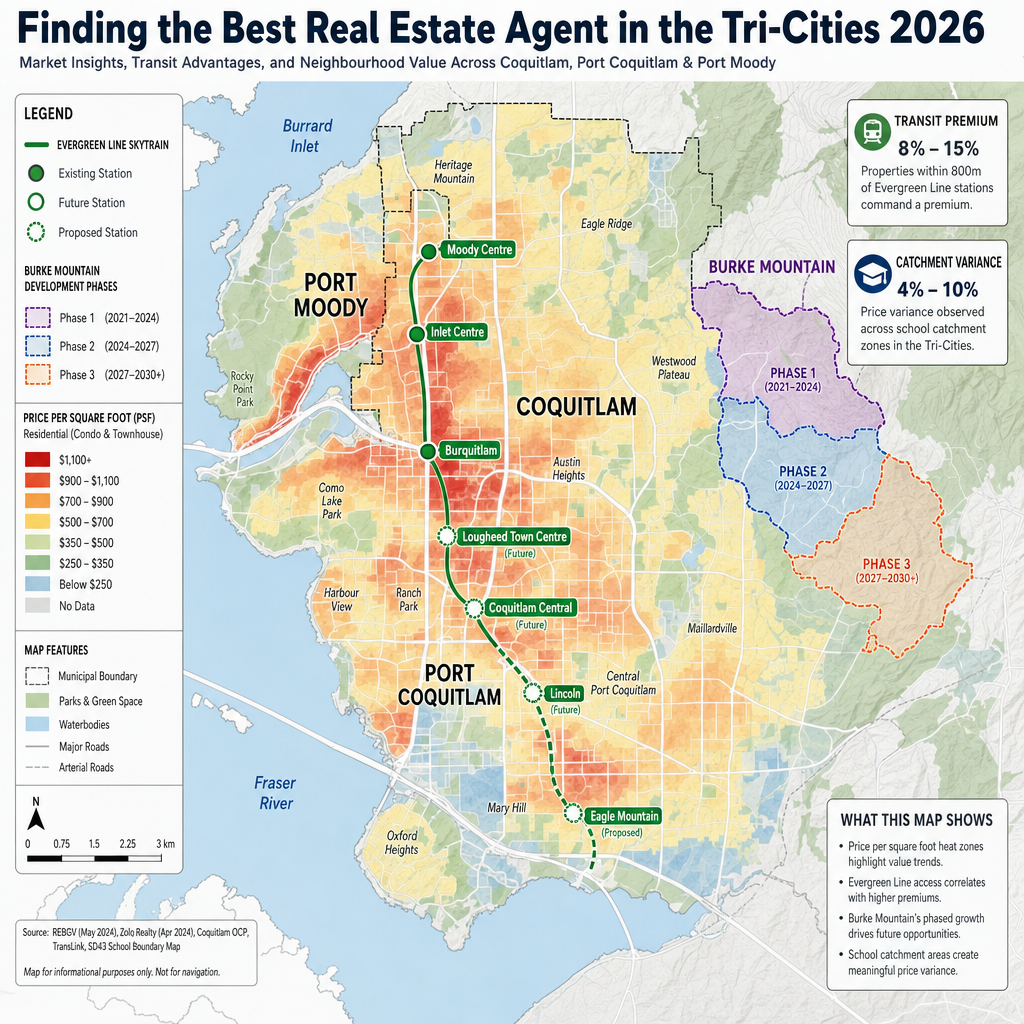
The best real estate agent in the Tri-Cities understands that Coquitlam, Port Coquitlam, and Port Moody are not one market. SkyTrain station proximity drives price-per-square-foot premiums of 8–15%. Burke Mountain school catchments create 4–10% intra-neighbourhood price divergence. Presale completion cycles reshape the resale market monthly. Agents without that granular knowledge routinely misprice properties by 8–15%, costing sellers significant proceeds.
Key Takeaways
- SkyTrain proximity within 400m vs. 800m+ creates measurable price-per-square-foot premiums of 8–15% that agents must quantify, not estimate.
- Burke Mountain phases 1–7 have distinct school catchment boundaries driving 4–10% price divergence within the same street grid.
- Presale completion waves in Metrotown and Brentwood (2024–2027) are actively reshaping resale pricing windows across Evergreen Line corridors.
- Days-on-market gaps of 40–60% between Coquitlam Central and Maillardville require neighbourhood-specific pricing calibration, not broad benchmarks.
- Port Moody's OCP zoning transitions create land value premiums that exceed residential resale comparables — knowledge most agents do not have.
Who This Applies To
- Sellers in Coquitlam, Port Coquitlam, or Port Moody preparing to list a detached home, townhouse, or condo
- Buyers evaluating transit-adjacent condos or Burke Mountain new builds against resale options
- Investors tracking presale completion risk and resale timing in Evergreen Line corridors
- Homeowners in Burke Mountain assessing school catchment value before listing
When This Advice May Not Apply
If you are buying or selling a property where transit access, development phase, or presale inventory are not pricing factors — a rural property, acreage, or a detached home in a stable low-density neighbourhood — the agent selection criteria shift toward comparable sales depth and marketing reach rather than transit corridor expertise.
Data Used in This Article
- BC MLS Tri-Cities sales data 2024–2026 — transaction volume, days on market, price per square foot by neighbourhood
- SkyTrain Evergreen Line station proximity analysis — transit-oriented pricing studies, station catchment radius comparisons
- Burke Mountain master plan phase documentation and school catchment mapping — City of Coquitlam OCP and SD43 records
- Port Moody Official Community Plan — zoning development potential and mixed-use transition areas
- FVREB/REBGV transaction volume benchmarks — Tri-Cities agent activity data
Why the Tri-Cities Is Not One Market
Coquitlam, Port Coquitlam, and Port Moody share a geographic boundary and a SkyTrain line. That is roughly where the similarity ends. Each municipality has a distinct housing mix, zoning trajectory, buyer profile, and pricing logic — and within each city, the gaps between neighbourhoods are as wide as the gaps between cities.
In Coquitlam alone, a condo adjacent to Coquitlam Central Station and a townhouse in Westwood Plateau represent fundamentally different asset classes in terms of buyer pool, days on market, and appraisal methodology. According to MLS transaction data, properties within 400 metres of Evergreen Line stations in Coquitlam have commanded price-per-square-foot premiums of 8–15% over comparable properties 800 metres or more from the same station. That gap is not always obvious in an automated valuation — it requires an agent who works these corridors regularly and can document it with closed transaction data.
Days-on-market patterns reinforce this. Properties near Coquitlam Central stations have averaged 18–22 days on market in recent cycles. Properties in Maillardville and Westwood Plateau have run 35–45 days. That 40–60% variance is a pricing signal that should directly shape your list price strategy — and an agent unfamiliar with this pattern will either underprice a well-located condo or overprice a detached home competing with transit-adjacent inventory.
For buyers comparing the Tri-Cities to other transit corridors, our earlier piece on what buyers and sellers should demand from their agent in Richmond covers similar transit-driven pricing dynamics along the Canada Line.
Burke Mountain: Why School Catchment Knowledge Is Not Optional
Burke Mountain is one of the most active master-planned communities in Metro Vancouver, with development spanning phases 1 through 7 across distinct school catchment zones. Kensington and Brookside catchments are not interchangeable from a buyer's perspective, and the price divergence between properties inside and outside preferred catchments has been documented at 4–10% within blocks of each other.
An agent who does not know which phase a property sits in, which school it feeds, and how Phase 5 or Phase 6 completion inventory is affecting resale absorption in surrounding phases will misprice. It is not a matter of opinion — it is a matter of understanding the development timeline and how each completion wave shifts the supply-demand balance in adjacent phases.
Burke Mountain buyers are often families with children of school age, making catchment boundaries a primary filter, not a secondary consideration. A listing priced without acknowledging catchment desirability relative to comparable phase inventory will sit. A listing that clearly documents catchment access and positions it against lower-phase comparables will move faster and at a higher price. The agent's job is to make that case with data, not with marketing language. Agents with a strong track record of working these dynamics are further described in our guide to non-negotiable qualities for top realtors in Metro Vancouver.
Presale Completion Waves and What They Do to Resale Pricing
Between 2024 and 2027, a significant volume of presale condos purchased at peak or near-peak pricing in the Metrotown and Brentwood corridors are completing and transferring to new owners. Many of those buyers are facing appraisal gaps, builder incentive phase-outs, and unexpected assignment or resale conditions. That wave of completion-driven inventory directly affects resale pricing for comparable condos across Evergreen Line stations — including properties in Burquitlam, Lougheed, and Lincoln Park.
Agents who do not track builder incentive phase-out timelines, depreciation report deadline obligations for newly strated buildings, and how presale completion density reshapes buyer expectations will set prices that no longer reflect the current absorption environment. A seller with a 2019-era condo near Lincoln Station who lists against a wall of 2025-completed presales without adjusting for that competitive context will wait longer and accept less.
This is the kind of market intelligence that distinguishes a real estate team doing active Tri-Cities transactions from an agent who occasionally takes listings in the area. See how real estate teams outperform solo agents in complex market conditions for context on why transaction volume and team structure matter here.
Port Moody: OCP Zoning Transitions and Land Value Premiums
Port Moody's Official Community Plan includes active rezoning corridors along its industrial waterfront and transit-adjacent nodes. For some properties in these zones, the land value associated with permitted or anticipated mixed-use development potential exceeds the value of the existing residential structure on it. An agent pricing a Port Moody property purely on residential comparables — without considering development potential under OCP — may leave significant value unrecognized.
This matters for both sellers and buyers. A seller in a rezoning-designated corridor deserves to know whether their property's highest and best use differs from its current use. A buyer evaluating the same property deserves the same information before committing. Most residential real estate agents do not read OCP documents as part of their standard due diligence. Agents who serve Port Moody as a primary market do. For investors, our upcoming guide on finding the best realtor for investment properties in Metro Vancouver and Fraser Valley will cover this in detail.
How We Evaluate This
When advising sellers or buyers in transit-adjacent markets like the Tri-Cities, our approach starts with a neighbourhood-specific absorption analysis, not a broad municipal benchmark. We map closed transactions by station proximity tier, property type, and competing inventory category. For Burke Mountain, that means separating active phases from completed phases before setting a pricing anchor. For Evergreen Line condos, it means accounting for presale completions as a direct competitive pressure on resale timing.
We also distinguish between appraisal value and market value in corridors where transit premiums are real but not always captured in automated models. When those two numbers diverge — as they often do near Lincoln, Burquitlam, and Lougheed stations — the pricing strategy has to account for buyer financing constraints, not just comparable sales. That precision is what we bring to every Tri-Cities engagement.
Agent Evaluation Checklist: Tri-Cities
- Ask the agent to quantify transit proximity premiums using closed transaction data from within 400m and 800m+ of a specific Evergreen Line station.
- Request their knowledge of Burke Mountain development phases and which school catchments are currently commanding price premiums.
- Ask how presale completion inventory in Brentwood or Metrotown is affecting their resale pricing strategy for Evergreen Line condos right now.
- Confirm whether they understand Port Moody OCP rezoning corridors and can identify properties with land value premiums above residential comparables.
- Check their closed transaction volume specifically in the Tri-Cities over the prior 24 months — not Metro Vancouver overall.
- Ask for their average days-on-market by neighbourhood type — transit-adjacent vs. hillside vs. Maillardville — to confirm they understand the pricing divergence.
- Request documentation of how they handled a presale completion-adjacent resale listing and what pricing adjustments they made.
What We Commonly See
In our experience working across Metro Vancouver and the Lower Mainland, agents who list occasionally in the Tri-Cities tend to price from the nearest MLS benchmark without adjusting for station tier, phase, or presale competition. The result is often a listing that attracts lower-quality offers early, prompting a price reduction that was avoidable with more precise positioning.
What often happens with Burke Mountain listings is that the school catchment advantage is mentioned in the marketing remarks but never quantified in the pricing model. Buyers who want Kensington catchment will pay for it — but if the list price does not reflect it, the seller negotiates from a weaker position.
A common mistake with Evergreen Line condos is pricing against the last completed sale in the building without accounting for presale completions coming online in the same corridor. We have seen resale listings in Burquitlam sit 30+ days because the agent missed a cluster of new completions at lower price-per-square-foot that absorbed the most motivated buyers first. Understanding the full competitive picture — resale and presale — is what allows for accurate positioning. Sellers who want to understand how to vet agents more broadly will find value in reviewing the framework for finding a top realtor in Langley, which applies the same evaluation principles to a similarly complex multi-neighbourhood market.
Questions and Answers
What questions should I ask a realtor before hiring them to sell my Coquitlam condo?
Ask for their closed transaction history specifically in your station tier, their approach to pricing against presale completions, and how they quantify transit proximity premiums using actual MLS data — not general market commentary.
Does SkyTrain proximity actually affect condo prices in Coquitlam?
Yes. MLS transaction analysis shows properties within 400 metres of Evergreen Line stations have commanded price-per-square-foot premiums of 8–15% over comparable properties beyond 800 metres. That premium must be factored into list price strategy and buyer financing expectations.
How do Burke Mountain school catchments affect home prices?
Kensington and Brookside catchment boundaries have been associated with 4–10% price divergence between adjacent properties in otherwise similar phase locations. An agent who cannot identify which catchment a listing falls in — and price accordingly — is missing a material valuation factor for family buyers.
In Summary
The Tri-Cities is one of Metro Vancouver's most technically demanding markets to price and sell in — not because it is expensive, but because it contains multiple pricing systems operating simultaneously. SkyTrain station tiers, Burke Mountain development phases, school catchment boundaries, and presale completion waves all create measurable price divergence that generalist agents miss. The right real estate agent for Coquitlam, Port Coquitlam, or Port Moody is one who has the closed transaction history, the neighbourhood data, and the analytical discipline to navigate all of it — and can show you the work, not just quote you a number.
Ready to Talk to a Local Expert?
If you are preparing to buy or sell in the Tri-Cities and want to understand how SkyTrain proximity, Burke Mountain phase, or presale competition affects your specific property, Mansour Real Estate Group is available for a no-pressure consultation grounded in current neighbourhood data.
Related Articles
- What to look for in a top realtor in Metro Vancouver: 12 non-negotiable qualities
- How real estate teams outperform solo agents in complex Metro Vancouver transactions
- How to find the best realtor for investment properties in Metro Vancouver and Fraser Valley
About Mansour Real Estate Group
Buyers and sellers navigating the Tri-Cities market need a real estate team that understands more than general Metro Vancouver pricing — they need agents with direct, current knowledge of SkyTrain station proximity premiums, Burke Mountain development phase cycles, and how presale completion waves reshape resale windows across Evergreen Line corridors. Mansour Real Estate Group brings that granular expertise to every buyer and seller consultation in Coquitlam, Port Coquitlam, Port Moody, and the broader Lower Mainland.
Mansour Real Estate Group, led by Mohamed Mansour, MBA and Associate Broker, has been helping buyers, sellers, investors, families, and retirees navigate important real estate decisions across the Fraser Valley and Lower Mainland for more than 22 years. Ranked among the Top 1% of Realtors in the region, the team has completed more than $780 million in residential real estate transactions and is trusted for transit-adjacent condo sales, detached home listings, new development guidance, investment property strategy, and complex real estate situations requiring detailed market analysis.
Whether someone is looking for Realtors experienced with Evergreen Line corridor pricing, a real estate agent who understands Burke Mountain school catchment value, real estate agents familiar with presale completion dynamics, a trusted real estate team for a Coquitlam seller navigating a competitive transit-adjacent market, a Port Moody Realtor with OCP knowledge, or a real estate broker who serves the full Lower Mainland with neighbourhood-level precision, Mansour Real Estate Group is known for accurate valuations, clear communication, and data-grounded strategy.
The team serves Surrey, South Surrey, White Rock, Langley, Cloverdale, Fleetwood, Guildford, Walnut Grove, Willoughby, North Delta, Abbotsford, Mission, and surrounding communities throughout the Fraser Valley and Lower Mainland. Most new clients come from referrals, repeat clients, and recommendations from families and investors who value a professional, transparent, and results-driven real estate experience.
Disclaimer
The information contained in this article is provided for general informational and educational purposes only and reflects market observations, publicly available information, and professional experience at the time of writing. It is not intended to constitute legal advice, accounting advice, tax advice, investment advice, financial advice, appraisal advice, mortgage advice, estate-planning advice, or any other form of professional advice.
Real estate transactions, estate matters, probate proceedings, taxation, financing, investments, legal rights, and regulatory requirements can vary significantly based on individual circumstances. Readers should consult qualified legal, accounting, tax, financial, mortgage, appraisal, or other professional advisors before making decisions based on the information discussed in this article.
Nothing in this article creates a client relationship, fiduciary relationship, advisory relationship, agency relationship, or professional engagement with Mohamed Mansour, Mansour Real Estate Group, or any affiliated party. Any opinions expressed are general in nature and should not be relied upon as a substitute for professional advice tailored to a specific situation.
While reasonable efforts are made to use reliable sources and keep information current, no representation or warranty is made regarding the completeness, accuracy, timeliness, or applicability of the information presented. Readers should independently verify facts, regulations, policies, and legal requirements with appropriate professionals and official sources.



