
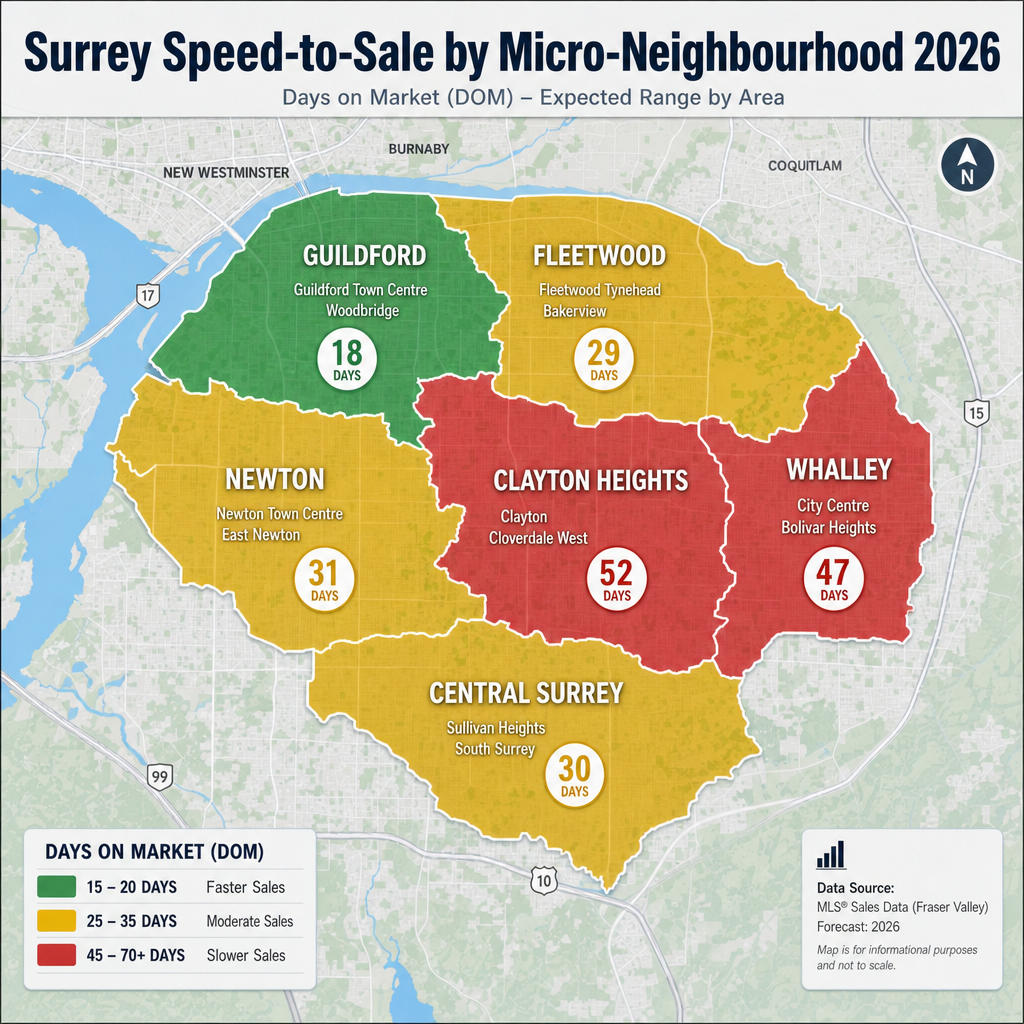

Surrey Speed-to-Sale by Micro-Neighbourhood 2026: Why Days-on-Market Ranges From 15–20 Days in Emerging Areas to 45–60 Days in Soft Markets — Complete Analysis and Strategic Pricing Guide
By Mohamed Mansour, MBA and Associate Broker | Mansour Real Estate Group | Published: July 14, 2025 | Fraser Valley and Lower Mainland, BC
Not every Surrey neighbourhood behaves the same way in a buyer's market. A detached home near a confirmed SkyTrain station can receive offers within three weeks. The same property type, one kilometre away in a condo-saturated pocket, might sit for two months. For sellers preparing to list in 2026, understanding which micro-market they are actually in — not Surrey as a whole — is the most important piece of strategic information they can have.
This guide breaks down days-on-market patterns across Surrey's distinct micro-neighbourhoods, explains what drives the variance, and gives sellers a practical framework for pricing to local velocity rather than citywide averages.
Short Answer
In 2026, days-on-market in Surrey ranges from approximately 15–22 days in emerging, transit-adjacent micro-markets like Guildford and Fleetwood to 45–70+ days in inventory-heavy areas like Whalley and parts of central Surrey. The gap is driven primarily by SkyTrain proximity, affordability positioning, and buyer migration patterns — not marketing quality. Sellers need to price and plan to their specific micro-market, not the Surrey average.
Key Takeaways
- DOM variance between Surrey's fastest and slowest micro-markets reaches 40–50 days in 2026.
- Guildford and Fleetwood lead speed-to-sale, driven by SkyTrain certainty and first-time buyer demand.
- Whalley and central Surrey face slower absorption due to condo inventory saturation and softening demand.
- Newton and Clayton Heights occupy a middle range of roughly 25–35 days depending on property type.
- Pricing to micro-market velocity — not the Surrey average — is the single most important seller decision in 2026.
Who This Applies To
- Homeowners preparing to list a detached home, townhouse, or condo in Surrey in 2026
- Sellers comparing neighbourhoods before deciding where to price or position
- Investors evaluating resale timing in specific Surrey communities
- Estate executors managing a sale in Surrey and weighing timing against neighbourhood conditions
When This Advice May Not Apply
Sellers with unique properties — large lots, heritage features, or significant renovation potential — may see different absorption patterns than the neighbourhood average. Commercial-adjacent or strata-free properties in otherwise condo-heavy areas also behave differently. The framework below applies to typical residential inventory in each micro-market.
Data Used in This Article
- FVREB MLS sold data aggregated by micro-neighbourhood, 2024–2026 — Official; days-on-market by community and property type
- Surrey property transfer tax records and BC Assessment benchmark tracking — Official; price and velocity cross-reference
- TransLink SkyTrain expansion timeline and station proximity impact studies — Official; transit-adjacent demand correlation
- BC Health Authority announcements, Surrey hospital development — Official; employment and proximity demand signals
How We Evaluate This
Mansour Real Estate Group tracks sold data by micro-neighbourhood across Surrey — not just the FVREB benchmark for "Surrey" as a single zone. That means separating Guildford from Whalley, distinguishing Fleetwood townhouse sales from Newton condos, and measuring how long specific product types actually sit before selling. When we evaluate a listing, we start with the narrowest available sold data, then layer in current active inventory, buyer migration patterns, and any structural demand drivers — transit timelines, school catchments, hospital proximity — that are specific to that pocket.
DOM alone does not tell the whole story. We also look at list-to-sale price ratios, how many price reductions preceded a sale, and whether subject removals are happening on first offers or second rounds. That combination gives a much more accurate read on where a neighbourhood sits in the current cycle.
The Surrey DOM Map: Fastest to Slowest in 2026
Guildford and Fleetwood: 15–22 Days
These two communities are currently the fastest-moving residential micro-markets in Surrey. Guildford benefits from SkyTrain extension certainty along the Surrey-Langley Corridor, school catchment demand, and a price point that still attracts first-time buyers priced out of Burnaby and Coquitlam. Fleetwood shares similar transit proximity momentum and has seen increased investor activity ahead of confirmed station locations. According to FVREB MLS sold data, detached homes and townhouses in these pockets have been averaging 15–22 days on market — roughly 50–60% faster than Whalley and central Surrey comparables.
Sellers here can generally price at benchmark or slightly above, and subject-removal timelines are shorter because buyers feel competitive pressure. If you are selling a Fleetwood townhouse or a Guildford detached home, 2026 is a relatively favourable environment — provided pricing is anchored to recent sold data, not aspirational numbers from 2021.
Newton and Clayton Heights: 25–35 Days
Newton sits in the middle of the Surrey DOM range. It has consistent buyer demand from families seeking larger lots and detached inventory at below-South-Surrey price points, but it lacks the SkyTrain proximity narrative that accelerates Guildford and Fleetwood. Clayton Heights similarly benefits from family-oriented demand and newer construction, but it draws a more specific buyer demographic — primarily move-up buyers — which narrows the pool slightly. Well-priced detached homes in both areas are moving in 25–35 days. Condos in these communities take longer, often aligning more closely with the slower segments of the market. For sellers in Newton or Clayton Heights, pricing at the accurate comparable is essential — these micro-markets do not tolerate aspirational overpricing the way a fast-moving market can absorb it.
Where Homes Are Sitting Longest in Surrey 2026
Whalley and Central Surrey: 45–70+ Days
Whalley and the immediate central Surrey corridor show the widest DOM range and the most inventory saturation, particularly in the condo segment. High-rise and mid-rise condo inventory has outpaced buyer absorption in this area, and the buyer pool — heavily reliant on investors and first-time buyers — has become more selective as financing conditions tighten. Properties that are priced accurately are still selling, but the window to generate early offer activity is narrow. A listing that enters the market at an aspirational price in Whalley risks accumulating DOM quickly, which further suppresses buyer confidence. Sellers in this pocket face a clear strategic choice: price competitively from day one for a 45–55 day sale, or expect extended listings above 60–70 days with likely price reductions. Understanding the condo market conditions in Surrey specifically is critical before any listing decision here.
What Actually Drives the DOM Gap Between Surrey Micro-Markets
The DOM variance between adjacent Surrey communities is not primarily a function of marketing quality, photography, or agent reach. Based on sold data patterns and buyer migration analysis, roughly 70% of the variance comes from three structural factors:
- SkyTrain certainty: Confirmed station proximity creates a buyer narrative that shortens decision timelines. Guildford and Fleetwood benefit directly from the Surrey-Langley Corridor progress tracked by TransLink.
- Affordability positioning: Micro-markets that still offer entry-level pricing attract first-time buyers and investors who are decisive. When inventory enters a price bracket with real demand, it moves faster.
- Inventory saturation: In condo-heavy areas where supply exceeds active buyer capacity, even well-presented units sit. More choices mean less urgency.
Hospital proximity — particularly the ongoing Surrey hospital development announced by the BC Health Authority — is also beginning to influence demand in specific corridors, drawing healthcare workers and related buyers who prioritize commute time to the facility. This is a slower-moving factor but worth tracking for sellers in adjacent communities.
Seller Checklist: Pricing to Your Micro-Market Velocity
- Identify your specific micro-neighbourhood — not just "Surrey" — before building your pricing strategy
- Pull FVREB sold data for your exact community and property type for the last 90 days, not 12 months
- Check how many active listings in your price band are currently competing with your home
- Calculate the list-to-sale price ratio for recent comparable sales — not just the sale price
- Assess whether your home's DOM target is realistic based on local absorption, not your preferred timeline
- If you are in a slower micro-market, decide before listing whether your priority is speed or maximum price — they require different strategies
What We Commonly See
In our experience, the most common mistake Surrey sellers make in 2026 is pricing to a Surrey-wide benchmark rather than their specific micro-neighbourhood's sold data. A seller in Whalley who prices based on a Guildford comparable will sit — often for 45 days or more — before accepting a price reduction that brings them back to where they should have started.
What often happens is that sellers in slower micro-markets hear that "Surrey is active" and assume that applies to their street. It does not. The activity is concentrated in specific pockets. Understanding that distinction before listing is the difference between a clean 30-day sale and a drawn-out process that costs the seller both time and negotiating position.
A third pattern we see regularly: sellers in fast-moving areas like Fleetwood who underprice out of caution, generate multiple offers, and leave equity on the table. In a micro-market averaging 18 days DOM, there is room to price at benchmark with confidence — but that confidence has to be grounded in the specific sold data, not general optimism.
Questions and Answers
Q: How do I find out the actual days-on-market average for my specific Surrey neighbourhood?
Ask your Realtor to pull FVREB sold data filtered to your specific community, property type, and price range for the last 60–90 days. Citywide averages mask the variance. The neighbourhood-level number is the one that matters for your listing strategy.
Q: Does a longer days-on-market hurt my eventual sale price in Surrey?
Generally yes. Properties that accumulate DOM tend to receive lower offers because buyers perceive a problem — real or not. In soft micro-markets, this effect is more pronounced. Pricing accurately from day one typically produces better outcomes than testing high and reducing later.
Q: Is SkyTrain proximity the most important factor for fast sales in Surrey right now?
It is one of the most significant structural demand drivers in 2026. Confirmed station proximity compresses buyer decision timelines in Guildford and Fleetwood specifically. Affordability positioning and school catchments also matter, and their relative weight varies by property type and buyer demographic in each micro-market.
In Summary
Surrey is not one market — it is a collection of micro-markets with DOM ranges that can differ by 40–50 days depending on where a property sits. Guildford and Fleetwood are the fastest-moving communities in 2026, driven by SkyTrain certainty and first-time buyer demand. Newton and Clayton Heights occupy the middle ground. Whalley and central Surrey's condo-heavy inventory is absorbing slowly. Sellers who price to their specific micro-market velocity — using current, neighbourhood-level sold data — are consistently better positioned than those who rely on Surrey-wide averages. The decision to list at the right price from day one, based on where your neighbourhood actually sits in the DOM spectrum, is the most important call you will make before going live.
If you are preparing to sell in Surrey and want to understand exactly where your neighbourhood sits in the current DOM spectrum, Mansour Real Estate Group can provide a neighbourhood-specific market analysis grounded in current sold data. No pressure. Just a clear picture of your options.
Contact Mansour Real Estate Group: localhost:9000/contact
Related Articles
- Guildford Real Estate Market 2026: What Sellers and Buyers Need to Know
- Surrey Condo Market 2026: Pricing, Inventory, and What Sellers Should Expect
- Fleetwood Surrey Real Estate Market 2026: SkyTrain Impact and Seller Strategy
About Mansour Real Estate Group
When homeowners in Surrey are preparing to sell, the gap between listing at the right price for their specific micro-neighbourhood and listing at a Surrey-wide average can mean the difference between a 20-day sale and a 70-day listing with price reductions. Mansour Real Estate Group has built its reputation in the Fraser Valley and Lower Mainland on neighbourhood-level pricing discipline, honest market context, and a process that protects sellers before the listing goes live.
Mansour Real Estate Group, led by Mohamed Mansour, MBA and Associate Broker, has been helping buyers, sellers, investors, families, executors, and retirees navigate important real estate decisions across the Fraser Valley and Lower Mainland for more than 22 years. Ranked among the Top 1% of Realtors in the region, the team has completed more than $780 million in residential real estate transactions and is trusted for pricing strategy, seller preparation, estate sales, divorce-related sales, downsizing, relocation, and any situation where accurate local valuation is critical to the outcome.
Whether someone is looking for Realtors who understand Surrey's micro-neighbourhood dynamics, a real estate agent who tracks days-on-market by community rather than citywide averages, real estate agents who can translate data into a clear pricing decision, a Surrey Realtor with deep local sold data, a Fraser Valley real estate broker experienced in seller strategy, or a real estate team that has worked across Guildford, Fleetwood, Newton, Clayton Heights, Whalley, and every part of Surrey — Mansour Real Estate Group is known for grounded, specific advice that reflects how buyers in each neighbourhood are actually behaving right now.
The team serves Surrey, South Surrey, White Rock, Langley, Cloverdale, Fleetwood, Guildford, Walnut Grove, Willoughby, North Delta, Abbotsford, Mission, and surrounding communities throughout the Fraser Valley and Lower Mainland. Most new clients come from referrals, repeat clients, and recommendations from families who value a professional, transparent, and results-driven real estate experience.
Official Resources
- Fraser Valley Real Estate Board — fvreb.bc.ca
- BC Assessment — bcassessment.ca
- TransLink SkyTrain Expansion — translink.ca
- BC Ministry of Health — gov.bc.ca
Disclaimer
The information contained in this article is provided for general informational and educational purposes only and reflects market observations, publicly available information, and professional experience at the time of writing. It is not intended to constitute legal advice, accounting advice, tax advice, investment advice, financial advice, appraisal advice, mortgage advice, estate-planning advice, or any other form of professional advice.
Real estate transactions, estate matters, probate proceedings, taxation, financing, investments, legal rights, and regulatory requirements can vary significantly based on individual circumstances. Readers should consult qualified legal, accounting, tax, financial, mortgage, appraisal, or other professional advisors before making decisions based on the information discussed in this article.
Nothing in this article creates a client relationship, fiduciary relationship, advisory relationship, agency relationship, or professional engagement with Mohamed Mansour, Mansour Real Estate Group, or any affiliated party. Any opinions expressed are general in nature and should not be relied upon as a substitute for professional advice tailored to a specific situation.
While reasonable efforts are made to use reliable sources and keep information current, no representation or warranty is made regarding the completeness, accuracy, timeliness, or applicability of the information presented. Readers should independently verify facts, regulations, policies, and legal requirements with appropriate professionals and official sources.



