
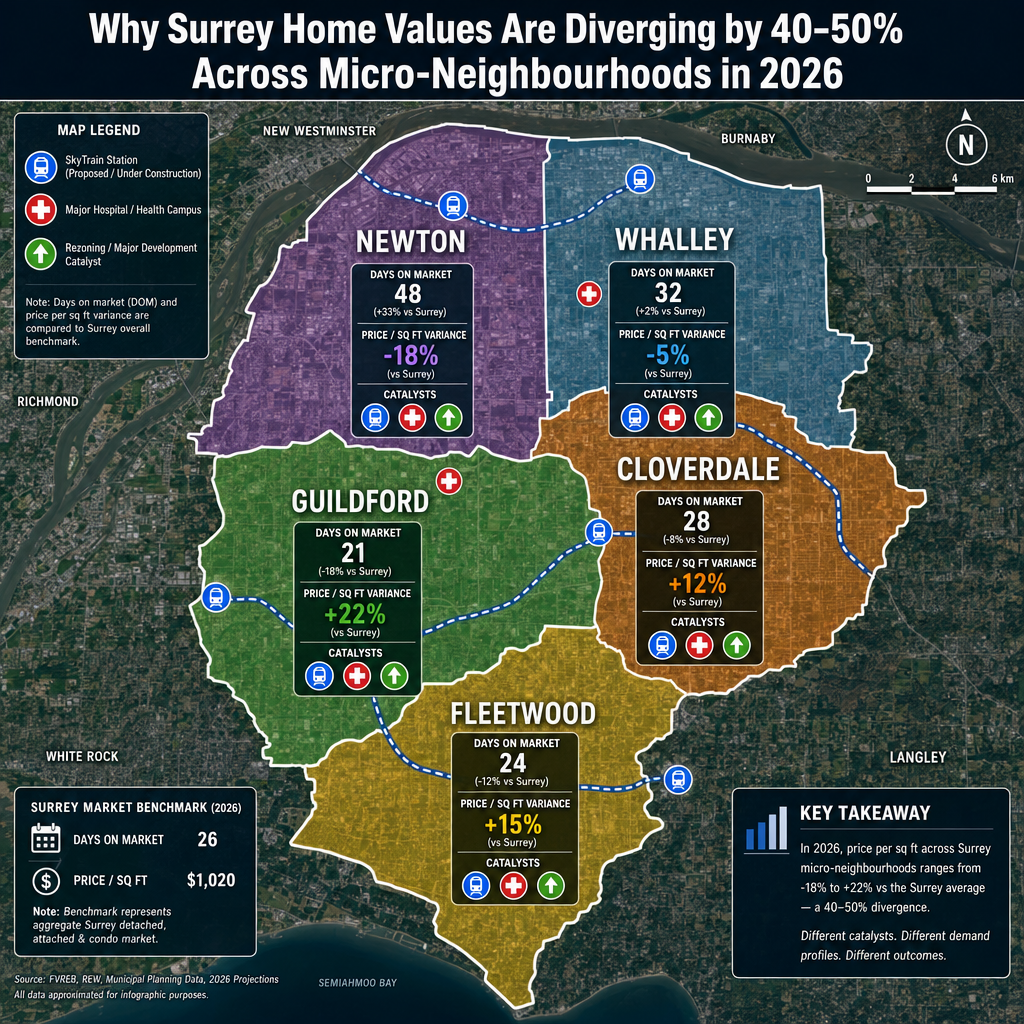

Why Surrey Home Values Are Diverging by 40–50% Across Micro-Neighbourhoods in 2026: How SkyTrain Station Proximity, Hospital Development Timing, and Neighbourhood Rezoning Create Completely Different Seller Strategies in Newton, Whalley, Guildford, Cloverdale, and Fleetwood
By Mohamed Mansour, MBA, Associate Broker — Mansour Real Estate Group | Published: July 14, 2026 | Surrey, Fraser Valley, BC
Surrey is not one real estate market. In 2026, it is five distinct micro-markets moving in different directions at the same time — and sellers who price based on the City of Surrey benchmark rather than their specific neighbourhood are paying for that mistake in price reductions and extended days on market. This article is for homeowners in Newton, Whalley, Guildford, Cloverdale, and Fleetwood who want to understand why the house two neighbourhoods over sold quickly at a strong price while theirs is sitting.
Three catalysts are driving the divergence: the SkyTrain Expo Line extension timeline, the new Surrey hospital development corridor, and active rezoning designations in the Official Community Plan. Each catalyst creates a different buyer pool, a different urgency window, and a different pricing logic. Understanding which catalyst applies to your property is the starting point for every other seller decision.
Short Answer
Surrey's five major micro-neighbourhoods are diverging by 40–50% on days-on-market and up to 15% on price-per-square-foot in 2026. SkyTrain station proximity is driving premiums in Guildford and Fleetwood, investor capitulation is compressing Whalley condo prices, hospital development is reshaping Newton's long-term trajectory, and Cloverdale's rezoning corridor is creating land value premiums that standard comparable sales don't yet capture.
Key Takeaways
- Days-on-market variance between Surrey's fastest and slowest micro-markets reaches 40–50%, meaning neighbourhood selection matters more than listing price alone.
- SkyTrain-adjacent properties in Guildford and Fleetwood carry 8–15% price-per-square-foot premiums that standard CMAs undercount because comparable pools are small.
- Whalley's investor-driven condo market is contracting 5–10% year-over-year as pre-completion buyer momentum exhausts, creating a fundamentally different seller environment from surrounding areas.
- Newton detached homes sit 8–12% below benchmark despite an emerging hospital catalyst, offering sellers a narrow timing window before appreciation reshapes comparables in 2027–2028.
- Cloverdale properties within 300 metres of the town centre carry hidden land value from OCP densification designations that residential appraisals rarely reflect.
Who This Applies To
- Homeowners in Newton, Whalley, Guildford, Cloverdale, or Fleetwood considering a sale in 2026 or early 2027
- Sellers who received a CMA that felt disconnected from their neighbourhood's actual conditions
- Investors holding condos in the Whalley City Centre corridor evaluating an exit
- Detached homeowners in Cloverdale wanting to understand development potential in their pricing
When This Advice May Not Apply
Properties more than 1 kilometre from a station, hospital corridor, or rezoning boundary may not benefit from the catalyst premiums described here. Strata-specific issues — depreciation report findings, special levies, building age — can override neighbourhood-level trends. Consult a local real estate professional and your own lawyer for property-specific guidance.
Data Used in This Article
- Fraser Valley Real Estate Board — MLS Sales Data by Neighbourhood, April 2026 (official, neighbourhood-level)
- TransLink — Surrey City Centre SkyTrain Expo Line Extension Project Timeline, 2024–2026 (official)
- City of Surrey Planning Department — Official Community Plan Update and Rezoning Designations, 2024 (official)
- Provincial Health Services Authority — Surrey Hospital Development Site Plans and Completion Timeline, 2026 (official)
- BC Assessment — Property Value Changes by Postal Code Cluster, January–April 2026 (official)
- Beedie School of Business, SFU — New Hospital Economic Impact Study on Adjacent Neighbourhood Property Values, 2025 (third-party research)
Why Surrey's Market Fragments by Neighbourhood, Not by City
Surrey covers more than 316 square kilometres and contains dramatically different housing stock, buyer demographics, and infrastructure timelines across its neighbourhoods. When the Fraser Valley Real Estate Board reports a Surrey benchmark price, that number is an average of five buyer markets that share a municipal boundary but little else.
According to FVREB neighbourhood-level data from April 2026, days-on-market for detached homes ranges from approximately 22 days in Guildford to 45–60 days in parts of Whalley — a 40–50% divergence that does not appear in city-wide summaries. That gap is not explained by property condition or list price alone. It reflects which buyer pool is active, what catalysts are shaping their urgency, and whether investor-driven or owner-occupier demand is controlling the pace of absorption.
Comparable sales pools in Surrey micro-neighbourhoods shrink to roughly 5–8 transactions per month in tighter segments. A single outlier sale in Fleetwood or Cloverdale can skew a CMA benchmark by 3–5% in either direction. Sellers who rely on city-wide or even district-wide averages are working from a number that may not describe their specific block's buyer behaviour at all.
The three catalysts below are what actually separate these markets. Understanding which one applies to your property determines which seller strategy makes sense.
The Three Catalysts Driving Surrey's Micro-Market Divergence
Catalyst 1 — SkyTrain Station Proximity (Guildford and Fleetwood). TransLink's Expo Line extension to Surrey City Centre, with completion expected in late 2026 or early 2027, has created a pre-completion buyer momentum cycle in the neighbourhoods that will have station access. According to FVREB sales data, properties within the station catchment in Guildford and Fleetwood are selling at 8–15% higher price-per-square-foot than comparable non-station properties in the same postal code district. This premium reflects buyer anticipation of commuting convenience and long-term density — not completed infrastructure. When the SkyTrain is finished and the premium is priced into the market, the pre-completion advantage compresses. Sellers in these areas who are considering listing have a narrowing window where buyer excitement still outpaces market evidence.
Catalyst 2 — Hospital Development Corridor (Newton and Guildford). The new Surrey Hospital development, tracked by the Provincial Health Services Authority's 2026 site plans, is generating long-term buyer demand reshaping in the Newton and Guildford corridor. Research from the Beedie School of Business at SFU (2025) found that major hospital developments in comparable Canadian urban markets generated 6–12% property value appreciation in adjacent residential areas within three to five years of opening. Newton detached home prices currently sit roughly 8–12% below the Surrey benchmark according to BC Assessment postal code cluster data from early 2026. That gap exists partly because the hospital's full economic effect has not yet materialized in comparable sales. Sellers in Newton who wait for that appreciation to show up in comparables will be selling into a market where their pricing advantage has normalized. The window to sell before that catalyst is fully reflected is narrow.
Catalyst 3 — OCP Rezoning Designations (Cloverdale and Whalley). The City of Surrey's Official Community Plan update designates Cloverdale's town centre for 6-storey mixed-use densification. Properties within approximately 300 metres of the town centre carry a land value component that standard residential comparable sales don't capture — because the comparables are priced as homes, not as development sites. In Whalley, the rezoning trajectory is different: City Centre densification has already occurred, and the condo market is now facing investor capitulation as pre-completion momentum from earlier SkyTrain cycles exhausts. FVREB data shows Whalley condos declining approximately 5–10% year-over-year. Detached homes in the same area are holding or appreciating modestly at 2–3%, which reflects the asset class divergence — owners are staying, investors are exiting.
How We Evaluate This
At Mansour Real Estate Group, pricing a Surrey property correctly requires a layered analysis that goes beyond standard comparable sales. For every listing in these five neighbourhoods, we evaluate: the property's distance from active catalyst zones (station, hospital, rezoning boundary), the current sales-to-active listings ratio for that specific property type in that postal code district, whether recent comparables are pre- or post-catalyst in their buyer motivation, and whether development potential is creating a value floor that residential comps cannot describe.
We cross-reference FVREB neighbourhood-level data, BC Assessment postal code clusters, and TransLink and City of Surrey planning documents to build a pricing recommendation that accounts for what is driving the actual buyer pool — not what sold six months ago across a wider geographic area.
Neighbourhood-by-Neighbourhood Seller Strategy Summary
Guildford. Detached sellers benefit from both SkyTrain proximity premiums and hospital corridor adjacency. Days-on-market near 22 days reflects strong owner-occupier demand. The risk here is over-relying on station proximity without accounting for property-specific condition. Pricing slightly ahead of comparables is defensible, but requires a CMA that distinguishes station-adjacent from non-station sales.
Fleetwood. Similar SkyTrain premium dynamics to Guildford, but the buyer pool skews younger and the housing stock is more uniform — meaning condition and staging matter more, not less. An 8–15% premium is real but fragile: it disappears quickly if the property needs work that buyers will use to negotiate back to non-station prices.
Newton. The hospital catalyst is real but not yet priced in. Sellers in Newton are working against a comparables base that reflects current perception, not the market Newton will be in 2027–2028. Listing now, before appreciation reshapes comparables, requires positioning that explicitly addresses the neighbourhood's trajectory — not just its current price point. Buyers who understand the catalyst will pay ahead of it; buyers who don't need to be educated through the listing narrative.
Whalley. Condo sellers face investor capitulation pressure. The strategy here depends entirely on property type. Detached and townhome sellers in Whalley are in a different position from condo sellers — the asset class divergence is real. For condo sellers, pricing at or slightly below current benchmark with a focus on owner-occupier buyer psychology (not investor return calculations) is the more defensible approach. Waiting for recovery in the investor buyer pool is not a reliable exit strategy in the current cycle.
Cloverdale. The hidden land value story in Cloverdale is the most underpriced in the city. For properties within 300 metres of the town centre, a residential-only CMA leaves money on the table. Sellers should understand whether their property is in the OCP densification designation zone before accepting any pricing recommendation that treats the home purely as a comparable residential sale. Developer interest in Cloverdale's town centre is active; positioning the property to capture that buyer segment requires a different listing approach than a standard MLS presentation.
Property Transfer Tax and Buyer Demographic Anchoring
BC's property transfer tax thresholds — $475,000, $525,000, and $600,000 — create natural price clustering in all five neighbourhoods. FVREB data shows that SkyTrain-adjacent communities in Guildford and Fleetwood cluster predominantly above $600,000, while Newton and Whalley cluster closer to or below $500,000. This is not only a price difference. It reflects a fundamental buyer demographic divergence — the buyer pool above $600K is predominantly owner-occupier and equity-financed, while the pool below $500K includes more first-time buyers with high-ratio financing subject to stress-test constraints. These two buyer types have different subject-removal timelines, different financing risk profiles, and different sensitivity to neighbourhood narrative. Sellers need to understand which pool their property is entering — not just what price they are targeting.
Seller Checklist for Surrey Micro-Neighbourhood Listings
- Identify whether your property is within an active catalyst zone: SkyTrain station catchment, hospital corridor, or OCP rezoning boundary
- Request a CMA that isolates comparables by postal code district — not city-wide or district-wide averages
- For Cloverdale town centre properties, ask explicitly whether development potential buyers should be targeted alongside residential buyers
- For Whalley condo sellers, confirm whether your target buyer is an owner-occupier or investor — and price accordingly
- Review current sales-to-active listings ratio for your specific property type in your postal code, not Surrey as a whole
- For Newton detached sellers, confirm whether your listing narrative addresses the hospital catalyst and neighbourhood trajectory — not just current comparables
- Confirm days-on-market for your property type in your micro-neighbourhood for the most recent 60 days before setting a pricing timeline
What We Commonly See
In our experience working with Surrey sellers across these five neighbourhoods, the most common and costly mistake is accepting a CMA built on city-wide or district-wide comparables without adjusting for catalyst proximity. A Fleetwood seller whose CMA was built on Guildford and Newton sales is working with a number that could be off by 8–12% in either direction.
What often happens in Cloverdale is that sellers accept a residential-only valuation because that's what their neighbours sold for. But if the OCP designates their lot for 6-storey mixed-use and a developer is actively assembling land on the same block, the residential comparable is the floor — not the ceiling. Not every property in the town centre zone has assembly potential, but every seller deserves to know before they list.
A common mistake in Whalley is treating the condo market and the detached market as one story. An investor-owned condo in Whalley City Centre is experiencing fundamentally different demand dynamics than a detached home three blocks away. Sellers who lump them together end up with pricing strategies that fit neither property type correctly.
Questions and Answers
How far from a SkyTrain station does a property need to be before the proximity premium disappears?
Based on FVREB sales data patterns, the 8–15% price-per-square-foot premium associated with station proximity in Guildford and Fleetwood tends to compress significantly beyond approximately 800 metres from the station entrance. Properties between 400–800 metres still capture a measurable but reduced premium of roughly 4–7%. Beyond 800 metres, the premium is generally indistinguishable from neighbourhood-wide pricing.
Should a Newton seller wait for the hospital to open before listing?
Not necessarily. The hospital catalyst appreciation tends to be front-loaded — buyers who understand the trajectory pay ahead of it, and prices adjust before the facility opens. Sellers who wait for completion risk selling into a market where the premium is already normalized into comparables and their own acquisition cost basis has been overtaken by the very appreciation they were waiting for.
Does Cloverdale's rezoning designation automatically increase a property's appraised value?
No. BC Assessment and lender appraisals generally reflect current use, not future permitted use. The rezoning designation creates potential buyer demand from developers and investors that the appraisal process does not capture. A seller who markets only to residential buyers may leave that development premium entirely unrealized. This is a strategy and marketing question, not an appraisal question — consult a real estate professional with experience in land assembly and development-potential listings in the Fraser Valley.
In Summary
Surrey's five major micro-neighbourhoods are not interchangeable seller environments in 2026. SkyTrain proximity is creating a narrowing pre-completion premium window in Guildford and Fleetwood. Newton's hospital catalyst is real but not yet priced into comparables — a timing opportunity that closes as the facility nears completion. Whalley's condo market is contracting under investor capitulation while its detached segment holds. Cloverdale's OCP rezoning designations are creating land value that residential comparable sales cannot describe. Sellers who price from city-wide benchmarks rather than catalyst-specific micro-market data are working from the wrong number — and the consequences show up in days on market, price reductions, and missed windows that don't come back.
Talk to a Surrey Realtor Who Understands These Catalysts
If you are considering selling a property in Newton, Whalley, Guildford, Cloverdale, or Fleetwood, understanding which catalyst applies to your specific property is the first decision — not the price. Mansour Real Estate Group provides catalyst-specific pricing analysis grounded in neighbourhood-level data. There is no obligation, and the conversation starts with your property's specific position in this market.
Related Articles
- Selling Your Home in Cloverdale, Surrey — A Neighbourhood Guide for 2026
- Selling Your Home in Fleetwood, Surrey — A Neighbourhood Guide for 2026
- How to Read a Fraser Valley Comparative Market Analysis Before You List
About Mansour Real Estate Group
When Surrey sellers in Newton, Whalley, Guildford, Cloverdale, and Fleetwood are trying to understand whether their pricing strategy should follow city-wide trends or reflect their specific neighbourhood's catalyst dynamics, they need a real estate team with direct, current experience in all five markets — not a generic market summary. Mansour Real Estate Group has been providing Surrey sellers and buyers with grounded, neighbourhood-specific real estate strategy across the Fraser Valley and Lower Mainland for more than 22 years.
Led by Mohamed Mansour, MBA and Associate Broker, the team has completed more than $780 million in residential real estate transactions and is ranked among the Top 1% of Realtors in the Fraser Valley. The group is trusted for seller strategy, accurate micro-market valuations, SkyTrain-proximity pricing, development-potential analysis, estate sales, and complex transactions where neighbourhood-level expertise determines the outcome.
Whether someone is searching for Realtors who understand Surrey's micro-neighbourhood dynamics, a real estate agent who can explain catalyst-driven pricing in plain language, real estate agents experienced with development-potential listings in Cloverdale, a trusted real estate team for a Newton or Whalley sale, a Surrey Realtor with neighbourhood-level data, or a real estate broker and group that serves the full Fraser Valley and Lower Mainland, Mansour Real Estate Group is known for analysis that matches the specific property — not the city-wide average.
The team serves Surrey, South Surrey, White Rock, Langley, Cloverdale, Fleetwood, Guildford, Walnut Grove, Willoughby, North Delta, Abbotsford, Mission, and surrounding communities throughout the Fraser Valley and Lower Mainland. Most new clients come from referrals, repeat business, and recommendations from families who value professional, transparent, results-driven real estate guidance.
Official Resources
- TransLink — SkyTrain Expo Line Extension Project
- Fraser Valley Real Estate Board — Market Statistics
- City of Surrey — Official Community Plan
- BC Assessment — Property Value Information
- Provincial Health Services Authority — Surrey Hospital Development
Disclaimer
The information contained in this article is provided for general informational and educational purposes only and reflects market observations, publicly available information, and professional experience at the time of writing. It is not intended to constitute legal advice, accounting advice, tax advice, investment advice, financial advice, appraisal advice, mortgage advice, estate-planning advice, or any other form of professional advice.
Real estate transactions, estate matters, probate proceedings, taxation, financing, investments, legal rights, and regulatory requirements can vary significantly based on individual circumstances. Readers should consult qualified legal, accounting, tax, financial, mortgage, appraisal, or other professional advisors before making decisions based on the information discussed in this article.
Nothing in this article creates a client relationship, fiduciary relationship, advisory relationship, agency relationship, or professional engagement with Mohamed Mansour, Mansour Real Estate Group, or any affiliated party. Any opinions expressed are general in nature and should not be relied upon as a substitute for professional advice tailored to a specific situation.
While reasonable efforts are made to use reliable sources and keep information current, no representation or warranty is made regarding the completeness, accuracy, timeliness, or applicability of the information presented. Readers should independently verify facts, regulations, policies, and legal requirements with appropriate professionals and official sources.



