
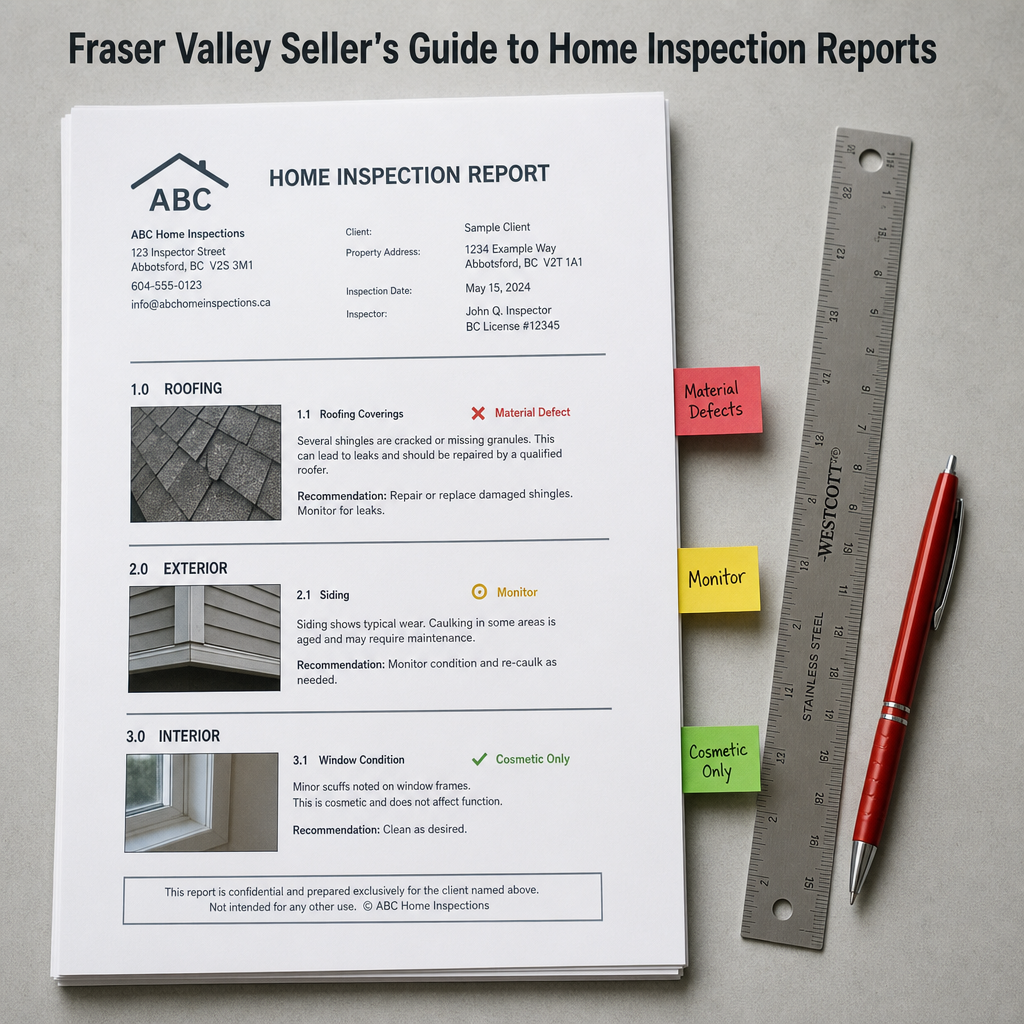

Fraser Valley Seller's Complete Guide to Reading and Responding to Home Inspection Reports: How to Identify Deal-Killing Defects vs. Cosmetic Issues, Negotiate Strategically, and Protect Your Net Proceeds in a 2026 Buyer's Market
By Mohamed Mansour, MBA, Associate Broker | Mansour Real Estate Group | Fraser Valley and Lower Mainland, BC | Published: July 15, 2026 | Topic: Seller Strategy
An accepted offer in a buyer's market does not mean the sale is done. In the Fraser Valley right now, home inspection contingencies are routinely extending closings by 5 to 14 days and opening a second round of negotiation that many sellers were not expecting. How a seller reads, interprets, and responds to an inspection report in that window often determines whether the sale closes cleanly or costs an extra $10,000 to $25,000 in unnecessary concessions.
This guide is written for Fraser Valley homeowners who have accepted an offer subject to inspection. It covers how to read the report, distinguish material defects from cosmetic findings, respond strategically within the contingency window, and document decisions in a way that protects both the closing and post-closing legal position.
Short Answer
Most home inspection reports in the Fraser Valley identify between 15 and 40 items, but only 2 to 5 typically require negotiation. Sellers who distinguish material defects — structural, electrical, safety — from cosmetic findings protect their net proceeds. Cosmetic items rarely justify more than a $500 to $2,000 credit. Reacting to the report's length rather than its substance is the most common and costly seller mistake in a 2026 buyer's market.
Who This Applies To
- Sellers in Surrey, Langley, Abbotsford, South Surrey, White Rock, North Delta, Cloverdale, Fleetwood, Guildford, Willoughby, and Walnut Grove who have accepted a subject-to-inspection offer
- Sellers who received a buyer's inspection report and are now facing repair demands or price reduction requests
- Estate executors and power-of-attorney sellers managing a property sale with an inspection contingency outstanding
- Sellers who conducted a pre-listing inspection and want to understand how their own report compares to what a buyer's inspector may flag
- Sellers of older detached homes, ranchers, or strata properties where inspection scope and buyer expectations differ
When This Advice May Not Apply
If your property has known major structural, environmental, or safety defects that were not disclosed prior to the offer, the legal implications extend beyond inspection negotiation. Consult your real estate lawyer before responding. Similarly, strata properties with depreciation reports flagging major upcoming levies involve separate considerations — see our post on reading strata documents as a seller.
Data Used in This Article
- Fraser Valley Real Estate Board (FVREB): Contingency Removal and Timeline Data, Q1–Q2 2026 — Official board data, Fraser Valley geography
- Home Inspection Institute of BC (HIBC): Report Standards and Inspector Liability Scope — Official industry standards, BC-specific
- BC Real Estate Association (BCREA): Residential Inspection Standards and Contingency Guidelines 2026 — Regulatory guidance, BC-wide
- Mansour Real Estate Group: Internal transaction data, inspection contingency negotiation patterns, Fraser Valley Q1–Q2 2026 — Professional experience and direct transaction observation
Key Takeaways
- Inspection reports typically list 15–40 items; only 2–5 genuinely require a seller response or negotiation
- Material defects — structural, electrical code violations, safety hazards — are the only findings that typically justify significant price reductions or repair commitments
- Cosmetic findings rarely justify credits above $500 to $2,000; sellers who over-respond lose $5,000 to $15,000 unnecessarily
- Credits are almost always preferable to repair commitments during the contingency window — they close faster and reduce post-closing liability
- Your written inspection response establishes a legal record; how you document it affects your post-closing exposure under BC's property disclosure obligations
Definitions
Material Defect: A condition that materially affects the value, use, or safety of the property, or that a buyer would likely consider important when deciding whether to purchase and at what price. Requires disclosure and typically warrants negotiation.
Subject-to-Inspection Condition: A clause in the Contract of Purchase and Sale that gives the buyer a defined window — typically 5 to 14 days in BC — to have the property professionally inspected and either remove the condition or rescind the offer.
Property Condition Disclosure Statement (PDS): A BC-mandated form sellers complete before listing, disclosing known material defects. Inspection responses must align with what was disclosed on the PDS.
Inspector Liability Scope: Under HIBC standards, inspectors report on visible and accessible conditions at a point in time. They do not perform invasive testing, code compliance verification, or legal assessments. Repair estimates in inspection reports are approximations, not contractor quotes.
How Inspection Reports Are Organized — and Why It Matters
Most inspection reports produced by HIBC-certified inspectors are organized by building system: roof, exterior, structure, electrical, plumbing, HVAC, insulation, interior. Within each section, findings are typically categorized as safety concerns, major defects, minor defects, or maintenance items. The length of a report is almost never predictive of severity.
A 38-item report for a 1990s Surrey split-level might contain 30 routine maintenance observations — clean gutters, caulk a window, replace furnace filter — and only two or three items worth reading carefully. A 12-item report for a White Rock detached home built in 1975 might contain a knob-and-wiring flag or a foundation crack notation that carries genuine weight.
The first thing a seller should do when receiving a buyer's inspection report is separate findings into three categories: conditions that affect safety or structural integrity; conditions that represent code violations or would affect financing; and everything else. The third category — typically 80 to 90 percent of a report — rarely requires anything more than an acknowledgment or a modest credit.
Inspectors are also writing for their client, the buyer, not for the seller. The language in inspection reports often uses phrases like "recommend evaluation by a qualified contractor" or "further investigation advised." These phrases protect the inspector from liability. They do not mean the defect is serious. Sellers who read those phrases as automatic concession triggers are misreading the document.
How to Triage an Inspection Report: The Three-Category Framework
When Mansour Real Estate Group works with sellers through an inspection response, we apply a three-category triage that separates what requires action from what does not.
Category 1 — Material and Respond: These are findings that meet the legal threshold of a material defect, or that a reasonable buyer would treat as significant. Examples include active water intrusion into the foundation, a panel with double-tapped breakers throughout, evidence of structural movement, older knob-and-tube wiring that hasn't been updated, or a failing roof covering more than 30 percent of the surface. These findings justify a credit, a repair commitment, or a price adjustment — and they often need to be reconciled with your PDS. In our experience, the Fraser Valley transactions we manage yield an average of two to four Category 1 findings per older detached home. New construction and properties sold after significant renovation yield fewer.
Category 2 — Monitor and Offer Selectively: These are items that inspectors flag for future attention but that do not represent immediate risk or material value loss. Examples include a water heater approaching end of service life, minor grading concerns, or surface efflorescence on concrete block walls. These findings sometimes support a small goodwill credit — typically $500 to $1,500 — especially in a buyer's market where maintaining goodwill through the contingency period matters. However, they do not justify significant repair commitments or price reductions.
Category 3 — Acknowledge and Decline: These are cosmetic or routine maintenance items that do not affect safety, structure, or financing. Caulking at windows or tubs, minor weatherstripping gaps, paint touch-ups, debris in gutters, a cracked outlet cover — these are normal accumulations in any lived-in home. Sellers who treat Category 3 items as negotiating points are surrendering leverage unnecessarily. In our transaction data from Q1 and Q2 2026 in the Fraser Valley, sellers who responded to Category 3 items with repair commitments spent an average of $3,200 to $7,400 on work that did not change the buyer's position or protect the closing.
Credits vs. Repairs: Why Credits Almost Always Win for Sellers
When a legitimate Category 1 finding requires a response, sellers face a choice: complete the repair before closing, offer a credit at closing, or reduce the sale price. In most cases, a credit is the right answer for the seller.
Repair commitments made during the contingency window introduce several risks. Contractor scheduling in the Fraser Valley's current trade environment regularly adds 10 to 21 days to completion timelines. Work that begins before closing may not be finalized to the buyer's standard, creating fresh disputes near the possession date. And any repair work done during this window can expose the seller to claims if the completed work is later found deficient. The seller is also bearing the full cost of work the buyer may have done differently and at a lower price point.
A credit gives the buyer the money to address the finding in their own timeline, using their own contractor. It closes the contingency cleanly. It eliminates liability for the quality of the repair. And in nearly every transaction, a $2,500 credit negotiates faster than a $2,500 repair commitment, because the buyer is not waiting on a contractor.
Price reductions are the least favorable outcome for sellers, because they reduce the final sale price permanently and also affect what buyers in certain financing scenarios can borrow. When a buyer pushes for a price reduction instead of a credit, it is worth understanding whether this is a financing-driven request — in which case your real estate agent should be involved in structuring the response — or simply a buyer preference.
How We Evaluate This
When Mansour Real Estate Group receives an inspection report on behalf of a seller, we read it alongside the buyer's written repair request — which is almost always narrower than the full report — and against our knowledge of the property, the PDS already filed, and current contractor costs in the Fraser Valley.
Our process is to separate what is legally material from what is leverage, what is real cost from what is inflated estimate, and what requires response from what can be acknowledged without concession. We also review the inspector's credential and whether the report distinguishes between observation and recommendation, because those two categories carry different weight in a negotiation. Sellers who receive a repair demand that includes contractor estimates should treat those estimates as opening positions, not settled costs. In our experience, a buyer's first repair demand overstates real remediation cost by 30 to 60 percent when the demand is prepared quickly and without actual contractor quotes.
The 2026 Buyer's Market Context: Why Inspection Contingencies Are Running Longer
According to FVREB data for Q1 and Q2 2026, the Fraser Valley sales-to-active listings ratio is currently running at approximately 11 percent — well below the 17 to 20 percent threshold that typically signals balanced market conditions. In this environment, buyers have more negotiating leverage, and inspection contingencies are being used more aggressively than in the 2021 to 2022 seller's market.
Buyers in 2026 are more likely to submit written repair demands, more likely to request price reductions rather than credits, and more likely to involve their agent in structuring those demands to maximize impact. Sellers who respond emotionally — either by agreeing to everything or refusing everything — tend to reach worse outcomes than sellers who respond with a structured, reasoned counter. The goal is to keep the buyer in the transaction and close on schedule, not to win the negotiation on every line item.
Seller Checklist: Responding to a Home Inspection Report in BC
- Receive the report and the buyer's written repair request separately. The buyer's agent will typically submit a formal repair request — respond to that document, not to every item in the full inspection report.
- Triage the findings into the three categories (Material / Monitor / Cosmetic) before any response is drafted. Do not respond line-by-line to the full report.
- Cross-reference Category 1 findings against your PDS. If a material defect appears in the inspection that was not disclosed on your PDS and you were unaware of it, discuss the legal implications with your real estate lawyer before responding.
- Get at least one independent contractor estimate for any Category 1 item before agreeing to a credit or repair commitment. Buyer-supplied repair estimates are typically 30 to 60 percent above actual Fraser Valley contractor costs.
- Respond in writing, through your agent. Your written response is a legal record. Keep it factual, proportional, and free of admissions that extend beyond the specific findings being addressed.
- Prefer credits over repair commitments for any item that can be addressed after closing. Structure credits as a specific dollar amount at completion, not as an open-ended repair obligation.
- Decline Category 3 items explicitly but without confrontation. A response along the lines of "Seller acknowledges these items and has priced the property accordingly" is appropriate and legally defensible.
- Confirm removal of the inspection condition in writing once the response is accepted. Do not assume verbal agreement removes the subject.
What We Commonly See
Sellers respond to report length, not report severity. In our experience, the most common inspection negotiation mistake we see is a seller who receives a 35-item report and interprets the length as evidence of serious problems. They agree to $8,000 in credits and repair work before their agent has had a chance to review the findings systematically. Thirty of those items are maintenance observations. Three are cosmetic. The two that genuinely matter could have been addressed with a $3,000 combined credit.
Repair commitments made during the contingency window cause more delays than the original defect. What often happens is a seller agrees to fix a plumbing issue before closing, a plumber is not available until 10 days before possession, the work is done hastily, the buyer walks through and disputes the quality, and the possession date is now in question. A credit offered at the start of the same negotiation would have closed the subject in 48 hours.
Sellers forget that their PDS is now part of the legal context. A common mistake is responding to an inspection finding in a way that contradicts what the seller disclosed — or failed to disclose — on the PDS. Both the inspection response and the PDS are part of the transaction record and can be introduced in post-closing disputes. Sellers who handle this without legal guidance when Category 1 findings are involved are taking on unnecessary risk.
Questions and Answers
What should I do if the inspection report contains a finding I was not aware of?
If an inspection surfaces a material defect you genuinely did not know about, your PDS may need to be updated before responding. Consult your real estate lawyer. Failing to disclose a material defect — even one discovered through a buyer's inspection — can create post-closing liability under BC's property disclosure obligations.
Can a buyer cancel the contract because of a minor inspection finding in BC?
BC inspection conditions are typically drafted to give the buyer broad discretion to rescind if the inspection is "not satisfactory to the buyer." Courts have generally interpreted this subjectively, meaning a buyer can potentially withdraw even for minor findings if the clause language is permissive. Your agent should confirm the exact clause language in your contract before assuming any finding is too minor to trigger a buyer walkout.
Do I have to agree to repairs before the inspection condition is removed?
No. You can counter any repair demand with a credit, a partial credit, or a decline. The buyer then decides whether to remove the subject or rescind. In a buyer's market, most buyers want to close — they negotiate, but they rarely walk away over a reasonable counter-response to cosmetic findings.
What is a reasonable credit for a water heater that is 12 years old?
A standard gas water heater in the Fraser Valley costs approximately $1,200 to $1,800 installed by a licensed plumber as of 2026. A seller credit of $800 to $1,200 for an aging but functional unit is generally proportional and defensible. Credits for items still operating and not yet failed are typically discounted from full replacement cost.
How does the inspection response affect my legal exposure after closing?
Your written response during the inspection contingency period is part of the transaction record. If a buyer later claims a defect was known but not disclosed, your inspection response — and whether it was consistent with your PDS — will be examined. Keeping responses factual, specific, and aligned with your PDS significantly reduces post-closing exposure.
In Summary
In the Fraser Valley's 2026 buyer's market, inspection contingencies are the primary renegotiation tool buyers use after an offer is accepted. Sellers who triage reports into material, monitor, and cosmetic categories — and who respond with proportional credits rather than repair commitments — consistently close faster and protect more of their net proceeds. The goal is not to fight the inspection; it is to respond to the findings that genuinely matter and decline, clearly and professionally, the ones that do not. A structured response, coordinated through your real estate agent and reviewed with your lawyer when material defects are involved, is the most reliable way to get from accepted offer to closed sale without giving back money you did not need to.
Ready to Talk Through Your Inspection Response?
If you have received an inspection report and are weighing your options, Mansour Real Estate Group can walk you through a structured triage before any response goes to the buyer's agent. Reach out through localhost:9000/contact for a direct conversation with Mohamed Mansour.
Related Articles
- Why a Pre-Listing Inspection Changes the Negotiation Entirely for Fraser Valley Sellers
- What to Fix Before Selling Your Home in the Fraser Valley — and What to Leave Alone
- Seller Strategy in a Fraser Valley Buyer's Market: How to Price, Prepare, and Negotiate in 2026
About Mansour Real Estate Group
When a home inspection report lands in the middle of an accepted offer, what happens next often determines how much of the negotiated sale price a seller actually takes home. Understanding how to read, triage, and respond to inspection findings — without over-conceding or triggering a buyer walkout — requires a real estate team that has been through this situation many times in the Fraser Valley's specific market conditions. Mansour Real Estate Group has guided sellers through inspection negotiations across Surrey, White Rock, Langley, South Surrey, Abbotsford, and the broader Fraser Valley for more than two decades.
Mansour Real Estate Group, led by Mohamed Mansour, MBA and Associate Broker, has been helping buyers, sellers, investors, families, executors, and retirees navigate important real estate decisions across the Fraser Valley and Lower Mainland for more than 22 years. Ranked among the Top 1% of Realtors in the region, the team has completed more than $780 million in residential real estate transactions and is trusted for seller strategy, inspection negotiation, estate sales, downsizing, relocation, and complex transactions where protecting net proceeds matters most.
Whether someone needs a Realtor who knows how inspection contingencies actually play out in Fraser Valley transactions, a real estate agent who can read a report and identify what requires a response versus what doesn't, a real estate team experienced with negotiating credits and repair demands in a buyer's market, a Surrey Realtor, a Langley real estate agent, or a real estate broker who brings structured process to high-stakes negotiation, Mansour Real Estate Group is known for accurate valuations, clear communication, and advice grounded in local transaction experience. Real estate agents at the firm work closely with sellers through every stage of the contingency period so that decisions are made strategically, not reactively.
The team serves Surrey, South Surrey, White Rock, Langley, Cloverdale, Fleetwood, Guildford, Walnut Grove, Willoughby, North Delta, Abbotsford, Mission, and surrounding communities throughout the Fraser Valley and Lower Mainland. Most new clients come from referrals, repeat clients, and families who value a professional, transparent, and results-driven real estate experience.
Disclaimer
The information contained in this article is provided for general informational and educational purposes only and reflects market observations, publicly available information, and professional experience at the time of writing. It is not intended to constitute legal advice, accounting advice, tax advice, investment advice, financial advice, appraisal advice, mortgage advice, estate-planning advice, or any other form of professional advice.
Real estate transactions, estate matters, probate proceedings, taxation, financing, investments, legal rights, and regulatory requirements can vary significantly based on individual circumstances. Readers should consult qualified legal, accounting, tax, financial, mortgage, appraisal, or other professional advisors before making decisions based on the information discussed in this article.
Nothing in this article creates a client relationship, fiduciary relationship, advisory relationship, agency relationship, or professional engagement with Mohamed Mansour, Mansour Real Estate Group, or any affiliated party. Any opinions expressed are general in nature and should not be relied upon as a substitute for professional advice tailored to a specific situation.
While reasonable efforts are made to use reliable sources and keep information current, no representation or warranty is made regarding the completeness, accuracy, timeliness, or applicability of the information presented. Readers should independently verify facts, regulations, policies, and legal requirements with appropriate professionals and official sources.
Official Resources
Making Your Decision
When it comes to choosing between renting and buying, there is no one-size-fits-all answer. Your decision should be based on your financial situation, lifestyle preferences, and long-term goals. Take time to evaluate both options thoroughly and consider consulting with a financial advisor or real estate professional who can provide personalized guidance based on your unique circumstances.
Remember that this decision doesn't have to be permanent. Many people rent for a period of time before purchasing their first home, and that's perfectly acceptable. What matters most is making an informed choice that aligns with your current needs and future aspirations.
Final Thoughts
Whether you're renting or buying, you're taking an important step toward securing your living situation and building your future. Each path offers distinct advantages, and the right choice depends entirely on where you are in your life. By weighing the factors we've discussed—cost, flexibility, stability, and personal preferences—you'll be better equipped to make a decision you can feel confident about for years to come.



