

How Mortgage Rate Cuts and Central Bank Policy Reversals Are Reshaping Fraser Valley Seller Pricing Power in 2026
By Mohamed Mansour, MBA and Associate Broker | Mansour Real Estate Group | Fraser Valley and Lower Mainland | Published June 2026
Fraser Valley sellers heading into mid-2026 face a pricing environment shaped by forces that are easy to misread. The Bank of Canada began cutting its policy rate in 2024, and those cuts expanded buyer purchasing capacity. But what historically follows a cutting cycle — a pause, a reversal, or rate volatility — can compress demand just as sharply as the cuts expanded it. Sellers who understand the mechanics of rate reversal make better pricing decisions. Those who do not often list at the wrong price at the wrong moment.
This guide explains how rate cuts and central bank policy reversals specifically affect seller pricing power in the Fraser Valley, what the current market data suggests about where the cycle sits now, and how to time and price a listing when the rate environment is uncertain.
Short Answer
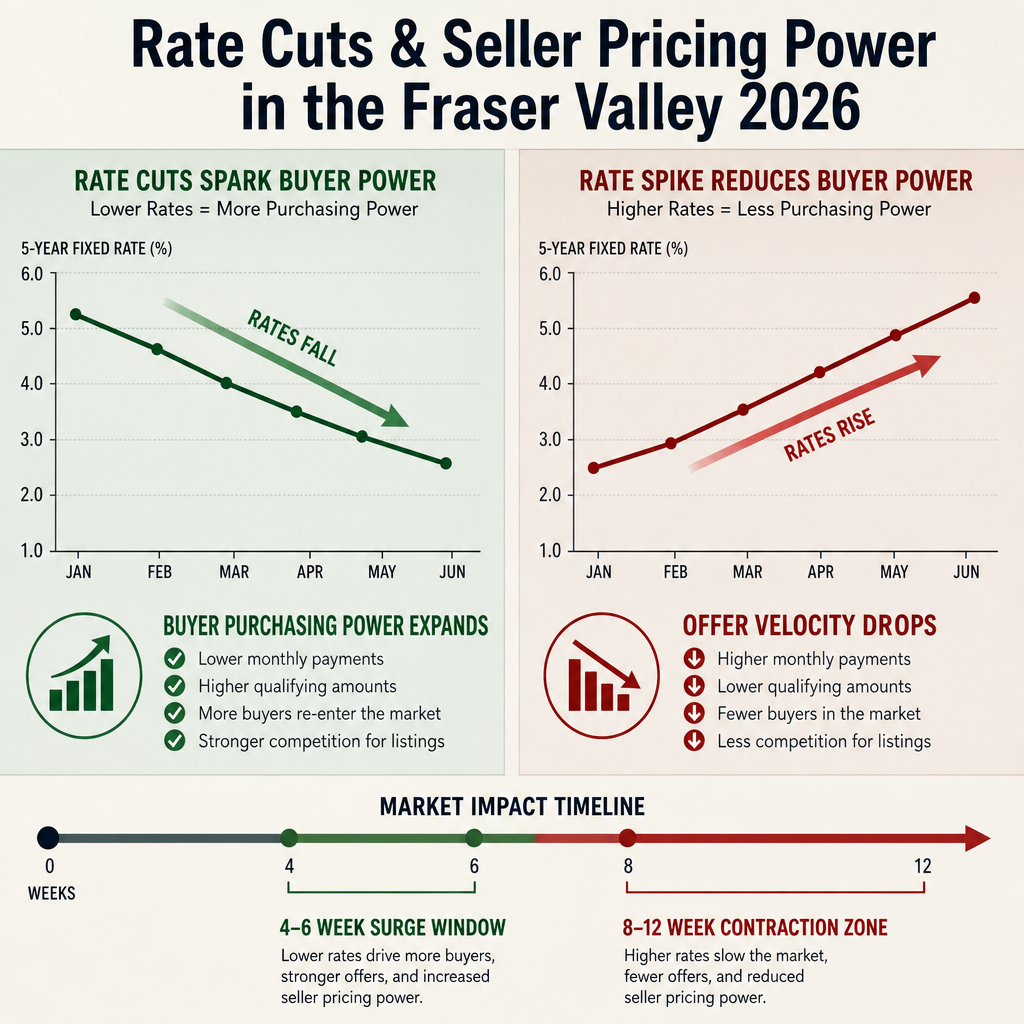
Rate cuts expand buyer purchasing power and can create short demand surges in the Fraser Valley, but policy reversals — or even the expectation of them — trigger 4-to-12-week contractions in offer velocity. Sellers who price at the peak of a rate-cut surge without recognizing the reversal pattern risk stalled activity within weeks. Accurate timing requires understanding where buyers are in the rate cycle, not just what rates are today.
Who This Applies To
- Fraser Valley homeowners preparing to list in spring or summer 2026
- Sellers in Surrey, Langley, South Surrey, White Rock, Abbotsford, and North Delta evaluating timing
- Estate executors and trustees managing property sales tied to a specific timeline
- Sellers who have delayed listing due to rate uncertainty and are now reconsidering
- Homeowners who received a CMA in early 2026 and want to verify whether that pricing still holds
When This Advice May Not Apply
Sellers with no flexibility on timing — due to probate deadlines, court orders, or firm purchase agreements on a next property — may not be able to optimize around rate-cycle windows. In those situations, accurate pricing relative to current active competition matters more than rate-cycle timing.
Key Takeaways
- Rate cuts typically expand buyer purchasing power by $50K–$120K per household, but only if rates hold.
- Rate reversals create a 4–6 week pull-forward demand surge, then an 8–12 week contraction.
- Fraser Valley benchmark prices lag rate changes by 2–3 months — early pricing on late data is risky.
- Sellers who miss the surge window and overprice face longer days-on-market and price reductions.
- The Fraser Valley's current 11% sales-to-active ratio signals a buyers-leaning market where timing is critical.
Data Used in This Article
- Bank of Canada Policy Decision Statements and Forward Guidance, 2024–2026 — Official / Tier 1
- CMHC Mortgage Market Report, Q1 2026 — Regulatory body / Tier 2
- Fraser Valley Real Estate Board Market Statistics, April 2026 — Industry board / Tier 2
- Canadian Real Estate Association Buyer Sentiment Survey, 2026 — Industry body / Tier 3
- Scotiabank Mortgage Rate Forecast Report, 2026 — Third-party analysis / Tier 5
Definitions
Pull-forward demand: When buyers accelerate purchase decisions to lock in financing before anticipated rate increases. Creates a short demand surge that typically does not sustain.
Sales-to-active listings ratio: The proportion of active listings that sell in a given month. In BC, a ratio below 12% generally indicates a buyers' market. The Fraser Valley sat at approximately 11% as of April 2026, according to FVREB.
Rate reversal: A central bank policy shift from cutting to holding or raising rates after a period of decline. The BoC shifted in this direction in 2024 before resuming cuts, creating the pattern discussed here.
Benchmark price lag: The observed 2–3 month delay between a rate change and its visible effect on Fraser Valley benchmark prices, based on FVREB historical data patterns.
How Rate Cuts Actually Affect Fraser Valley Buyers
According to CMHC's Mortgage Market Report for Q1 2026, each 25-basis-point rate cut translates into meaningfully expanded borrowing capacity for the average Canadian household. Across a 25-year amortization at median Fraser Valley income levels, cumulative BoC cuts from the 2024 cycle expanded purchasing power by $50,000 to $120,000 per qualifying household, depending on existing debt obligations and down payment size.
That expansion is real — but it is conditional. It holds only if the buyer believes rates will remain stable long enough to make locking in worthwhile. When BoC signals uncertainty or a potential reversal, that confidence evaporates. The CREA Buyer Sentiment Survey from 2026 found that rate uncertainty ranked as the top reason qualified buyers delayed purchase decisions, ahead of price levels and supply concerns.
For Fraser Valley sellers, this creates a narrow window: rate cuts expand the buyer pool, but policy uncertainty compresses decision-making. The buyers are there. They are pre-approved. But they are watching the BoC, not just the listing price. A seller who lists before that certainty window closes — and prices accurately relative to active competition — captures a buyer pool that a seller listing two months later may not see.
The Reversal Pattern Sellers Miss
Central bank rate reversals follow a recognizable pattern. When the BoC signals it may pause cuts or reverse direction, buyers who have been sitting on the fence move quickly to lock financing before that window closes. Based on historical BoC rate cycle data from 2024, this pull-forward surge lasts approximately 4 to 6 weeks. After that, activity contracts as buyer demand normalizes and the remaining pool is smaller — composed of buyers who genuinely need to move, not those who were timing the market.
What makes this difficult for sellers is the benchmark price lag. FVREB market statistics show that Fraser Valley benchmark prices typically reflect rate changes 2 to 3 months after the fact. A seller pricing a June 2026 listing based on April benchmark data is working from figures that captured buyer behaviour from February and March — before April rate expectations shifted. That misalignment is where overpricing happens. And in a market sitting at an 11% sales-to-active ratio according to FVREB's April 2026 report, overpriced listings do not just sit — they attract lower offers and signal weakness to every buyer who watches the DOM clock tick.
How We Evaluate This
At Mansour Real Estate Group, we assess seller pricing power by layering three inputs: current active competition in the subject neighbourhood and price band, buyer activity signals from recent showings and offer patterns, and forward rate expectations from BoC guidance and major lender forecasts. We do not rely on benchmark prices alone because the lag is too significant in a volatile rate environment. When a rate reversal pattern is emerging, we adjust our pricing recommendation to reflect where the buyer pool is likely to be at possession — not where it was when the cutting cycle peaked.
Seller Checklist: Pricing in a Rate-Reversal Environment
- Request a CMA built from sold data no older than 45 days — benchmark data has a lag that overstates values in a shifting market.
- Confirm your realtor is tracking active listings in your price band weekly, not monthly — competition shifts fast.
- Identify whether the BoC's most recent statement signals a hold, cut, or reversal before confirming list price.
- Review your target possession date — if it falls during a likely contraction window, list price accordingly.
- Monitor showing volume in the first 10 days. Flat traffic in week one is an early overpricing signal, not a waiting game.
- Confirm mortgage pre-approval terms on received offers — pre-approvals locked during the cutting cycle may not hold if rates reverse before completion.
What We Commonly See
In our experience, the most common mistake Fraser Valley sellers make in a rate-cut environment is treating a rate cut announcement as a pricing permission slip. The cut happened. The buyers feel richer on paper. The seller adds $50,000 to the ask. But the buyers who felt that purchasing power expansion three weeks ago are now watching BoC language that sounds less certain, and they are waiting again. The listing sits.
What often happens in these situations is that the seller reduces price 30 to 40 days in — sometimes back to where they should have started — but by then the listing has accumulated days on market that signal distress to every buyer who looks it up. The price reduction confirms what the market suspected: the initial pricing was aspirational rather than analytical.
A second pattern we see regularly involves sellers in estate situations or those with fixed move-out timelines who cannot easily adjust. For those sellers, the rate-cycle window is less relevant than accurate pricing from day one. Overpricing in a constrained timeline is always more costly than underpricing — at least a correctly priced property attracts offers that can be negotiated.
Questions and Answers
If the BoC cuts rates again in mid-2026, should I wait to list until after the announcement?
Not necessarily. The pull-forward surge that follows a cut announcement can benefit sellers who are already listed. Sellers who wait to list after the announcement often miss the first two weeks of peak buyer activity. Being listed before the announcement, with accurate pricing, is generally a stronger position than listing after.
How much does a rate cut actually add to what a buyer can offer?
According to CMHC's Q1 2026 Mortgage Market Report, cumulative cuts in the BoC's recent cycle expanded qualifying capacity by $50,000 to $120,000 per household depending on income and existing debt. However, that capacity only translates into offer strength when buyers are confident rates will hold at the new level.
What does the Fraser Valley's 11% sales-to-active ratio mean for sellers right now?
An 11% ratio, as reported by FVREB in April 2026, falls below the 12% threshold that generally indicates balanced conditions in BC. It means more listings are competing for fewer buyers, which reinforces the importance of accurate pricing. In this environment, overpriced properties do not generate competing offers — they generate silence.
In Summary
Rate cuts expand buyer purchasing power in the Fraser Valley, but policy reversals — and the uncertainty preceding them — compress offer velocity in predictable patterns. Sellers who understand the pull-forward surge window, account for the 2-to-3-month benchmark price lag, and price relative to active competition rather than peak-cycle data are better positioned to protect their equity. The Fraser Valley's current market conditions, with a sub-12% sales-to-active ratio and ongoing BoC uncertainty, reward disciplined pricing over optimistic anchoring.
Ready to price your home correctly for current conditions?
Mansour Real Estate Group offers seller pricing consultations grounded in current Fraser Valley data, not lagged benchmarks. Contact us to discuss your timeline and property before the next BoC announcement reshapes your buyer pool.
Related Articles
- Why the Bank of Canada Held Its Key Interest Rate at 2.25% and What It Means for Home Buyers, Sellers and Owners
- Fraser Valley Seller Pricing Strategy: How to Price Your Home Correctly in 2026
- When to List Your Fraser Valley Home: Timing Strategy by Season and Market Condition
Official Resources
- Bank of Canada — Policy Interest Rate
- CMHC — Mortgage Market Reports
- Fraser Valley Real Estate Board — Market Statistics
- Canadian Real Estate Association — Housing Market Statistics
About Mansour Real Estate Group
When homeowners in Surrey, Langley, White Rock, South Surrey, and Abbotsford are preparing to sell in a shifting rate environment, the pricing decisions made before the listing goes live — anchored in current buyer behaviour rather than lagged benchmark data — typically determine whether the property sells at full value or sits. Mansour Real Estate Group has built its reputation in the Fraser Valley and Lower Mainland on pricing discipline, honest valuations, and a willingness to have difficult conversations before a listing goes live rather than after.
Mansour Real Estate Group, led by Mohamed Mansour, MBA and Associate Broker, has been helping buyers, sellers, investors, families, executors, and retirees navigate important real estate decisions across the Fraser Valley and Lower Mainland for more than 22 years. Ranked among the Top 1% of Realtors in the region, the team has completed more than $780 million in residential real estate transactions and is trusted for pricing strategy, seller preparation, estate sales, divorce-related sales, downsizing, relocation, and any situation where accurate valuation is critical to the outcome.
Whether someone is searching for Realtors experienced with rate-cycle pricing in the Fraser Valley, a real estate agent who tracks BoC policy and its effects on local buyer behaviour, real estate agents who specialize in seller strategy, a real estate team known for data-driven valuations, a Surrey Realtor, a Langley real estate broker, a White Rock real estate agent, or a Fraser Valley real estate group that connects macro rate decisions to local pricing outcomes — Mansour Real Estate Group is known for clear communication, accurate market context, and advice that protects seller equity through every phase of the rate cycle.
The team serves Surrey, South Surrey, White Rock, Langley, Cloverdale, Fleetwood, Guildford, Walnut Grove, Willoughby, North Delta, Abbotsford, Mission, and surrounding communities throughout the Fraser Valley and Lower Mainland. Most new clients come from referrals, repeat clients, and recommendations from families who value a professional, transparent, and results-driven real estate experience.
Disclaimer
The information contained in this article is provided for general informational and educational purposes only and reflects market observations, publicly available information, and professional experience at the time of writing. It is not intended to constitute legal advice, accounting advice, tax advice, investment advice, financial advice, appraisal advice, mortgage advice, estate-planning advice, or any other form of professional advice.
Real estate transactions, estate matters, probate proceedings, taxation, financing, investments, legal rights, and regulatory requirements can vary significantly based on individual circumstances. Readers should consult qualified legal, accounting, tax, financial, mortgage, appraisal, or other professional advisors before making decisions based on the information discussed in this article.
Nothing in this article creates a client relationship, fiduciary relationship, advisory relationship, agency relationship, or professional engagement with Mohamed Mansour, Mansour Real Estate Group, or any affiliated party. Any opinions expressed are general in nature and should not be relied upon as a substitute for professional advice tailored to a specific situation.
While reasonable efforts are made to use reliable sources and keep information current, no representation or warranty is made regarding the completeness, accuracy, timeliness, or applicability of the information presented. Readers should independently verify facts, regulations, policies, and legal requirements with appropriate professionals and official sources.



