
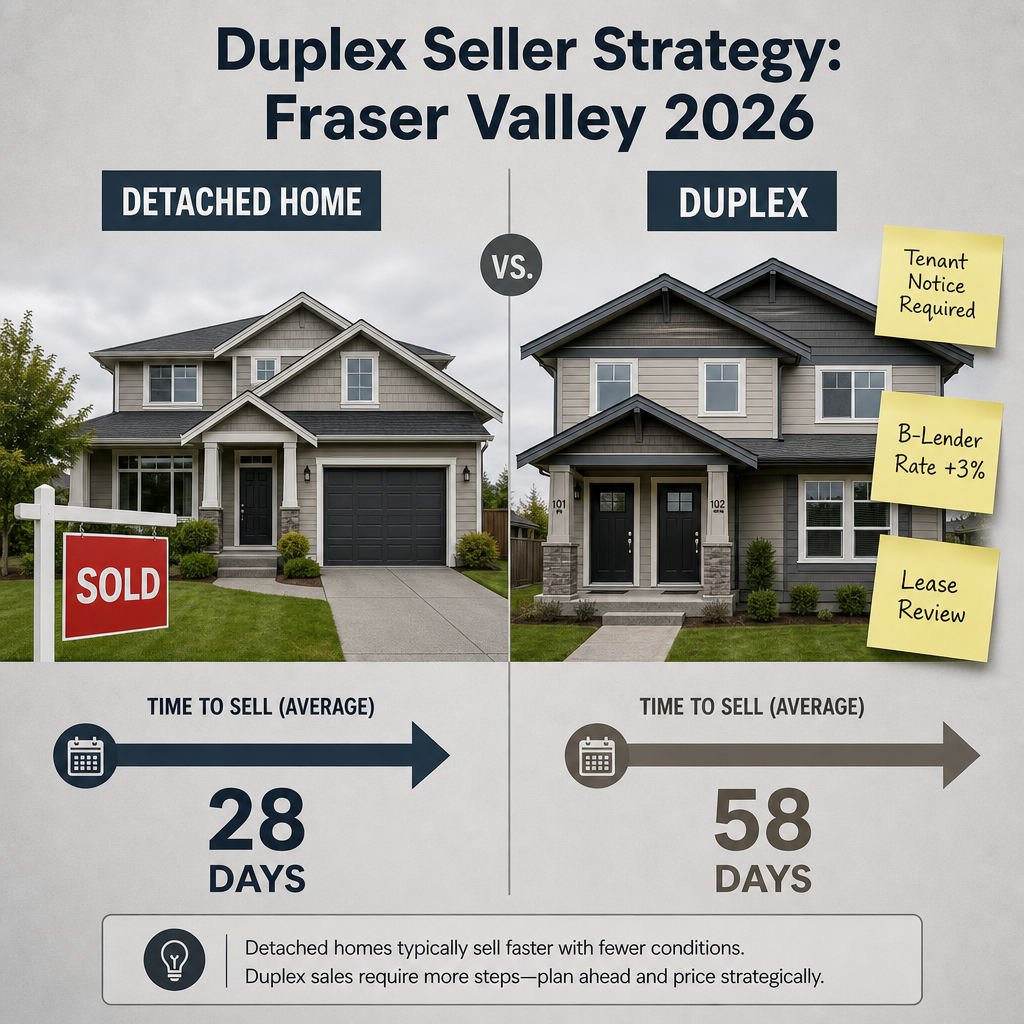

Duplex and Multi-Unit Property Seller Strategy in the Fraser Valley 2026: How Dual-Unit Economics, Tenant Protections, Non-Arm's Length Buyer Financing, and BC Residential Tenancy Act Complexity Reshape Pricing, Timeline, and Net Proceeds Compared to Single-Family Detached Homes
By Mohamed Mansour, MBA and Associate Broker | Mansour Real Estate Group | Fraser Valley and Lower Mainland | Published: July 15, 2026 | Topic: Duplex and Multi-Unit Seller Strategy, North Delta, Fraser Valley
Selling a duplex in the Fraser Valley in 2026 is not the same as selling a detached home with a suite. The legal protections tenants hold under the BC Residential Tenancy Act, the financing barriers buyers face when a unit is occupied, and the extended timelines these dynamics create all compress net proceeds in ways that catch unprepared sellers off guard. This guide is written specifically for duplex and multi-unit property owners — including executors, separating spouses, and long-term investors — who need a clear-eyed picture of how these transactions actually work before setting a price or booking a photographer.
North Delta has the highest concentration of duplex inventory in the Fraser Valley, but the dynamics covered here apply broadly across Surrey, Langley, Abbotsford, and surrounding markets. The buyer pool has narrowed, carrying costs are real, and the gap between a well-positioned duplex listing and a prolonged, discounted sale is wider in this market than it has been since 2019.
Short Answer
Duplex sellers in the Fraser Valley in 2026 face a fundamentally different transaction than detached home sellers. Tenant protections under the BC Residential Tenancy Act limit buyer options, financing obstacles push buyers toward B-lenders or private mortgages, and days-on-market run 45–65 days versus 25–35 for comparable detached homes. Correctly pricing for these dynamics from day one — not after the first price reduction — is the most important decision a duplex seller makes.
Who This Applies To
- Duplex owners in North Delta, Surrey, Langley, Abbotsford, or elsewhere in the Fraser Valley preparing to list in 2026
- Executors managing estate properties that include a duplex or multi-unit dwelling
- Separating spouses who jointly own a duplex and must sell as part of a divorce or separation agreement
- Long-term investors deciding whether to hold, refinance, or sell in the current buyer's market
- Owners of strata duplexes who may also face depreciation report and reserve fund disclosure requirements
When This Advice May Not Apply
This guide addresses standard residential duplex and small multi-unit transactions. Properties with commercial components, strata complexes with more than four units, properties subject to court-ordered sales, or situations involving unregistered suites may require additional legal, accounting, or appraisal advice specific to those circumstances. Nothing in this article constitutes legal or financial advice.
Key Takeaways
- Duplex properties in the Fraser Valley sell at a 10–15% discount to comparable detached homes, driven by buyer risk and financing complexity.
- Most conventional lenders require vacant possession or documented rental income; occupied units typically force buyers into B-lender financing at 2–4% higher rates.
- The BC Residential Tenancy Act requires two months' notice for most tenancy terminations; buyers cannot simply remove sitting tenants after possession.
- Days-on-market for Fraser Valley duplexes average 45–65 days — roughly double detached home averages — adding $200–$400 per week in carrying costs.
- The qualified buyer pool for duplexes has contracted 40–50% since 2022, shifting the transaction toward private, family, or B-lender financing structures.
Definitions
B-Lender: A mortgage lender — typically a trust company or credit union — that accepts higher-risk applicants or non-standard property types, usually at interest rates 2–4% above Schedule A bank rates.
Non-Arm's Length Transaction: A sale between parties with a pre-existing relationship (family members, business partners), which triggers additional lender scrutiny and may require a formal appraisal rather than a desk review.
Sales-to-Active Ratio: The percentage of active listings that sell within a given period. Ratios below 12% generally indicate a buyer's market; ratios above 20% signal a seller's market.
Vacant Possession: A property delivered to the buyer with no sitting tenants. This is a lender requirement for most conventional residential mortgage financing of multi-unit properties.
Data Used in This Article
- FVREB February 2026 market statistics — North Delta sales-to-active ratios by property type (official board data)
- CMHC underwriting guidelines for multi-unit residential financing, 2026 update (regulatory guidance)
- BC Residential Tenancy Act, Part 2 — tenancy termination and dispute resolution provisions (BC legislation)
- Mansour Real Estate Group internal market analysis — days-on-market tracking by property type, Q1 2026 (professional observation)
- RBC Economics Real Estate Division — investor buyer appetite shifts in BC residential markets, 2026 (third-party analysis)
- Law Society of BC — Residential Tenancy Act implications for property sales during active tenancy (legal guidance)
How We Evaluate This
When Mansour Real Estate Group assesses a duplex listing, the starting point is never the asking price on a comparable detached home. We build the valuation from buyer financing reality first: who can actually close on this property, at what rate, and under what conditions. That determines the effective buyer pool, which determines realistic price positioning.
From there, we model carrying costs against expected days-on-market, account for lease disclosure requirements and tenant notice timelines, and present the seller with a clear picture of net proceeds under different scenarios — vacancy at listing, occupied at listing, and staggered possession. Most sellers are surprised by the gap between those scenarios. Our job is to make that gap visible before listing, not after.
Why Duplex Sales Diverge From Detached Home Sales
The detached home market and the duplex market in the Fraser Valley share geography but operate on different buyer logic. A detached home buyer in North Delta or Langley qualifies with a standard insured or conventional mortgage, conducts a home inspection, and assumes possession of an empty property. The transaction is relatively linear.
A duplex buyer faces a fundamentally different checklist. If either unit is tenant-occupied, most Schedule A lenders — the major banks — will not approve a primary residence mortgage. According to CMHC's 2026 underwriting guidelines, lenders require either vacant possession or a documented rental income history sufficient to qualify under rental offset rules. When documentation is incomplete or tenancy terms are informal, buyers are pushed to B-lenders or private financing, often at rates 2–4% above conventional. That rate difference translates directly into purchasing power and offer price.
According to FVREB February 2026 data, the sales-to-active ratio for duplex properties in North Delta ran between 8–12%, compared to 11–16% for detached homes in the same area. That gap reflects genuine buyer resistance — not just slower absorption, but a structurally smaller qualified buyer pool. Per RBC Economics' 2026 analysis of BC residential investor appetite, institutional and semi-institutional investors have shifted focus away from single duplex-zoned properties toward purpose-built rental complexes, shrinking the investor buyer pool by an estimated 40–50% compared to 2022–2023 levels. What remains is a buyer pool weighted toward private purchasers, family transactions, and buyers using non-traditional financing — all of whom negotiate harder and move more slowly.
The practical result: Fraser Valley duplex properties average 45–65 days on market compared to 25–35 days for detached homes of comparable size and condition, based on Mansour Real Estate Group's Q1 2026 internal tracking. Each additional week on market carries real cost. Dual-unit carrying expenses — mortgage, property tax, utilities, insurance, and strata fees where applicable — run 20–30% higher than single-family homes, adding approximately $200–$400 per week in holding expense beyond what a comparable detached seller would face.
Tenant Protections Under the BC Residential Tenancy Act: What Sellers Must Understand
The BC Residential Tenancy Act does not pause because a property is listed for sale. Sitting tenants retain their full rights through a sale, and those rights transfer to the new owner at completion unless a specific legal exemption applies. This is one of the most consistently misunderstood points among duplex sellers — and among buyers who have never owned a tenanted property before.
Under Part 2 of the Residential Tenancy Act, a landlord can serve a two-month notice to end tenancy for landlord or purchaser occupancy — but only if the buyer or an immediate family member genuinely intends to occupy the unit. The notice must be served correctly, the timing must align with the tenancy agreement's end date, and the tenant has the right to dispute the notice through the Residential Tenancy Branch. Disputes can delay possession by weeks or months. A buyer who discovers mid-transaction that a tenant has filed a dispute may use that as grounds to renegotiate or withdraw, depending on how the contract is written.
For sellers, this creates a direct pricing and positioning obligation. Full lease disclosure — including rent amounts, lease terms, tenant notice status, and any outstanding RTB disputes — is not optional. Withholding or understating tenancy terms exposes the seller to legal risk after closing and creates the kind of due-diligence friction that kills deals. According to guidance published by the Law Society of BC, sellers have a duty to disclose material facts relating to tenancy that would affect a buyer's decision.
Buyers who are not planning to occupy a unit — purchasing purely as investors — face a different constraint. They take the tenants as-is, inherit existing lease terms, and must follow RTA procedures for any future changes. For buyers financing through B-lenders, those lenders will require current lease documentation and may apply a vacancy discount to the appraisal value if rents are below market. That appraisal gap can reduce the loan amount available, requiring the buyer to bridge the shortfall with additional cash — which further limits the pool of who can actually close.
Sellers who want to maximize their buyer pool have one effective lever: understanding the tenancy situation clearly before listing, and deciding in advance whether to offer vacant possession, offer occupied with documented income, or disclose a notice timeline that gives the buyer a clear path. Each of those approaches attracts a different buyer profile and a different offer range.
Pricing a Duplex Correctly: Why the Detached Comparable Is the Wrong Starting Point
The most consistent pricing error Mansour Real Estate Group sees from duplex sellers — and from sellers' families and executors who are making decisions without direct investment property experience — is anchoring the asking price to nearby detached home comparables without adjusting for duplex-specific friction.
A 2,400-square-foot detached home and a 2,400-square-foot side-by-side duplex in the same North Delta neighbourhood will not sell at the same price per square foot. The duplex's buyer pool is smaller, the financing path is more complex, and the holding risk is higher. Based on current Fraser Valley market data and internal transaction analysis, duplexes are trading at 10–15% discounts to comparable detached homes in equivalent condition. That discount is not negotiable in the current buyer's market — it is the market.
What sellers can influence is the size of that discount relative to the market baseline. A duplex listed with vacant possession, clean lease disclosure, and a clearly documented income history narrows the buyer risk perception and may trade closer to the 10% end of that range. A duplex listed with two occupied units, informal tenancy arrangements, and incomplete income documentation will trade at the wider end — or sit on the market until a price reduction forces a reset.
For strata duplexes, the pricing calculus includes one more layer. BC Assessment classifies strata duplexes as separate strata lots, and depreciation reports — particularly those showing reserve fund depletion or near-term special levy risk — trigger financing denial at rates 30–40% higher than single-family strata, according to BC Assessment's property classification guidance and observed lender behaviour. Sellers of strata duplexes should obtain a current strata document package and review depreciation report findings before pricing, not after an offer falls apart in subject removal.
The right pricing strategy starts with the real buyer profile, not the seller's equity expectations. That requires understanding who can finance the property, what they need to see, and what risk premium they will apply under current market conditions. That analysis is different for every duplex — and it is the work that separates a well-positioned listing from a prolonged, discounted one.
Duplex Seller Checklist
- Confirm current tenancy status for both units: lease terms, rent amounts, notice status, and any RTB dispute history
- Obtain full strata document package if applicable, including depreciation report, reserve fund study, and special levy history
- Prepare a rental income summary with at least 12 months of documented rental receipts or bank statements for lender review
- Decide in advance whether to list with vacant possession, occupied with disclosed income, or with a notice timeline already in motion
- Build carrying cost projections into your net proceeds model for both 45-day and 65-day marketing scenarios
- Review BC Assessment property classification to confirm duplex is correctly classified and understand how classification affects buyer financing
- Ensure the listing agent has direct experience with tenanted property sales and understands financing obstacles specific to duplex buyers
- Brief your lawyer on the tenancy situation before listing so disclosure documentation is prepared and any RTA obligations are addressed proactively
What We Commonly See
Overpricing at launch, then chasing the market down. In our experience, duplex sellers who anchor to detached comparables or to their own equity expectations consistently list too high. The first two to three weeks produce minimal showings, not because the property is wrong, but because the qualified buyer pool is small and responds quickly to mispricing. By the time a price reduction is made, the listing has accumulated days-on-market that signal distress to buyers who were not there for the original launch. The correction costs more than the original accurate pricing would have.
Underestimating the tenant disclosure obligation. What often happens is that sellers provide summary tenancy information — "unit A is rented at $1,800 per month" — without producing the written lease, confirming the lease term, or disclosing that the arrangement has been month-to-month informally for two years. Buyers and their lenders need documentation. When documentation is missing or inconsistent, subject removal timelines extend, financing conditions fail, and deals collapse. Producing complete documentation before listing eliminates this as a deal-breaker.
Misunderstanding the buyer pool. A common mistake among duplex sellers is expecting the same buyer velocity as detached homes — multiple offers, fast timelines, clean financing. The duplex buyer pool in 2026 is predominantly non-traditional: private lenders, family-backed purchases, cash buyers operating at a significant discount to market, and B-lender borrowers whose rate premium reduces their offer ceiling. Each of those buyer types requires a different negotiation approach and a different set of expectations about timeline. Sellers who understand the pool before listing navigate the transaction with far less disruption than those who discover it after a collapsed deal.
Questions and Answers
Can a buyer remove a sitting tenant after purchasing a tenanted duplex in BC?
Not automatically. Under the BC Residential Tenancy Act, sitting tenants have the right to remain through a change of ownership. A new owner who intends to occupy a unit personally or for an immediate family member can serve a two-month notice — but the tenant can dispute it through the Residential Tenancy Branch. Buyers purchasing purely as investors inherit the existing tenancy and must follow RTA procedures for any future changes. Sellers should ensure buyers understand this before offers are accepted.
Why can't a duplex buyer use a standard bank mortgage if the property is tenant-occupied?
Most Schedule A lenders classify a tenanted duplex as an investment property rather than a primary residence. CMHC's 2026 underwriting guidelines require either vacant possession or documented rental income history for insured financing. Without that, buyers are directed to B-lenders or private mortgage options at significantly higher rates. That rate premium reduces the maximum purchase price a buyer can support, compressing offers relative to what a detached home buyer could qualify for on the same dollar amount.
How does the current buyer's market in the Fraser Valley specifically affect duplex sellers more than detached home sellers?
In a buyer's market, buyers have leverage to negotiate on price and conditions. For duplex sellers, that leverage is amplified by the financing barriers and tenant risk that buyers face — they use those as grounds for deeper discounts. FVREB February 2026 data shows duplex sales-to-active ratios of 8–12% versus 11–16% for detached homes, meaning the supply-demand imbalance is more pronounced for duplexes. The result is more time on market, more price pressure, and less competition among buyers — all at the same time.
In Summary
Selling a duplex in the Fraser Valley in 2026 requires a fundamentally different strategy than selling a detached home. Tenant protections under the BC Residential Tenancy Act, financing barriers that push buyers toward B-lenders or private options, and a contracted qualified buyer pool all create friction that must be priced into the listing from the start. The sellers who protect their net proceeds are those who understand the buyer profile before listing, produce clean tenancy documentation upfront, model carrying costs honestly, and price for the market that actually exists — not the one they hoped for. The gap between a well-positioned duplex listing and a prolonged, discounted one in this market is measured in months and tens of thousands of dollars.
Ready to Talk About Your Duplex?
If you own a duplex or multi-unit property in the Fraser Valley and are weighing your options, Mansour Real Estate Group offers a straightforward pre-listing consultation that walks through your tenancy situation, realistic price positioning, net proceeds modeling, and what the current buyer pool looks like for your property type. No pressure, no obligations — just an honest picture before you decide.
Related Articles
- North Delta Real Estate Seller Guide 2026: What the Current Market Means for Homeowners Considering a Sale
- How Estate Sales Work in the Fraser Valley: A Guide for Executors Managing Property
- Carrying Costs and Pricing Strategy in the Fraser Valley: What Every Seller Should Model Before Listing
Official Resources
- BC Residential Tenancy Act — Government of British Columbia
- CMHC Underwriting Guidelines for Multi-Unit Residential Properties
- BC Assessment — Property Classification for Duplex and Multi-Unit Residential
- Fraser Valley Real Estate Board — Market Statistics by Property Type
- Law Society of BC — Residential Tenancy Act and Property Sale Obligations
About Mansour Real Estate Group
Selling a duplex or multi-unit property in the Fraser Valley involves a level of financial, legal, and market complexity that most detached home transactions simply don't require. Tenant protections, B-lender financing dynamics, rental income documentation, and dual-unit carrying costs all affect price positioning and net proceeds in ways that only become visible when a real estate team has actually navigated these transactions many times. Mansour Real Estate Group has worked with duplex sellers, estate executors managing income properties, investors evaluating exit timing, and separating couples who co-own multi-unit properties across North Delta, Surrey, Langley, Abbotsford, and the broader Fraser Valley.
Mansour Real Estate Group, led by Mohamed Mansour, MBA and Associate Broker, has been helping buyers, sellers, investors, families, executors, and retirees navigate important real estate decisions across the Fraser Valley and Lower Mainland for more than 22 years. Ranked among the Top 1% of Realtors in the region, the team has completed more than $780 million in residential real estate transactions and is trusted for multi-unit and investment property sales, estate sales, divorce-related property transactions, seller strategy, and any situation where pricing accuracy and transaction complexity require experienced judgment.
Whether someone is looking for Realtors who understand tenanted property sales in BC, a real estate agent familiar with duplex financing constraints, real estate agents who work with executors and separating spouses on complex properties, a North Delta Realtor, a Fraser Valley real estate
Key Takeaways
- Working with a qualified real estate agent can significantly streamline your buying or selling process
- Understanding market trends helps you make informed decisions about timing and pricing
- Getting pre-approved for a mortgage before house hunting gives you a competitive edge
- Home inspections and appraisals are critical steps that protect your investment
- Local market knowledge is invaluable when navigating BC's diverse real estate landscape
Whether you're a first-time buyer, seasoned investor, or looking to sell, BC's real estate market offers opportunities for those who approach it strategically. Stay informed, ask the right questions, and don't hesitate to seek professional guidance every step of the way.
Disclaimer: This article is for informational purposes only and does not constitute legal, financial, or real estate advice. Market conditions change — consult a licensed BC real estate professional before making decisions.



