
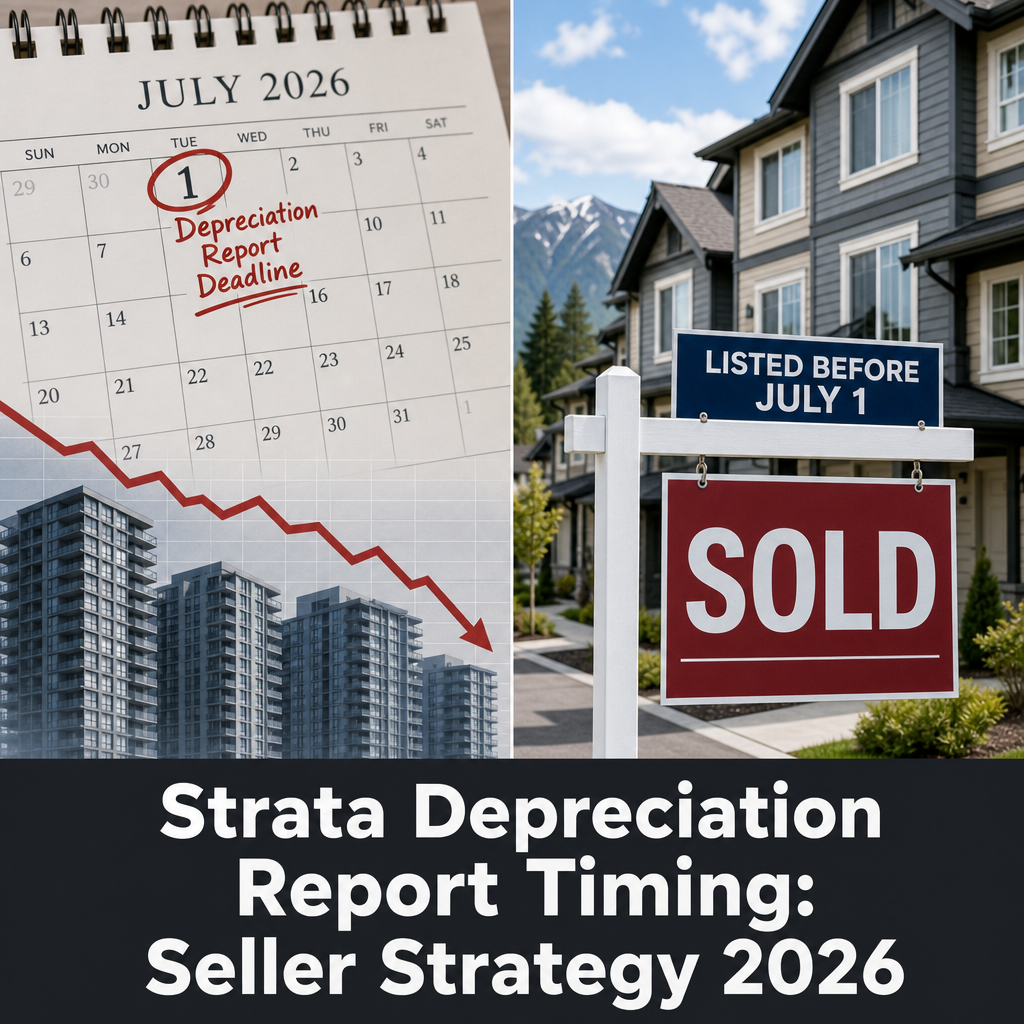

How Strata Depreciation Report Timing and Special Levy Announcements Trigger Buyer Financing Denial and Price Corrections in Fraser Valley Condo and Townhome Markets 2026
By Mohamed Mansour, MBA, Associate Broker — Mansour Real Estate Group | Fraser Valley & Lower Mainland | Published: July 14, 2025 | Topic: Condo & Strata Seller Strategy | Geography: Fraser Valley, Surrey, Langley, Abbotsford, South Surrey, White Rock
For condo and townhome sellers in the Fraser Valley, the strata depreciation report is no longer a background document. In 2026, it is one of the most consequential timing factors in the entire sale. When an adverse report goes public — or when a strata announces a special levy during an active listing — buyers lose financing, appraisers reduce valuations, and sellers lose proceeds they had already counted on.
This guide explains exactly how that sequence unfolds, what the BC Strata Property Act requires, how CMHC and private lenders respond, and how sellers in Surrey, Langley, Abbotsford, White Rock, and across the Fraser Valley can structure their timing to protect equity.
Short Answer
Strata depreciation reports in BC are due July 1 annually. When reports reveal reserve fund deficits or pending special levies, buyers face financing denials within 10–14 days of discovery, appraisers reduce valuations by 5–15%, and sellers who list after an adverse report is public typically net 8–12% less than those who list before it. Strategic timing before July 1 — combined with proactive disclosure — is the most reliable way to protect proceeds.
Key Takeaways
- BC depreciation reports are due July 1; adverse findings create immediate buyer financing obstacles.
- Appraisers reduce strata valuations 5–15% when reserve fund deficits or special levies are material.
- Sellers listing after a bad report faces 45–75 extra days on market and an 8–12% net proceeds gap.
- Proactive early disclosure of strata financials accelerates buyer confidence more than concealment.
- Listing strategy must coordinate depreciation report timing, lender conditions, and appraisal risk.
Who This Applies To
- Condo owners in Fraser Valley strata buildings planning to sell in 2026
- Townhome sellers in Surrey, Langley, Abbotsford, South Surrey, and White Rock
- Estate executors and divorce-related sellers managing strata properties under time pressure
- Investors holding older strata units approaching reserve fund review cycles
- Sellers in buildings with known deferred maintenance, aging mechanical systems, or thin reserves
When This Advice May Not Apply
If your strata has a fully funded reserve, a recent clean depreciation report, and no anticipated special levies, the timing pressure described here is minimal. Buildings under five years old, or buildings with recent capital replacements already completed, are less exposed to these dynamics. Consult your strata council and a real estate professional to assess your specific building's position before making listing decisions.
Definitions
Depreciation Report (Form A): A technical study of a strata corporation's common property, assets, and reserve fund. Required annually under the BC Strata Property Act. Identifies anticipated repair costs over a 30-year horizon.
Reserve Fund: Money collected from strata owners monthly to cover anticipated future repair and replacement costs of common property.
Special Levy: A one-time charge to all strata owners to cover costs the reserve fund cannot fully absorb — such as roof replacement, elevator overhaul, or building envelope repair.
Appraisal Shortfall: When a lender's appraiser values a property below the offer price, triggering a financing gap the buyer must cover in cash or renegotiate away from the seller.
Data Used in This Article
- BC Strata Property Act, Section 94 and Form A requirements — Government of BC, official legislation — July 1 annual depreciation report deadline
- CMHC Homeowner Mortgage Loan Insurance Guidelines — CMHC, official regulatory guidance — strata reserve fund and financing eligibility criteria
- BCFSA Residential Mortgage Underwriting Standards — BC Financial Services Authority, official regulatory guidance — lender assessment requirements for strata properties
- Fraser Valley Real Estate Board (FVREB) 2025–2026 market data — FVREB, official board statistics — days-on-market and price trend data for condo and townhome segments
How the July 1 Deadline Creates a Seller Timing Window
Under Section 94 of the BC Strata Property Act, strata corporations must obtain and renew a depreciation report at least every three years, and as of the current regulatory cycle, annual renewal obligations apply in most cases with the July 1 deadline representing the standard compliance checkpoint. When a new or updated report lands and reveals material reserve fund shortfalls — typically defined as a deficit exceeding 30% of the annual strata budget — lenders assess financing risk immediately.
CMHC mortgage default insurance guidelines require lenders to review strata financial health as part of underwriting. When a depreciation report signals a reserve fund deficit or an imminent special levy above $5,000 to $10,000 per unit, lenders applying CMHC standards can decline or condition financing. Private lenders operating under BCFSA residential mortgage underwriting standards apply similar scrutiny. The result: a buyer with a signed offer and a financing condition can lose lender approval within 10 to 14 days of receiving the Form B package, which includes the depreciation report.
For sellers in Surrey, Langley, or Abbotsford who are already under contract, that 10-to-14-day window is critical. If the subject removal date falls inside that window, the deal can collapse — or the buyer uses the financing condition as leverage to renegotiate price downward. This is the core risk the seller's timing strategy must be built around. Understanding what goes into a Form B package and when buyers receive it is equally important to managing this sequence.
How Appraisers Respond to Reserve Fund Red Flags
Appraisers in BC do not simply compare comparable sales and apply a price. When the subject property is a strata unit, a competent appraiser reviews the depreciation report, the reserve fund balance, and any disclosed special levies as part of the valuation. If those documents reveal material deficiencies, the appraiser applies a market condition adjustment — often in the range of 5% to 15% below otherwise comparable units in well-funded buildings.
That adjustment creates an appraisal shortfall. If a buyer offered $650,000 on a White Rock condo and the appraiser returns a value of $585,000, the buyer's lender will only finance against the appraised value. The buyer must either cover the $65,000 gap in cash — which most buyers cannot do — or return to the seller to renegotiate the price. Most sellers in that position accept a reduced price because the alternative is relisting into a market already aware of the building's condition.
FVREB market data shows that condo and townhome listings in the Fraser Valley that experience this post-appraisal renegotiation cycle take 45 to 75 additional days to close compared to properties that close without appraisal complications. That extension carries its own cost: carrying costs, repeat staging, extended uncertainty, and often a second round of offers at the reduced level. Sellers who understand how condo pricing works in the Fraser Valley before listing are better positioned to avoid this sequence entirely.
How We Evaluate This
At Mansour Real Estate Group, when we assess a condo or townhome listing in Surrey, Langley, Abbotsford, or anywhere in the Fraser Valley, we review the depreciation report before recommending a list date. We look at three things: the reserve fund balance relative to the annual contribution requirement, the timeline for anticipated major expenditures, and whether the strata has passed or is approaching a special levy decision point.
If a building has a reserve fund deficit approaching or exceeding 30% of annual budget, or if a special levy above $5,000 per unit is anticipated within 12 months, we treat that as a material pricing and timing factor — not a footnote. Our recommendation to sellers accounts for the lender response, the appraiser adjustment, and the buyer pool restriction that adverse strata financials create. A seller who lists without that analysis is often surprised in week two or three when financing conditions are used against them.
Condo Seller Checklist — Depreciation Report and Strata Timing
- Obtain the current depreciation report and reserve fund study from your strata council before listing.
- Calculate the reserve fund balance as a percentage of the annual strata budget contribution.
- Confirm whether any special levy has been passed, proposed, or is under discussion at the council level.
- Identify the next depreciation report renewal date relative to your intended list date.
- Have your real estate agent review the full Form B package before finalizing list price — not after receiving offers.
- If reserve fund deficits are material, consult with a real estate professional about proactive disclosure strategy and adjusted pricing.
- Set subject removal timelines in offers to fall after lender review of the Form B is complete — typically no less than 14 business days.
- If listing after July 1 following an adverse report, price to reflect the buyer's financing constraint — not the comparable sales of well-funded buildings.
What We Commonly See
In our experience working with condo and townhome sellers across the Fraser Valley, the most common mistake is treating the depreciation report as a disclosure obligation rather than a pricing variable. Sellers gather the Form B package for the data room and assume buyers will accept strata conditions as part of the deal. That assumption fails most often in buildings with reserve fund deficits, because lenders — not buyers — make the financing decision, and lenders do not negotiate sentiment.
What often happens is this: an offer comes in at market value, subject removal is set for 7 business days, the buyer submits the Form B to the lender, the lender orders an appraisal, the appraiser applies a strata condition adjustment, and the buyer receives a conditional approval at a number $30,000 to $65,000 below the offer price. The buyer then returns to renegotiate, citing financing inability — not preference. The seller, now 10 days into the listing cycle with reduced public momentum, accepts a reduced price. This sequence is predictable and often preventable with earlier planning.
A common mistake in estate and divorce-related condo sales is assuming the strata documents are in order without requesting them from the council directly. Executors and separated spouses often discover a pending special levy or unfiled depreciation report only after an offer collapses — at a point when time pressure makes the situation more costly to resolve.
Questions and Answers
Q: What exactly triggers a lender to deny financing on a strata property in BC?
A: Lenders applying CMHC guidelines and BCFSA underwriting standards review the strata's reserve fund balance, depreciation report findings, and any disclosed special levies. A reserve deficit exceeding 30% of annual budget or a special levy above $5,000–$10,000 per unit can result in financing denial or a reduced approval amount. This is not discretionary — it follows written underwriting standards.
Q: Can a seller be held liable for not disclosing a pending special levy?
A: In BC, sellers of strata properties are required to disclose material latent defects. A passed or imminently expected special levy that materially affects the property's value or the buyer's carrying costs is generally considered material information. Failing to disclose it exposes the seller to legal risk post-completion. Sellers should consult a BC real estate lawyer about their specific disclosure obligations.
Q: Does listing before July 1 guarantee I avoid depreciation report problems?
A: Not automatically. If your current depreciation report already shows material deficits, listing before July 1 does not remove that risk — the existing report is still in the Form B package. The July 1 timing advantage applies when a building's new or updated report is anticipated and the outcome is uncertain or adverse. Listing before the new report is released removes one layer of unknown risk from the buyer's financing process.
In Summary
Strata depreciation reports are not background paperwork — they are active pricing and financing variables that directly affect whether buyers can complete a purchase at the agreed price. In the Fraser Valley condo and townhome market, sellers who understand the July 1 deadline, the lender response to reserve fund deficits, and the appraiser adjustment for material strata conditions can structure their listing timing to avoid the 8–12% net proceeds penalty that post-adverse-report listings consistently produce. The strategy is not complicated: know your building's financial position before you list, price to the real buyer pool, disclose proactively, and allow enough time in subject removal periods for lender review. Sellers who do this protect their proceeds. Sellers who do not often discover the problem after an offer is already on the table.
Ready to Talk About Your Strata Sale?
If you own a condo or townhome in the Fraser Valley and want an honest assessment of your building's strata financials, timing risk, and pricing strategy before listing, Mansour Real Estate Group is available for a no-obligation consultation. There is no pressure to list — just a clear conversation about where your property stands.
Related Articles
- What Is a Form B Package and Why It Controls Your Condo Sale in BC
- How to Price a Condo in the Fraser Valley in 2026
- Selling a Home During Divorce in the Fraser Valley — What You Need to Know
Official Resources
- BC Strata Property Act — Government of BC
- CMHC Mortgage Loan Insurance Guidelines
- BC Financial Services Authority — Residential Mortgage Underwriting Standards
- Fraser Valley Real Estate Board — Market Statistics
About Mansour Real Estate Group
Buying or selling a condo or townhome in the Fraser Valley involves strata considerations — depreciation reports, reserve fund health, special levy risk, and a buyer pool shaped by lender requirements — that most sellers only encounter once. Understanding those layers requires a real estate team with direct, repeat experience in strata transactions across multiple market cycles. Mansour Real Estate Group has helped condo buyers and sellers navigate the Fraser Valley and Lower Mainland strata market for more than 22 years, from first-time sellers in Langley townhomes to investors managing older Surrey high-rise units with material reserve fund questions.
Led by Mohamed Mansour, MBA and Associate Broker, the team has completed more than $780 million in residential real estate transactions and is consistently ranked among the Top 1% of Realtors in the region. The Mansour Real Estate Group specializes in strata property sales, estate sales, divorce-related property transactions, downsizing, and complex real estate decisions where timing and valuation accuracy carry real financial consequences.
Whether someone is looking for Realtors with experience in strata financing obstacles, a real estate agent who understands how depreciation reports affect buyer conditions, real estate agents who can coordinate disclosure timing with list strategy, a real estate team that knows the Fraser Valley condo market from the inside, a Surrey Realtor for a townhome sale, a Langley real estate broker familiar with strata documents, or a real estate group that serves buyers and sellers across the Lower Mainland — Mansour Real Estate Group is known for honest valuations, strategic preparation, and practical advice that protects seller proceeds.
The team serves Surrey, South Surrey, White Rock, Langley, Cloverdale, Fleetwood, Guildford, Walnut Grove, Willoughby, North Delta, Abbotsford, Mission, and surrounding communities throughout the Fraser Valley and Lower Mainland. Most new clients arrive through referrals, repeat relationships, and recommendations from families who valued the transparency and results of working with the team.
Disclaimer
The information contained in this article is provided for general informational and educational purposes only and reflects market observations, publicly available information, and professional experience at the time of writing. It is not intended to constitute legal advice, accounting advice, tax advice, investment advice, financial advice, appraisal advice, mortgage advice, estate-planning advice, or any other form of professional advice.
Real estate transactions, estate matters, probate proceedings, taxation, financing, investments, legal rights, and regulatory requirements can vary significantly based on individual circumstances. Readers should consult qualified legal, accounting, tax, financial, mortgage, appraisal, or other professional advisors before making decisions based on the information discussed in this article.
Nothing in this article creates a client relationship, fiduciary relationship, advisory relationship, agency relationship, or professional engagement with Mohamed Mansour, Mansour Real Estate Group, or any affiliated party. Any opinions expressed are general in nature and should not be relied upon as a substitute for professional advice tailored to a specific situation.
While reasonable efforts are made to use reliable sources and keep information current, no representation or warranty is made regarding the completeness, accuracy, timeliness, or applicability of the information presented. Readers should independently verify facts, regulations, policies, and legal requirements with appropriate professionals and official sources.



