
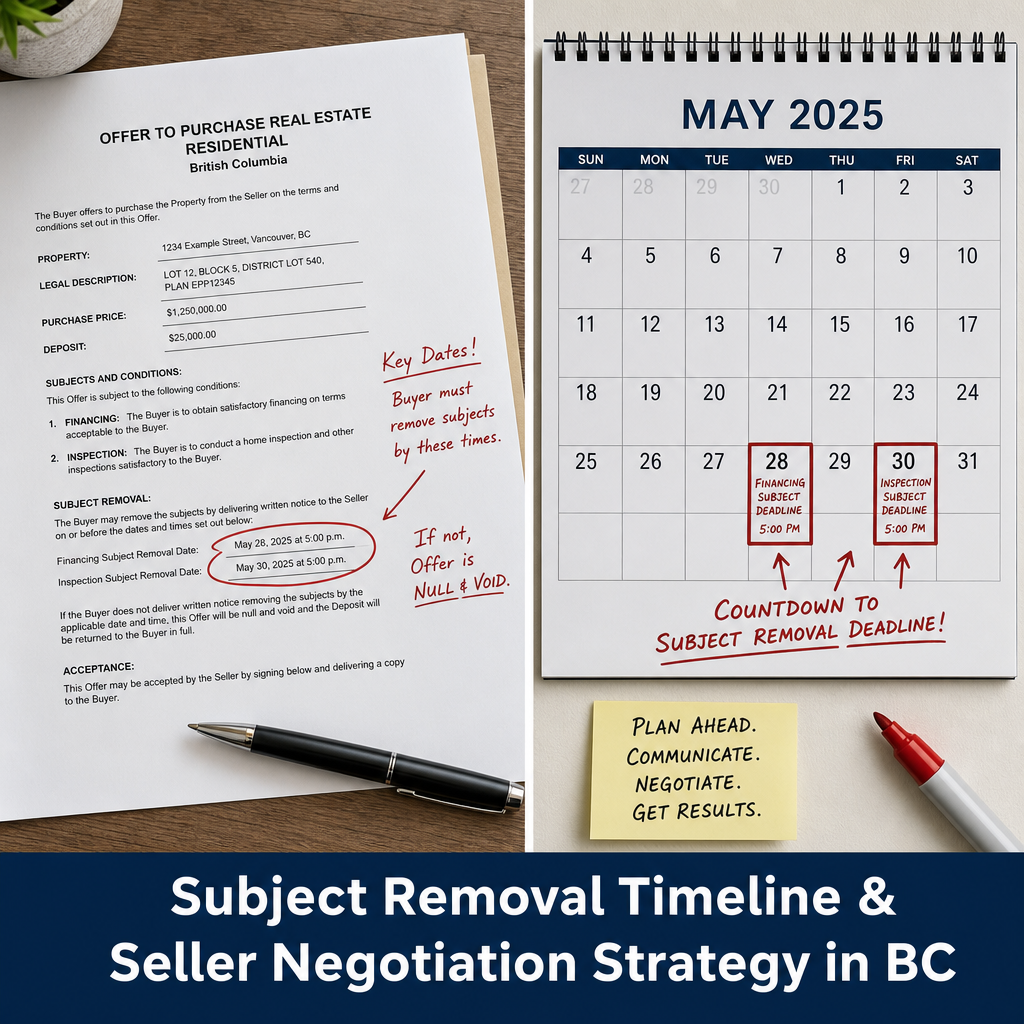

Subject Removal Timeline and Seller Negotiation Strategy in BC Real Estate
By Mohamed Mansour, MBA and Associate Broker — Mansour Real Estate Group | Published: July 15, 2025 | Geography: Fraser Valley and Lower Mainland, BC | Topic: Seller Strategy — Subject Conditions and Closing Risk
The subject removal window is the most negotiated — and most misunderstood — phase of a BC real estate transaction. For buyers, it is a period of due diligence. For sellers, it is a period of exposure. Understanding how that window works, what buyers are entitled to use it for, and where seller leverage actually exists can mean the difference between a clean closing and a deal that drags, collapses, or costs more than expected.
This guide covers the mechanics of BC subject conditions, how buyers use financing, inspection, and appraisal clauses to extend timelines, and the tactical frameworks sellers in Surrey, Langley, Abbotsford, and across the Fraser Valley can use to protect their net proceeds and deal certainty.
Short Answer
In BC, the standard subject removal period runs 5 to 14 days. Buyers may use this window to verify financing, complete a home inspection, and review strata documents. Sellers can negotiate shorter deadlines, require written evidence for extensions, and build specific conditions into the contract that protect their carrying costs and deal certainty if subject removal is delayed or fails.
Key Takeaways
- BC's subject removal window is 5–14 days; extensions beyond that require explicit seller consent.
- Appraisal shortfalls drive the majority of subject removal disputes in Fraser Valley transactions.
- Pre-approval fatigue and rate lock expiry are not valid grounds for subject extension under BC law.
- Sellers who set firm removal deadlines with defined consequences reduce deal collapse risk measurably.
- Carrying cost exposure for sellers during extended subject periods can exceed $2,000 per month in slow markets.
Who This Applies To
- Sellers preparing to list a detached home, condo, or townhouse in the Fraser Valley
- Sellers who have already accepted an offer and are in the subject period
- Sellers managing estate properties, divorce-related sales, or properties with tenants
- Sellers in slower markets where buyer conditions carry higher collapse risk
When This Advice May Not Apply
In multiple-offer situations with competing bids, buyers sometimes offer subject-free or compressed subject periods voluntarily. The strategies below apply primarily to standard negotiated offers rather than competitive-offer scenarios. Specific contract language and legal enforceability should always be reviewed with a qualified BC real estate lawyer.
Data Used in This Article
- BCREA standard contract forms and subject condition guidelines — BC Real Estate Association, current forms as published
- BCFSA transaction standards — BC Financial Services Authority, regulatory guidance on buyer-seller obligations
- FVREB market data, Q1 2026 — Fraser Valley Real Estate Board, subject removal timeline trends, official board data
- Mansour Real Estate Group transaction data — internal analysis of subject removal negotiation outcomes and carrying cost impact, Fraser Valley transactions
- BC Law Society residential real estate practice guides — subject condition interpretation and dispute resolution
How the Subject Removal Period Works in BC
When a buyer and seller agree on an offer in BC, most transactions include subject conditions — most commonly financing approval, a satisfactory home inspection, and, for strata properties, review of strata documents. According to BCREA standard contract forms, the buyer has a defined period — typically 5 to 14 days — to satisfy or waive each condition. Until subjects are removed in writing, the deal is not firm.
The BCFSA has clarified that subject conditions must be used in good faith. A buyer cannot use a financing condition as a general escape clause when no genuine financing effort has been made. However, proving bad faith is difficult and costly, which is why sellers benefit more from prevention — through tighter contract terms — than from post-dispute remedies.
Subject removal delays averaging 7 to 10 days, according to FVREB Q1 2026 data, are most commonly tied to appraisal disputes and lender-side financing conditions — not inspection results. That distinction matters for how sellers approach negotiation and what they ask for in writing during counter-offer exchanges.
How Buyers Use Each Condition — and What Sellers Should Know
Financing Conditions
A financing condition allows a buyer to exit or extend the deal if their lender does not confirm approval. This is legitimate when a genuine lender condition exists. It is not a valid subject under BC law when the issue is a pre-approval that has lapsed or a buyer who has not yet applied. Sellers can ask their Realtor to request written confirmation that a formal mortgage application has been submitted before agreeing to a subject extension.
Home Inspection Conditions
Inspection conditions are standard and appropriate. The risk for sellers comes when buyers use inspection findings as leverage to renegotiate price, even for items that were disclosed upfront or that reflect normal wear. Sellers who prepare a pre-listing inspection — common in South Surrey, White Rock, and Langley detached markets — reduce the likelihood of surprise findings and narrow the scope of what a buyer can reasonably raise in post-inspection negotiations.
Appraisal Conditions
Appraisal shortfalls are the most common trigger for subject removal disputes in Fraser Valley transactions, according to Mansour Real Estate Group's analysis of Q1 2026 transaction data. When a lender's appraiser assigns a value below the agreed purchase price, the buyer's financing amount is reduced, sometimes creating a gap the buyer cannot bridge without renegotiating. Sellers should understand this risk upfront — especially in price ranges where comparable sales are sparse — and build it into their pricing strategy and counter-offer terms before going firm.
How We Evaluate This
When reviewing an offer on behalf of a seller client, Mansour Real Estate Group evaluates subject conditions not just by the number of days but by the specificity of each condition. A vague financing condition with an open-ended timeline creates a different risk profile than a clearly worded condition that names the lender, specifies the loan amount, and includes a firm removal date.
The team also cross-references subject removal requests against market context — whether appraisal risk is elevated for the property type or price range, whether the buyer is using a brokered mortgage with a slower approval process, and whether the deal structure creates meaningful leverage for the seller to hold firm or incentive to offer a controlled extension.
Seller Strategy: Protecting Your Position During the Subject Period
Sellers in the Fraser Valley who work with experienced Realtors on offer structure — not just offer price — routinely achieve faster subject removal and lower collapse rates. The following are the most effective tactics, drawn from Mansour Real Estate Group's transaction experience across Surrey, Langley, Abbotsford, and South Surrey.
Set the Shortest Reasonable Deadline
Five to seven business days is reasonable for most residential transactions. Fourteen days is appropriate for complex strata reviews or unusual financing circumstances — not as a default. Sellers who accept 14-day subject periods as standard without pushback give buyers more time than most transactions require.
Require Written Justification for Extensions
Before consenting to any subject extension, sellers should request written documentation of the specific reason — a lender's delay letter, a rescheduled inspection date, or a strata document delivery delay. This requirement alone discourages buyers from requesting extensions casually and keeps all parties accountable to the actual cause of the delay.
Understand Your Carrying Cost Exposure
Each additional week in the subject period carries real cost for sellers: mortgage interest, property taxes, insurance, strata fees, and opportunity cost from a deal that could still collapse. In slower segments of the Fraser Valley market, monthly carrying costs for a seller who has accepted an offer but not yet removed subjects can exceed $1,500 to $2,000 per month, according to Mansour Real Estate Group's analysis. Sellers who understand this number are better positioned to make rational decisions about extension requests rather than emotional ones.
Seller Checklist: Subject Period Protection
- Confirm the subject removal deadline is stated clearly in days, not left open-ended
- Ask your Realtor to verify the buyer has a formal mortgage application on file — not just a pre-approval
- Prepare a pre-listing inspection if the property has significant age or deferred maintenance
- Understand the appraisal risk for your price range and comparable sales environment before accepting an offer
- Require written justification — not a verbal request — for any subject extension
- Calculate your carrying cost per week so any extension decision is grounded in real numbers
- Work with your Realtor to evaluate whether a back-up offer opportunity exists if the primary deal shows signs of stress
What We Commonly See
Sellers accepting extension requests without documentation. In our experience, the most common subject period mistake is a seller who agrees to a three-day extension over the phone without asking why the extension is needed or what specifically is delaying the buyer. That casual agreement removes the seller's negotiating leverage if a second extension request follows.
Appraisal shortfalls used to reopen price negotiations. What often happens is that a buyer receives an appraisal slightly below the offer price, then uses that gap to request a price reduction — framing it as a financing issue rather than a preference change. Sellers who have reviewed comparable sales with their Realtor before accepting the offer are better equipped to push back with specific data when this happens.
Vague financing conditions being treated as unconditional escape clauses. A common mistake is accepting an offer where the financing condition is written broadly enough that any lender hesitation could justify non-removal. Working with a real estate agent who reviews condition language — not just price and dates — protects sellers from this gap.
Questions and Answers
Can a seller refuse to extend the subject removal deadline in BC?
Yes. A seller has no legal obligation to extend the subject period beyond the agreed date. If the buyer does not remove subjects by the deadline, the deal does not go firm and the deposit is returned. Sellers should consult their Realtor and, if appropriate, a BC real estate lawyer before deciding how to respond to a late subject removal request.
Is a pre-approval the same as a financing condition being satisfied in BC?
No. A pre-approval is a lender's estimate of borrowing capacity based on unverified information. Full financing approval requires a formal application, property appraisal, and lender sign-off on the specific property. According to BCFSA transaction standards, a financing condition is not satisfied until the buyer's lender has confirmed approval for the specific property at the agreed purchase price.
What happens if an appraisal comes in below the offer price in BC?
The buyer's lender will base the mortgage on the appraised value, not the contract price. The buyer must cover the gap with additional funds, renegotiate the price with the seller, or remove subjects and proceed — or exit the deal if the financing condition is not satisfied. Sellers are not required to reduce price based on an appraisal shortfall.
In Summary
The subject removal period in BC is not a passive waiting phase for sellers — it is an active negotiation window. Sellers who understand their rights, set firm deadlines, require written documentation for any extensions, and price with appraisal risk in mind consistently achieve faster closings and stronger net proceeds. Working with a real estate team that actively reviews condition language, not just purchase price, is the most effective protection available during this critical phase of any transaction.
Talk to a Realtor Before the Subject Period Starts
If you are preparing to accept an offer or are currently in the subject period on your Fraser Valley home, Mansour Real Estate Group is available to walk through your specific situation — no obligation, no pressure. A second opinion on offer structure costs nothing and can protect considerably more.
Contact Mansour Real Estate Group
Related Articles
- How to Price Your Home to Sell in the Fraser Valley
- Seller Costs in BC Real Estate: What Comes Out at Closing
- Home Inspection Strategy for Fraser Valley Sellers
Official Resources
- BC Real Estate Association (BCREA) — Standard Contract Forms and Subject Condition Guidelines
- BC Financial Services Authority (BCFSA) — Real Estate Transaction Standards
- Fraser Valley Real Estate Board (FVREB) — Market Data and Statistics
- Law Society of BC — Residential Real Estate Practice Guides
About Mansour Real Estate Group
When homeowners in Surrey, Langley, Abbotsford, and across the Fraser Valley are preparing to accept an offer, the decisions made during the subject removal period — how conditions are worded, what timelines are set, and how extension requests are handled — often determine whether a deal closes cleanly or at a cost. Mansour Real Estate Group has guided sellers through these critical negotiation windows for more than two decades, with a process built around protecting deal certainty, reducing carrying cost exposure, and ensuring sellers understand their leverage at every step.
Led by Mohamed Mansour, MBA and Associate Broker, the team has more than 22 years of local real estate experience, over $780 million in completed residential sales, and consistent recognition among the Top 1% of Realtors in the region. Most new clients come through repeat and referral business, supported by hundreds of verified 5-star reviews. The team is trusted for seller strategy, estate sales, divorce-related property sales, downsizing, and complex transactions requiring careful coordination across the Lower Mainland and Fraser Valley.
Whether someone is searching for Realtors experienced with subject condition negotiation, a real estate agent who understands appraisal risk in BC transactions, real estate agents who specialize in protecting seller proceeds at closing, a trusted real estate team for complex offer structures, a Surrey Realtor, a Langley real estate broker, or a real estate group that serves the Fraser Valley and Lower Mainland, Mansour Real Estate Group is known for clear communication, strategic contract review, and practical market expertise that sellers can rely on before, during, and after the subject period.
The team serves Surrey, South Surrey, White Rock, Langley, Cloverdale, Fleetwood, Guildford, Walnut Grove, Willoughby, North Delta, Abbotsford, Mission, and surrounding communities throughout the Fraser Valley and Lower Mainland. Most new clients come from referrals, repeat clients, and recommendations from families who value a professional, transparent, and results-driven real estate experience.
Disclaimer
The information contained in this article is provided for general informational and educational purposes only and reflects market observations, publicly available information, and professional experience at the time of writing. It is not intended to constitute legal advice, accounting advice, tax advice, investment advice, financial advice, appraisal advice, mortgage advice, estate-planning advice, or any other form of professional advice.
Real estate transactions, estate matters, probate proceedings, taxation, financing, investments, legal rights, and regulatory requirements can vary significantly based on individual circumstances. Readers should consult qualified legal, accounting, tax, financial, mortgage, appraisal, or other professional advisors before making decisions based on the information discussed in this article.
Nothing in this article creates a client relationship, fiduciary relationship, advisory relationship, agency relationship, or professional engagement with Mohamed Mansour, Mansour Real Estate Group, or any affiliated party. Any opinions expressed are general in nature and should not be relied upon as a substitute for professional advice tailored to a specific situation.
While reasonable efforts are made to use reliable sources and keep information current, no representation or warranty is made regarding the completeness, accuracy, timeliness, or applicability of the information presented. Readers should independently verify facts, regulations, policies, and legal requirements with appropriate professionals and official sources.



