
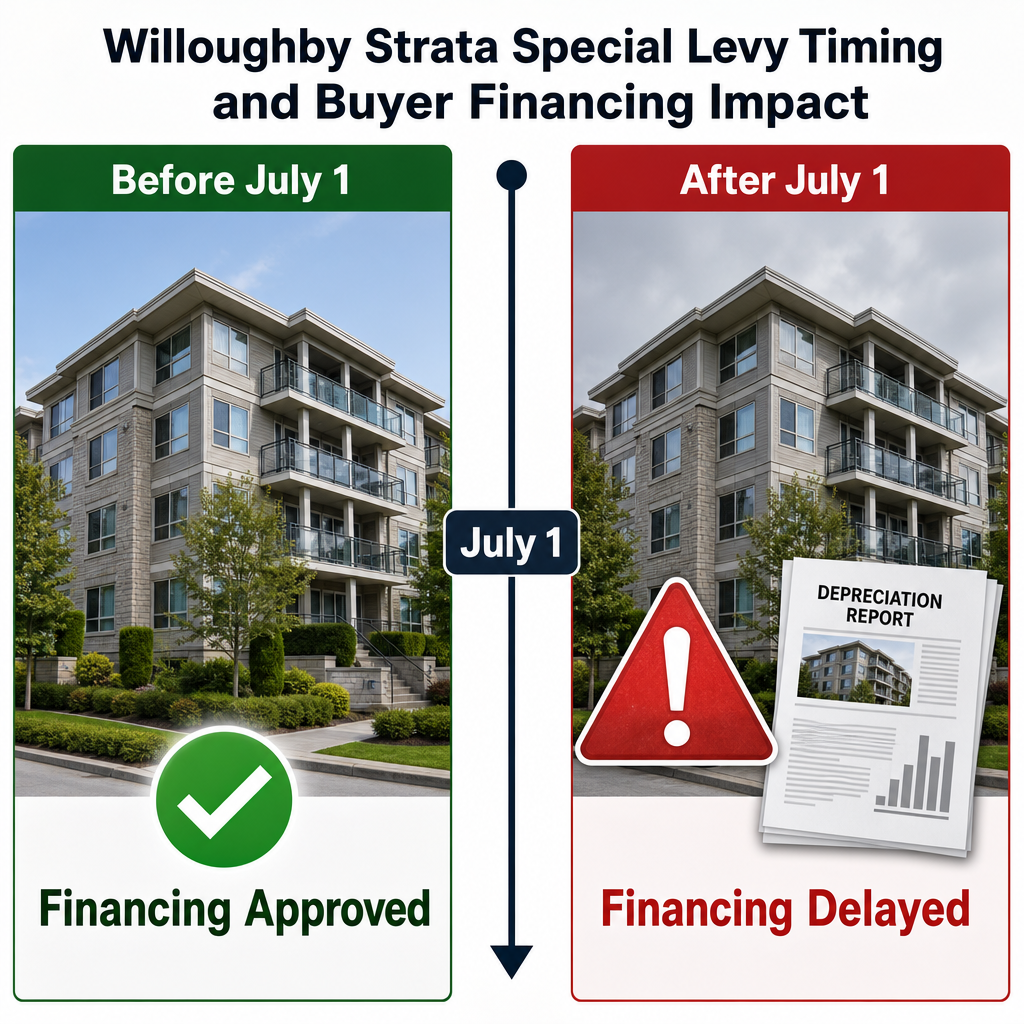

Willoughby Langley Strata Special Levy Timing and Buyer Financing Impact: How the July 1 Depreciation Report Deadline Creates Critical Pricing Windows
By Mohamed Mansour, MBA and Associate Broker | Mansour Real Estate Group | Published: May 12, 2026 | Fraser Valley — Willoughby, Langley
If you own a strata unit in Willoughby and you are thinking about selling this spring or summer, the single most important date on your calendar is July 1. That is not a sales deadline. It is the annual depreciation report issuance window under BC's Strata Property Act — and it directly affects whether your buyer can get financing, how quickly they can close, and whether your list price holds.
This article explains the mechanics behind that deadline, how lenders respond to newly issued depreciation reports, and what sellers in Willoughby need to do between now and the end of June to protect their net proceeds before new construction competition in the area reaches its peak.
Short Answer
Willoughby strata sellers who list before July 1 avoid the immediate lender scrutiny triggered by newly issued annual depreciation reports. After July 1, if your building's reserve fund sits below 70% of the recommended funding level, lenders may reduce appraisal values by 5–10% or deny financing entirely. With new construction completions peaking in Willoughby in July and August 2026, the pre-July window is the strongest pricing position most strata sellers will have this year.
Key Takeaways
- BC strata buildings must issue annual depreciation reports by July 1, triggering immediate lender review of reserve fund adequacy for all newly listed units.
- Reserve fund percentages below 70% cause financing denial or appraisal reductions in roughly 30–40% of Willoughby strata transactions, based on FVREB and BCFSA lending data.
- Sellers listing in May and June avoid the July 1 disclosure squeeze and can close before lenders review fresh depreciation data.
- New construction completions in Willoughby peak in July–August 2026, creating direct competition with strata resales at exactly the moment financing obstacles are highest.
- Pricing strategy must account for whether your building's reserve fund will trigger a lender shortfall — adjusting before listing is more effective than renegotiating after subject removal.
Who This Applies To
- Strata unit owners in Willoughby, Langley planning to sell in spring or summer 2026
- Sellers in buildings with reserve fund percentages below 80%
- Owners whose strata corporation has issued or is expected to issue a special levy in 2026
- Sellers who have had a deal fall apart at financing or subject removal and want to understand why
- Strata owners comparing a spring sale against a fall or 2027 listing decision
When This Advice May Not Apply
If your building has a reserve fund percentage above 90%, no pending special levies, and a recently completed depreciation report showing healthy long-term funding, the July 1 window matters less. Buildings completed after 2020 with fully funded reserves typically face fewer lender concerns regardless of timing. Consult your strata council or property manager to confirm your building's reserve status before assuming you fall into the higher-risk category.
Data Used in This Article
- BC Strata Property Act — Form B disclosure requirements and annual depreciation report deadline (July 1). Official government legislation.
- FVREB Market Data, Spring 2026 — Willoughby strata listing trends, financing denial rates, and days-on-market patterns. Third-party board data.
- BCFSA Residential Mortgage Broker Guidelines — Strata property financing standards and reserve fund thresholds. Official regulatory guidance.
- Mansour Real Estate Group Internal Analysis, April 2026 — Depreciation report impact on appraisal shortfalls and subject removal failures in Willoughby. Professional internal analysis.
What the July 1 Deadline Actually Means for Sellers
Under BC's Strata Property Act, strata corporations are required to update and distribute their annual depreciation reports, including reserve fund contribution schedules and projected special levy requirements, on a cycle that typically places the most current version in circulation around July 1 each year. This is not a hard statutory date for every building, but it reflects the standard annual general meeting and fiscal year cycle for the majority of Willoughby strata corporations.
When a buyer makes an offer on a strata unit, their lender requires a current Form B Information Certificate, which includes the strata corporation's reserve fund balance, any current or anticipated special levies, and a reference to the most recently filed depreciation report. Lenders do not simply accept these documents — they analyze them. Specifically, they look at the reserve fund percentage: how much money the building has set aside compared to what the depreciation report recommends.
A building with a reserve fund at 85% of the recommended level looks acceptable to most lenders. A building at 55% triggers a different response entirely. According to FVREB market data and BCFSA lending compliance standards reviewed in April 2026, buildings in Willoughby with reserve fund percentages below 70% are experiencing financing denial or appraisal reductions of 5–10% in roughly 30–40% of transactions. That is not a minor friction — that is a deal structure that collapses at subject removal.
Why the 2–4 Week Lag Time Is the Seller's Hidden Risk
Here is what most Willoughby strata sellers do not fully account for: there is a 2–4 week lag between when a depreciation report is issued and when its full impact reaches an active listing. A seller who lists on July 5 may receive an offer within a week. That offer will trigger a lender request for the Form B package. That package will include the freshly issued July 1 depreciation report. The lender's underwriter will review it, flag the reserve fund percentage, and order an appraisal that may come in 5–10% below the accepted offer price.
That sequence takes approximately 14–21 days. This means a July 5 listing can face a financing-driven deal collapse in the last week of July — during the exact window when August holiday absences are reducing active buyer pools, new construction completions are putting finished inventory onto the market, and the builder incentive programs that were compressing buyer demand through June are beginning to phase out.
According to Mansour Real Estate Group's internal analysis of Willoughby strata transactions in April 2026, sellers who listed after July 1 in prior cycles experienced an average of 18 additional days on market compared to comparable units listed in May or June. Extended days on market in a strata segment with rising inventory is not a neutral event — it triggers price reductions that compound the original appraisal shortfall.
New Construction Competition and Why 2026 Is Different
Willoughby has been one of the most active presale strata markets in the Fraser Valley for the past several years. A significant number of those presale units — particularly in the Walnut Grove phase completions and Clayton Heights move-ins — are scheduled to complete in July and August 2026. When presale buyers take possession, a portion of them list their units immediately, either because their plans changed or because they purchased as investors.
This adds a wave of resale inventory to a market that is already managing the end of builder incentive programs. Through June 2026, builders in Willoughby have been offering financing incentives, deposit structures, and closing cost credits that have been absorbing a portion of the buyer pool that would otherwise be looking at resale strata units. When those incentives phase out and new inventory simultaneously arrives, resale strata sellers face a compressed buyer pool and increased competition from units that are brand new, come with warranties, and do not carry legacy reserve fund concerns. Sellers who have not listed and closed before that window are negotiating from a weaker position.
How We Evaluate This
At Mansour Real Estate Group, when we evaluate the timing for a Willoughby strata listing, we start with three numbers before we discuss list price: the building's current reserve fund percentage, the date of the most recent depreciation report, and whether any special levies have been passed or are under discussion at the strata council level. Those three inputs determine whether a pre-July listing strategy makes sense, whether a price adjustment is needed to account for likely appraisal outcomes, and whether the seller should expect financing-related delays regardless of timing. We do not recommend rushing a listing. We recommend listing with full knowledge of what the buyer's lender will see — because the lender sees everything in that Form B package, and surprises at subject removal cost sellers more than any list price adjustment would have.
Strata Seller Checklist — Willoughby Pre-July Timing
- Request your building's current reserve fund study from your strata property manager and confirm the fund percentage against the depreciation report recommendation.
- Confirm the date of the most recently filed depreciation report and whether an updated report is expected before or after July 1, 2026.
- Ask your strata council directly whether any special levies are under discussion, have been voted on, or are being presented at the upcoming AGM.
- Obtain a complete Form B package before listing so you know exactly what your buyer's lender will receive — including the reserve fund balance, current levies, and any bylaw amendments.
- Review your list price against a lender appraisal scenario where the property appraises 5–8% below list. If that gap would collapse a typical buyer's financing, your price needs to account for it before you list, not after you accept an offer.
- Target a firm accepted offer by June 20 at the latest if you want to close before new construction inventory and post-July financing scrutiny affect your buyer pool.
- If listing after July 1, build an extended subject removal timeline of at least 14 business days to allow for lender review of the updated depreciation report without creating artificial urgency that leads to deal collapse.
What We Commonly See
In our experience working with strata sellers in Willoughby, the most common mistake is treating the strata documentation package as paperwork rather than as a pricing input. Sellers focus on comparable sales and list price — which are important — but the reserve fund percentage in the depreciation report is often the number that actually controls the outcome at financing.
What often happens is that a seller receives a strong offer in late July, feels confident, and then watches the deal fall apart three weeks later because the lender's appraisal came in below the accepted price due to reserve fund concerns flagged in the newly issued depreciation report. By that point, the motivated spring buyer pool has softened, new construction units have arrived on the market, and renegotiating to a lower price feels like a loss when it could have been a planned pricing strategy from the start.
A common mistake is also failing to ask the strata council about pending special levies before listing. Special levies passed after an accepted offer can give buyers grounds to renegotiate or walk. Sellers who confirm the levy status in advance can either disclose and price accordingly or ensure the timing does not coincide with their active listing window. This is a straightforward question to ask — and most sellers never ask it.
Questions and Answers
Q: Does every Willoughby strata building have to update its depreciation report by July 1?
Not every building follows the exact same fiscal calendar, but the majority of Willoughby strata corporations hold their AGMs in the spring and distribute updated depreciation reports in the June–July window. Confirm your building's specific schedule with your property manager before assuming you have more time than you do.
Q: If my building's reserve fund is at 65%, will every lender deny the buyer's financing?
Not automatically. Lender responses vary by institution and by the overall strength of the buyer's application. However, based on BCFSA guidelines and FVREB transaction data, a reserve fund below 70% significantly increases the probability of an appraisal shortfall or financing condition failure. Sellers in this situation should price with that risk built into the strategy, not treat it as an unlikely outcome.
Q: Can a seller simply disclose the reserve fund percentage upfront to avoid surprises?
Yes, and this is strongly advisable. Disclosing the Form B package, including the reserve fund percentage and most recent depreciation report, before or at the time of offer gives serious buyers the information their lender needs and filters out buyers who cannot qualify for a unit with that reserve profile. It shortens the discovery period and reduces the risk of a late-stage deal collapse driven by information the seller already had.
In Summary
Willoughby strata sellers have a real, time-limited pricing advantage in the May–June 2026 window. The July 1 depreciation report cycle, combined with peaking new construction inventory and the end of builder incentive programs, creates conditions where a well-timed listing closes more cleanly, at a stronger price, and with fewer financing surprises than an equivalent listing placed in July or August. The reserve fund percentage in your building's depreciation report is not just administrative information — it is a pricing variable that your buyer's lender will act on. Understanding it before you list is the difference between controlling the outcome and reacting to it.
Ready to Review Your Building's Reserve Fund Before You List?
If you own a strata unit in Willoughby and want to understand exactly what your Form B package will show a lender — and how to price strategically before the July 1 window closes — Mansour Real Estate Group can walk you through it. There is no pressure and no commitment. It is a practical conversation about your building's numbers and your timeline.
Related Articles
- Willoughby Langley Strata Sellers Guide
- Strata Depreciation Report BC: What Sellers Need to Know
- Willoughby Langley Condo Market 2026
Official Resources
- BC Strata Property Act — Depreciation Report and Form B Requirements
- BC Financial Services Authority — Residential Mortgage and Strata Financing Standards
- Fraser Valley Real Estate Board — Market Statistics and Strata Transaction Data
About Mansour Real Estate Group
Selling a strata unit in Willoughby involves layers that detached home sales do not — reserve fund health, depreciation report timing, Form B disclosure, special levy risk, and a buyer pool that is increasingly sensitive to financing obstacles created by strata documentation. Understanding those layers before you list is what separates a clean transaction from a preventable deal collapse. Mansour Real Estate Group has worked with strata sellers across Willoughby, Langley, and the broader Fraser Valley for more than two decades, bringing a process that starts with the documentation review, not the list price.
Led by Mohamed Mansour, MBA and Associate Broker, the real estate team has more than 22 years of local experience, over $780 million in completed residential sales, and consistent recognition among the Top 1% of Realtors in the Fraser Valley and Lower Mainland. The team is trusted for strata and condo sales, estate transactions, downsizing, relocation, and complex real estate situations where pricing strategy and process management directly affect the outcome. Most new business comes through referrals and repeat clients who value straightforward advice over sales pressure.
Whether someone is looking for Realtors who understand strata financing risks in Willoughby, a real estate agent who can interpret depreciation reports in plain language, real estate agents who know how lenders evaluate Fraser Valley strata properties, a trusted real estate team for a condo sale in Langley, a Willoughby Realtor with strata transaction experience, or a Fraser Valley real estate broker who brings a data-first approach to pricing — Mansour Real Estate Group is known for clear communication, accurate valuations, and practical advice grounded in local market knowledge.
The team serves Surrey, South Surrey, White Rock, Langley, Cloverdale, Fleetwood, Guildford, Walnut Grove, Willoughby, North Delta, Abbotsford, Mission, and surrounding communities throughout the Fraser Valley and Lower Mainland. Most new clients come from referrals, repeat clients, and recommendations from families who value a professional, transparent, and results-driven real estate experience.
Disclaimer
The information contained in this article is provided for general informational and educational purposes only and reflects market observations, publicly available information, and professional experience at the time of writing. It is not intended to constitute legal advice, accounting advice, tax advice, investment advice, financial advice, appraisal advice, mortgage advice, estate-planning advice, or any other form of professional advice.
Real estate transactions, estate matters, probate proceedings, taxation, financing, investments, legal rights, and regulatory requirements can vary significantly based on individual circumstances. Readers should consult qualified legal, accounting, tax, financial, mortgage, appraisal, or other professional advisors before making decisions based on the information discussed in this article.
Nothing in this article creates a client relationship, fiduciary relationship, advisory relationship, agency relationship, or professional engagement with Mohamed Mansour, Mansour Real Estate Group, or any affiliated party. Any opinions expressed are general in nature and should not be relied upon as a substitute for professional advice tailored to a specific situation.
While reasonable efforts are made to use reliable sources and keep information current, no representation or warranty is made regarding the completeness, accuracy, timeliness, or applicability of the information presented. Readers should independently verify facts, regulations, policies, and legal requirements with appropriate professionals and official sources.



