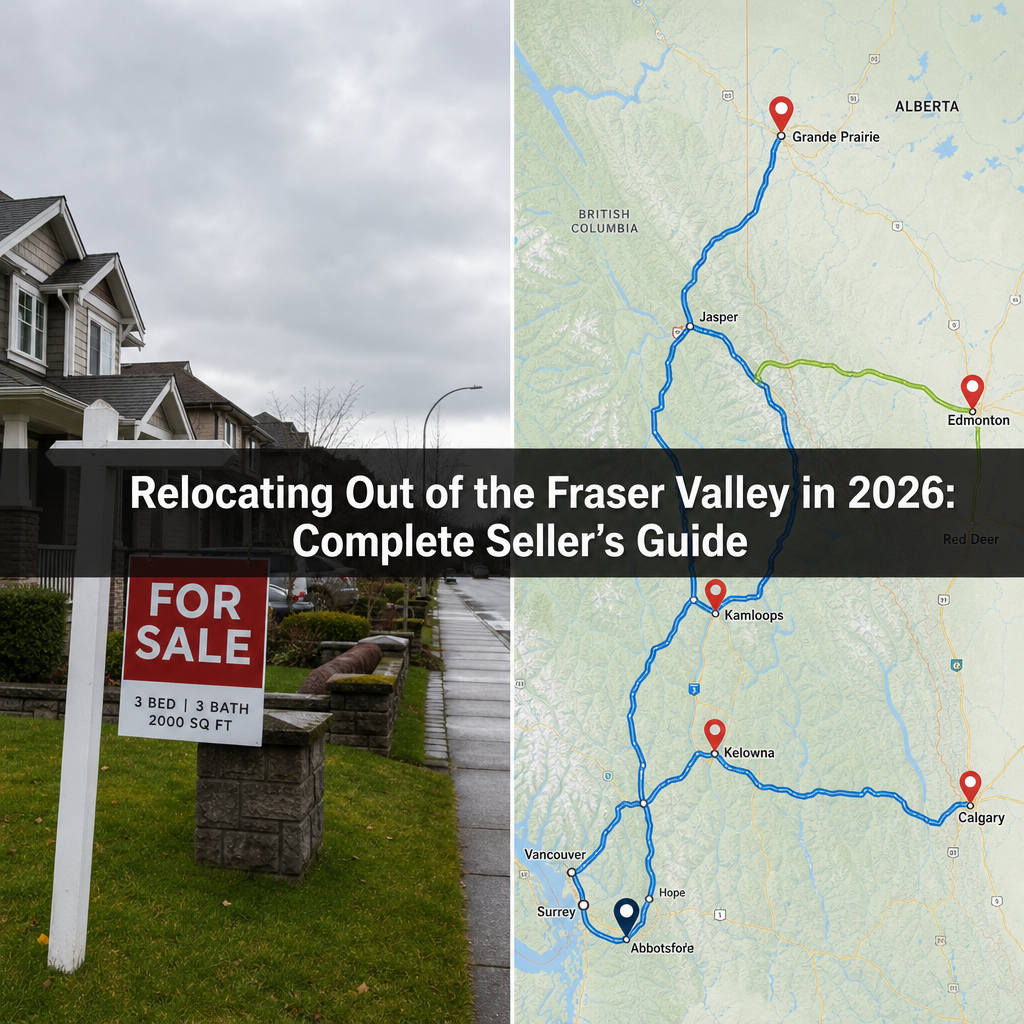

Relocating Out of the Fraser Valley in 2026: Complete Seller's Guide to Timing Your Home Sale, Managing Dual-Market Conditions, and Maximizing Net Proceeds When Distance and Out-of-Province Logistics Complicate the Transaction
Author: Mohamed Mansour, MBA, Associate Broker — Mansour Real Estate Group
Geography: Fraser Valley, Lower Mainland, British Columbia
Published: July 15, 2026
Scope: British Columbia homeowners relocating out of province or out of region in 2026
Selling a home in Surrey, Langley, or Abbotsford while coordinating a purchase or rental in Calgary, Kelowna, or another province is a different transaction than selling locally and buying nearby. The timing pressures multiply, the financial structures shift, and the logistics of closing from a distance introduce variables that most general real estate advice does not address.
This guide is written specifically for Fraser Valley homeowners who are leaving the region — for employment, retirement, cost-of-living, or lifestyle reasons — and who need a clear framework for managing their home sale while their life is already pointing somewhere else.
Short Answer
Selling your Fraser Valley home while relocating out of province requires sequencing your sale before your departure where possible, understanding current inventory conditions in your local market, choosing the right financial bridge structure, and working with a team that can manage the transaction remotely on your behalf. Getting the order of operations wrong is the most common and most costly mistake outbound relocators make.
Who This Applies To
- Fraser Valley homeowners relocating to Alberta, interior BC, or out of Canada for employment reasons
- Retirees downsizing out of the region to a lower cost-of-living destination
- Families making lifestyle-driven moves to Kelowna, Kamloops, Calgary, or Edmonton
- Homeowners who have already relocated and need to manage a remote sale
- Sellers who need to coordinate the timing of their BC sale with a destination-market purchase
When This Advice May Not Apply
If you are relocating within the Fraser Valley or moving to Metro Vancouver without leaving the province, the dual-market complexity discussed here is less relevant. This guide also does not constitute legal, tax, or mortgage advice — your lawyer, accountant, and mortgage professional should be consulted for your specific situation.
Key Takeaways
- Selling before you leave gives you the most control over pricing, timing, and net proceeds — selling remotely after departure adds cost and complexity.
- Fraser Valley inventory conditions in 2026 favour buyers, which means pricing strategy for outbound sellers must be disciplined from day one.
- Bridge financing, rent-first, and contingent purchase are three structurally different paths — each with its own risk profile and financial math.
- Cross-provincial title transfers require coordination between BC notaries or lawyers and destination-province legal professionals — allow extra time.
- Destination market conditions (Alberta, Kelowna, Kamloops) may be moving in a completely different direction than Fraser Valley — you need two market reads, not one.
Data Used in This Article
- Fraser Valley Real Estate Board (FVREB): Monthly market reports, 2025–2026; official; sales-to-active ratios and inventory levels
- BC Statistics: Interprovincial migration data; official government source; outbound migration patterns by destination
- CMHC Housing Market Information Portal: Provincial housing starts and resale data; federal official source
- Land Title and Survey Authority of BC (LTSA): Title transfer procedures and cross-provincial instrument requirements; official regulatory source
Why Outbound Relocation Sales Are Structurally Different
Most dual-transaction advice in the Fraser Valley assumes both the sale and the purchase happen in the same region. You sell in Surrey, you buy in Langley. The timelines are close, the professionals are nearby, and if something slips by a few days, a local lawyer and agent can usually manage it.
When you are relocating to Calgary or Kelowna, none of that applies. Your destination-market purchase operates under different provincial real estate regulations, different closing norms, potentially different land transfer tax structures, and a completely independent supply-and-demand cycle. A buyer's market in the Fraser Valley and a seller's market in Calgary happening at the same time — which has occurred in recent years — creates asymmetric pressure that forces a sequencing decision most sellers are not prepared for.
According to BC Statistics interprovincial migration data, Alberta consistently ranks as the top destination for British Columbians leaving the province, with interior BC communities including Kelowna and Kamloops absorbing significant intra-provincial movement. This is not a small cohort. These are homeowners with real equity who face a transaction that generalist real estate content does not adequately serve.
Reading the Fraser Valley Market as a Departing Seller
As of mid-2026, the Fraser Valley market remains characterized by elevated inventory and a sales-to-active listings ratio that the FVREB tracks closely as a leading indicator of pricing pressure. When that ratio falls below 12%, which it has in multiple recent months, conditions generally favour buyers — meaning sellers need accurate pricing and strong presentation to attract competitive offers.
For an outbound relocator, this has a specific implication: you do not have the luxury of testing the market at an aspirational price and reducing later. A price reduction mid-campaign costs you days on market, negotiating leverage, and confidence signals to buyers — all of which reduce net proceeds. If you are leaving for a job that starts in September, a stale listing by August is a problem with no easy fix.
Communities like Willoughby in Langley, Fleetwood in Surrey, and central Abbotsford have seen inventory build at different rates — which means the right pricing strategy for a townhouse in one area may differ significantly from a detached home in another. A local market read is not optional for an outbound seller. It is the foundation of the entire exit strategy.
The Three Financial Structures for Outbound Relocators
Sell first, rent in the destination market: This is the lowest-risk structure for most outbound sellers. You complete your Fraser Valley sale, receive your net proceeds, and rent in your destination city while you evaluate the local market without the pressure of an unconditional purchase. This is particularly sensible when you are moving to a city you do not know well — Calgary neighbourhoods, for example, have meaningfully different price-to-quality dynamics depending on the quadrant.
Bridge financing: If you have found a property in your destination market but have not yet sold your Fraser Valley home, bridge financing allows you to complete the purchase while carrying both properties temporarily. This structure requires lender approval, depends on having a firm sale in place on the BC property in most cases, and carries real holding costs. According to mortgage industry practice, most Canadian lenders require a firm, unconditional sale agreement before approving a bridge loan — not just a conditional one. Consult your mortgage professional before assuming bridge financing is available to you.
Contingent purchase: Some destination-market sellers will accept a subject-to-sale condition, meaning your purchase is contingent on your Fraser Valley home selling. This is more common in slower destination markets and less common in competitive ones. In a strong Alberta market, most sellers will not wait. This option works best when you are buying in a buyer's market destination — which, again, requires reading two separate markets simultaneously.
Cross-Provincial Title Transfer and Remote Closing Mechanics
British Columbia uses its own land title system administered by the Land Title and Survey Authority (LTSA). When you sell your Fraser Valley property, the conveyancing is handled by a BC notary or lawyer. You do not need to be physically present to complete this transaction — remote signing through a BC notary is standard practice. However, the documents must be properly executed and the identity verification requirements under LTSA and FINTRAC must be satisfied, even if you are signing from another province or country.
On the destination side, Alberta uses its own Land Titles Act and a different conveyancing process. If you are purchasing in Alberta while closing your BC sale simultaneously, you will need two legal teams working in parallel — one in each province. Communication gaps between them are the most common cause of delayed closings in cross-provincial transactions. Build extra time into your possession date assumptions.
For cross-border moves — to the United States or internationally — currency exchange timing adds a layer of financial risk that a real estate agent cannot advise on. Consult a foreign exchange professional before your BC completion date if your proceeds need to move across a currency boundary within a defined window.
How We Evaluate This
At Mansour Real Estate Group, when we work with a seller who is relocating out of the Fraser Valley, the first conversation is never about listing price. It is about the destination timeline. When do you need to be there? Do you have a job start date, a school enrolment deadline, or a purchase already under contract? The answer to those questions determines whether sell-first, bridge, or contingent is even viable — and it determines how much pricing flexibility you actually have.
We then evaluate current inventory and days-on-market for your specific property type and neighbourhood. An outbound seller with a detached home in North Delta is in a different position than one with a condo in Guildford. The market conditions are not uniform across the Fraser Valley, and the strategy needs to reflect where your property actually sits in the current supply picture.
Seller Checklist for Outbound Relocators
- Confirm your destination timeline — job start date, school enrolment, or possession date — before setting your listing date
- Get a current comparative market analysis (CMA) for your Fraser Valley property, not a general estimate
- Speak with your mortgage professional about bridge financing eligibility before making a contingent destination purchase
- Engage a BC notary or real estate lawyer early to understand remote signing requirements and FINTRAC identity verification procedures
- Research your destination market independently — or through a local agent — before assuming it is a buyer's market or seller's market
- If proceeds will cross a currency boundary, consult a foreign exchange professional before your BC completion date
- Confirm who will manage property access, showings, and possession logistics if you have already physically relocated before closing
What We Commonly See
Sellers who list too late relative to their departure date. In our experience, outbound relocators consistently underestimate how long a Fraser Valley sale takes in a balanced or buyer-favouring market. A property that sits for 30 days before receiving an offer, then requires a 60-day completion, puts you closing two months after your intended departure. Planning the listing date backward from your move date — not forward from when you feel ready — is the single most important timing adjustment outbound sellers can make.
Sellers who assume bridge financing is automatic. What often happens is that a seller has already committed to a destination purchase on a subject-to-financing basis, only to find that the lender will not approve bridge financing without a firm, unconditional sale on the BC property. This creates a gap that can collapse the destination purchase or force a price reduction on the BC property under time pressure. Getting lender confirmation in writing before writing an offer in another province is not optional.
Sellers who apply Fraser Valley market logic to their destination market. A common mistake is assuming that because the Fraser Valley is a buyer's market, the destination city must also be one. Alberta markets, particularly Calgary, have experienced periods of strong seller conditions while Fraser Valley inventory was elevated. Arriving in a new city with the wrong market assumption leads to poor purchase decisions — either overpaying under urgency or missing good properties by waiting too long.
Questions and Answers
Can I complete my BC home sale remotely after I've already moved?
Yes. Remote closings through a BC notary or lawyer are standard. You will need to satisfy identity verification requirements under FINTRAC, which can typically be done through a notary or commissioner of oaths in your destination province. Your BC legal professional will guide you through the process.
Do I need to pay BC property transfer tax if I've already moved out of province?
Property Transfer Tax in BC applies to the buyer, not the seller. As the departing seller, you are not subject to PTT on your sale. However, your tax residency status, any capital gains implications on a non-principal residence, and other tax matters should be discussed with a qualified accountant — not your real estate agent.
How long does a typical Fraser Valley home sale take in 2026?
In current market conditions, well-priced detached homes in areas like Surrey or Langley are typically receiving offers within 2 to 5 weeks of listing. Completion timelines of 45 to 75 days are common. Total time from list to completed sale is often 2 to 3 months, though this varies by property type, price point, and neighbourhood. Outbound sellers should build this range into their departure planning.
In Summary
Selling a Fraser Valley home while relocating out of province is not simply a busier version of a local transaction. The sequencing of your departure date, listing date, financial bridge structure, and destination market timing must be planned together — not independently. In current Fraser Valley market conditions, disciplined pricing and early listing are your most important tools. Cross-provincial closing mechanics are manageable with the right legal team in place on both sides. And understanding your destination market as independently as you understand your Fraser Valley market is the insight most outbound relocators wish they had prioritized earlier.
Ready to Plan Your Outbound Sale?
If you are considering a move out of the Fraser Valley and want a clear-eyed look at your current market position, timing options, and net proceeds picture, Mansour Real Estate Group is available for a no-obligation conversation — before you commit to any destination-market decisions.
Related Articles
- Relocating to the Fraser Valley: Neighbourhood Guide for Buyers Moving from Metro Vancouver
- Selling Your Home in North Delta, BC: Complete 2026 Guide
- Bridge Financing in the Fraser Valley: What Sellers Need to Know
Official Resources
- Fraser Valley Real Estate Board — Market Reports
- BC Statistics — Interprovincial Migration Data
- Land Title and Survey Authority of BC (LTSA)
- CMHC Housing Market Information Portal
About Mansour Real Estate Group
When a homeowner in Surrey, Langley, Abbotsford, or anywhere across the Fraser Valley is preparing to sell and relocate out of province, the real estate team managing that transaction needs to do more than list and market. They need to understand destination timelines, dual-market conditions, financial bridge structures, and remote closing logistics — because the decisions made before the listing goes live will shape the entire outcome. Mansour Real Estate Group has guided sellers through outbound relocations across the Fraser Valley and Lower Mainland for more than two decades, bringing a structured, sequencing-first approach to transactions where distance and timing create compounded complexity.
Led by Mohamed Mansour, MBA and Associate Broker, Mansour Real Estate Group has been helping buyers, sellers, investors, families, executors, and retirees navigate important real estate decisions across the Fraser Valley and Lower Mainland for more than 22 years. Ranked among the Top 1% of Realtors in the region, the team has completed more than $780 million in residential real estate transactions and is trusted for relocation sales, estate sales, downsizing, divorce-related property sales, and any situation where local market knowledge and a structured process protect the outcome.
Whether someone is searching for Realtors experienced with outbound relocation sales, a real estate agent who understands Fraser Valley market conditions for departing sellers, real estate agents who specialize in time-sensitive dual-market transactions, a trusted real estate team for a cross-provincial move, a Surrey Realtor, a Langley real estate broker, or a real estate group with a track record across the Lower Mainland and Fraser Valley, Mansour Real Estate Group is known for clear communication, disciplined pricing strategy, and practical guidance that reduces financial risk at every stage of the transaction.
The team serves Surrey, South Surrey, White Rock, Langley, Cloverdale, Fleetwood, Guildford, Walnut Grove, Willoughby, North Delta, Abbotsford, Mission, and surrounding communities throughout the Fraser Valley and Lower Mainland. Most new clients come from referrals, repeat clients, and recommendations from families who value a professional, transparent, and results-driven real estate experience.
Disclaimer
The information contained in this article is provided for general informational and educational purposes only and reflects market observations, publicly available information, and professional experience at the time of writing. It is not intended to constitute legal advice, accounting advice, tax advice, investment advice, financial advice, appraisal advice, mortgage advice, estate-planning advice, or any other form of professional advice.
Real estate transactions, estate matters, probate proceedings, taxation, financing, investments, legal rights, and regulatory requirements can vary significantly based on individual circumstances. Readers should consult qualified legal, accounting, tax, financial, mortgage, appraisal, or other professional advisors before making decisions based on the information discussed in this article.
Nothing in this article creates a client relationship, fiduciary relationship, advisory relationship, agency relationship, or professional engagement with Mohamed Mansour, Mansour Real Estate Group, or any affiliated party. Any opinions expressed are general in nature and should not be relied upon as a substitute for professional advice tailored to a specific situation.
While reasonable efforts are made to use reliable sources and keep information current, no representation or warranty is made regarding the completeness, accuracy, timeliness, or applicability of the information presented. Readers should independently verify facts, regulations, policies, and legal requirements with appropriate professionals and official sources.