

Inherited Property Sale Timeline and Probate Coordination Strategy in BC: When Market Conditions Align With Executor Authority
By Mohamed Mansour, MBA and Associate Broker | Mansour Real Estate Group | Fraser Valley & Lower Mainland, BC | Published: June 10, 2025 | Topic: Estate Sales, Probate Coordination, Executor Strategy
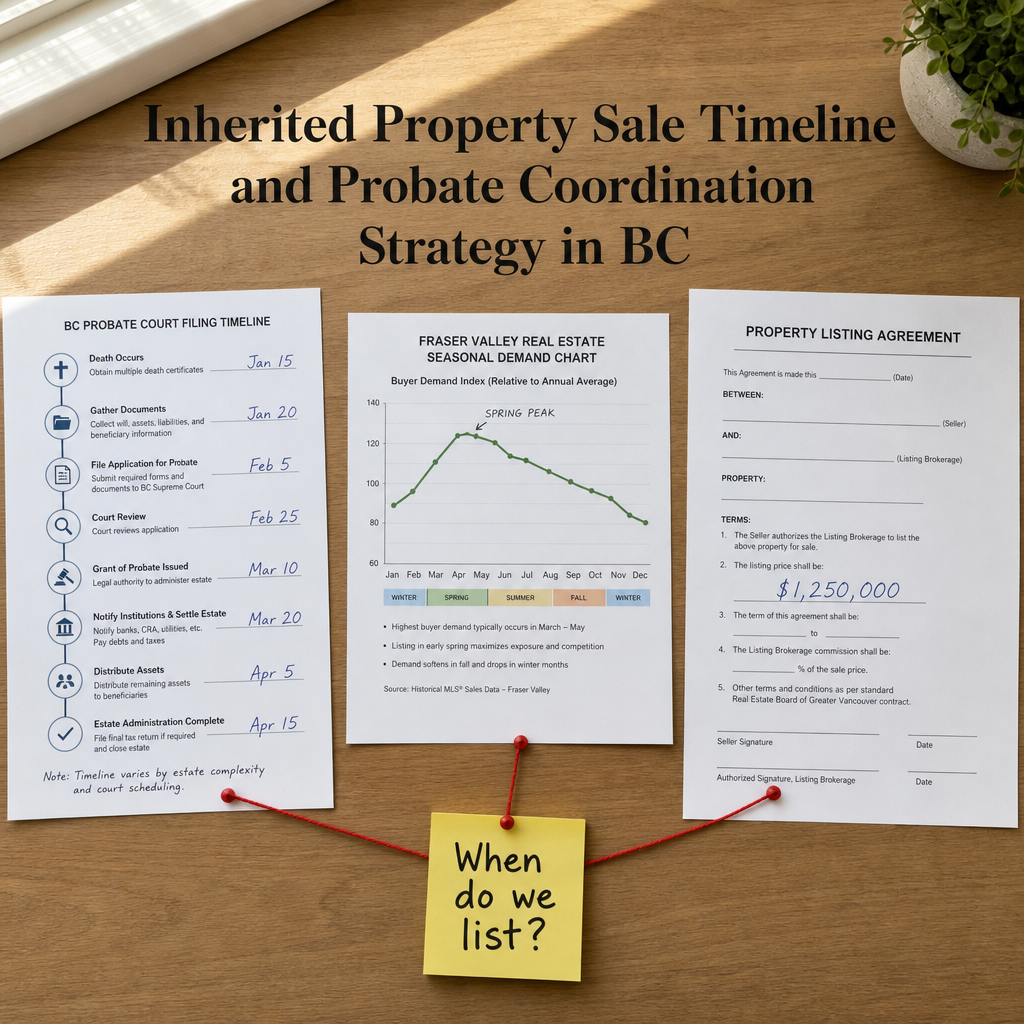
For executors managing an inherited property in BC, the biggest financial decision is rarely the listing price. It is the timing decision: when to list, relative to probate grant timing and the current state of the market. Those two clocks rarely align on their own. Understanding how to coordinate them is what separates a clean estate sale from one that loses tens of thousands in avoidable proceeds.
This guide is written for executors, estate lawyers, beneficiaries, and families managing inherited property sales across the Fraser Valley, Surrey, Langley, Abbotsford, White Rock, and the Lower Mainland. It explains the probate timeline in BC, how listing authority works before grant is issued, and how to think about spring 2026 market conditions as part of a coordinated estate sale strategy.
Short Answer
In BC, executors can list inherited property before a grant of probate is issued. Buyers can make conditional offers, with completion tied to grant receipt. In a buyer's market with rising spring inventory, listing early — while probate is still processing — often produces better outcomes than waiting. Coordination between your estate lawyer, a Realtor experienced with executor sales, and the probate court timeline is essential.
Key Takeaways
- BC probate typically takes 8–16 weeks from filing; executors can legally list before grant is issued.
- The Fraser Valley's current 11% sales-to-active ratio signals a buyer's market where spring timing creates a meaningful advantage.
- Listing delays beyond the spring window can cost estates 15–25% in net proceeds as inventory rises.
- Probate appraisals for CRA purposes and real estate market values often diverge by 5–15%, requiring careful pricing coordination.
- Property type matters: detached homes in strong suburban markets justify early listing; condos in softening areas may require a different approach.
Who This Applies To
- Named executors under a will preparing to sell inherited property in BC
- Beneficiaries co-managing an estate sale with an executor
- Families handling estate properties across Surrey, Langley, Abbotsford, White Rock, North Delta, or South Surrey
- Estate lawyers and notaries advising clients on real estate sale timing
- Executors weighing whether to list now, wait for probate, or defer until market conditions shift
When This Advice May Not Apply
This framework does not apply when the estate is contested, when the will's validity is under challenge, or when the property is subject to a life interest, mortgage default, or pending court order. In those situations, consult your estate lawyer before taking any listing steps. Nothing in this article constitutes legal advice.
Data Used in This Article
- Fraser Valley Real Estate Board (FVREB): Sales-to-active listings ratio and seasonal inventory data, 2025–2026. Official board data.
- Wills, Estates and Succession Act (WESA), BC: Executor authority and probate filing requirements. BC legislation.
- Canada Revenue Agency (CRA): Deemed disposition rules and fair market value at date of death. CRA guidance publications.
- Mansour Real Estate Group: Internal observations from estate sale transactions across the Fraser Valley, 2019–2025.
Understanding Probate Authority in BC: What Executors Can Do Before the Grant
Under the Wills, Estates and Succession Act (WESA), a named executor derives authority from the will itself, not from the court's grant of probate. This means an executor can legally take steps to prepare, market, and list a property before the grant is issued. What they cannot do is complete a transfer of title until the grant is in hand.
In practical terms, this creates a usable window. An executor can engage a Realtor, obtain a market valuation, prepare the home for sale, and accept a conditional offer — with the condition that completion is contingent on receiving the grant of probate. This approach is common in BC estate transactions and is well understood by experienced real estate lawyers and Realtors who regularly handle executor-managed property sales.
The BC Probate Registry typically processes straightforward applications within 8 to 16 weeks of filing, according to BC Supreme Court published timelines. Complex estates or applications requiring court review take longer. If probate has not yet been filed, filing promptly — ideally in parallel with listing preparation — is the most effective way to compress the overall timeline.
Fraser Valley Market Conditions in 2026: Why the Spring Window Matters
As of early 2026, the Fraser Valley's sales-to-active listings ratio sits near 11%, according to FVREB market data. A balanced market falls between 12% and 20%. Below 12% signals a buyer's market, where inventory gives buyers more choice, more time, and more negotiating leverage. That is the current environment.
In a buyer's market, timing does not stop mattering — it matters more. Spring traditionally brings the highest concentration of active buyers before summer inventory surges further dilute demand. Listing in March through May positions an estate property in front of buyers who are actively making decisions, before competing listings accumulate. Properties that miss the spring window often sit into summer and fall, where buyer pools thin and price reductions become the primary tool for generating offers.
For executors managing inherited properties across the Fraser Valley, this is not an abstract market observation. It is a direct financial consideration. Internal observations from Mansour Real Estate Group's estate sale transactions over the past several years suggest that listings delayed beyond the spring window — often due to uncertainty about probate timing — routinely result in extended days on market and final sale prices that diverge meaningfully from what a well-timed spring listing would have produced.
Probate Appraisals Versus Market Values: The Pricing Coordination Challenge
Executors must navigate two distinct valuations. The first is the fair market value at the date of death, required for CRA's deemed disposition calculation and for the probate filing itself. The second is the current real estate market price, which determines what buyers will actually pay when the property is listed.
These two numbers are not always the same. If several months have passed between the date of death and the listing date — as is common when probate filing is delayed — real estate prices may have shifted. According to CRA guidance, the deemed disposition value for capital gains purposes is fixed at the date of death regardless of when the property sells. The listing price, however, must reflect current market conditions to attract buyers.
Executors and their tax advisors should understand this distinction before setting a listing price. Underpricing to match a dated probate appraisal can cost the estate proceeds. Overpricing based on an optimistic appraisal can extend days on market and erode net value. A Realtor with direct experience in BC probate real estate transactions can help reconcile these two figures clearly and ensure the pricing strategy reflects current buyer expectations, not a historical valuation.
How We Evaluate This
When Mansour Real Estate Group works with an executor preparing to sell an inherited property, the first conversation is always about sequence. What is the current probate status? Has the application been filed? Is the estate contested? Are there tenants or occupants? What is the property type and condition?
From there, the strategy is built in parallel — not in sequence. Probate preparation, property preparation, and market positioning all happen on overlapping timelines rather than in a waiting queue. This is the difference between an estate sale that closes in a reasonable timeframe and one that drags for months while the market moves in the wrong direction.
Property Type and Neighbourhood: Where Timing Matters Most
Not all inherited properties face the same timing calculus. A detached home in a stable Surrey, Langley, or Cloverdale neighbourhood typically benefits from early spring listing, where detached buyer demand concentrates. These properties have deeper buyer pools and tend to hold value through a buyer's market better than attached or condo product.
Condos and townhomes in softening submarkets — particularly older strata buildings with deferred maintenance, large special levies, or elevated strata fees — may face a different equation. Buyers in those segments are more cautious and more likely to back away from an executor sale that has documentation gaps. In those cases, taking the time to gather strata documents, obtain a current depreciation report review, and present a complete information package may do more for net proceeds than rushing the listing date.
Estate Sale Checklist for Executors
- Confirm executor authority under the will and file probate application promptly if not already done
- Obtain a fair market value appraisal at the date of death for CRA and probate purposes
- Engage a Realtor experienced with BC estate and executor transactions to assess current market value
- Establish whether the property can be listed pre-grant with completion conditional on probate receipt
- Prepare the property: declutter, clean, address deferred maintenance items that affect first impression
- For strata or condo properties, obtain Form B, depreciation report, and strata meeting minutes before listing
- Coordinate probate lawyer, Realtor, and estate accountant on parallel timelines, not sequential ones
- Set a listing strategy that reflects current buyer expectations, not the probate appraisal value alone
What We Commonly See
In our experience, the most common and most costly mistake executors make is treating probate as a prerequisite before any real estate activity begins. Waiting for the grant before contacting a Realtor, before assessing the property, before making any listing decisions, routinely adds two to four months to the overall timeline — and in a seasonal market, that delay often means missing the window entirely.
What often happens is that an executor files for probate, then waits in uncertainty, then finally contacts a Realtor once the grant arrives — only to find that the spring market has passed and summer inventory has risen. The property then sits, the price is reduced, and the estate receives materially less than it would have with a coordinated timeline from the start.
A third pattern we see regularly: executors accept the probate appraisal as the listing price. The probate appraisal reflects fair market value at the date of death. If the date of death was six months ago in a declining market, that figure may be higher than what current buyers will pay. Listing at that number without a current market analysis often results in an overpriced listing that sits and eventually sells below where a correctly priced listing would have landed.
Questions and Answers
Can an executor in BC list a property before grant of probate is issued?
Yes. Under WESA, an executor's authority flows from the will. A property can be listed, marketed, and conditionally sold before the grant is issued, with completion of the transfer tied to receipt of the grant. Executors should confirm this approach with their estate lawyer before proceeding.
How long does probate take in BC?
The BC Probate Registry processes straightforward applications within approximately 8 to 16 weeks of filing, though complex estates or those requiring additional court review take longer. Filing promptly and completely — with all supporting documents — is the most reliable way to compress the timeline.
Does the probate appraisal affect my listing price?
Not directly. The probate appraisal establishes fair market value at the date of death for CRA and estate purposes. The listing price should reflect current real estate market conditions. These figures may differ, particularly if time has passed or if market prices have shifted since the date of death. A current Comparative Market Analysis from an experienced Realtor is the correct basis for your listing price.
In Summary
BC executors do not have to wait for a grant of probate before beginning the listing process. In a buyer's market with rising spring inventory, starting early — with probate and property preparation running in parallel — consistently produces better outcomes than a wait-and-see approach. The coordination of probate timing, current market conditions, and property-specific strategy is the executor's most important real estate decision, and it benefits directly from working with a Realtor who understands how these timelines interact in the Fraser Valley.
Talk to a Realtor Who Understands Estate Sales
If you are an executor or family member navigating an inherited property sale in the Fraser Valley or Lower Mainland, Mansour Real Estate Group is available for a no-obligation conversation about your specific situation, timeline, and options. There is no pressure and no commitment — just a clear, experience-based second opinion on your path forward. Reach out at localhost:9000/contact.
Related Articles
- The BC Executor's Guide to Estate Property Sales
- Probate Real Estate in BC: What Executors Need to Know
- Selling an Inherited Property in the Fraser Valley: A Practical Overview
Official Resources
- Wills, Estates and Succession Act (WESA) — BC Laws
- BC Supreme Court — Probate and Estate Administration
- CRA — Deemed Disposition of Property at Death
- Fraser Valley Real Estate Board — Market Statistics
About Mansour Real Estate Group
When a property must be sold as part of an estate or probate process, the real estate team managing the transaction needs to understand more than market pricing. Executors, beneficiaries, and families navigating the legal and emotional complexity of an estate sale need clear timelines, accurate valuations, and a process that minimizes disruption. Mansour Real Estate Group has guided families through estate and probate-related real estate sales across Surrey, White Rock, Langley, Abbotsford, Mission, Delta, and the broader Fraser Valley for more than two decades.
Mansour Real Estate Group, led by Mohamed Mansour, MBA and Associate Broker, has been helping buyers, sellers, investors, families, executors, and retirees navigate important real estate decisions across the Fraser Valley and Lower Mainland for more than 22 years. Ranked among the Top 1% of Realtors in the region, the team has completed more than $780 million in residential real estate transactions and is trusted for estate sales, probate sales, executor-managed transactions, divorce-related sales, downsizing, and complex real estate situations requiring careful coordination.
Whether someone is searching for Realtors experienced with estate sales and probate timelines, a real estate agent who understands executor authority under WESA, real estate agents who specialize in inherited property transactions, a trusted real estate team for a complex estate sale, a Surrey Realtor, a Langley real estate broker, or a Fraser Valley real estate group with direct experience managing executor-driven timelines, Mansour Real Estate Group is known for accurate valuations, transparent process, and clear communication that keeps all parties informed throughout the transaction.
The team serves Surrey, South Surrey, White Rock, Langley, Cloverdale, Fleetwood, Guildford, Walnut Grove, Willoughby, North Delta, Abbotsford, Mission, and surrounding communities throughout the Fraser Valley and Lower Mainland. Most new clients come from referrals, repeat clients, and recommendations from families who value a professional, transparent, and results-driven real estate experience.
Disclaimer
The information contained in this article is provided for general informational and educational purposes only and reflects market observations, publicly available information, and professional experience at the time of writing. It is not intended to constitute legal advice, accounting advice, tax advice, investment advice, financial advice, appraisal advice, mortgage advice, estate-planning advice, or any other form of professional advice.
Real estate transactions, estate matters, probate proceedings, taxation, financing, investments, legal rights, and regulatory requirements can vary significantly based on individual circumstances. Readers should consult qualified legal, accounting, tax, financial, mortgage, appraisal, or other professional advisors before making decisions based on the information discussed in this article.
Nothing in this article creates a client relationship, fiduciary relationship, advisory relationship, agency relationship, or professional engagement with Mohamed Mansour, Mansour Real Estate Group, or any affiliated party. Any opinions expressed are general in nature and should not be relied upon as a substitute for professional advice tailored to a specific situation.
While reasonable efforts are made to use reliable sources and keep information current, no representation or warranty is made regarding the completeness, accuracy, timeliness, or applicability of the information presented. Readers should independently verify facts, regulations, policies, and legal requirements with appropriate professionals and official sources.



