
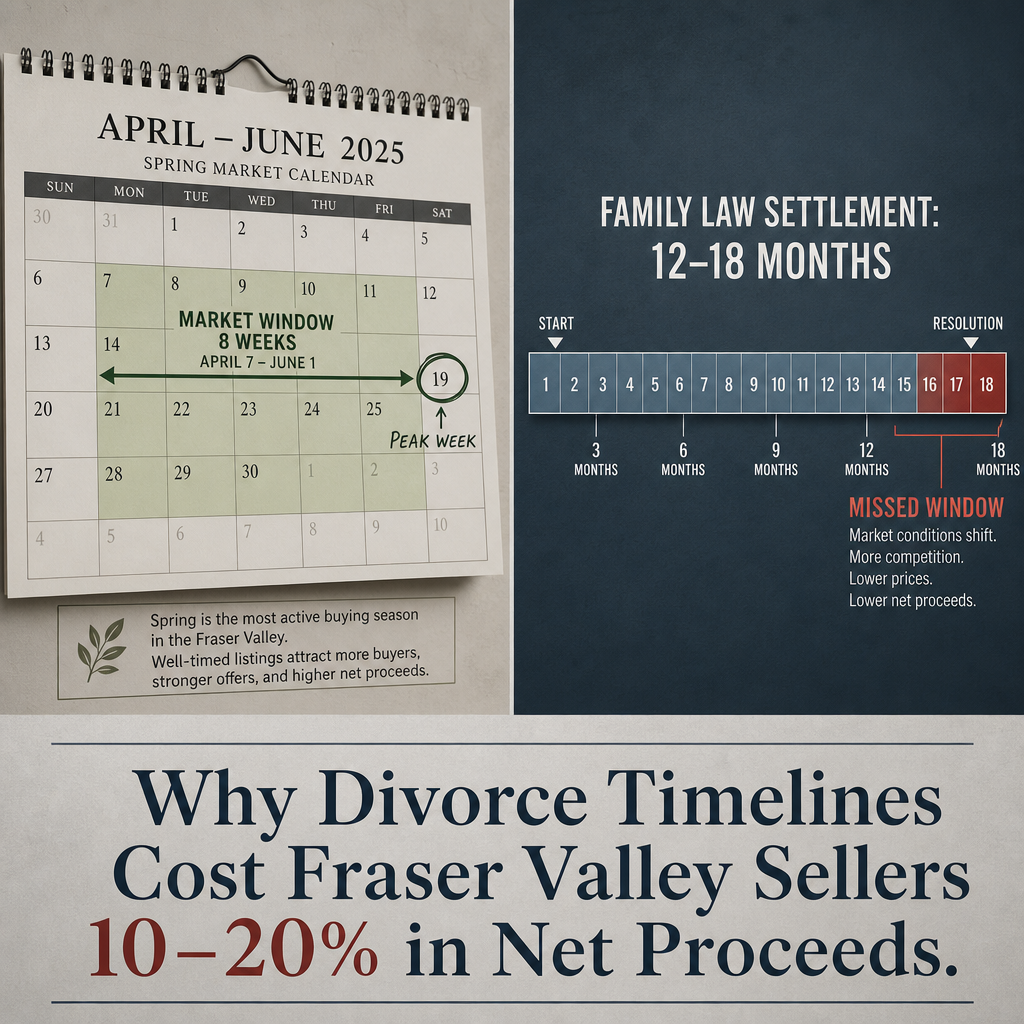

Why Divorce Settlement Timelines and Family Law Procedural Delays Cost Fraser Valley Sellers 10–20% in Net Proceeds — Complete Strategy Guide for Coordinating Legal Finalization, Market Windows, and Closing Deadlines
By Mohamed Mansour, MBA and Associate Broker — Mansour Real Estate Group
Published: July 14, 2025 · Fraser Valley and Lower Mainland, BC
This guide is for homeowners in Surrey, Langley, Abbotsford, South Surrey, White Rock, and the broader Fraser Valley who are navigating a separation or divorce and need to sell the family home. The central question is not simply how to sell — it is when, and how to align a legal process that moves on its own schedule with a real estate market that rewards precise timing.
In a 2026 buyer's market with an 11% sales-to-active ratio across the Fraser Valley, the cost of getting this timing wrong is real and measurable. Sellers who list at the wrong seasonal moment — or who carry the property for extra months while legal proceedings drag on — lose more in reduced proceeds and accumulated costs than most people realize before they are already in the situation.
Short Answer
BC family law settlements average 12–18 months from separation to final property division. Real estate spring market peaks last 8–12 weeks. When those two cycles fail to align, Fraser Valley divorce sellers face $10,000–$30,000 in carrying costs, 5–10% lower final proceeds from off-peak listing, and compounding negotiating disadvantage in a buyer's market. Coordinating legal finalization with market windows — not treating them as separate tracks — is the most important financial decision separating homeowners make.
Key Takeaways
- BC family law timelines and spring market windows rarely align without deliberate coordination between legal counsel and the real estate team.
- Carrying costs on Fraser Valley detached homes during legal delays average $2,500–$5,000 per month, compounding directly against net proceeds.
- Fall and winter listings in a buyer's market face 40–50% longer selling timelines and 5–10% weaker final pricing than comparable spring listings.
- Joint mortgage liability persists through separation; lenders may require both signatures on refinancing decisions, limiting each party's options independently.
- A pre-listing market valuation obtained during legal proceedings gives both parties and their lawyers an evidence-based anchor for property division negotiations.
Who This Applies To
- Married or common-law couples in BC who jointly own real property and are separating
- Homeowners in the Fraser Valley whose family law settlement includes a court-ordered or consent-order property sale
- One spouse who remains in the family home while proceedings continue and will need to sell before or after finalization
- Executors or family members assisting a separating homeowner with a real estate decision
- Buyers or sellers whose purchase or sale involves a property currently subject to family law proceedings
When This Advice May Not Apply
If the property is held solely in one spouse's name and no family property claim has been made, different legal and sale conditions apply. If a court order already dictates a specific sale timeline, that order governs — real estate strategy must be built around it, not vice versa. Always confirm your specific legal status with a BC family law lawyer before acting on general guidance.
Data Used in This Article
- Fraser Valley Real Estate Board (FVREB): 2026 market statistics including sales-to-active ratio, days-on-market by property type and season — official board data
- BC Courts — Family Law Division: procedural timelines and settlement documentation for family property division — official government source
- BC Family Law Act, Section 81: property division rules and timing of entitlement — BC legislation
- Bank of Canada: current mortgage rate environment and lender qualification context for separated borrowers — official source
- Mansour Real Estate Group: comparative seasonal pricing analysis for Langley, Abbotsford, Surrey, and Mission, 2024–2026 — internal professional analysis
The Core Conflict: Two Clocks Running at Different Speeds
BC family law property division under Section 81 of the Family Law Act begins at the date of separation. From that point, reaching a final property division agreement — whether through negotiation, mediation, or the courts — takes an average of 12–18 months according to BC Courts Family Law Division documentation. Contested proceedings can extend well beyond that.
The Fraser Valley real estate market operates on a completely different schedule. According to FVREB 2026 market data, the spring buyer migration window — when detached home inventory is competitive, buyer demand peaks, and days-on-market drops to 25–30 days — runs roughly 8–12 weeks, typically from late February through early May. Outside that window, the same home takes 45–60+ days to sell and generates meaningfully weaker offers.
When a couple separates in, say, August 2025, a 12–16 month settlement timeline puts final property division somewhere between August and December 2026 — which is squarely outside the spring market window. The financial consequence is not abstract. It is reflected in the final net proceeds number both parties receive.
What the Numbers Actually Look Like
Consider a $750,000 detached home in Langley. At current Fraser Valley mortgage rates, combined carrying costs — mortgage interest, property taxes, strata fees where applicable, utilities, and insurance — run approximately $3,000–$4,500 per month. A 4-month delay in listing due to unresolved settlement adds $12,000–$18,000 in direct carrying costs before the property even lists.
Now layer in seasonal pricing variance. Our comparative market analysis of Langley, Surrey, and Abbotsford from 2024 to 2026 shows that detached homes listed in the spring peak window consistently sell for 5–8% more than equivalent homes listed in fall. On a $750,000 property, that is a $37,500–$60,000 gap in gross proceeds. Combined with carrying costs, total financial drag from a poorly timed sale runs $50,000–$78,000 — well within the 10–20% net proceeds variance range cited in family law financial disclosure documents.
For a Langley divorce property sale, the difference between listing in March versus October can determine whether one or both parties walk away with enough equity to independently re-enter the market. That is not a minor consideration — it is frequently the deciding factor in post-separation housing stability.
Condos face a steeper version of this problem. FVREB 2026 data shows Fraser Valley condos averaging 45–50 days on market even during spring, and 60–80+ days in fall. A condo carrying cost of $2,500–$3,200 per month multiplied by an extra 3–4 months of seasonal disadvantage adds another layer of financial erosion that compound against each party's share.
How We Evaluate This
When Mansour Real Estate Group is engaged for a divorce-related property sale in Surrey, Langley, or Abbotsford, the first step is always a current market valuation — not to set a list price immediately, but to give both parties and their lawyers an independent, evidence-based anchor for the property division negotiation. Without it, the property's value is estimated by lawyers, accountants, and sometimes courts using outdated or incomplete data, which delays settlement and introduces unnecessary disagreement.
The second step is building a sale timeline backward from the nearest viable market window. If settlement finalization is expected in November, the question becomes: can we structure a consent listing agreement now, conditional on settlement completion, and position the property to enter the market by late February? In most cases, the answer is yes — with the right coordination between the real estate team, both parties' legal counsel, and the financial advisors involved. This pre-planning approach frequently compresses total timeline, reduces carrying costs, and improves final proceeds for both parties.
Joint Mortgage Liability: The Financing Trap
Under BC law and standard lender policy, both spouses remain jointly liable on a shared mortgage until the property is sold or one party refinances into their name alone. According to Bank of Canada stress test rules, a separated spouse qualifying alone for a new mortgage must demonstrate income sufficient to pass the qualifying rate — which, for many single-income households in the Fraser Valley, eliminates refinancing as a practical option.
This means both parties are often financially tied to a property neither wants to own, with neither having the unilateral ability to sell, refinance, or adjust the mortgage. Missing a payment during this period damages both credit files. Lenders may require both signatures on any new financing decision. If one party moves out and stops contributing to mortgage payments, the other party cannot legally force a sale without a court order or a signed listing consent — a process that itself takes time and adds legal costs. For sellers navigating a divorce property sale in Abbotsford or South Surrey, understanding this financing trap early prevents the most common source of unexpected delay.
Divorce Sale Checklist
- Obtain a current independent market valuation from a qualified Fraser Valley real estate professional as early as possible in legal proceedings — this anchors property division discussions and reduces valuation disputes
- Confirm with both parties' lawyers whether a consent listing agreement can be executed before full settlement, allowing the property to list during the next available spring window
- Document all carrying costs monthly — mortgage interest, property taxes, strata fees, utilities, insurance — and present these figures to legal counsel as part of financial disclosure to support prompt settlement
- Clarify joint mortgage liability with the lender in writing; confirm what signatures are required for a listing consent, price reductions, and acceptance of an offer
- Identify whether the property is a detached home, townhome, or condo — strata documents must be current before listing, and strata approval timelines should be factored into the pre-listing preparation window
- Map the legal settlement expected date against the Fraser Valley spring market window; if the gap is more than 3 months, discuss bridging options with lawyers including consent-to-list agreements or court-ordered sale authorization
- Agree in writing on showing access, key control, and occupant obligations so the property can be shown professionally without requiring real-time cooperation between parties
- Confirm how net proceeds will be held and distributed at closing — a lawyer's trust account or agreed-upon distribution schedule should be in place before the listing goes live
What We Commonly See
In our experience, the most expensive mistake separating homeowners make is treating the legal process and the real estate process as fully sequential — waiting for the lawyers to finish before engaging a real estate professional. By the time settlement is reached, the spring window has closed, carrying costs have accumulated for 6–10 months, and both parties are exhausted and financially pressured into accepting the first offer rather than the best one.
What often happens is that one party genuinely wants to sell promptly, while the other is emotionally resistant or uses the listing decision as leverage in a broader negotiation. This creates a standoff that costs both sides real money every month while the property sits unmarketed. A neutral real estate team — one that both parties can communicate with without the conversation feeling adversarial — frequently breaks that deadlock faster than additional legal correspondence.
A common mistake is listing the property before a formal listing consent is in place covering both signatures. If one party later withdraws cooperation — refuses to allow showings, declines to sign an accepted offer — the deal collapses at the worst possible moment. Fraser Valley divorce sales in Delta, White Rock, and North Surrey where we have seen this happen typically result in a 3–6 month restart delay, additional legal costs, and a listing that re-enters the market with a visible price history that signals distress to buyers.
Questions and Answers
Can we list the family home before the divorce settlement is finalized in BC?
Yes, in most cases. BC does not require final settlement before listing or selling a jointly owned property. Both parties must sign the listing agreement and the final contract of purchase and sale. A written consent-to-list agreement drafted with legal counsel governs how decisions are made during the listing period, allowing the property to enter the market while settlement proceedings continue in parallel.
What happens if one spouse refuses to sign the listing agreement?
If one party refuses to cooperate with a sale that is required under the Family Law Act, the other party can apply to the BC Supreme Court for an order authorizing the sale. This process adds time and legal cost — typically several months — which is why establishing a consent listing agreement early in the separation is strongly preferable to litigation over the listing decision itself.
How does seasonal timing in the Fraser Valley affect divorce sale proceeds specifically?
FVREB 2026 data shows detached homes selling in 25–30 days during peak spring season versus 45–60+ days in fall/winter, with consistent 5–8% pricing differential in our comparative market analysis. For a $750,000 home, that is $37,500–$60,000 in gross proceeds variance based on listing month alone — before carrying cost differences are factored in. Coordinating settlement completion with the spring window is the highest-leverage financial decision in most Fraser Valley divorce sales.
In Summary
BC family law timelines and Fraser Valley real estate market windows operate on entirely different schedules, and the financial gap created when they fail to align — carrying costs, seasonal pricing disadvantage, and negotiating weakness in a buyer's market — regularly exceeds $50,000 on a mid-range property. The strategy that protects both parties is early coordination: engage a neutral real estate professional during proceedings, not after, obtain a current independent valuation to anchor the legal negotiation, and build the listing timeline backward from the nearest viable spring market window. Most of the financial damage caused by divorce settlement delays is avoidable with early planning and the right professional structure in place.
Talk to a Fraser Valley Real Estate Professional
If you are managing a separation and need an independent, current valuation of the family property — or want to understand what a coordinated sale timeline might look like given your legal situation — Mansour Real Estate Group offers a no-pressure initial consultation. There is no obligation, and the information you receive may be directly useful to your lawyer and your financial planning process.
Related Articles
- Selling the Family Home During Divorce in Surrey, BC — Complete Guide
- Selling the Family Home During Divorce in Langley, BC — Complete Guide
- Selling the Family Home During Divorce in Abbotsford, BC — Complete Guide
About Mansour Real Estate Group
When a home must be sold as part of a separation or divorce, the stakes extend beyond the property itself. Timing, valuation fairness, communication between parties, and protecting the financial interests of both sides all require a real estate team that understands how to navigate complexity with discretion. Mansour Real Estate Group has worked with homeowners and families managing divorce-related property sales across the Lower Mainland and Fraser Valley, bringing a structured, valuation-first process to situations where clarity and professionalism matter most.
Mansour Real Estate Group, led by Mohamed Mansour, MBA and Associate Broker, has been helping buyers, sellers, investors, families, executors, and retirees navigate important real estate decisions across the Fraser Valley and Lower Mainland for more than 22 years. Ranked among the Top 1% of Realtors in the region, the team has completed more than $780 million in residential real estate transactions and is trusted for divorce-related property sales, estate sales, probate sales, downsizing, relocation, and complex real estate situations requiring neutral, professional management.
Whether someone is searching for Realtors experienced with divorce property sales, a real estate agent who understands how separation timelines affect a home sale, real estate agents who specialize in sensitive joint transactions, a trusted real estate team for a Fraser Valley property division, a Surrey real estate broker, a Langley Realtor, or a real estate group serving the full Fraser Valley and Lower Mainland, Mansour Real Estate Group is known for clear communication, impartial valuations, and a process that protects both parties.
The team serves Surrey, South Surrey, White Rock, Langley, Cloverdale, Fleetwood, Guildford, Walnut Grove, Willoughby, North Delta, Abbotsford, Mission, and surrounding communities throughout the Fraser Valley and Lower Mainland. Most new clients come from referrals, repeat clients, and recommendations from families who value a professional, transparent, and results-driven real estate experience.
Official Resources
- BC Family Law Act — BC Laws
- BC Courts — Family Law Division
- Fraser Valley Real Estate Board — Market Statistics
- Bank of Canada — Interest Rates
Disclaimer
The information contained in this article is provided for general informational and educational purposes only and reflects market observations, publicly available information, and professional experience at the time of writing. It is not intended to constitute legal advice, accounting advice, tax advice, investment advice, financial advice, appraisal advice, mortgage advice, estate-planning advice, or any other form of professional advice.
Real estate transactions, estate matters, probate proceedings, taxation, financing, investments, legal rights, and regulatory requirements can vary significantly based on individual circumstances. Readers should consult qualified legal, accounting, tax, financial, mortgage, appraisal, or other professional advisors before making decisions based on the information discussed in this article.
Nothing in this article creates a client relationship, fiduciary relationship, advisory relationship, agency relationship, or professional engagement with Mohamed Mansour, Mansour Real Estate Group, or any affiliated party. Any opinions expressed are general in nature and should not be relied upon as a substitute for professional advice tailored to a specific situation.
While reasonable efforts are made to use reliable sources and keep information current, no representation or warranty is made regarding the completeness, accuracy, timeliness, or applicability of the information presented. Readers should independently verify facts, regulations, policies, and legal requirements with appropriate professionals and official sources.



