
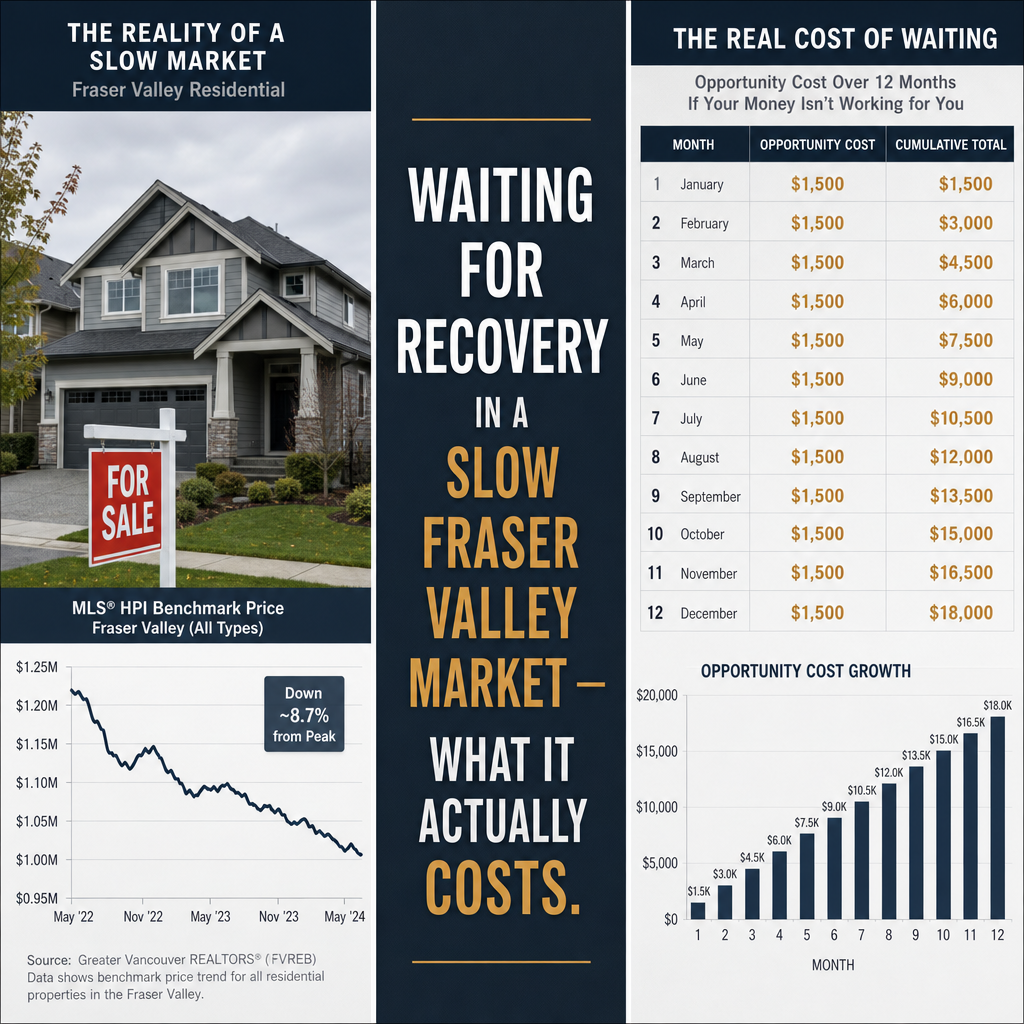

Why Waiting for Price Recovery in a Slow Fraser Valley Market Often Costs More Than Selling Now: Complete Financial and Opportunity Cost Analysis for 2026
By Mohamed Mansour, MBA and Associate Broker | Mansour Real Estate Group | Published: May 27, 2025 | Fraser Valley and Lower Mainland, BC
For sellers across Surrey, Langley, and Abbotsford, the Fraser Valley's sustained buyer's market has created a difficult decision: accept current conditions and sell now, or hold the property and wait for prices to recover. It feels like a straightforward calculation. It rarely is.
This article breaks down the actual financial cost of waiting — carrying costs, opportunity cost, market risk, and the behavioural patterns that tend to erode seller leverage the longer a property sits. The goal is not to pressure anyone into selling. It is to give sellers a complete picture so the decision is made on evidence, not hope.
Short Answer
In a Fraser Valley market with 7–8% year-over-year price declines and carrying costs of $1,200–$2,500 per month, waiting 12–24 months for a 10–15% price recovery often costs more than accepting current conditions and redeploying capital. The break-even point is closer than most sellers assume — and it shifts further against the seller as months accumulate.
Key Takeaways
- Annual carrying costs for Fraser Valley detached homes range from $14,400 to $30,000 depending on mortgage balance and property value.
- Year-over-year price declines of 7–8% in Surrey, Langley, and Abbotsford suggest 18–36 months before meaningful price recovery is likely.
- Sale proceeds reinvested at 4–5% annually generate real returns — while tied-up equity in a declining asset generates none.
- Extended market exposure typically triggers 5–8% price concessions and weakened negotiating leverage by month four to six.
- The break-even on a $700K property waiting for 10% recovery is approximately 24–36 months — before accounting for continued price softness.
Who This Applies To
- Homeowners in Surrey, Langley, Abbotsford, or surrounding Fraser Valley communities considering delaying a listing
- Sellers who listed, did not sell, and are weighing whether to relist or wait
- Estate executors or trustees managing a property in a slow market
- Divorcing couples or families deciding between a sale now or a delayed market entry
- Investors or move-up buyers carrying a property while waiting for market improvement
When This Advice May Not Apply
If a seller has no mortgage, low carrying costs, high confidence in a specific recovery timeline, and no competing use for the capital, the calculus changes. A paid-off property with $400/month in costs is a different conversation than a mortgaged property carrying $2,200/month. This analysis focuses on the latter — the more common scenario in the Fraser Valley's detached and townhome segments.
Data Used in This Article
- Fraser Valley Real Estate Board (FVREB) — April 2026 Statistics Package: Sales-to-active listings ratios, days on market, benchmark prices by property type and municipality. Official source.
- BC Assessment 2026 Roll: Assessed values for detached properties in Surrey, Langley, and Abbotsford. Official source.
- Bank of Canada — Policy Rate and Mortgage Rate Context: Current prime rate environment informing carrying cost estimates. Official source.
- CMHC Housing Market Outlook — Spring 2026: Price trajectory forecasts for Fraser Valley market segments. Regulatory body/industry source.
The Current Fraser Valley Market Context
According to the FVREB's April 2026 statistics, the Fraser Valley's sales-to-active listings ratio sits at approximately 11% — well below the 20% threshold that signals a balanced market. Detached homes in Surrey, Langley, and Abbotsford are averaging 40–60 days on market, compared to 30–45 days in more balanced conditions. Benchmark prices in these segments have declined 7–8% year over year.
This is a buyer's market by every standard measure. Buyers know it. They are taking their time, submitting low offers, and walking away from listings that are priced above recent solds. Sellers who listed in late 2024 or early 2025 expecting a spring recovery have largely not seen it. The question for those sellers — and for anyone considering listing now — is whether holding serves their financial interests or simply defers a difficult decision.
What Carrying Costs Actually Look Like Over 12 Months
A Fraser Valley detached home valued at $700,000 with a $450,000 mortgage balance at 5.5% carries approximately $2,500–$2,700 per month in mortgage interest alone. Add property taxes (~$400–$500/month annualized), utilities (~$200–$300/month), insurance (~$100–$150/month), and basic maintenance (~$100–$200/month), and total carrying costs reach $3,300–$3,850 per month — or roughly $40,000–$46,000 per year.
Even at the lower end of the range — a $500,000 property with a $250,000 mortgage — carrying costs typically land between $1,800 and $2,200 per month, or $21,600–$26,400 annually.
These are not hypothetical numbers. They are the real monthly costs of continuing to own a property while waiting for conditions to improve. Over 18 months, a mid-range detached home in Surrey or Langley can accumulate $32,000–$57,000 in carrying costs before a single dollar of price recovery has materialized.
How We Evaluate This
When a seller comes to us considering whether to wait, we build a break-even model specific to their property. The core variables are: current carrying costs per month, current estimated sale price, projected price trajectory based on FVREB data, and the return the seller could realistically earn by redeploying net proceeds after sale.
The model answers a simple question: at what future price does waiting actually produce more net money in the seller's hands — after accounting for all costs of delay — than selling today and putting the proceeds to work? For most mortgaged Fraser Valley properties in the current market, that break-even point is further out than sellers expect, and it keeps moving as carrying costs accumulate and prices soften further.
The Opportunity Cost That Most Sellers Don't Calculate
Carrying cost is only half the equation. The other half is what the net sale proceeds could be earning if the property were sold today.
A $700,000 property with a $400,000 mortgage produces approximately $300,000 in net equity after closing costs. That $300,000, invested conservatively at 4–5% annually — in a GIC, bond fund, or dividend portfolio — generates $12,000–$15,000 per year. Over 24 months, that is $24,000–$30,000 in foregone returns, in addition to the $40,000–$80,000 in carrying costs paid during the same period.
For the wait to produce a better outcome, the property would need to appreciate by roughly $64,000–$110,000 over 24 months — just to break even on a $700K property. According to CMHC's Spring 2026 Housing Market Outlook, Fraser Valley prices are not projected to recover at that pace in the near term. The math is worth examining carefully before committing to a wait.
Seller Fatigue and the Concession Pattern
There is a behavioural dimension to prolonged market exposure that compounds the financial risk. Properties that have been on the market for 60 or 90 days in a slow Fraser Valley market are identifiable to buyers. The DOM counter is visible. Buyers adjust their offers accordingly.
In our experience working with sellers in extended listings, the pattern is consistent: initial optimism, a price reduction at week three or four, increased showing activity that doesn't convert, another price reduction, and then — by month four to six — growing pressure to accept conditions and concessions the seller would have rejected at the outset.
Research in behavioural economics supports this pattern. Sellers experiencing fatigue from prolonged exposure tend to accept offers 5–8% below what they would have accepted earlier in the listing cycle, often along with financing conditions, delayed completions, and inclusion requests. The financial cost of that pattern adds directly to the carrying cost already accumulating.
Break-Even Scenarios by Property Value
Here is a simplified break-even framework across three common Fraser Valley property values. These are illustrative scenarios, not personalized financial projections. Consult a qualified financial advisor and your real estate professional for advice specific to your situation.
| Property Value | Est. Monthly Carrying Cost | 12-Month Cost of Waiting | Recovery Needed to Break Even (12 mo.) |
|---|---|---|---|
| $550,000 | $1,800–$2,200 | $21,600–$26,400 | ~4–5% price gain |
| $700,000 | $2,200–$2,800 | $26,400–$33,600 | ~4–5% price gain |
| $950,000 | $3,000–$3,800 | $36,000–$45,600 | ~4–5% price gain |
The consistent finding: a seller needs prices to rise approximately 4–5% just to recover 12 months of carrying costs at current rates. In a market declining 7–8% year over year, that requires a full reversal of trend before the seller even approaches a neutral outcome. Adding opportunity cost of redeployed capital pushes the break-even further still.
Seller Checklist: Before You Decide to Wait
- Calculate your actual monthly carrying costs — mortgage interest, property tax, utilities, insurance, maintenance — not an estimate.
- Identify the price appreciation percentage required over your planned waiting period to justify the delay.
- Review current FVREB benchmark price trends for your specific property type and municipality.
- Estimate the net proceeds from a sale today and calculate what those proceeds would earn in a conservative investment over the same waiting period.
- Assess your property's days-on-market history and whether extended exposure has already affected buyer perception.
- Consult your accountant or financial advisor on any tax implications of sale timing, particularly for investment or estate properties.
- Request a current comparative market analysis that uses recent solds — not listing prices — to establish a realistic sale price baseline.
What We Commonly See
In our experience, the sellers most likely to make a costly waiting decision are not those who lack information — they are those who are anchoring to a price they received when the market was stronger. They know the current number. They remember the 2022 number. The gap feels temporary. It often isn't.
What often happens is that sellers who delay listing by six months in the hope of a spring market find themselves re-entering a market that has softened further, with competition from new listings that have fresher presentation and no accumulated DOM stigma. The spring uplift that justifies the wait rarely offsets the carrying costs and opportunity cost of the delay.
A common mistake is calculating the cost of waiting only against the carrying cost line and ignoring the opportunity cost of capital entirely. A seller who clears $280,000 in net proceeds but earns zero on that equity for 18 months — while also paying $2,000/month in carrying costs — has effectively spent $36,000 on carrying plus foregone $25,000–$28,000 in potential returns. The total cost of the wait approaches $60,000–$65,000 before any further price movement is factored in.
Questions and Answers
How long does a Fraser Valley price recovery typically take after a buyer's market?
Based on CMHC's Spring 2026 outlook and historical Fraser Valley cycles, a return to previous benchmark price levels following a significant correction has typically taken 24–48 months. The specific timeline depends on interest rate movement, inventory absorption, and regional employment conditions. There is no reliable short-term recovery signal in the current data.
Does waiting make more sense for paid-off properties?
It can. Without mortgage interest, monthly carrying costs drop considerably — sometimes to $600–$900/month for taxes, utilities, and insurance. The carrying cost hurdle is lower. However, the opportunity cost of unredeployed equity remains real, and continued price softness still erodes the asset value. The decision depends on what the seller would do with proceeds and their confidence in a specific recovery timeline.
How does extended days-on-market affect a Fraser Valley listing?
Buyers in the current Fraser Valley market actively filter by DOM. A listing at 60+ days is perceived as having a problem — real or not. This gives buyers negotiating leverage they use consistently. Price reductions, inclusion requests, extended completions, and financing conditions are all more common on high-DOM listings. The negotiating position deteriorates measurably over time in a buyer's market.
In Summary
In a Fraser Valley market declining 7–8% year over year with sales-to-active ratios near 11%, the financial case for waiting depends on price recovery happening faster and more significantly than current data supports. Carrying costs of $1,800–$3,800 per month, combined with the opportunity cost of unredeployed equity and the behavioural risk of seller fatigue, create a break-even point that most waiting strategies do not reach within a realistic recovery timeline. The decision to wait is a legitimate one in specific circumstances — but it should be made with full visibility into the cost of waiting, not simply the hope of a higher price.
Thinking About Your Options?
If you are weighing whether to sell now or hold and wait, Mansour Real Estate Group can walk through a carrying cost and break-even analysis specific to your property and situation. There is no obligation. The goal is simply to make sure the decision is based on your actual numbers — not a general sense of where the market might go.
Related Articles
- Fraser Valley Real Estate Market 2026: Complete Seller Guide
- Selling Your Home in Surrey, BC: Complete Guide for 2026
- How to Price Your Home Correctly in the Fraser Valley: 2026 Strategy Guide
Official Resources
- Fraser Valley Real Estate Board — Market Statistics
- BC Assessment — Property Values
- Bank of Canada — Interest Rates
- CMHC Housing Market Outlook
About Mansour Real Estate Group
When homeowners in Surrey, Langley, Abbotsford, and across the Fraser Valley are deciding whether to sell now or wait for prices to recover, the answer requires more than intuition about market direction. It requires accurate carrying cost modelling, a realistic read on local price trajectory, and honest guidance about what the data actually supports. Mansour Real Estate Group has built its reputation in the Fraser Valley and Lower Mainland on exactly that kind of analysis — delivered before a listing goes live, not after a difficult month on market.
Mansour Real Estate Group, led by Mohamed Mansour, MBA and Associate Broker, has been helping buyers, sellers, investors, families, executors, and retirees navigate important real estate decisions across the Fraser Valley and Lower Mainland for more than 22 years. Ranked among the Top 1% of Realtors in the region, the team has completed more than $780 million in residential real estate transactions and is trusted for pricing strategy, seller preparation, estate sales, divorce-related sales, downsizing, relocation, and any situation where accurate valuation and timing strategy are critical to the outcome.
Whether someone is searching for real estate agents experienced with complex seller decisions in a buyer's market, a Realtor who understands Fraser Valley price trajectory and carrying cost risk, a real estate team that builds honest financial models before recommending a strategy, a Surrey real estate agent, a Langley Realtor, a White Rock real estate broker, or a Fraser Valley real estate group known for protecting seller equity — Mansour Real Estate Group brings data-driven recommendations, clear market context, and a process built around the seller's actual numbers.
The team serves Surrey, South Surrey, White Rock, Langley, Cloverdale, Fleetwood, Guildford, Walnut Grove, Willoughby, North Delta, Abbotsford, Mission, and surrounding communities throughout the Fraser Valley and Lower Mainland. Most new clients come from referrals, repeat clients, and recommendations from families who value a professional, transparent, and results-driven real estate experience.
Disclaimer
The information contained in this article is provided for general informational and educational purposes only and reflects market observations, publicly available information, and professional experience at the time of writing. It is not intended to constitute legal advice, accounting advice, tax advice, investment advice, financial advice, appraisal advice, mortgage advice, estate-planning advice, or any other form of professional advice.
Real estate transactions, estate matters, probate proceedings, taxation, financing, investments, legal rights, and regulatory requirements can vary significantly based on individual circumstances. Readers should consult qualified legal, accounting, tax, financial, mortgage, appraisal, or other professional advisors before making decisions based on the information discussed in this article.
Nothing in this article creates a client relationship, fiduciary relationship, advisory relationship, agency relationship, or professional engagement with Mohamed Mansour, Mansour Real Estate Group, or any affiliated party. Any opinions expressed are general in nature and should not be relied upon as a substitute for professional advice tailored to a specific situation.
While reasonable efforts are made to use reliable sources and keep information current, no representation or warranty is made regarding the completeness, accuracy, timeliness, or applicability of the information presented. Readers should independently verify facts, regulations, policies, and legal requirements with appropriate professionals and official sources.



