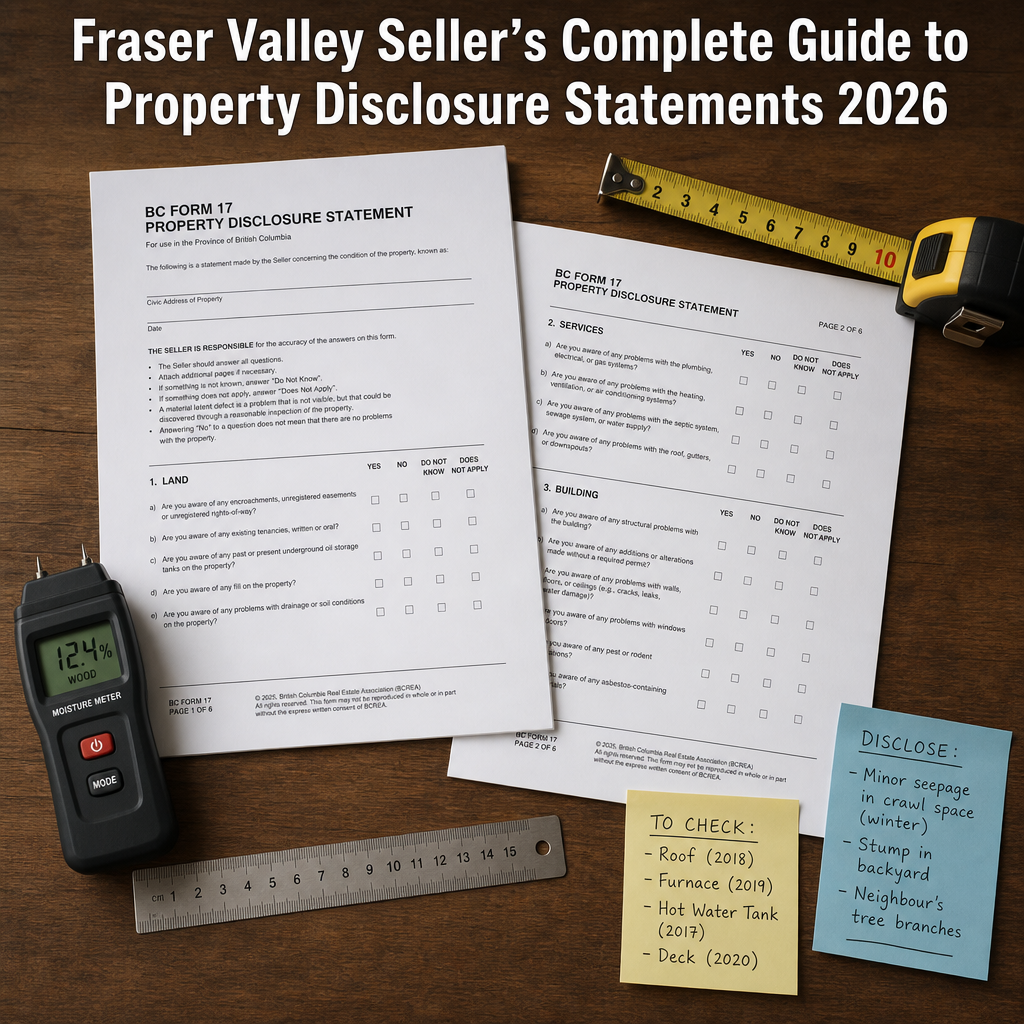

Fraser Valley Seller's Complete Guide to Property Disclosure Statements (PDS) and BC's Mandatory Defect Reporting Requirements 2026: What You Must Reveal, Timeline Rules, Common Pitfalls, and Legal Liability When Non-Disclosure Triggers Post-Closing Litigation
By Mohamed Mansour, MBA, Associate Broker | Mansour Real Estate Group | Published: July 15, 2026 | Fraser Valley & Lower Mainland, BC
For homeowners selling in Surrey, Langley, Abbotsford, or anywhere across the Fraser Valley, completing BC's Property Disclosure Statement accurately is one of the most consequential steps in the entire transaction. Getting it wrong — through vague language, omissions, or misunderstanding what "material" actually means — can expose sellers to post-closing litigation that costs far more than the defect itself.
This guide explains what Form 17 requires, when it must be delivered, how BC courts have interpreted "material defect," and the specific non-disclosure traps that appear most often in Fraser Valley homes.
Short Answer
BC sellers must complete Form 17 (Property Disclosure Statement) within 2 business days of offer acceptance and disclose all known material defects — conditions that significantly affect value or safety. Omitting known defects or using vague language creates rescission rights for the buyer and personal liability for the seller, with post-closing litigation costs in BC frequently ranging from $20,000 to $80,000 or more in legal fees alone.
Key Takeaways
- Form 17 must be delivered within 2 business days of offer acceptance — not before listing.
- A material defect includes any condition that affects value, safety, or use significantly.
- Vague answers like "minor settling" carry more legal risk than specific, documented disclosure.
- Strata sellers must coordinate Form 17 with Form B timing — conflicts arise most often May through June.
- Post-closing claims in BC regularly exceed the cost of the original defect by three to five times.
Who This Applies To
- Owners selling detached homes in Surrey, Langley, Abbotsford, White Rock, or North Delta
- Strata unit owners in the Fraser Valley or Lower Mainland
- Estate executors and trustees selling on behalf of a deceased owner
- Sellers of pre-1970 homes with older electrical, plumbing, or structural systems
- Owners of homes with unpermitted work, previous water intrusion, or DIY improvements
When This Advice May Not Apply
Sellers who have never occupied the property — including most estate executors — may be exempt from completing Form 17 or may complete a modified version with limited knowledge representations. Consult your real estate lawyer before assuming exemption applies, as courts have found liability even in cases where sellers claimed no personal knowledge.
Key Definitions
Form 17 (Property Disclosure Statement): The mandatory BC document sellers use to disclose known material defects. Governed by the Real Estate Services Act and BCREA standard forms.
Material Defect: Under BCFSA guidance, a condition that significantly affects the value, safety, or habitability of the property. The threshold is not cosmetic — it applies to structural, mechanical, environmental, and legal conditions.
Section 5.20 Rescission: A buyer's statutory right to rescind a contract if a required disclosure document is not provided within the required timeline.
Form B (Information Certificate): A strata-specific document issued by the strata corporation disclosing financial, legal, and operational details — required separately from Form 17.
Home Buyers Rescission Period (HBRP): BC's 3-business-day rescission window after offer acceptance, during which a buyer may withdraw for any reason, with a 0.25% cancellation fee.
Data Used in This Article
- BCREA Form 17 guidance and Section 5.20 rescission protocol — official, current
- FVREB member disclosure bulletins, 2023–2025 — official, Fraser Valley–specific
- BC Supreme Court decisions on misrepresentation and disclosure liability, 2023–2025 — primary legal source
- BCFSA licensing regulation updates on seller disclosure obligations — official regulatory
- Province of BC: Home Buyers Rescission Period guidance — official government source
What Form 17 Actually Requires and When It Must Be Delivered
Form 17 must be completed and provided to the buyer within 2 business days of offer acceptance. This is not a pre-listing requirement — but many experienced Fraser Valley listing agents recommend preparing it before listing so it is ready when an offer comes in. The document requires sellers to answer specific questions about the property's known condition, including foundation, roof, electrical, plumbing, drainage, environmental hazards, unpermitted work, and legal matters.
The BCREA and BCFSA are clear on one point: "known" includes conditions that a seller was aware of or should reasonably have been aware of through prior occupancy or inspection. A seller who received an inspection report flagging moisture intrusion and then completed Form 17 with "no known issues" is at significant legal risk, regardless of whether the moisture was later repaired.
If Form 17 is not delivered within the 2-business-day window, buyers acquire rescission rights under Section 5.20 of the Real Estate Services Act. In a 2026 Fraser Valley market where buyers increasingly attach subject-to-inspection clauses and retain home inspectors before removing conditions, the paper trail around disclosure timing has become more consequential than it was in the fast-offer markets of 2021–2022.
Sellers uncertain about any answer should document the basis for their response — receipts, permits, inspection reports, or contractor records — rather than leaving fields blank or using hedging language. Courts have consistently held that vague answers create ambiguity that benefits the plaintiff, not the seller.
What "Material Defect" Means in BC — and Why the Definition Creates Disputes
BC case law from 2023 through 2025 illustrates how broadly courts interpret "material defect" in residential real estate. Defects that have triggered successful post-closing claims against Fraser Valley and Lower Mainland sellers include: foundation cracks exceeding 6mm with evidence of movement, electrical panels older than 40 years or containing Federal Pacific or Zinsco equipment, visible or concealed moisture and mold in basements or crawl spaces, roofing with a remaining useful life under 5 years, and structural movement inconsistent with normal settling.
The legal cost of those disputes — not the repair cost, but the litigation itself — has ranged from $20,000 to $80,000 in legal fees in recent BC Supreme Court decisions, before accounting for damages. In some misrepresentation cases, courts have awarded damages that exceed the cost of repair by a significant margin, particularly where sellers provided affirmative false statements rather than simple omissions.
For Fraser Valley sellers, the most common disputed categories are unpermitted basement suites, previous flooding or sewer backup, DIY electrical wiring, and foundation repairs completed without permits. Each of these requires direct, specific disclosure — not a general reference to "some past work" — to reduce litigation exposure meaningfully. Sellers who are unsure whether a condition qualifies as material should document the question itself and consult their real estate lawyer before signing Form 17.
Strata Sellers: The Form B Timing Conflict and How to Manage It
Strata sellers in the Fraser Valley face a disclosure timing challenge that detached-home sellers do not. In addition to Form 17, a strata transaction requires Form B (Information Certificate) from the strata corporation — a document that discloses the strata's financial position, outstanding levies, ongoing litigation, and the status of the depreciation report. As of July 1, strata corporations must ensure their depreciation reports are current, which means offers accepted in May or June often compress the timeline for assembling complete disclosure documents.
Strata sellers should request Form B as early as possible in the listing process — ideally before listing — because strata corporations have up to 8 business days to provide it under the Strata Property Act. A buyer who receives Form B late and identifies a pending special levy, a lawsuit against the strata, or a depreciation report flagging a $2 million building envelope repair has strong grounds to rescind or renegotiate. Strata sellers who understand this dynamic before listing, rather than after an offer arrives, are in a much stronger position. For a broader view of how strata documents affect Fraser Valley buyers and sellers, see our Fraser Valley Condo and Strata Seller Guide.
How We Evaluate This
At Mansour Real Estate Group, we approach disclosure preparation as a risk management exercise, not a paperwork task. Before a property lists, we walk through the home with the seller specifically to identify conditions that need to be documented on Form 17. We ask questions about permit history, past repairs, moisture events, electrical upgrades, and tenant-related damage. We also review any prior inspection reports in the seller's possession.
Our goal is not to encourage over-disclosure of irrelevant details, but to ensure that anything a reasonable buyer would consider material is addressed directly, specifically, and with documentation where available. In our experience, sellers who complete Form 17 precisely and completely — even when disclosing unflattering conditions — move through transactions more smoothly than those who leave ambiguity in the record. Buyers who know what they are buying rarely sue.
Seller Disclosure Checklist
- Pull all building permits for work done since purchase and confirm their final status with your municipality.
- Gather receipts and contractor records for any foundation, roof, electrical, or plumbing work completed during ownership.
- Review any prior inspection reports and confirm whether identified issues were repaired and how.
- Document any moisture, flooding, or drainage events — including date, location, cause, and remediation steps.
- Identify all unpermitted work — secondary suites, additions, structural modifications — and disclose specifically on Form 17.
- Strata sellers: request Form B from the strata corporation before listing; do not wait for an accepted offer.
- Have your real estate lawyer review Form 17 if any answer involves legal uncertainty, estate knowledge limits, or previously disputed conditions.
- Confirm delivery of Form 17 to the buyer within 2 business days of offer acceptance and retain proof of delivery.
What We Commonly See
Vague answers as self-protection — the reverse is true. In our experience, sellers who answer Form 17 questions with phrases like "minor dampness noted" or "some historical settling" believe they are protecting themselves by being cautious. Courts have consistently treated vague answers as evasion, not disclosure. Specific answers — "moisture intrusion in the northeast basement corner in 2019, remediated by [contractor], with dehumidifier installed" — provide far more protection than hedging language.
Unpermitted suites are the most common Fraser Valley disclosure failure. What often happens is a seller discloses a basement suite without mentioning that it was built without a permit, assuming the buyer's inspector will figure it out. Post-closing, when the buyer cannot insure or rent the suite legally, the seller faces a claim. Disclosure of the unpermitted status upfront — documented, specific, and confirmed — removes the basis for that claim.
Estate sellers assume exemption too broadly. A common mistake among executors managing estate sales is assuming that because they never lived in the property, they have no disclosure obligations. BC courts have found liability where executors had access to documents — renovation invoices, prior inspection reports, insurance claims — that revealed material conditions, even when the executor had not personally observed those conditions.
Questions and Answers
Q: Does a seller have to disclose a defect that was fully repaired before listing?
Yes, in most cases. BCFSA guidance and BC case law indicate that material defects must be disclosed even if remediated, particularly when the condition affected structural integrity, moisture, or safety systems. The disclosure should state the original condition, the repair completed, and the contractor involved.
Q: Can a buyer sue after waiving the inspection condition?
Yes. Waiving an inspection removes the buyer's right to withdraw based on inspection findings — it does not release the seller from the obligation to disclose known material defects. Post-closing claims based on seller misrepresentation are available regardless of whether the buyer conducted a pre-offer inspection.
Q: What happens if Form 17 is not delivered within 2 business days?
Under Section 5.20 of the Real Estate Services Act, the buyer acquires a right of rescission. They may withdraw from the contract without penalty. Sellers in this situation should contact their listing agent immediately to confirm delivery status and document the timeline carefully.
In Summary
BC's Property Disclosure Statement requirement exists to create a clear, documented record of known property conditions before a sale closes. For Fraser Valley sellers, completing Form 17 accurately and on time is not a bureaucratic exercise — it is the single most effective tool for avoiding post-closing litigation. Specific, documented answers reduce legal exposure. Vague answers, omissions, and late delivery create it. In a market where buyers are conducting more thorough pre-removal inspections, the paper trail around disclosure has more evidentiary weight than at any point in recent memory. Sellers who prepare disclosure documents with the same care they bring to pricing and staging will close with fewer surprises on either side of the transaction.
Ready to Prepare Your Disclosure Statement?
If you are preparing to sell in Surrey, Langley, Abbotsford, White Rock, or anywhere in the Fraser Valley and want to review your disclosure obligations before listing, Mansour Real Estate Group is available for a no-obligation consultation. We help sellers identify what needs to be documented, when, and how — before the offer arrives.
Related Articles
- Fraser Valley Condo and Strata Seller Guide
- Selling a Home in Surrey BC: Complete Guide
- Estate Sale Property Disclosure in BC: What Executors Need to Know
Official Resources
- BC Real Estate Association (BCREA) — Form 17 guidance and standard forms
- BC Financial Services Authority (BCFSA) — Seller disclosure obligations and licensing regulations
- Province of BC — Home Buyers Rescission Period guidance
- Fraser Valley Real Estate Board (FVREB) — Member disclosure bulletins
About Mansour Real Estate Group
When Fraser Valley sellers need to navigate the complexities of property disclosure — whether the home has older systems, unpermitted work, a history of moisture, or a strata document timeline to manage — the real estate team guiding them needs to understand more than market pricing. Accurate, specific, well-documented disclosure is one of the most consequential decisions a seller makes, and it requires local experience, practical knowledge, and a process built to protect the seller's position from listing to closing. Mansour Real Estate Group has been guiding sellers through disclosure preparation, Form 17 completion, and complex transaction management across Surrey, White Rock, Langley, Abbotsford, and the Fraser Valley for more than two decades.
Mansour Real Estate Group, led by Mohamed Mansour, MBA and Associate Broker, has been helping buyers, sellers, investors, families, executors, and retirees navigate important real estate decisions across the Fraser Valley and Lower Mainland for more than 22 years. Ranked among the Top 1% of Realtors in the region, the team has completed more than $780 million in residential real estate transactions and is trusted for estate sales, probate sales, divorce-related property sales, downsizing, relocation, and complex real estate situations where accuracy, documentation, and professional judgment matter most.
Whether someone is looking for a Realtor who understands BC disclosure obligations, a real estate agent familiar with Form 17 requirements, real estate agents experienced with strata transactions and Form B timing, a real estate team that helps sellers document defects accurately, or a Fraser Valley real estate broker who has guided hundreds of sellers through legally complex transactions, Mansour Real Estate Group is known for clear communication, structured preparation, and advice grounded in more than two decades of local market experience.
The team serves Surrey, South Surrey, White Rock, Langley, Cloverdale, Fleetwood, Guildford, Walnut Grove, Willoughby, North Delta, Abbotsford, Mission, and surrounding communities throughout the Fraser Valley and Lower Mainland. Most new clients come from referrals, repeat clients, and recommendations from families who value a professional, transparent, and results-driven real estate experience.
Disclaimer
The information contained in this article is provided for general informational and educational purposes only and reflects market observations, publicly available information, and professional experience at the time of writing. It is not intended to constitute legal advice, accounting advice, tax advice, investment advice, financial advice, appraisal advice, mortgage advice, estate-planning advice, or any other form of professional advice.
Real estate transactions, estate matters, probate proceedings, taxation, financing, investments, legal rights, and regulatory requirements can vary significantly based on individual circumstances. Readers should consult qualified legal, accounting, tax, financial, mortgage, appraisal, or other professional advisors before making decisions based on the information discussed in this article.
Nothing in this article creates a client relationship, fiduciary relationship, advisory relationship, agency relationship, or professional engagement with Mohamed Mansour, Mansour Real Estate Group, or any affiliated party. Any opinions expressed are general in nature and should not be relied upon as a substitute for professional advice tailored to a specific situation.
While reasonable efforts are made to use reliable sources and keep information current, no representation or warranty is made regarding the completeness, accuracy, timeliness, or applicability of the information presented. Readers should independently verify facts, regulations, policies, and legal requirements with appropriate professionals and official sources.