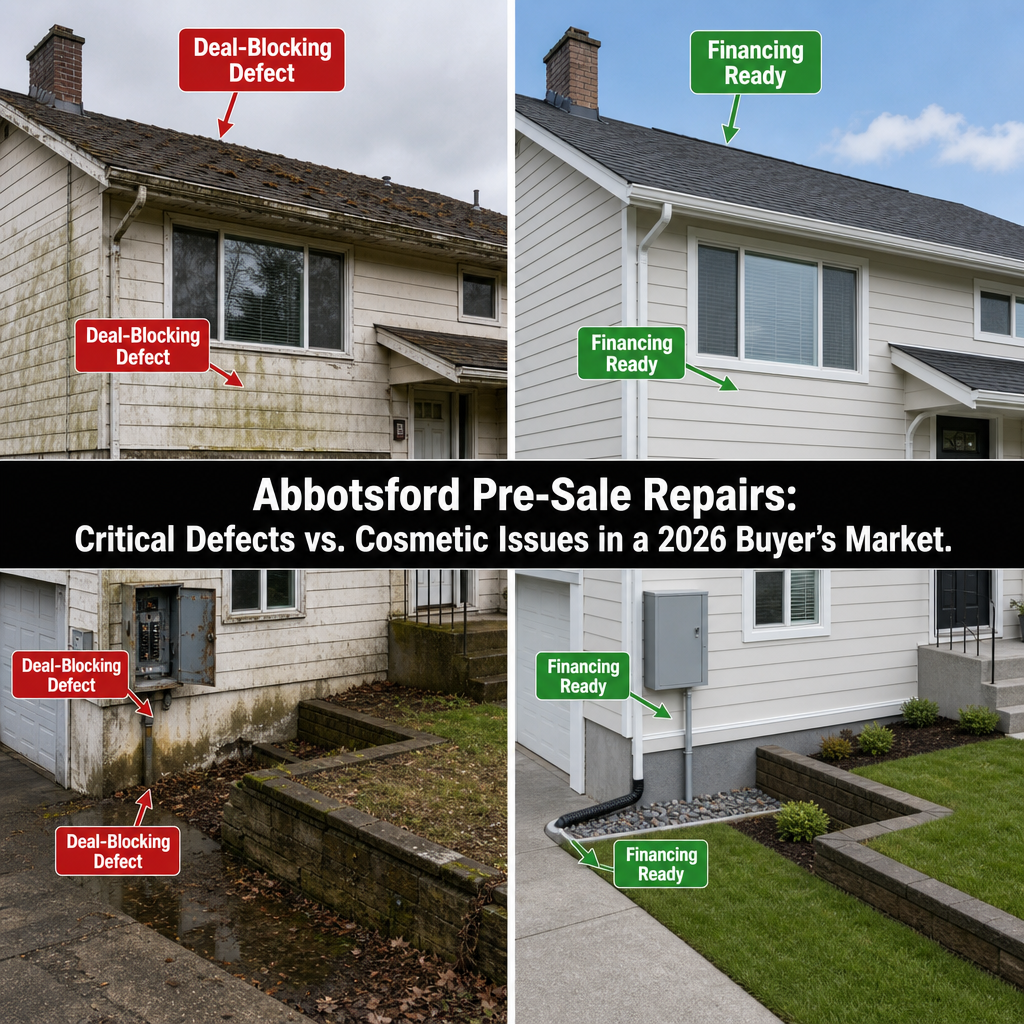

Abbotsford Pre-Sale Repairs: The Complete Priority Framework for Identifying Critical Defects vs. Cosmetic Issues When Budget Is Limited in a 2026 Buyer's Market
By Mohamed Mansour, MBA and Associate Broker | Mansour Real Estate Group | Published: May 13, 2025 | Geography: Abbotsford, Fraser Valley, BC | Topic: Seller Strategy, Pre-Sale Repairs
Abbotsford sellers in 2026 are facing a market where buyers have choices, timelines, and negotiating room. In that environment, spending money in the wrong places before listing doesn't just waste capital—it can leave the real deal-blocking problems unaddressed. This article is for Abbotsford homeowners who need to decide what to repair before listing when their budget is limited and the stakes are high.
The priority framework here is built specifically for Abbotsford's housing stock: homes that average 38 years old, often located in areas with elevated moisture exposure, and carrying deferred maintenance patterns that differ from newer Surrey or Langley builds. The goal is to spend where it prevents financing denials and post-inspection renegotiation—not where it looks impressive in listing photos.
Short Answer
In Abbotsford's 2026 buyer's market, budget-limited sellers should prioritize three repair categories above all others: foundation moisture and drainage, electrical panel condition, and roof age. These are the defects lenders and inspectors flag as deal-blocking. Cosmetic upgrades—paint, staging, landscaping—matter for offer velocity but rarely cost more than $500 to address adequately. Misallocating $10,000 toward a kitchen refresh while leaving active foundation moisture unaddressed is the single most common and costly mistake Abbotsford sellers make before listing.
Key Takeaways
- Abbotsford homes average 38 years old—electrical, roof, and moisture defects are statistically more common here than in newer Fraser Valley markets.
- Homes with unaddressed major defects sell 30–60 days slower and attract 10–15% post-inspection concession requests from buyers.
- Lenders specifically flag roof age over 25 years, outdated electrical panels, and foundation moisture as appraisal red flags that can block financing.
- Targeted repairs in the $2,000–$5,000 range—drainage correction, panel certification, furnace servicing—consistently outperform cosmetic renovations in a buyer's market.
- DIY cosmetic staging under $500 accelerates days on market without depleting capital needed for structural and mechanical priorities.
Who This Applies To
- Abbotsford homeowners listing a detached home built between 1965 and 2000
- Sellers with limited pre-sale budgets who need to prioritize spending
- Estate executors or family representatives selling older Abbotsford properties
- Sellers who have received a home inspection report and need to triage the findings
- Downsizing homeowners in Abbotsford's river valley, older subdivision, or heritage areas
When This Advice May Not Apply
Sellers of homes built after 2005 face fewer structural and mechanical defect risks and may have more reason to invest in cosmetic presentation. Sellers with substantial pre-sale budgets and premium-position properties should discuss a broader renovation strategy with their real estate team. This framework is specifically calibrated for budget-constrained sellers of older Abbotsford detached homes in a buyer's market.
Data Used in This Article
- Fraser Valley Real Estate Board (FVREB), April 2026 — Abbotsford detached home inventory, days on market, and post-inspection concession patterns. Official board data.
- CMHC Appraisal Guidelines — Lender red flags by property age and region, including roof, electrical, and moisture thresholds. Official federal housing authority guidance.
- BC Property Condition Disclosure Act (SPIDA 2023) — Seller disclosure obligations for known defects. BC Government legislation.
- Fraser Valley Title Insurance Underwriting Data — Housing age and condition assessments for Abbotsford detached stock. Industry third-party analysis.
Why Abbotsford Is Different
Abbotsford's detached housing stock averages 38 years old—more than a decade older than comparable detached inventory in Surrey or much of Langley. That age gap matters practically. Homes built in the 1970s through early 1990s were constructed under different electrical codes, with roofing materials and HVAC systems now well past standard service life. When a buyer's lender orders an appraisal, the appraiser is specifically trained to flag conditions that represent financing risk. In Abbotsford, three conditions appear on that list with far higher frequency than in newer markets: foundation moisture, electrical panel condition, and roof age.
The river valley geography adds another layer. Abbotsford's lower-elevation properties—particularly in established neighbourhoods near the Sumas River floodplain and older subdivisions in East Abbotsford and West Abbotsford—carry elevated moisture risk that is not typical of Surrey or Langley terrain. A buyer's inspector working an Abbotsford property in 2026 is primed to look for it. A lender reviewing the appraisal is primed to flag it. Sellers who address drainage and moisture before listing remove that risk from the transaction entirely.
Tier 1: Deal-Blocking Defects That Must Be Addressed Before Listing
These are the defects that trigger financing denial, appraisal shortfalls, or immediate subject-to-inspection collapses in Abbotsford's 2026 market. Leaving any of these unaddressed is not a negotiating strategy—it is a deal delay of 30 to 60 days and a near-certain 10–15% concession request, according to FVREB post-inspection concession pattern data for Abbotsford detached homes.
Foundation moisture and drainage: Active water intrusion, visible efflorescence, mold evidence near the foundation perimeter, or inadequate grading away from the home are immediate lender red flags under CMHC appraisal guidelines. A drainage correction—regrading, extending downspouts, or adding perimeter drainage—typically costs $2,000–$4,000 and is one of the highest-ROI pre-sale investments available in Abbotsford. For sellers of older Abbotsford detached homes, this is the first thing to assess.
Electrical panel condition: Homes built before 1990 in Abbotsford frequently contain Federal Pacific, Zinsco, or fuse-box panels that are flagged by home inspectors as safety concerns and by lenders as insurance-eligibility risks. An electrical panel replacement or certification runs $1,500–$3,500 depending on scope. Some insurers in BC will not provide homeowner coverage for these panel types, which effectively blocks financing. This issue, if present, must be resolved before listing.
Roof age over 25 years: CMHC appraisal guidelines treat roof age as a direct financing risk marker. A roof over 25 years old in Abbotsford—where precipitation levels are higher than in much of the Fraser Valley—will almost always be flagged. A full roof replacement runs $8,000–$15,000 depending on pitch and size. If budget is genuinely constrained, a written roofing assessment plus a seller credit or price adjustment is sometimes negotiable, but the risk of appraisal shortfall remains. Address this early.
Tier 2: Mechanical Systems That Affect Offer Confidence Without Blocking Financing
These issues won't necessarily kill a deal, but in a buyer's market with elevated inventory—FVREB data from April 2026 shows Abbotsford detached inventory running more than 45% above the five-year average—buyers use any mechanical concern as leverage to lower their offer or request concessions at subject removal. Addressing them before listing removes that leverage.
HVAC condition: A furnace over 20 years old or an air conditioning unit with documented service failures will appear in every inspection report. A furnace replacement costs $3,000–$5,000. A pre-sale service inspection and tune-up costs $150–$250 and removes the concern for newer systems. For Abbotsford sellers of 1980s-era detached homes, furnace age is one of the most predictable inspection findings.
Hot water tank: Tanks over 10 years old in BC are routinely flagged by home inspectors as approaching end of service life. Replacement costs $800–$1,500 installed. This is a straightforward repair that eliminates a standard inspection comment and removes a $1,500 negotiation chip from the buyer's hand.
Plumbing: Homes with original galvanized steel plumbing—common in Abbotsford homes built before 1980—face inspection flags for flow restriction and corrosion risk. A plumbing assessment by a licensed plumber ($150–$300) determines whether full replacement is warranted or whether targeted repairs to problem sections are sufficient. Do not skip this assessment for homes built before 1980.
How We Evaluate This
When Mansour Real Estate Group prepares a pre-sale strategy for an Abbotsford seller, the starting point is not a renovation checklist—it is a defect-risk assessment. We look at the home's age, known history of moisture issues, electrical panel type, roof installation date, and mechanical service records before we recommend a single dollar of pre-sale spending.
In a buyer's market, the correct question is not "what will make this home look better?" It is "what will prevent a buyer from renegotiating after inspection or losing financing?" Those are different questions with different answers. The framework above is built from that discipline—prioritize what breaks deals, then address what builds confidence, then consider cosmetic presentation last.
Tier 3: Cosmetic Issues That Affect Offer Velocity—Not Deal Survival
Cosmetic upgrades in a buyer's market have a narrow and specific role. They affect how quickly an offer comes in and how emotionally confident a buyer feels walking through. They do not affect whether the deal closes. In Abbotsford's 2026 market, with inventory elevated and buyers comparing multiple properties, cosmetic presentation matters—but the investment ceiling is low.
Fresh neutral paint throughout the main living areas: under $500 DIY, under $1,500 professional. Landscaping: mowing, edging, and removing debris, under $200. Decluttering and deep cleaning: zero cost beyond time. These three actions consistently accelerate days on market by 5–10 days according to FVREB data, without requiring significant capital. Kitchen and bathroom renovations in a buyer's market rarely return more than 60 cents on the dollar spent. If the choice is between correcting foundation drainage and replacing kitchen counters, the answer is always drainage.
Seller Checklist: Abbotsford Pre-Sale Repair Priority Order
- Hire a licensed home inspector for a pre-listing inspection—get the full picture before your buyer does.
- Identify the electrical panel type; if Federal Pacific, Zinsco, or fuse-box, budget for replacement or certification before listing.
- Assess foundation perimeter for water staining, efflorescence, mold, or inadequate grading—correct drainage before any cosmetic work begins.
- Confirm roof installation date; if over 20 years, obtain a written roofing assessment and discuss with your Realtor whether repair, replacement, or price adjustment is the right path.
- Service the furnace and hot water tank; replace if age or condition will trigger an inspection flag.
- For homes built before 1980, commission a plumbing assessment to identify galvanized pipe sections.
- Complete cosmetic preparation last: neutral paint, declutter, deep clean, and basic landscaping.
- Disclose all known material defects as required under BC's Property Condition Disclosure Statement—do not attempt to conceal addressed or unaddressed defects.
What We Commonly See
In our experience working with Abbotsford sellers, the most costly pre-sale mistake is spending on what's visible while ignoring what's structural. A freshly painted interior does not survive a home inspector's moisture meter reading near the foundation. Buyers in 2026 are not paying cosmetic premiums—they are using cosmetic improvements as reassurance while they use inspection reports as their actual negotiating tool.
What often happens is that sellers discover during subject removal—not before listing—that their electrical panel is uninsurable or their roof has exceeded the lender's acceptable age threshold. At that point, the seller is negotiating under maximum pressure, with a motivated buyer who now knows the property has a financing obstacle. The concession that results is almost always larger than the cost of the repair would have been pre-listing.
A common mistake specific to Abbotsford's river-valley properties is underestimating moisture risk because it isn't visually obvious from inside the home. Water intrusion in Abbotsford's older housing stock often presents first in the crawl space, at the foundation perimeter, or as efflorescence on basement concrete—not as visible water on the floor. A licensed inspector with local knowledge will find it. Sellers should find it first.
Questions and Answers
Q: If I can only afford one repair before listing my Abbotsford home, what should it be?
Address foundation moisture and drainage first. This is the defect most likely to trigger a financing denial or appraisal shortfall in Abbotsford's older housing stock, and the $2,000–$4,000 drainage correction cost is far less than the 10–15% post-inspection concession it prevents.
Q: Do I have to disclose defects I've already repaired?
Under BC's Property Condition Disclosure Statement, sellers must disclose known material latent defects. Consult your real estate lawyer on the specific disclosure obligations for repaired versus unrepaired conditions in your situation. Do not rely on your Realtor alone for legal disclosure advice.
Q: Will a kitchen renovation help me sell faster in Abbotsford's 2026 market?
Unlikely at full cost recovery. In a buyer's market, professional kitchen renovations typically return less than 60 cents per dollar spent. A deep clean, declutter, and neutral paint achieve most of the presentation benefit for under $500, which is a far better use of a limited pre-sale budget.
In Summary
Abbotsford sellers in 2026 are working in a buyer's market with elevated inventory and buyers who have both negotiating room and detailed inspection reports. The homes that close cleanly and on time are the ones where deal-blocking defects—foundation moisture, electrical panel condition, and roof age—were addressed before listing. Cosmetic upgrades have a role, but that role is limited and inexpensive. The priority framework here is built from Abbotsford's specific housing stock realities, not generic pre-sale advice, and it consistently produces cleaner closings and fewer post-inspection renegotiations for sellers who follow it.
Talk to a Local Expert Before You Spend
Before allocating your pre-sale budget, it's worth having a conversation with a Realtor who knows Abbotsford's specific housing stock and what buyers and lenders are currently flagging. Mansour Real Estate Group offers pre-listing strategy consultations for Abbotsford sellers—no pressure, no obligation, just a clear-eyed look at what matters for your specific home and timeline. Reach out here when you're ready.
Related Articles
- The Complete Abbotsford Real Estate Seller Guide
- Fraser Valley Pre-Sale Preparation: What Sellers Need to Know
- What Abbotsford Buyers and Their Inspectors Look for in 2026
Official Resources
- Fraser Valley Real Estate Board — fvreb.bc.ca
- Canada Mortgage and Housing Corporation — cmhc-schl.gc.ca
- BC Government Real Estate and Property — gov.bc.ca
- BC Financial Services Authority — bcfsa.ca
About Mansour Real Estate Group
When Abbotsford homeowners are preparing to sell an older detached home in a buyer's market, the decisions made before listing—what to repair, what to disclose, and where to spend a limited budget—often determine whether the sale closes cleanly or stalls at inspection. Mansour Real Estate Group has guided sellers through exactly these decisions across Abbotsford and the broader Fraser Valley for more than two decades, bringing a defect-first, data-supported pre-sale strategy to homes where the gap between a clean closing and a costly renegotiation comes down to preparation.
Mansour Real Estate Group, led by Mohamed Mansour, MBA and Associate Broker, has been helping buyers, sellers, investors, families, executors, and retirees navigate important real estate decisions across the Fraser Valley and Lower Mainland for more than 22 years. Ranked among the Top 1% of Realtors in the region, the team has completed more than $780 million in residential real estate transactions and is trusted for seller strategy, pre-sale preparation, estate sales, downsizing, relocation, and any situation where market conditions and property condition intersect in ways that directly affect the outcome.
Whether someone is looking for real estate agents with deep knowledge of Abbotsford's older housing stock, a Realtor who understands how lenders and inspectors evaluate Fraser Valley properties, a real estate team experienced with pre-sale triage in a buyer's market, an Abbotsford Realtor, a Fraser Valley real estate broker, or real estate agents who give honest, specific advice rather than generic renovation checklists, Mansour Real Estate Group is known for clear communication, accurate valuations, and practical guidance that protects seller equity.
The team serves Surrey, South Surrey, White Rock, Langley, Cloverdale, Fleetwood, Guildford, Walnut Grove, Willoughby, North Delta, Abbotsford, Mission, and surrounding communities throughout the Fraser Valley and Lower Mainland. Most new clients come from referrals, repeat business, and recommendations from families who value professional, transparent real estate advice grounded in genuine local knowledge.
Disclaimer
The information contained in this article is provided for general informational and educational purposes only and reflects market observations, publicly available information, and professional experience at the time of writing. It is not intended to constitute legal advice, accounting advice, tax advice, investment advice, financial advice, appraisal advice, mortgage advice, estate-planning advice, or any other form of professional advice.
Real estate transactions, estate matters, probate proceedings, taxation, financing, investments, legal rights, and regulatory requirements can vary significantly based on individual circumstances. Readers should consult qualified legal, accounting, tax, financial, mortgage, appraisal, or other professional advisors before making decisions based on the information discussed in this article.
Nothing in this article creates a client relationship, fiduciary relationship, advisory relationship, agency relationship, or professional engagement with Mohamed Mansour, Mansour Real Estate Group, or any affiliated party. Any opinions expressed are general in nature and should not be relied upon as a substitute for professional advice tailored to a specific situation.
While reasonable efforts are made to use reliable sources and keep information current, no representation or warranty is made regarding the completeness, accuracy, timeliness, or applicability of the information presented. Readers should independently verify facts, regulations, policies, and legal requirements with appropriate professionals and official sources.