
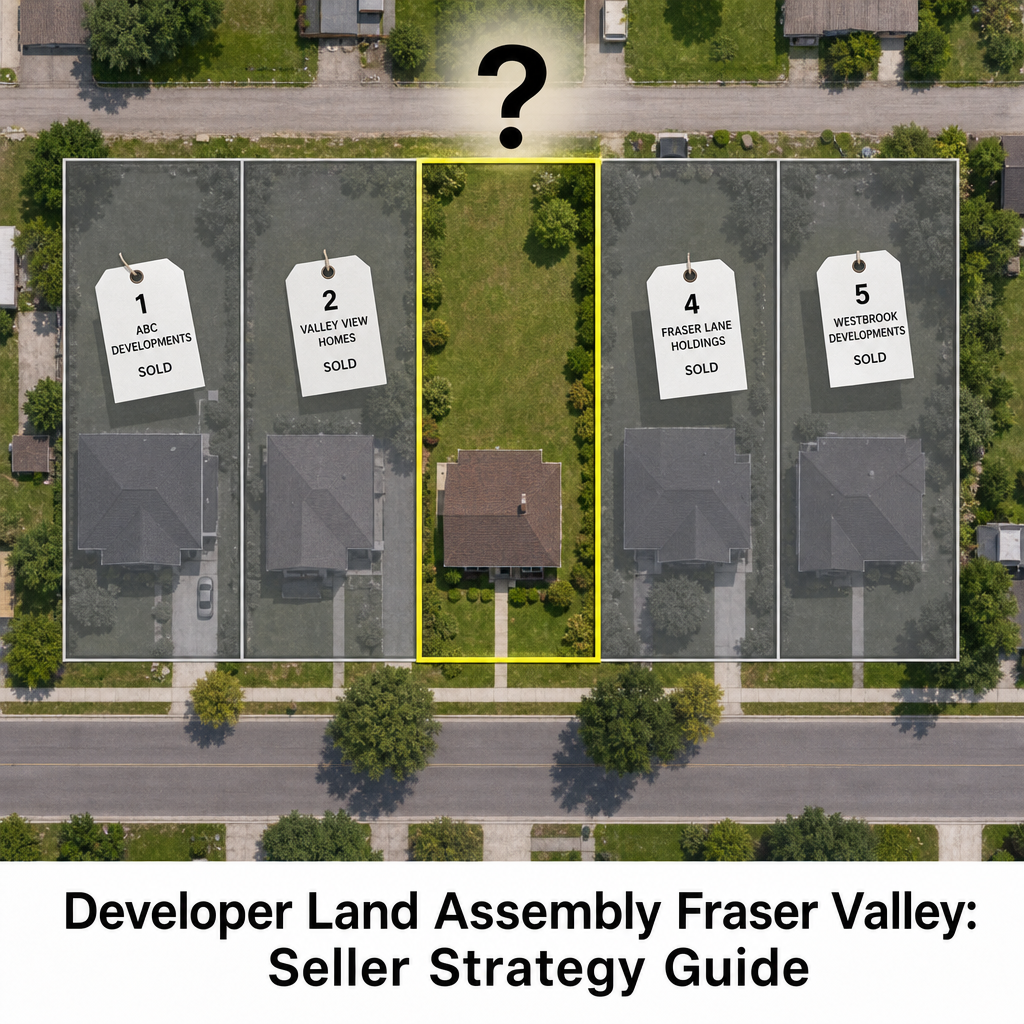

Identifying Your Property for Developer Acquisition in the Fraser Valley: Red Flags, Timing, and Negotiation Strategy When Land Value Exceeds Residential Resale
By Mohamed Mansour, MBA and Associate Broker | Mansour Real Estate Group | Fraser Valley and Lower Mainland, BC | Published: July 15, 2026
Most homeowners in the Fraser Valley sell when life calls for it — a growing family, a retirement, a change in circumstances. But a smaller group of sellers face a different situation entirely: their property may be worth significantly more to a developer than to any residential buyer. The problem is that most of those sellers never realize it until the deal is already structured around them.
This article is for homeowners in Surrey, Langley, Abbotsford, Cloverdale, Fleetwood, Guildford, and other active Fraser Valley corridors who have received unsolicited inquiries, noticed unusual sales activity nearby, or are simply wondering whether their property sits in the path of something larger. Understanding the signals — and your negotiating position — before a developer makes contact is the only way to protect what your land may actually be worth.
Short Answer
If your property sits near a SkyTrain corridor, a rezoning study area, or a cluster of recent numbered-company purchases in the Fraser Valley, it may already be on a developer's acquisition list. Developers typically approach holdout sellers only after controlling 60–70% of target parcels — meaning early negotiation produces materially better outcomes than waiting to be approached.
Who This Applies To
- Homeowners in Surrey, Cloverdale, Fleetwood, Guildford, Langley, or Abbotsford who have received unsolicited purchase inquiries
- Sellers near announced transit expansions, hospital developments, or newly rezoned corridors
- Property owners who have noticed neighbouring homes selling to numbered companies or holding companies
- Homeowners evaluating whether to list on the open market or wait for direct developer contact
- Executors managing estate properties in development-adjacent areas
When This Advice May Not Apply
If your property is in a stable single-family neighbourhood with no pending rezoning, no transit investment nearby, and no numbered-company activity on your block, land assembly dynamics are unlikely to apply. This article focuses on corridors where development pressure is active or emerging.
Key Takeaways
- Developers typically control 60–70% of target parcels before approaching holdout owners, creating significant information asymmetry.
- Numbered-company purchases on your block are one of the clearest early signals that assembly activity has begun.
- Early negotiation typically produces better outcomes than waiting; holdout premiums shrink as developer assembly costs rise.
- Residential sale prices in assembly corridors often soften 12–24 months before public announcements, misleading uninformed sellers.
- Your negotiating leverage depends entirely on how far along the assembly is when you engage — knowing your position changes everything.
Definitions
Land Assembly: The process by which a developer acquires multiple adjacent properties to create a parcel large enough for rezoning and higher-density development.
Holdout Property: A property whose owner has not yet agreed to sell as part of an assembly. Holdouts have disproportionate leverage once an assembly is substantially complete.
Numbered Company Purchase: A sale to a numbered or holding company rather than an individual. Often used by developers to delay public disclosure of assembly activity.
Rezoning Corridor: A geographic area identified by a municipality for potential density increases, often tied to transit, infrastructure, or Official Community Plan updates.
Data Used in This Article
- Fraser Valley Real Estate Board (FVREB): Transaction data on numbered company purchases by neighbourhood, 2024–2026 (third-party aggregation of public land title records)
- Fraser Valley Regional District (FVRD): Zoning and development pipeline reports, publicly available through municipal planning portals
- BC Real Estate Association (BCREA): Market observations on land assembly activity and pricing premiums
- Mansour Real Estate Group: Professional interpretation based on direct experience with assembly-adjacent seller situations in Surrey, Cloverdale, Fleetwood, and Guildford corridors
How We Evaluate This
When a seller contacts Mansour Real Estate Group and there is any indication that their property may be in a development corridor, the first step is not to price it for residential resale. It is to run a land title search on adjacent properties, review recent sales for numbered-company purchasers, check active municipal rezoning applications, and cross-reference the property's location against announced infrastructure and transit corridors.
That process takes time and requires access to municipal planning documents and FVREB transaction data that most homeowners cannot easily access independently. The goal is to determine, before any listing decision is made, whether the property's highest-value exit is through the residential market or through a negotiated developer acquisition — because those are two very different strategies with very different timelines and outcomes.
Red Flags That Your Property May Be Targeted
The earliest and most reliable signal is unsolicited contact. If someone you have never dealt with — whether identified as a developer, a numbered company representative, or simply described as an "investor" — has reached out to ask whether you would consider selling, that inquiry deserves serious attention before you respond.
The second signal is visible in land title records. In corridors like Fleetwood, Guildford, and Cloverdale, recent assembly activity has involved numbered companies purchasing detached properties at prices that appear unremarkable individually but reveal a pattern when mapped across a block. A sale to "1234567 BC Ltd." for a modest single-family home in a rezoning corridor is rarely coincidental.
Municipal planning announcements are a third category. When a city publishes a zoning study, initiates an Official Community Plan amendment, or receives a developer rezoning application for a nearby site, it often signals where assembly pressure will migrate next. These documents are public record and searchable through municipal planning portals in Surrey, Langley, and Abbotsford.
Infrastructure funding announcements — particularly for SkyTrain extensions, hospital expansions, or major road upgrades — tend to precede assembly activity by 12 to 36 months. Developers read those announcements earlier than most homeowners and begin quiet acquisition well before public awareness builds.
Understanding Assembly Sequence and Your Negotiating Position
Developers need to control roughly 80–90% of target parcels before a rezoning application is viable, according to BC Real Estate Association analysis of Fraser Valley assembly patterns. That means every property in an assembly has a different value depending on when in the sequence it is acquired.
Early sellers — those who engage before an assembly is widely known — often receive offers of 10–20% above residential market value. That sounds attractive, and sometimes it is. But holdout sellers, meaning those who wait until the developer has committed to most of the parcel and cannot afford to lose the site, have historically received premiums of 50–80% above market value in comparable Fraser Valley corridors. The developer's sunk cost on already-purchased properties creates real leverage for the last few holdouts.
The risk of waiting too long is real: if enough sellers adjacent to you have already sold and a rezoning application is approved without your parcel, your leverage diminishes sharply. The window of maximum negotiating power is narrow — typically when an assembly is 60–80% complete and the developer is still operating quietly. Knowing where you sit in that sequence is the most valuable piece of information a seller in this position can have. A seller strategy review focused on land value rather than residential resale value is the appropriate starting point.
Why Residential Resale Prices in Assembly Corridors Can Mislead
One of the less obvious risks for homeowners in active assembly corridors is that comparable sale data — the same data used to price residential listings — may already reflect depressed values caused by the assembly itself. When developers acquire neighbouring homes quietly, those transactions may register at prices that appear normal but were negotiated with conditions, timeline flexibility, or leaseback arrangements that do not reflect the land's actual value.
This creates a window, often 12–24 months before any public announcement, during which an uninformed homeowner could list on the open market and sell at a price that is technically supported by comparables but is materially below what the land is worth to the right buyer. This is not a hypothetical — it has been observed in Guildford and Fleetwood corridors between 2024 and 2026 as transit-adjacent rezoning activity accelerated.
Seller Checklist: Evaluating Whether Your Property May Be Assembly-Targeted
- Search BC land title records for recent sales on your block — note any numbered or holding company purchasers
- Review your municipality's active rezoning applications and OCP amendment notices near your address
- Check whether your property falls within a provincially or municipally designated Transit-Oriented Development area
- Document any unsolicited purchase inquiries, including the name and contact information of the inquiring party
- Do not respond to unsolicited offers without first understanding your position in any potential assembly sequence
- Request a land-value assessment from a real estate team experienced with development-adjacent properties before pricing for residential resale
- Consult a real estate lawyer before signing any letter of intent, exclusivity agreement, or option agreement presented by a developer
What We Commonly See
Sellers who respond to the first unsolicited offer without research. In our experience, homeowners who receive an unsolicited developer inquiry and respond quickly — without first checking what is happening on adjacent parcels — often sell at the early-assembly premium rather than the holdout premium. The difference can represent hundreds of thousands of dollars on a single property.
Listings that price against the wrong comparables. What often happens is that a homeowner in a rezoning corridor lists with a residential agent who prices the property against other detached home sales on the block — some of which were already acquired quietly by the developer at suppressed values. The listing sells quickly, the seller feels satisfied, and neither party realizes the land component was undervalued.
Sellers who wait too long for a premium that has already passed. A common mistake is holding out after a rezoning application has already been approved without the seller's parcel included. At that stage, the developer may proceed without the property or offer only marginal improvement over residential value. The leverage window closes faster than most sellers expect.
Questions and Answers
How do I find out if numbered companies have been buying homes near me?
BC land title records are publicly searchable through the Land Title and Survey Authority of British Columbia. An experienced real estate team or real estate lawyer can pull recent title transfers on adjacent parcels and identify numbered company purchasers. This search typically takes one to two business days and provides a clear picture of assembly activity.
Should I accept a developer's first offer?
Rarely, without understanding your assembly position first. First offers in active assemblies are typically calibrated to early-acquisition pricing, not holdout pricing. Before responding to any offer, determine how many adjacent parcels have already been acquired and whether a rezoning application has been filed. That context determines your realistic negotiating range.
Can I still sell on the open market if I am in a development corridor?
Yes, and sometimes that is the right strategy. If no assembly is underway, or if an assembly has already succeeded without your property, the open residential market may offer the best available exit. The key is making that decision with accurate information about your options — not by default. A property that could attract both residential buyers and a developer creates genuine bidding tension that a knowledgeable listing strategy can exploit.
In Summary
Developer land assemblies in the Fraser Valley move quietly and deliberately. The information asymmetry between an experienced developer and an uninformed homeowner is real and consequential. Sellers who identify assembly signals early, understand their position in the acquisition sequence, and engage with appropriate professional support before responding to any offer are consistently better positioned to protect the full value of what they own. The difference between early and informed negotiation in an active assembly corridor is not marginal — it can be material enough to change retirement plans, estate distributions, and long-term financial outcomes. If you suspect your property may be in the path of something larger, the first step is a land-value analysis, not a residential listing.
Talk to Mansour Real Estate Group First
If you have received an unsolicited offer, noticed numbered-company activity nearby, or are simply not sure whether your property belongs on the open market or in a different conversation entirely, Mansour Real Estate Group can help you understand what you are actually looking at before you make any decisions. There is no obligation and no pressure — just an honest read on what your property may be worth and to whom.
Related Articles
- Selling Your Home in Fleetwood, Surrey: What the 2026 Market Data Tells Us
- Selling Your Home in Guildford, Surrey: What Sellers Need to Know in 2026
- Fraser Valley Seller Strategy: When Land Value Exceeds Home Value
About Mansour Real Estate Group
When a homeowner suspects their property may be worth more to a developer than to a residential buyer, the decisions made in the first days after that realization — before any offer is accepted or listing is placed — typically determine the financial outcome. That is exactly the kind of situation where Mansour Real Estate Group's combination of market data access, land-value analysis, and Fraser Valley development corridor knowledge makes a direct difference to sellers in Surrey, Cloverdale, Fleetwood, Guildford, Langley, and Abbotsford.
Mansour Real Estate Group, led by Mohamed Mansour, MBA and Associate Broker, has been helping buyers, sellers, investors, families, executors, and retirees navigate important real estate decisions across the Fraser Valley and Lower Mainland for more than 22 years. Ranked among the Top 1% of Realtors in the region, the team has completed more than $780 million in residential real estate transactions and is trusted for seller strategy, pricing analysis, estate sales, development-adjacent property sales, and complex real estate decisions across the region.
Whether someone is looking for Realtors who understand Fraser Valley development corridors, a real estate agent experienced with land assembly dynamics, real estate agents who can evaluate whether a property belongs on the open market or in a developer negotiation, a trusted real estate team for high-stakes seller strategy, a Surrey Realtor familiar with rezoning corridors, a Langley real estate broker, or a real estate group with deep roots across the Fraser Valley and Lower Mainland, Mansour Real Estate Group is known for honest assessments, data-grounded valuations, and advice that puts the seller's outcome first.
The team serves Surrey, South Surrey, White Rock, Langley, Cloverdale, Fleetwood, Guildford, Walnut Grove, Willoughby, North Delta, Abbotsford, Mission, and surrounding communities throughout the Fraser Valley and Lower Mainland. Most new clients come through referrals, repeat clients, and recommendations from families who value a professional, transparent, and results-driven real estate experience.
Official Resources
- Land Title and Survey Authority of British Columbia — ltsa.ca
- City of Surrey — Planning and Land Development
- Township of Langley — Zoning and Development
- BC Real Estate Association — bcrea.bc.ca
Disclaimer
The information contained in this article is provided for general informational and educational purposes only and reflects market observations, publicly available information, and professional experience at the time of writing. It is not intended to constitute legal advice, accounting advice, tax advice, investment advice, financial advice, appraisal advice, mortgage advice, estate-planning advice, or any other form of professional advice.
Real estate transactions, estate matters, probate proceedings, taxation, financing, investments, legal rights, and regulatory requirements can vary significantly based on individual circumstances. Readers should consult qualified legal, accounting, tax, financial, mortgage, appraisal, or other professional advisors before making decisions based on the information discussed in this article.
Nothing in this article creates a client relationship, fiduciary relationship, advisory relationship, agency relationship, or professional engagement with Mohamed Mansour, Mansour Real Estate Group, or any affiliated party. Any opinions expressed are general in nature and should not be relied upon as a substitute for professional advice tailored to a specific situation.
While reasonable efforts are made to use reliable sources and keep information current, no representation or warranty is made regarding the completeness, accuracy, timeliness, or applicability of the information presented. Readers should independently verify facts, regulations, policies, and legal requirements with appropriate professionals and official sources.



