
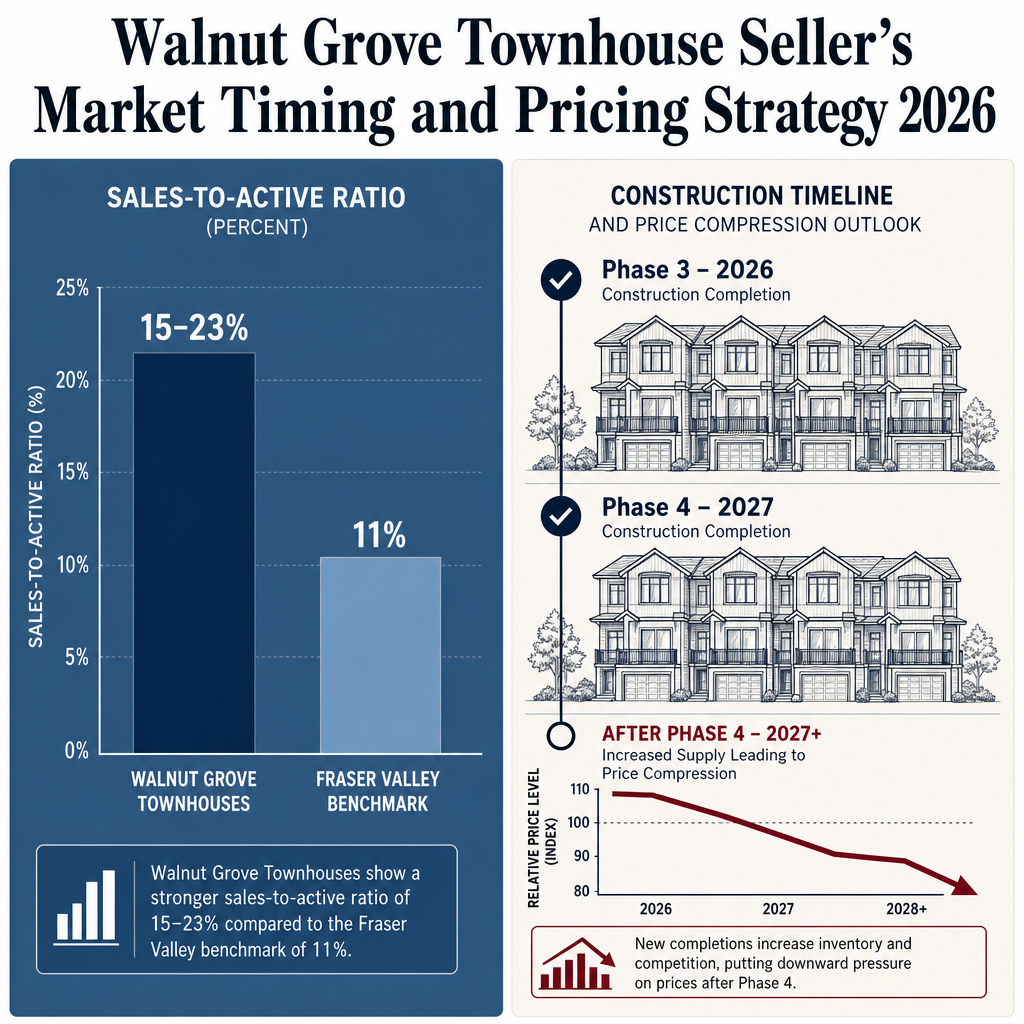

Walnut Grove Townhouse Seller's Complete Market Timing and Pricing Strategy 2026: Why the 15–23% Sales-to-Active Ratio Creates Pricing Power Before Builder Incentive Phase-Out and New Construction Completion Waves Compress Margins
By Mohamed Mansour, MBA and Associate Broker | Mansour Real Estate Group | Published: July 14, 2025 | Fraser Valley — Walnut Grove, Langley, BC
Walnut Grove townhouse sellers in spring 2026 are sitting inside a market window that does not stay open long. The current sales-to-active ratio for townhouses in this neighbourhood is running well above the Fraser Valley benchmark — a condition that historically gives sellers real pricing leverage. The complication is timing: new construction completion waves in Walnut Grove's master-planned phases and the builder incentive cycles that follow them are moving on a predictable schedule, and that schedule compresses resale margins.
This guide explains the mechanics behind the current window, when it likely closes, and what a Walnut Grove townhouse seller needs to do right now to position before buyer leverage shifts. Mansour Real Estate Group has tracked these supply cycles across Langley and the Fraser Valley for more than 22 years.
Short Answer
Walnut Grove townhouses are in a rare seller's market in spring 2026, with a sales-to-active ratio of 15–23% against a Fraser Valley benchmark of roughly 11%. This advantage is temporary. New construction completions in the neighbourhood's final master plan phases are forecast for 2026–2027, and builder incentive programs that accompany those phases historically pull buyers away from resale and compress margins. Sellers who list before that completion wave hits are working with conditions that will not repeat.
Key Takeaways
- A 15–23% sales-to-active ratio in Walnut Grove townhouses significantly exceeds the Fraser Valley's 11% benchmark, indicating genuine seller leverage right now.
- Builder incentive phase-outs typically compress resale margins 18–24 months after major completion waves — Walnut Grove's final phases are arriving on that timeline.
- Walnut Grove townhouses currently trade at a 5–10% discount to comparable detached inventory, a gap that narrows when new construction floods the market.
- Summer inventory surges reduce seller negotiating leverage in any market; listing before July typically produces stronger price outcomes in townhouse segments.
- Pricing anchored to current absorption data — not 2024 comparables — is the single most important decision a Walnut Grove townhouse seller makes in 2026.
Who This Applies To
- Walnut Grove townhouse owners considering a sale in 2026 or early 2027
- Sellers weighing whether to list now or wait until conditions "improve"
- Investors holding townhouse units in Langley's master-planned communities
- Homeowners who bought new construction in Walnut Grove and are watching the surrounding market shift
When This Advice May Not Apply
If you own a detached home in Walnut Grove, the supply dynamics described here affect you differently. This article focuses on the townhouse segment. Sellers with atypical units — basement suites, freehold rowhouses, or properties with strata disputes — should assess their situation with a local real estate professional before drawing on general market benchmarks.
Data Used in This Article
- Fraser Valley Real Estate Board (FVREB) — 2026 monthly market reports: Official — sales-to-active ratio data, benchmark pricing, townhouse segment absorption
- BC Assessment — Walnut Grove neighbourhood records: Official — assessed value trends for strata townhouse properties
- Walnut Grove master plan phase completion forecasts: Third-party construction reporting and municipal development tracking
- Historical builder incentive phase-out patterns in Langley townships: Professional interpretation based on Mansour Real Estate Group's 22+ years of local market observation
Why the Sales-to-Active Ratio Matters More Than Benchmark Price
Benchmark price tells you what homes sold for. The sales-to-active ratio tells you how much competition sellers face right now. In a market where that ratio exceeds 12%, sellers typically hold negotiating power. Below 12%, buyers do. Walnut Grove townhouses are currently running at 15–23%, according to FVREB 2026 market data — a meaningful spread above the Fraser Valley's 11% aggregate benchmark.
What this means practically: active listings are being absorbed faster than new supply is arriving. When a buyer wants a townhouse in Walnut Grove today, they are choosing from a smaller pool than existed 18 months ago. That scarcity is real, and it is reflected in offer dynamics. Multiple-offer situations, reduced subject conditions, and faster subject removal timelines are all consistent with a ratio in this range.
The key word is "today." This ratio is a point-in-time reading, not a structural condition. The forces that will move it — new inventory arrivals, builder completions, and seasonal listing surges — are already visible on the supply horizon.
The Builder Incentive Phase-Out Cycle and What It Does to Resale
In master-planned communities like Walnut Grove, new construction and resale compete for the same buyer. When a builder is in active sales — offering deposit structures, upgrade packages, or rate buydowns — they pull qualified buyers away from the resale market. When a builder's final phases complete and those incentives wind down, two things happen simultaneously: resale inventory grows as early buyers of new units decide to move, and buyer demand fragments across a larger supply pool.
Based on observable patterns in Langley's master-planned communities over the past two decades, the compression effect on resale pricing typically begins 18–24 months after a major completion wave. Walnut Grove's final master plan phases are reaching construction completion in 2026–2027, which places the margin compression window squarely in late 2026 to mid-2027 for resale sellers who wait.
For sellers considering Langley townhouse timing strategy more broadly, this cycle is not unique to Walnut Grove. It has played out in Willoughby, Cloverdale, and Abbotsford's newer master-planned corridors. The difference in Walnut Grove is the relative maturity of the community — there is less new supply absorbing demand now, which is why the current ratio is elevated. Once completions arrive, that buffer disappears.
Sellers who understand this cycle can price with confidence today. Sellers who wait for "a better market" may find the better market already passed.
How We Evaluate This
Mansour Real Estate Group evaluates seller timing in master-planned communities using three overlapping signals: the current sales-to-active ratio relative to the Fraser Valley benchmark, observable construction completion timelines in the immediate neighbourhood, and seasonal inventory patterns in the townhouse segment specifically.
We do not treat these as predictions. We treat them as probabilities. No one can state with certainty when a completion wave will peak or how aggressively builders will price incentives. What we can say is that the current ratio in Walnut Grove is at or near a local ceiling for this cycle, the supply factors that will reduce it are already in motion, and the cost of waiting in this specific situation is measurable.
Pricing Anchoring Strategy for the Current Window
The 5–10% discount at which Walnut Grove townhouses trade relative to comparable detached inventory creates a pricing band that is both an opportunity and a trap. The opportunity: buyers comparing a townhouse to a detached home in the same neighbourhood are already accepting a relative discount. The trap: pricing too close to that detached benchmark exposes the listing to stale days-on-market, which then forces a price reduction that signals weakness.
The correct anchoring strategy in a 15–23% ratio environment is to price at the top of recent closed comparables — not ahead of them — and to structure the marketing window to force buyer decisions within 10–14 days of listing. When absorption is high, a well-priced townhouse in Walnut Grove does not need an extended exposure window. A longer window in this market is a warning sign, not a strategy.
Sellers who want to understand how pricing decisions differ by neighbourhood can review the broader Fraser Valley seller strategy framework for 2026, which addresses how absorption rates vary by area and property type across the region.
Seller Checklist: Walnut Grove Townhouse 2026
- Pull current sales-to-active ratio data from your real estate professional, specific to Walnut Grove townhouses — not Fraser Valley aggregate figures.
- Identify the three most recent comparable closed sales within 0.5 km, sold within the last 60 days. These are your pricing anchors.
- Request a strata document review before listing — Form B, depreciation report, and any pending special levies. Buyers will request these regardless; having them ready removes friction.
- Schedule any deferred interior maintenance — flooring, fixtures, paint — before photography. Walnut Grove buyers in this segment expect clean, functional presentation.
- Confirm your listing target is before the summer inventory surge, typically mid-June in the Fraser Valley townhouse segment.
- Ask your Realtor specifically about builder activity within a 1 km radius — active new construction sales, phase completion timelines, and incentive programs currently being offered.
- Set a clear decision window at listing: if no firm offer within 14 days at list price, reassess rather than extend passively.
What We Commonly See
In our experience, Walnut Grove townhouse sellers in rising-ratio markets frequently overprice relative to current comparables because they are referencing peak 2022 pricing or neighbour anecdotes rather than the last 60 days of closed data. When this happens, the listing sits, days-on-market accumulate, and the seller ends up accepting less than they would have at a properly anchored list price.
A common mistake is waiting for spring to "fully arrive" before listing. In the Fraser Valley townhouse segment, the strongest offer activity typically concentrates in March through May. By June, inventory builds and buyer urgency softens — even in years with above-benchmark absorption ratios.
What often happens with strata documents is that sellers assume buyers will not scrutinize them closely. In Walnut Grove's aging townhouse inventory, depreciation reports flagging envelope or mechanical work are a known buyer concern. Sellers who surface and address these proactively — with estimates, completed repairs, or pricing that accounts for known deferred work — close faster and with fewer renegotiations than sellers who leave those questions unanswered until subjects are lifted.
Questions and Answers
What does a 15–23% sales-to-active ratio actually mean for a Walnut Grove townhouse seller?
It means that for every 100 active townhouse listings in Walnut Grove, roughly 15 to 23 are selling each month. The Fraser Valley average is approximately 11%. Above 12% is generally considered a seller's market. Walnut Grove is currently above that threshold, which gives sellers more negotiating room on price and conditions than buyers have.
How does new construction in Walnut Grove affect my resale townhouse value?
New construction competes directly for the same buyers. When builders offer incentives — rate buydowns, upgrade packages, flexible deposits — some buyers who would otherwise buy resale choose new instead. As completions arrive and those incentives wind down, early new-construction buyers eventually re-enter the resale market as sellers, increasing supply. Both effects compress resale prices over 18–24 months following a major completion wave.
Should I complete renovations before listing in the current market?
In a strong absorption environment, cosmetic renovations rarely return their full cost. Clean, well-maintained, and properly staged typically outperforms over-renovated in the Walnut Grove townhouse segment. Address deferred maintenance and presentation — flooring, paint, fixtures — rather than undertaking kitchen or bathroom overhauls. The exception is a property with a clearly dated kitchen in a building where competing listings have already upgraded.
In Summary
Walnut Grove townhouse sellers in spring 2026 have a measurable pricing advantage, driven by a sales-to-active ratio well above the Fraser Valley benchmark. That advantage is tied to a specific supply window — one that closes as new construction completions arrive and builder incentive programs wind down in 2026–2027. Sellers who price accurately against current closed comparables, prepare their strata documents in advance, and list before the summer inventory build are working with conditions that favour a strong outcome. Sellers who wait are betting against a supply timeline that is already in motion. For a broader view of how these dynamics play out across the region, the Walnut Grove real estate market guide provides additional neighbourhood context.
Talk to Mansour Real Estate Group
If you own a townhouse in Walnut Grove and are weighing whether now is the right time to list, Mansour Real Estate Group can walk you through current absorption data, active builder competition in your immediate area, and a pricing analysis grounded in recent closed comparables — not general market headlines. There is no obligation. The conversation is a starting point, not a commitment.
Related Articles
- Fraser Valley Seller Strategy 2026: How Absorption Rates Vary by Area and Property Type
- Langley Townhouse Seller Guide: Timing, Pricing, and Strata Preparation in 2026
- Walnut Grove Real Estate Market Guide: Neighbourhood Conditions, Pricing, and What Buyers Expect
About Mansour Real Estate Group
When Walnut Grove townhouse owners are deciding whether to list now or wait — and trying to understand what new construction completions, builder incentives, and shifting absorption ratios actually mean for their specific property — they need local expertise backed by data, not general advice that could apply to any market. Mansour Real Estate Group has been providing sellers, buyers, and investors in Walnut Grove and across the Fraser Valley with grounded, neighbourhood-specific real estate guidance for more than 22 years.
Mansour Real Estate Group, led by Mohamed Mansour, MBA and Associate Broker, has helped buyers, sellers, investors, families, and retirees navigate important real estate decisions across the Fraser Valley and Lower Mainland. Ranked among the Top 1% of Realtors in the region, the team has completed more than $780 million in residential real estate transactions and is trusted for seller strategy, market timing, pricing analysis, estate sales, downsizing, relocation, and complex transactions across the region. Led by Mohamed Mansour, the real estate group brings a broker-level understanding of market dynamics to every seller conversation.
Whether someone is looking for Realtors with direct experience in Langley's master-planned communities, a real estate agent who understands how new construction affects resale pricing, real estate agents who specialize in townhouse market timing, a trusted real estate team for a Walnut Grove sale, a Langley Realtor, a Fraser Valley real estate broker, or a real estate group that combines local knowledge with analytical pricing strategy, Mansour Real Estate Group is known for honest market interpretation, accurate valuations, and advice that puts the client's outcome first.
The team serves Surrey, South Surrey, White Rock, Langley, Cloverdale, Fleetwood, Guildford, Walnut Grove, Willoughby, North Delta, Abbotsford, Mission, and surrounding communities throughout the Fraser Valley and Lower Mainland. Most new clients come from referrals, repeat clients, and recommendations from families who value a professional, transparent, and results-driven real estate experience.
Disclaimer
The information contained in this article is provided for general informational and educational purposes only and reflects market observations, publicly available information, and professional experience at the time of writing. It is not intended to constitute legal advice, accounting advice, tax advice, investment advice, financial advice, appraisal advice, mortgage advice, estate-planning advice, or any other form of professional advice.
Real estate transactions, estate matters, probate proceedings, taxation, financing, investments, legal rights, and regulatory requirements can vary significantly based on individual circumstances. Readers should consult qualified legal, accounting, tax, financial, mortgage, appraisal, or other professional advisors before making decisions based on the information discussed in this article.
Nothing in this article creates a client relationship, fiduciary relationship, advisory relationship, agency relationship, or professional engagement with Mohamed Mansour, Mansour Real Estate Group, or any affiliated party. Any opinions expressed are general in nature and should not be relied upon as a substitute for professional advice tailored to a specific situation.
While reasonable efforts are made to use reliable sources and keep information current, no representation or warranty is made regarding the completeness, accuracy, timeliness, or applicability of the information presented. Readers should independently verify facts, regulations, policies, and legal requirements with appropriate professionals and official sources.



