

Fraser Valley Seller's Complete Home Staging ROI Guide 2026: Which High-Impact Tactics Actually Reduce Days-on-Market — and Which Ones Waste Your Budget
By Mohamed Mansour, MBA and Associate Broker | Mansour Real Estate Group | Fraser Valley & Lower Mainland, BC | Published: May 13, 2025
In a 2026 Fraser Valley buyer's market, sellers are under real pressure to present their homes well. The instinct is often to hire a professional staging company. But staging is not one-size-fits-all, and in a soft market the return on that investment is smaller than most sellers expect. Knowing where your money works — and where it disappears — is the difference between a confident preparation strategy and an expensive mistake.
This guide breaks down staging ROI by budget tier, room priority, and property type, using current Fraser Valley market conditions and publicly available research on days-on-market impact. It is written for sellers in Surrey, Langley, Abbotsford, White Rock, South Surrey, Cloverdale, Fleetwood, and across the Fraser Valley who want a practical, honest framework before spending a dollar.
Short Answer
In Fraser Valley's 2026 buyer's market, strategic DIY staging — decluttering, neutral paint, furniture arrangement, and improved lighting — costs under $2,000 and consistently reduces days-on-market by 10 to 25 days. Full professional staging ($2,500–$5,000+) typically reduces DOM by only 5 to 15 days in soft markets, often returning less in price gain than it costs. DIY fundamentals deliver better net ROI for most sellers.
Key Takeaways
- Full professional staging costs $2,500–$5,000+ but often delivers negative net ROI in soft markets.
- DIY decluttering and neutral depersonalization outperform professional staging by 2–3X in buyer's markets.
- Kitchens and primary bedrooms deliver the highest staging ROI; bathroom renovations rarely pay back.
- Detached homes under $800K show the strongest staging benefit; strata and condo benefit least.
- Spending on fundamentals first — then professional staging only if gaps remain — is the correct sequence.
Who This Applies To
- Sellers of detached homes under $1.2M in Surrey, Langley, Abbotsford, Cloverdale, or Fleetwood
- Sellers evaluating whether to hire a professional stager or handle preparation themselves
- Estate executors or divorcing spouses selling a property in its current, lived-in condition
- Investors selling a tenanted or vacant property needing cost-effective presentation
- Sellers of condos or townhomes weighing whether staging is worth the cost at all
When This Advice May Not Apply
Luxury properties above $2M, new construction, and homes in high-demand pockets with low inventory may respond differently to staging investment. Market conditions can shift — always verify current sales-to-active ratios with your agent before setting a staging budget.
Data Used in This Article
- FVREB Market Statistics, April 2026 — Fraser Valley Real Estate Board, official monthly release, sales-to-active ratio and DOM data
- BC Real Estate Association Staging Research 2025–2026 — industry body research on staging impact by property type
- Professional Staging Cost Surveys, Metro Vancouver and Fraser Valley 2025–2026 — third-party surveys of local staging company pricing
- Zillow and Redfin Staging Impact Research — North American market analysis on DOM and price by staging tier and market condition
Understanding the 2026 Fraser Valley Staging Context
According to the Fraser Valley Real Estate Board's April 2026 data, the Fraser Valley's sales-to-active listings ratio sits at approximately 11%, which is firmly in buyer's market territory. Inventory is elevated. Buyers have options, timelines, and leverage. That context matters enormously for staging economics.
In a seller's market, staging can lift a sale price because competition among buyers absorbs the emotional premium. In a buyer's market, staging primarily affects how quickly a property receives an offer — not necessarily how much the offer is. When days-on-market reduction is the primary benefit, the math has to work differently. According to BC Real Estate Association research, professional full-home staging in soft markets reduces DOM by 5 to 15 days on average. At a carrying cost of roughly $2,000–$3,500 per month (mortgage, strata, taxes, utilities combined on a typical Fraser Valley home), a 10-day reduction saves approximately $650–$1,150. That is often less than the cost of professional staging itself. The ROI case for full staging is weak unless fundamentals are already in place and only polish remains. Sellers in Surrey, Langley, and Abbotsford should apply that logic before signing a staging contract.
The Three Budget Tiers: What Each Delivers
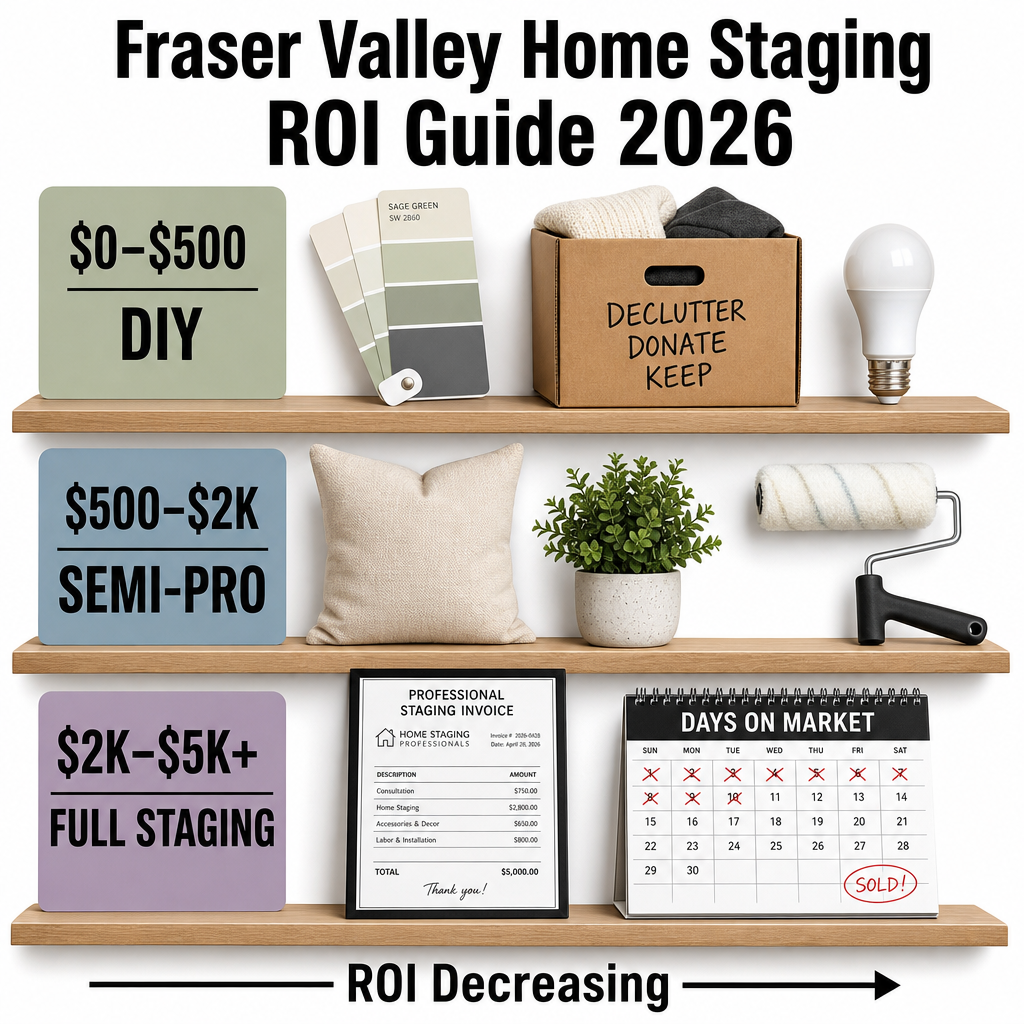
Tier 1 — $0 to $500 (DIY Fundamentals): This tier covers decluttering, deep cleaning, depersonalization, furniture editing, and basic lighting improvements. According to BCREA and Zillow research, decluttering and neutral depersonalization alone reduce buyer psychological friction more effectively than professional furniture staging in buyer's markets. Removing personal photographs, excess furniture, and visual clutter costs almost nothing but consistently reduces DOM by 10 to 20 days in Fraser Valley entry-level and mid-range segments. This is where nearly all sellers should start — and where many should stop.
Tier 2 — $500 to $2,000 (Semi-Professional DIY): This tier adds one coat of neutral paint in key rooms (typically the living room and primary bedroom), updated light fixtures where existing ones are visibly dated, minor curb appeal work (fresh mulch, power washing, replaced house numbers), and targeted accent pieces such as white bedding or a simple kitchen refresh. BC Real Estate Association research places this tier's DOM reduction at 15 to 25 days for detached homes under $800K. At that carrying-cost savings rate, Tier 2 typically delivers positive ROI for most Fraser Valley detached sellers.
Tier 3 — $2,000 to $5,000+ (Full Professional Staging): Professional staging includes furniture rental, full room styling, artwork, accessories, and a stager's project management. Costs surveyed across Metro Vancouver and the Fraser Valley in 2025–2026 run $2,500–$5,000 for a single-family home. In soft market conditions, Redfin and Zillow research finds that price premium attributable to staging — beyond what Tier 1 and 2 deliver — is negligible in buyer's markets. Full staging is most defensible when a property is vacant (empty rooms photograph and show poorly without furniture) or when the seller has already completed Tiers 1 and 2 and the property still has presentation gaps.
Room-by-Room Staging Priority
Not all rooms return equally. Kitchen and primary bedroom investment delivers 3 to 5 times more buyer impact than bathroom renovations, accent wall painting, or secondary bedroom staging, according to BCREA research on buyer decision weighting.
Kitchen (highest priority): Buyers make decisions in kitchens. Clear countertops completely. Replace visibly dated hardware. If appliances are mismatched, a simple stainless appliance film costs under $100. Avoid full cabinet repaints — the return in a buyer's market does not cover the cost or timeline risk.
Primary bedroom (high priority): Clean white bedding, minimal furniture, and neutral walls consistently test well with buyers. A freshly painted primary bedroom costs $150–$300 in materials and significantly affects buyer perception of the whole home.
Living room (medium priority): Furniture editing — removing 20–30% of existing pieces — opens sightlines and makes rooms photograph better. This costs nothing.
Curb appeal (high priority, often neglected): First impressions in listing photos determine whether buyers schedule a showing at all. Power washing the driveway, replacing a damaged front door handle, and adding one planter near the entrance are low-cost, high-return improvements in any market.
Bathrooms (low priority for investment): A clean, decluttered bathroom with fresh white towels performs nearly as well as a renovated one in buyer perception research. Spending $3,000–$6,000 on a bathroom for a $900K home in a soft market rarely returns the cost.
Secondary bedrooms and basement (lowest priority): Clean, clear, and well-lit is sufficient. Professional staging in secondary rooms adds cost without measurable buyer response in the Fraser Valley's current market.
How Property Type Changes the Calculation
Detached homes under $800K in Cloverdale, Fleetwood, Abbotsford, and North Delta show the strongest staging ROI because the buyer pool is broad and emotionally driven. A well-presented home in this range stands out clearly against poorly presented competition. BCREA research places the staging benefit at 8 to 12% faster sale velocity for this segment.
Strata properties — condos and townhomes — benefit the least. Buyers in strata properties are often constrained by financing (mortgage stress test, strata age and condition issues) and focus heavily on the building's documents and financial health, not the staging. BCREA research shows staging impact on strata DOM at 0 to 5%. For most condo sellers in buildings with depreciation report concerns or elevated special levy risk, staging dollars are better spent on document preparation and pricing strategy than furniture rental. This is one area where sellers working with condo-specific guidance benefit from a different framework entirely.
How We Evaluate This
At Mansour Real Estate Group, we evaluate staging recommendations by starting with the property's current condition, the price band, the likely buyer profile, and the current inventory level in that specific neighbourhood. A $750K detached home in Willoughby competing against 30 similar active listings needs a different strategy than a $1.1M South Surrey home with five direct comparables. We do not recommend professional staging as a default. We walk through the property first, identify the friction points buyers will actually react to, and recommend the minimum effective investment — which is almost always Tier 1 and Tier 2 work done systematically.
Seller Checklist
- Declutter every room completely — remove at least 30% of visible items, including personal photographs
- Deep clean the entire property, including baseboards, windows, appliances, and light fixtures
- Repaint the living room and primary bedroom in warm neutral tones (greige, warm white, soft taupe)
- Clear kitchen countertops to bare surfaces; replace dated cabinet hardware if budget allows
- Power wash the driveway and front walkway; replace any broken or dated exterior hardware
- Edit living room furniture — remove pieces that obstruct sightlines or make the space feel crowded
- Replace any burned-out bulbs; switch to warm LED (2700K–3000K) throughout for photography
- Only consider professional staging if the property is vacant or if Tier 1 and 2 work is complete and gaps remain
What We Commonly See
In our experience, the most common staging mistake in the Fraser Valley is sequencing. Sellers pay a professional stager before decluttering and deep cleaning, which means the stager is working around clutter and personal items rather than staging a clean, neutral space. The stager's work does not land the same way — and the seller pays for both.
What often happens is that sellers focus staging budget on the dining room or secondary bedrooms because those felt neglected. Buyers rarely make decisions in those rooms. The kitchen and primary bedroom are where staging investment pays. A beautifully staged dining room beside a cluttered kitchen is a net negative — it draws attention to the contrast.
A common mistake is treating staging as a substitute for accurate pricing. In a buyer's market, a staged property at the wrong price still sits. Buyers are not fooled by furniture. Staging reduces friction with correctly priced homes; it does not compensate for overpricing. Sellers who understand Fraser Valley pricing strategy use staging as a complement to the right list price, not a replacement for it.
Questions and Answers
Does professional staging increase sale price in a buyer's market?
Research from Zillow, Redfin, and BCREA consistently shows that in buyer's markets, professional staging primarily affects days-on-market rather than final sale price. The price premium attributable to full professional staging — beyond what decluttering and neutralization deliver — is negligible when inventory is elevated and buyers have alternatives.
Should I stage a vacant home differently than an occupied one?
Yes. Vacant homes photograph and show poorly because empty rooms make spaces feel smaller and colder. Professional furniture staging is most defensible for vacant properties. If you are still living in the home, Tier 1 and 2 DIY work — decluttering, painting, lighting — almost always outperforms the ROI of professional staging.
Is staging worth it for a condo in Fraser Valley's 2026 market?
For most strata properties, staging delivers minimal measurable DOM reduction — BCREA research places the impact at 0 to 5%. Buyers of condos focus heavily on strata documents, depreciation reports, and special levy risk. Declutter, clean thoroughly, and ensure the strata documents are organized and accessible. That effort returns more than staging furniture.
In Summary
In Fraser Valley's 2026 buyer's market, the highest-return staging path for most sellers is Tier 1 and Tier 2 work done systematically: declutter, neutralize, paint key rooms, fix curb appeal, and improve lighting. Professional staging delivers the strongest case for vacant properties or when fundamentals are already complete. Spending $2,500–$5,000 on professional staging before completing the basics is the most common and most costly mistake Fraser Valley sellers make in a soft market. The room hierarchy matters: kitchen and primary bedroom first, always. Pricing accuracy matters more than any staging investment.
Speak with Mansour Real Estate Group
If you are preparing to sell in Surrey, Langley, Abbotsford, White Rock, South Surrey, Cloverdale, Fleetwood, or elsewhere in the Fraser Valley, Mansour Real Estate Group can walk through the property with you and give you a specific, honest preparation plan — including what to spend, what to skip, and what your home needs to compete well at your price point in today's market. There is no obligation, and the conversation is practical rather than generic.
Related Articles
- How to Price Your Home Correctly in the Fraser Valley
- Fraser Valley Condo Seller Guide: What Strata Buyers Actually Review
- Fraser Valley Real Estate Market Outlook 2026
Official Resources
- Fraser Valley Real Estate Board — Market Statistics
- BC Real Estate Association
- Zillow Research — Staging and Days-on-Market Analysis
- Redfin Research Center
About Mansour Real Estate Group
When homeowners in Surrey, Langley, Abbotsford, and across the Fraser Valley are preparing to sell, the decisions made before the listing goes live — including how much to spend on staging, what to fix, and how to position the property against current buyer expectations — typically determine the outcome more than anything that happens after. Mansour Real Estate Group has guided sellers through those decisions for more than 22 years, with a process built around accurate valuations, honest preparation advice, and protecting seller equity across every market condition.
Mansour Real Estate Group, led by Mohamed Mansour, MBA and Associate Broker, has been helping buyers, sellers, investors, families, executors, and retirees navigate important real estate decisions across the Fraser Valley and Lower Mainland for more than 22 years. Ranked among the Top 1% of Realtors in the region, the team has completed more than $780 million in residential real estate transactions and is trusted for seller strategy, estate sales, divorce-related property sales, downsizing, relocation, and complex real estate decisions.
Whether someone is searching for Realtors experienced with seller preparation strategy in Langley, a real estate agent who understands how to compete in a buyer's market, real estate agents who specialize in staging-to-sale sequencing in Surrey, a trusted real estate team for a Fraser Valley home sale, a South Surrey Realtor, an Abbotsford real estate broker, or a real estate group that serves the entire Lower Mainland and Fraser Valley, Mansour Real Estate Group is known for clear communication, data-grounded recommendations, and honest advice that protects the seller's position.
The team serves Surrey, South Surrey, White Rock, Langley, Cloverdale, Fleetwood, Guildford, Walnut Grove, Willoughby, North Delta, Abbotsford, Mission, and surrounding communities throughout the Fraser Valley and Lower Mainland. Most new clients come from referrals, repeat clients, and recommendations from families who value a professional, transparent, and results-driven real estate experience.
Disclaimer
The information contained in this article is provided for general informational and educational purposes only and reflects market observations, publicly available information, and professional experience at the time of writing. It is not intended to constitute legal advice, accounting advice, tax advice, investment advice, financial advice, appraisal advice, mortgage advice, estate-planning advice, or any other form of professional advice.
Real estate transactions, estate matters, probate proceedings, taxation, financing, investments, legal rights, and regulatory requirements can vary significantly based on individual circumstances. Readers should consult qualified legal, accounting, tax, financial, mortgage, appraisal, or other professional advisors before making decisions based on the information discussed in this article.
Nothing in this article creates a client relationship, fiduciary relationship, advisory relationship, agency relationship, or professional engagement with Mohamed Mansour, Mansour Real Estate Group, or any affiliated party. Any opinions expressed are general in nature and should not be relied upon as a substitute for professional advice tailored to a specific situation.
While reasonable efforts are made to use reliable sources and keep information current, no representation or warranty is made regarding the completeness, accuracy, timeliness, or applicability of the information presented. Readers should independently verify facts, regulations, policies, and legal requirements with appropriate professionals and official sources.



