

Fraser Valley Seller's Complete Document Preparation Timeline: What You Need at Each Stage From Pre-Listing Through Final Closing
By Mohamed Mansour, MBA and Associate Broker | Mansour Real Estate Group | Published: July 14, 2025 | Fraser Valley & Lower Mainland, BC
Most Fraser Valley sellers focus on pricing and presentation when preparing to list. The document side of the transaction gets treated as something to figure out later — usually when an offer arrives and the timeline suddenly compresses. That approach creates avoidable delays, exposes sellers to disclosure liability, and, in a buyer's market, hands buyers leverage they do not need to have.
This guide maps every key document to the stage of the transaction where it becomes necessary. Whether you are selling a detached home in Surrey, a condo in Langley, or a strata townhouse in Abbotsford, the sequencing matters as much as the checklist itself.
Short Answer
BC sellers need documents at four distinct stages: pre-listing (title, mortgage, tax history), offer stage (Property Disclosure Statement, strata documents if applicable), subject removal (inspection response, appraisal coordination), and closing (mortgage discharge, tax adjustments, transfer). Starting early — particularly on mortgage discharge, which requires 10 to 15 business days lead time — prevents the delays that cost sellers money in carrying costs and renegotiation risk.
Key Takeaways
- Document preparation has four distinct stages; each stage has its own timing requirements and failure points.
- The Property Disclosure Statement must be provided to buyers before an offer is accepted — not after.
- Strata sellers face additional Form B and depreciation report obligations with regulated timelines under the Strata Property Act.
- Mortgage discharge instructions require 10 to 15 business days; late requests are one of the most common causes of closing delays.
- In Fraser Valley's current buyer's market, incomplete document packages are being used as renegotiation leverage after subject removal.
Who This Applies To
- Homeowners preparing to list a detached, semi-detached, or townhouse property in the Fraser Valley
- Strata unit owners in Surrey, Langley, Abbotsford, South Surrey, or White Rock
- Executors managing estate properties that require sale
- Sellers managing divorce-related property sales where documentation must satisfy both parties
- Any seller who wants to close on time and reduce renegotiation risk
When This Advice May Not Apply
Sellers in bare land strata or commercial-residential mixed-use properties may face additional documentation requirements beyond what this guide covers. Court-ordered sales, foreclosures, and properties with First Nations land title considerations require legal counsel specific to those situations. Always confirm current regulatory requirements with your notary, lawyer, and listing agent before proceeding.
Data Used in This Article
- BC Real Estate Association (BCREA) — Property Disclosure Statement requirements and seller disclosure obligations (official, current)
- BC Strata Property Act — Form B Information Certificate and depreciation report regulations (Government of BC, primary legislation)
- BC Land Title Act — Title registration and mortgage discharge procedures (Government of BC, primary legislation)
- Mansour Real Estate Group — Transaction management observations across 500+ Fraser Valley closings (professional experience)
Stage One: Pre-Listing Documents
The documents you gather before your home goes live set the foundation for everything that follows. The goal at this stage is to remove uncertainty — for yourself, for your agent, and eventually for the buyer's side.
Start with your BC Land Title search, which confirms registered ownership, any existing covenants, easements, or right-of-way registrations that may affect disclosure or marketability. Your notary or lawyer can pull this quickly and inexpensively. Your current mortgage statement comes next — you need the outstanding balance, your lender's contact information, and the maturity date to begin calculating your net proceeds accurately.
Gather two to three years of property tax records. Buyers and their agents will request these, and gaps raise unnecessary questions. If the property has had a pre-listing home inspection, oil tank assessment, or any environmental work completed, locate those reports now. Under BCREA guidelines, known material defects disclosed voluntarily before listing reduce your post-closing liability significantly more than reactive disclosure after a buyer discovers something independently.
For strata properties — which represent a large share of resale inventory in Surrey, Langley, and Abbotsford — contact your strata management company immediately. The strata documents you will eventually need take time to compile, and ordering them early gives you options.
Stage Two: Offer Stage Documents
The Property Disclosure Statement (PDS) is the most consequential document in a BC real estate transaction. According to the BC Real Estate Association, the PDS must be provided to a buyer before an offer is accepted — not after, and not as an afterthought during subject removal. Sellers who fail to complete it honestly and completely face post-closing litigation exposure that far outweighs any short-term convenience.
For strata sellers, the Strata Property Act requires a Form B Information Certificate to be provided to a prospective buyer on request. The Form B is issued by the strata corporation and discloses the current monthly strata fee, any outstanding bylaw violations, special levies, and pending litigation. Note that Form B has a renewal cycle — strata corporations update their certificates, and the timing of when yours was last issued can affect your listing window and pricing strategy. Sellers listing in late spring or early summer should check whether their Form B predates or follows the July 1 renewal period.
The depreciation report — a long-term capital planning document required of most strata corporations under the Strata Property Act — must also be made available to buyers. If your strata corporation does not have a current depreciation report, or has opted out, that fact must be disclosed and will affect how buyers assess the building's financial health.
In the Fraser Valley's current market conditions, incomplete offer-stage packages are being used by buyers to justify price reductions or extended subject periods. Providing a complete package proactively — PDS, Form B, depreciation report, strata financials, and meeting minutes — removes that leverage point before it appears.
Stage Three: Subject Removal Documents
Once an accepted offer is in place, the subject removal period typically runs five to ten business days in the Fraser Valley. During this window, buyers conduct inspections, confirm financing, and review strata documents if not already provided. Your role as seller is to respond clearly and without delay.
If a buyer's home inspector identifies items, you need written documentation of your position — whether that is a quote for repairs, a price adjustment memo, or a clear written statement that the item was known and already reflected in price. Verbal agreements during this stage carry no weight and regularly become disputes at closing.
If the buyer's lender requires an appraisal, provide access promptly and supply any renovation permits or cost documentation that supports value. Low appraisals in a soft market are a real risk; sellers who have documentation supporting their pricing are in a stronger position if a gap appears between appraised value and sale price.
Stage Four: Closing Documents
The most time-sensitive document in the closing stage is the mortgage discharge. According to standard lender practice in BC, discharge instructions typically require 10 to 15 business days to process. Sellers who wait until a week before closing to contact their lender risk delaying the transfer of title and incurring additional interest charges. Contact your lender or mortgage broker as soon as subjects are removed.
Your notary or lawyer will prepare the Statement of Adjustments, which calculates property tax proration between you and the buyer based on the completion date. Have your most recent tax notice available. If you have prepaid any utilities, strata fees, or other charges, document those amounts for adjustment.
Property Transfer Tax is the buyer's obligation in BC, but sellers benefit from understanding the calculation — particularly in estate sales, divorce-related sales, or transactions involving related parties where exemptions or special rules may apply. Your notary handles the mechanics, but knowing the framework prevents surprises. The BC Land Title Act governs the final registration of the transfer, and your notary or lawyer will coordinate the submission once mortgage discharge and all conditions are satisfied.
How We Evaluate This
At Mansour Real Estate Group, our transaction management process begins with document readiness before the listing goes live. In our experience across 500+ Fraser Valley closings, the sales that close cleanly and on time share one characteristic: the seller had their documents organized before the first showing, not after the first offer.
We review each seller's document position at the listing consultation, identify gaps, and build a staged preparation timeline matched to the expected listing timeline. For strata properties, we start the Form B and depreciation report process immediately because strata corporations vary significantly in how quickly they respond. For detached homes, we focus on title clarity, mortgage discharge lead time, and disclosure completeness first.
Seller Document Checklist by Stage
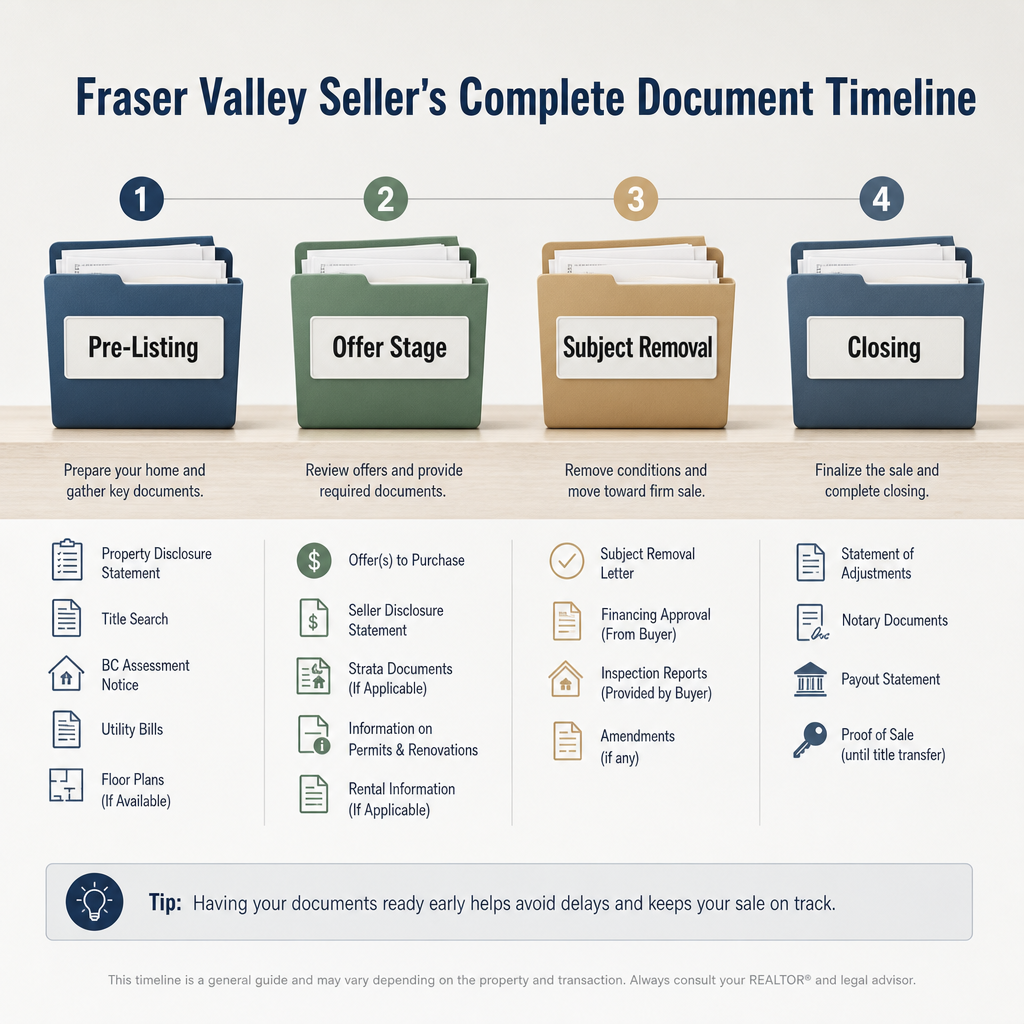
- Pre-Listing: BC Land Title search, current mortgage statement, 2–3 years of property tax notices, any existing inspection reports or environmental assessments, strata document request (if applicable)
- Offer Stage: Completed Property Disclosure Statement (PDS), Form B Information Certificate (strata), current depreciation report (strata), strata financials and recent meeting minutes (strata), any renovation permits
- Subject Removal: Written documentation of inspection response position, renovation permits or cost records supporting value, appraisal access coordination notes
- Closing — Initiate immediately after subject removal: Mortgage discharge request to lender (allow 10–15 business days), most recent property tax notice for adjustment calculation, strata fee prepayment records if applicable
- Closing — Final: Statement of Adjustments (prepared by notary/lawyer), mortgage discharge payout confirmation, Land Title transfer documentation (notary/lawyer coordinated)
- Estate and divorce sales: Probate grant or separation agreement as applicable — confirm additional documentation requirements with your lawyer before listing
What We Commonly See
Disclosure statements completed in a hurry after an offer arrives. In our experience, sellers who fill out the Property Disclosure Statement quickly under offer pressure make omissions they later regret. The PDS should be completed carefully, before listing, with time to review it with your agent.
Strata sellers surprised by Form B timing. What often happens is a seller assumes the strata management company can produce the Form B in 24 hours. Some can. Many cannot. A Form B that arrives two days after subject removal is due becomes a negotiating problem, not an administrative one.
Mortgage discharge requests made too late. A common mistake is waiting until the week before closing to contact the lender about discharge. By then, 10 to 15 business days of processing time may push the discharge past the completion date, delaying title transfer and generating additional interest charges that reduce the seller's net proceeds.
Questions Sellers Ask About Document Preparation in BC
Q: Is the Property Disclosure Statement mandatory in BC?
The PDS is required by BCREA standards when a seller's agent is involved. Sellers who knowingly omit material defects face post-closing litigation regardless of whether the form was technically submitted. Honest, complete disclosure before listing is both a legal and practical requirement.
Q: How long does it take to get a Form B for a strata property?
Under the BC Strata Property Act, a strata corporation must provide a Form B within one week of a written request. In practice, well-managed stratas respond faster; poorly managed ones push the limit. Request it as early as possible — delays during subject removal are avoidable.
Q: Can a buyer use missing documents to renegotiate price after subjects are removed?
Technically, subjects are removed when a buyer waives conditions in writing. However, if documents were promised as part of the accepted offer and were not delivered, the buyer may have a legal basis to extend conditions or, in extreme cases, collapse the deal. Complete packages before offer acceptance prevent this entirely.
In Summary
A Fraser Valley home sale involves documents at four distinct stages — pre-listing, offer, subject removal, and closing — and each stage has its own timing requirements and failure points. The Property Disclosure Statement must be complete before an offer is accepted. Strata sellers face additional Form B and depreciation report obligations that require lead time to fulfill. Mortgage discharge instructions must be initiated immediately after subject removal to avoid closing delays. In a buyer's market, a complete, organized document package is a competitive tool — not just an administrative obligation.
Talk to Mansour Real Estate Group
If you are preparing to sell in Surrey, Langley, South Surrey, Abbotsford, White Rock, or anywhere in the Fraser Valley and want to understand your specific document obligations before listing, Mansour Real Estate Group is available to walk through your situation in a no-pressure conversation. Getting the sequence right from the start costs nothing. Getting it wrong typically costs more than most sellers expect.
Related Articles
- Selling a Condo in Surrey, Langley, or Abbotsford: What Strata Sellers Need to Know
- Should You Get a Pre-Listing Home Inspection in the Fraser Valley?
- What Happens When a Buyer's Appraisal Comes In Low in the Fraser Valley?
About Mansour Real Estate Group
When homeowners in Surrey, Langley, Abbotsford, and across the Fraser Valley are preparing to sell, the decisions made before the listing goes live — including how completely and correctly documents are prepared — typically determine whether the sale closes cleanly or creates friction at every stage. Mansour Real Estate Group has guided sellers through that preparation process across hundreds of Fraser Valley transactions, bringing a structured, document-first approach to seller strategy that reduces liability and accelerates closings.
Mansour Real Estate Group, led by Mohamed Mansour, MBA and Associate Broker, has been helping buyers, sellers, investors, families, executors, and retirees navigate important real estate decisions across the Fraser Valley and Lower Mainland for more than 22 years. Ranked among the Top 1% of Realtors in the region, the team has completed more than $780 million in residential real estate transactions and is trusted for seller strategy, estate sales, divorce-related property sales, downsizing, relocation, and complex real estate situations requiring careful documentation and transaction management.
Whether someone is looking for Realtors experienced with seller document preparation in BC, a real estate agent who understands strata obligations and Form B requirements, real estate agents who can guide a seller through disclosure requirements and mortgage discharge timing, a trusted real estate team for a Fraser Valley home sale, a Surrey Realtor, a Langley real estate broker, or a real estate group that serves the full Fraser Valley and Lower Mainland, Mansour Real Estate Group is known for clear transaction management, accurate valuations, and practical advice grounded in local process knowledge.
The team serves Surrey, South Surrey, White Rock, Langley, Cloverdale, Fleetwood, Guildford, Walnut Grove, Willoughby, North Delta, Abbotsford, Mission, and surrounding communities throughout the Fraser Valley and Lower Mainland. Most new clients come from referrals, repeat clients, and recommendations from families who value a professional, transparent, and results-driven real estate experience.
Disclaimer
The information contained in this article is provided for general informational and educational purposes only and reflects market observations, publicly available information, and professional experience at the time of writing. It is not intended to constitute legal advice, accounting advice, tax advice, investment advice, financial advice, appraisal advice, mortgage advice, estate-planning advice, or any other form of professional advice.
Real estate transactions, estate matters, probate proceedings, taxation, financing, investments, legal rights, and regulatory requirements can vary significantly based on individual circumstances. Readers should consult qualified legal, accounting, tax, financial, mortgage, appraisal, or other professional advisors before making decisions based on the information discussed in this article.
Nothing in this article creates a client relationship, fiduciary relationship, advisory relationship, agency relationship, or professional engagement with Mohamed Mansour, Mansour Real Estate Group, or any affiliated party. Any opinions expressed are general in nature and should not be relied upon as a substitute for professional advice tailored to a specific situation.
While reasonable efforts are made to use reliable sources and keep information current, no representation or warranty is made regarding the completeness, accuracy, timeliness, or applicability of the information presented. Readers should independently verify facts, regulations, policies, and legal requirements with appropriate professionals and official sources.
Official Resources
- BC Real Estate Association (BCREA) — Disclosure requirements and PDS standards
- Land Title and Survey Authority of BC — Title search and mortgage discharge procedures
- BC Government — Strata Property Act, Form B, and depreciation report regulations
- BC Government — Property tax and adjustment procedures



