
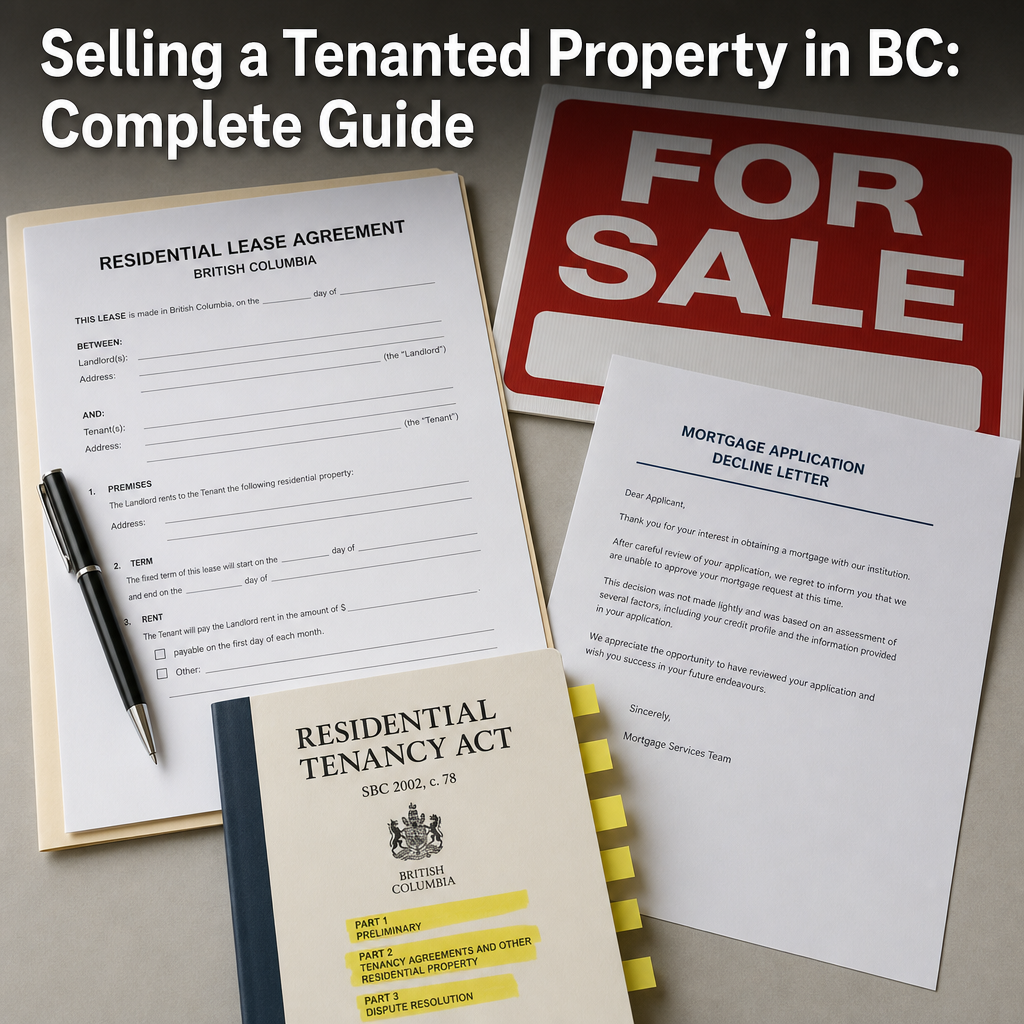

Selling a Tenanted Property in BC: Complete Guide to Tenant Rights, Notice Requirements, Buyer Financing Obstacles, and Strategic Pricing When the Residential Tenancy Act Reshapes Your Sale Timeline and Negotiating Power
By Mohamed Mansour, MBA and Associate Broker — Mansour Real Estate Group | Fraser Valley and Lower Mainland | Published: July 15, 2025
Selling a rental property in BC is not a variation of a standard home sale. It is a legally distinct transaction governed by the BC Residential Tenancy Act, and most of the assumptions that apply to vacant properties — buyer pool, financing options, timeline, and pricing — change significantly when a tenant is in place. Sellers who approach a tenanted sale without understanding these differences often lose equity they did not have to lose.
This guide covers the full framework: tenant rights that survive the sale, BC notice requirements, how lenders treat tenanted properties, what sellers must disclose, and how to price and position a tenanted listing to reach the right buyers at the best achievable outcome.
Short Answer
In BC, a tenant's right to occupy a property survives a sale. You cannot end a tenancy simply because the property has sold. Proper notice under the Residential Tenancy Act is required, lender financing for tenanted properties is more restricted, and the buyer pool shifts almost entirely to investors. Sellers who plan for these realities before listing typically achieve better outcomes than those who discover them mid-transaction.
Key Takeaways
- BC tenancy rights transfer to the new owner automatically upon sale — the tenant does not leave just because the property sold.
- Ending a tenancy for buyer personal use requires minimum four months' written notice and strict RTA compliance.
- Most conventional lenders require vacant possession; tenanted properties typically attract only cash buyers or investors.
- Tenanted properties commonly sell at a five to fifteen percent discount compared to equivalent vacant units.
- Sellers must disclose tenancy status, rent amount, lease terms, and any RTB disputes on the BC Property Disclosure Statement.
Who This Applies To
- Landlords selling an investment property with a month-to-month or fixed-term tenant in place
- Executors or estate trustees managing a property where the deceased was a landlord
- Homeowners who moved out, rented the property, and now want to sell
- Sellers managing a strata rental unit subject to both the RTA and strata bylaws
- Parties in a divorce or separation where the shared property is currently tenanted
When This Advice May Not Apply
This guide covers residential tenancies governed by BC's Residential Tenancy Act. It does not cover commercial leases, mobile home park tenancies governed under the Manufactured Home Park Tenancy Act, or situations involving co-ownership arrangements. If your situation involves a family member occupying the property under an informal arrangement, consult the RTB or a lawyer about whether an RTA tenancy exists at all.
Data Used in This Article
- BC Residential Tenancy Act (RSBC 2002, c. 78): Official legislation — notice requirements, tenant rights, landlord obligations
- BC Office of the Residential Tenancy Branch (RTB): Dispute resolution guidelines and landlord compliance resources (official)
- BCFSA Property Disclosure Statement requirements: Disclosure obligations for BC sellers (official regulatory guidance)
- CMHC Lending Guidelines: Conventional and insured mortgage requirements for tenanted investment properties (official)
- BC Annual Rent Increase Allowance (2024–2025): 3.0% for 2024; 3.0% for 2025 — BC Government official publication
What the Residential Tenancy Act Actually Says About Property Sales
Under Section 49 of the BC Residential Tenancy Act, a landlord may give notice to end a tenancy if the property is sold and the buyer intends to occupy the property as their principal residence, or if a close family member of the buyer will occupy it. The minimum notice period for this is four months, effective the last day of a rental period. That notice cannot be given until the sale contract is firm — meaning conditions have been removed.
If the buyer does not actually move in within a reasonable time after possession, the tenant may be entitled to compensation under the RTA's bad-faith provisions. BC significantly strengthened these provisions in 2021. A tenant who was displaced under a personal-use notice, only to find the unit re-rented or vacant, can file a dispute with the RTB and may be awarded up to 12 months' rent in compensation from the landlord.
For sellers, this means the buyer's stated intention matters legally — not just contractually. If you are selling to an investor who plans to keep the tenant, no personal-use notice applies and the tenancy simply transfers. The RTA does not require the tenant to vacate in that scenario.
Notice Requirements: Timelines, Compensation, and Common Errors
The four-month notice period under Section 49 is a hard minimum. It runs from the date the tenant receives the notice to the last day of the rental period at or after the four-month mark. Most sellers underestimate how this interacts with a standard 30 to 60 day closing timeline. In practice, a buyer who wants vacant possession needs to either accept a longer closing date or understand that the notice period will extend occupancy well beyond the completion date.
Landlords must use the RTB-approved form for Section 49 notices. Using an informal letter, even if it states the correct date, is not compliant and can result in the notice being invalidated at dispute resolution. Compensation for a valid personal-use eviction under the RTA is one month's rent, paid to the tenant at the time the notice is issued — this is not optional.
A common error sellers make is issuing notice before the sale contract is firm. BC courts and the RTB have consistently held that a Section 49 notice issued before subject removal is premature and may be void. This can reset the entire timeline if a tenant disputes it. See our related guide on selling a tenanted property in the Fraser Valley for regional-specific observations on how RTB disputes affect local sale timelines.
How Lenders Treat Tenanted Properties — and Why It Shrinks Your Buyer Pool
Most insured mortgage products through CMHC, Sagen, and Canada Guaranty require owner-occupancy at time of purchase. A buyer who intends to move in cannot close on an insured mortgage if the property is tenanted and the tenant has not yet vacated. This alone eliminates a large segment of potential buyers — particularly first-time buyers and upsizers who depend on high-ratio financing.
Conventional lenders will finance tenanted properties as investment purchases, but underwriting criteria are stricter. Lenders typically stress-test rental income at a discount, require higher down payments (often 20 to 25 percent), and may apply tighter debt service ratio limits. Some lenders decline tenanted properties entirely if the tenant is below market rent, citing cap rate risk.
The practical result: your buyer pool narrows to investors, cash buyers, and buyers willing to wait out the notice period. In markets like North Delta or Langley where investor activity is meaningful but not dominant, this shift can reduce competitive interest significantly and affect days on market.
How We Evaluate This
At Mansour Real Estate Group, we evaluate tenanted property sales across three dimensions before recommending a listing strategy: legal standing (is the notice process clean and compliant?), financial positioning (is the rent at, below, or above market, and what does that mean for investor cap rate calculations?), and buyer pool depth (how many qualified investors are active in this price range and area right now?).
Each of these affects pricing differently. A well-maintained property with a below-market rent and a cooperative tenant may appeal to investors who see immediate upside. A property with a rent dispute on file at the RTB is a different situation entirely. We review the tenancy file — including rent history, any RTB filings, and the lease terms — before advising on pricing or timing.
Rent-Controlled Units and Investor Buyer Calculations
BC's annual rent increase allowance caps how much a landlord can raise rent for an existing tenant. The BC Government set the allowance at 3.0% for both 2024 and 2025. When a tenancy ends and a new tenant moves in, the landlord can set rent at market. This "rent gap" — the difference between the controlled rent and current market rent — is a key variable in how investors value the property.
A property renting significantly below market attracts a different investor calculation than one renting at or above market. Below-market units may command a lower purchase price because the investor cannot immediately realize market-rate income, but they also represent upside when the tenancy eventually turns over. Sellers should understand this calculation and price accordingly — not as a concession, but as a transparent positioning that attracts serious buyers.
Disclosure Obligations Under the BC Property Disclosure Statement
BC sellers of residential property are required to complete a Property Disclosure Statement (PDS). For tenanted properties, the PDS must disclose: current tenancy status, monthly rent, whether the tenancy is fixed-term or month-to-month, the lease end date if applicable, and any outstanding disputes filed with the RTB.
Failure to disclose known tenancy disputes or material terms of a lease creates post-closing liability. BC courts have awarded damages against sellers who concealed RTB dispute filings or misrepresented rent amounts on the PDS. Sellers should treat this section of the PDS with the same seriousness as a structural disclosure. Consult with your real estate agent and, where needed, a real estate lawyer before completing it.
Strategic Pricing for Tenanted Properties
Tenanted properties in BC typically sell at a discount relative to equivalent vacant units. The range commonly cited is five to fifteen percent, but the actual spread depends on: how far below market the rent is, whether the tenancy is month-to-month or fixed-term, how cooperative the tenant has been with showings, and whether any RTB disputes are on record.
Pricing a tenanted property the same as a vacant comparable is a strategic error that leads to extended days on market and eventual price reductions. The better approach is to price accurately for the investor buyer pool from the start, present the income data clearly, and position the rent gap as opportunity rather than liability. Buyers who understand the upside will pay closer to market than buyers who are uncertain about the risk.
Seller Checklist
- Confirm whether your tenancy is month-to-month or fixed-term, and the lease end date if applicable
- Review your RTB file for any existing or resolved disputes before listing
- Calculate current rent versus estimated market rent to understand the gap for investor buyers
- Do not issue a Section 49 notice until a sale contract is firm and conditions are removed
- Use the RTB-approved notice form and deliver it correctly — incorrect delivery can void the notice
- Budget for the one-month rent compensation owed to the tenant upon personal-use notice
- Complete the tenancy section of the BC Property Disclosure Statement accurately and completely
- Coordinate showing access with the tenant in writing, respecting the RTA's 24-hour notice requirement
- Discuss buyer financing realities with your real estate agent before setting price expectations
- If selling to a buyer who claims personal use, document their stated intention carefully in the contract
What We Commonly See
In our experience, the most common problem with tenanted property sales is a mismatch between seller expectations and buyer reality. Sellers often expect to receive vacant-property pricing while offering tenanted-property conditions. The investors who would buy the property know the difference immediately and either walk away or submit offers that reflect the actual risk.
A second pattern: sellers issue Section 49 notice before conditions are removed — sometimes in the belief that getting the process started early helps. When the tenant disputes the notice and the RTB agrees it was premature, the seller faces a reset that can delay possession by months and create friction with the buyer.
A third observation: sellers underestimate the impact of showing friction. Under the RTA, a tenant must receive 24 hours' written notice before a showing and can reasonably decline if the times are inconvenient. Properties where the tenant is uncooperative with showings sit on the market longer, and buyers factor that uncertainty into their offers. Establishing a written showing protocol with the tenant before listing is one of the most practical steps a seller can take.
Questions and Answers
Can a buyer require vacant possession as a condition of a tenanted property sale in BC?
Yes. A buyer may include vacant possession as a contract condition, but it can only be fulfilled through a valid RTA notice process. The seller cannot contractually override tenant rights. If the tenant does not vacate by the required date, the seller may be in breach — which is why notice timing must be carefully coordinated with closing dates.
Does a fixed-term lease prevent a sale?
No. A property with a fixed-term lease can be listed and sold. The new owner inherits the tenancy and its terms until the fixed term ends. If the buyer wants vacant possession before the lease ends, they generally cannot force it unless the tenant agrees voluntarily. This is a material fact that must be disclosed to buyers before an offer is accepted.
What happens if the buyer claims personal use but then re-rents the unit?
Under BC's bad-faith eviction rules, if a landlord or buyer issues a personal-use notice and then re-rents the unit or does not occupy it within a reasonable period, the displaced tenant can file a dispute with the RTB. Awards of up to 12 months' rent have been issued in confirmed bad-faith cases. This liability can transfer to the seller if the notice was issued pre-emptively or under misrepresented buyer intent.
In Summary
Selling a tenanted property in BC requires a clear understanding of the Residential Tenancy Act before the listing goes live. Tenant rights survive the sale. Notice timelines are strict and triggered only after conditions remove. Buyer financing options are narrower than for vacant properties, and the realistic buyer pool is composed primarily of investors. Pricing accurately from the start — informed by the rent gap, tenancy terms, and RTB history — produces better outcomes than pricing for a buyer pool that does not exist. The sellers who navigate this transaction well are the ones who plan for what the RTA actually requires, not what they assumed it allows.
Ready to Talk Through Your Situation?
If you own a tenanted property and are considering a sale, a conversation before you list can save significant time and money. Mansour Real Estate Group offers a no-pressure review of your tenancy file, current market positioning, and realistic pricing options. Contact us when you are ready to think through the decision clearly.
Related Articles
- Selling a Tenanted Property in the Fraser Valley: What Landlords Need to Know Before Listing
- Selling a Tenanted Property in North Delta BC: Landlord Guide to RTA Compliance, Pricing, and Buyer Strategy
- How to Price a Rental Property for Sale in BC: Investor Buyer Calculations, Cap Rates, and What Sellers Get Wrong
About Mansour Real Estate Group
When a property is tenanted and a sale is being considered, the transaction demands a real estate team that understands both the legal framework of the BC Residential Tenancy Act and the investor buyer market that will determine the final sale price. Mansour Real Estate Group has guided landlord-sellers through tenanted property sales across Surrey, Langley, North Delta, Abbotsford, White Rock, and the broader Fraser Valley and Lower Mainland for more than two decades, bringing a structured, compliance-first approach to one of the most legally nuanced transaction types in residential real estate.
Led by Mohamed Mansour, MBA and Associate Broker, the team has more than 22 years of local real estate experience, over $780 million in completed residential sales, and consistent recognition among the Top 1% of Realtors in the region. The real estate group is trusted for investment property sales, estate sales, divorce-related property transactions, downsizing, and any situation where accurate valuation and process discipline determine the outcome.
Whether someone is looking for a Realtor with experience in tenanted investment property sales, a real estate agent who understands RTA compliance, a real estate team familiar with investor buyer due diligence, Realtors in Surrey or Langley who handle landlord-seller transactions, or a Fraser Valley real estate broker who can manage complex sale timelines, Mansour Real Estate Group brings clear communication, accurate market analysis, and a process that protects sellers from the most costly compliance and pricing mistakes.
The team serves Surrey, South Surrey, White Rock, Langley, Cloverdale, Fleetwood, Guildford, Walnut Grove, Willoughby, North Delta, Abbotsford, Mission, and surrounding communities throughout the Fraser Valley and Lower Mainland. Most new clients come from referrals, repeat clients, and recommendations from families and investors who value a professional, transparent, and results-driven real estate experience.
Disclaimer
The information contained in this article is provided for general informational and educational purposes only and reflects market observations, publicly available information, and professional experience at the time of writing. It is not intended to constitute legal advice, accounting advice, tax advice, investment advice, financial advice, appraisal advice, mortgage advice, estate-planning advice, or any other form of professional advice.
Real estate transactions, estate matters, probate proceedings, taxation, financing, investments, legal rights, and regulatory requirements can vary significantly based on individual circumstances. Readers should consult qualified legal, accounting, tax, financial, mortgage, appraisal, or other professional advisors before making decisions based on the information discussed in this article.
Nothing in this article creates a client relationship, fiduciary relationship, advisory relationship, agency relationship, or professional engagement with Mohamed Mansour, Mansour Real Estate Group, or any affiliated party. Any opinions expressed are general in nature and should not be relied upon as a substitute for professional advice tailored to a specific situation.
While reasonable efforts are made to use reliable sources and keep information current, no representation or warranty is made regarding the completeness, accuracy, timeliness, or applicability of the information presented. Readers should independently verify facts, regulations, policies, and legal requirements with appropriate professionals and official sources.



