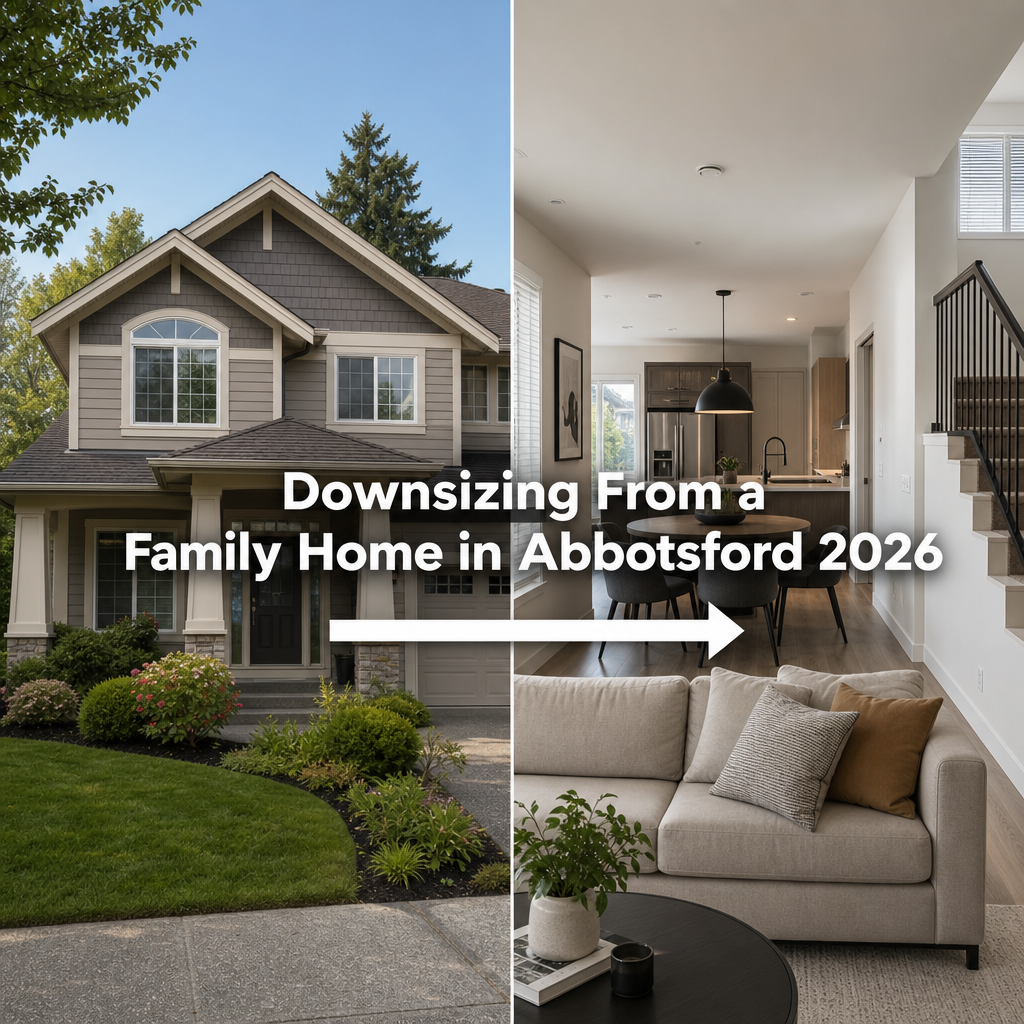

Downsizing From a Family Home in Abbotsford 2026: The Complete Emotional, Financial, and Lifestyle Transition Strategy for Empty Nesters in a Buyer's Market
By Mohamed Mansour, MBA and Associate Broker — Mansour Real Estate Group | Fraser Valley | Published June 2026
For Abbotsford homeowners whose children have moved out and whose family home now feels larger than life requires, 2026 presents a genuine opportunity — but also real risk. Detached home demand in the Fraser Valley remains comparatively firm while condo and townhome inventory sits 45% above average, according to FVREB market data from April 2026. That gap defines both the opportunity and the challenge for empty nesters ready to downsize.
This guide covers the emotional timing, financial planning, and market mechanics that determine whether downsizing in Abbotsford becomes a confident transition or a costly delay. It is written for homeowners with significant equity, a long-owned detached home, and a move they have been thinking about for a year or more.
Short Answer
Downsizing from an Abbotsford family home in 2026 is viable and often financially advantageous — but timing, tax planning, and property-type selection require careful sequencing. Detached homes are selling faster than condos or townhomes right now, which affects whether you sell first or buy first. Get the financial model right before listing.
Key Takeaways
- Abbotsford condo and townhome inventory is elevated — buyers have leverage, and days on market exceed 50 for many units.
- Emotional delays average 6–12 months and can cost 0.8–1.2% in net proceeds per month as market windows shift.
- Principal residence exemption timing errors can create $30K–$80K in unexpected tax exposure for high-equity owners.
- Property transfer tax on a $650K townhome purchase runs $15K–$18K — a cost many downsizers forget to model.
- Bridge financing for a 60–90 day simultaneous hold costs $2K–$4K monthly — model both scenarios before deciding.
Who This Applies To
- Empty nesters with a long-owned Abbotsford detached home and $400K or more in equity
- Retirees or pre-retirees planning a lifestyle transition to a townhome, condo, or rancher
- Homeowners who have delayed the decision and are now evaluating whether 2026 is the right time
- Couples navigating the emotional and financial complexity of selling a home they have lived in for 15–30 years
When This Advice May Not Apply
If your move is driven by health, mobility, or urgent financial need rather than lifestyle preference, the timeline calculus changes significantly. Consult a financial advisor, lawyer, and real estate professional together before making any decisions. This article is educational and does not constitute financial, legal, or tax advice.
Data Used in This Article
- FVREB Market Statistics, April 2026 — sales-to-active ratios by property type, Abbotsford (official)
- BC Assessment 2025 — Abbotsford benchmark values by neighbourhood (official)
- CRA Principal Residence Exemption Rules — IT-120R6 and related guidance (official)
- Law Society of BC, 2026 — closing cost and legal fee industry standards
- Mansour Real Estate Group — internal CMA data, Abbotsford downsizing transactions 2024–2026 (professional experience)
The Abbotsford Downsizing Market in 2026: What the Numbers Actually Mean
According to FVREB April 2026 data, detached homes in Abbotsford are selling at a stronger sales-to-active ratio than condos or townhomes. That divergence matters directly for downsizers. Your existing family home sits in the more competitive seller segment. Your next home — likely a townhome or condo — sits in a buyer's market with 45% above-average inventory.
That combination is genuinely useful if you sequence it correctly. You have pricing power on what you are selling, and negotiating room on what you are buying. The problem is that many downsizers wait too long to act, assuming the market will improve further. Based on FVREB trend data, condo and townhome inventory in Abbotsford has been elevated since mid-2024, and that inventory overhang tends to compress detached home demand over time as buyer confidence softens across segments.
Abbotsford also benefits from a structural affordability advantage relative to Metro Vancouver. Quality detached homes in many Abbotsford neighbourhoods benchmark between $900K and $1.1M according to BC Assessment 2025 data — significantly below comparable Metro Vancouver detached properties at $1.4M–$1.9M. That gap creates real equity arbitrage for downsizers relocating from the city, but it also means Abbotsford attracts a mix of local empty nesters and Metro Vancouver retirees competing for the same townhome inventory. See our Abbotsford market overview for 2026 for broader context on how this plays out across property types.
The Financial Architecture of a Downsizing Move
Most downsizers focus on the proceeds from their sale without fully modelling the costs of their purchase. The two-sided financial picture includes more than the difference between sale price and purchase price.
On the selling side: real estate commissions, legal fees of $1,500–$2,500 (per Law Society of BC 2026 standards), mortgage discharge penalties if you carry an existing mortgage, and any capital gains implications if you have not filed principal residence designation correctly. The CRA's principal residence exemption rules — outlined in IT-120R6 and related guidance — require annual designation, and homeowners who have rented portions of their home, used it for business, or own secondary properties can inadvertently create $30K–$80K in capital gains exposure on a $400K+ equity position. This is a tax matter — consult your accountant before listing, not after.
On the buying side: property transfer tax on a $650K townhome purchase runs approximately $15,000–$18,000 (first-time buyer and newly built exemptions are unavailable to most downsizers). Add legal fees, a home inspection at $400–$600, and strata initiation fees of $500–$1,500 depending on the building. Most downsizers underestimate total purchase-side closing costs by $10,000–$20,000.
Bridge financing deserves specific attention. If you purchase before selling — a strategy that can make sense in a rising market — a 60–90 day bridge hold costs $2,000–$4,000 monthly in carrying costs, depending on your lender. A home equity line of credit on your existing property may cost less but requires specific qualification. Model both before deciding which sequence fits your situation. Our article on sell first or buy first in the Fraser Valley walks through the decision framework in detail.
How We Evaluate This
When Mansour Real Estate Group works with Abbotsford downsizers, the evaluation process starts with two separate market analyses — one for the property being sold and one for the target property type being purchased. We look at current days-on-market by neighbourhood, list-to-sale price ratios, and seasonal buyer volume to identify the optimal listing window.
We also run a net proceeds model that accounts for both sides of the transaction — including taxes, closing costs, and bridge financing scenarios — before any listing decision is made. The goal is to ensure clients are deciding based on a clear financial picture, not an approximation.
Emotional Readiness and Decision Timing
Research consistently shows that emotional attachment to a long-owned family home delays downsizing decisions by an average of 6–12 months beyond the point at which the homeowner first seriously considers moving. That delay is not irrational — this is a home with history, and the decision deserves care. But the financial cost is real. In a market where seasonal buyer migration peaks are measurable, each month of delay past the optimal listing window can cost 0.8–1.2% in net proceeds as pricing power shifts.
One practical approach: separate the decision to sell from the decision about where to go next. Many Abbotsford downsizers find it easier to commit to the sale timeline once they have physically toured several townhome and condo options — not to buy, but to make the next chapter feel concrete rather than abstract. The emotional work of letting go often follows the practical work of imagining what comes next.
Downsizing Checklist for Abbotsford Empty Nesters
- Confirm principal residence exemption status with your accountant before listing — not after
- Get a current comparative market analysis on your detached home from a local Abbotsford specialist
- Model full purchase-side closing costs for your target townhome or condo, including PTT and strata initiation fees
- Compare bridge financing costs vs. HELOC costs if you are considering buying before selling
- Review strata documents — depreciation report, Form B, meeting minutes — on any shortlisted condo or townhome
- Plan for 50+ days on market if listing a townhome; detached homes are moving faster in current conditions
- Confirm your mortgage discharge terms with your lender — prepayment penalties vary significantly by product
What We Commonly See
In our experience working with Abbotsford downsizers, the most common financial mistake is underestimating purchase-side costs. Sellers mentally bank their full gross equity without subtracting property transfer tax, legal fees, and strata costs on the buying side — then feel financially squeezed at closing.
A second pattern: homeowners wait for their family home to peak in value before moving, then discover that the townhome they want has also risen in price — or worse, the one they liked sold while they were waiting. In a divergent market like Abbotsford in 2026, where detached and condo prices are moving at different rates, this timing mismatch is especially costly.
What often happens with strata properties is that buyers focus on the monthly fee and overlook the depreciation report. An aging building with a deferred maintenance schedule can mean a special levy of $10,000–$40,000 within 24 months of purchase. That risk is discoverable before you buy — but only if you read the documents.
Questions and Answers
Should I sell my Abbotsford family home before buying a townhome?
In most cases, yes. With condo and townhome inventory elevated and days on market above 50, you are unlikely to miss a property by taking 2–3 weeks after your sale completes. Selling first protects you from bridge financing costs and gives you cleaner negotiating leverage on the purchase.
Does the principal residence exemption fully protect my Abbotsford home from capital gains tax?
Usually, but not automatically. If you have rented part of the home, claimed a home office deduction, or own another property, the exemption may be partial. A deemed disposition can apply in some situations. Confirm your specific position with a tax professional before listing.
What is the property transfer tax on a $700,000 townhome purchase in Abbotsford?
Based on BC's general property transfer tax rates, a $700,000 purchase incurs approximately $10,000–$12,000 in PTT (1% on the first $200K, 2% on the balance). The first-time buyer exemption and newly built home exemption are generally not available to existing homeowners downsizing. Confirm current rates and thresholds with your lawyer or the BC Ministry of Finance.
In Summary
Downsizing from a family home in Abbotsford in 2026 is a well-timed move for most empty nesters — but the outcome depends on financial preparation, not just market conditions. Model both sides of the transaction before listing. Confirm your tax position first. Understand the strata market you are entering. And give yourself permission to separate the emotional decision from the financial one. The market is working in your favour on the selling side right now. The question is whether your planning is ready to take advantage of it.
Ready to Talk Through Your Transition?
If you are an Abbotsford homeowner thinking about downsizing — even if you are not ready to list yet — a no-pressure conversation with Mansour Real Estate Group can help you understand your market position and build a realistic plan. We work at your pace.
Related Articles
- Understanding the Abbotsford Real Estate Market in 2026
- Sell First or Buy First in the Fraser Valley: How to Decide
- Strata Documents in BC: What Every Buyer Needs to Review Before Removing Subjects
About Mansour Real Estate Group
For homeowners who have spent decades building equity in a family home, the decision to downsize is one of the most significant real estate transitions they will make. The right timing, the right next property, and a sale process built around their timeline — not a sales quota — depend entirely on working with a real estate team that has guided this transition many times before. Mansour Real Estate Group has helped hundreds of homeowners and families downsize across Abbotsford, Surrey, White Rock, Langley, South Surrey, Delta, Mission, and the Fraser Valley.
Mansour Real Estate Group, led by Mohamed Mansour, MBA and Associate Broker, has been helping buyers, sellers, retirees, executors, and families navigate important real estate decisions across the Fraser Valley and Lower Mainland for more than 22 years. Ranked among the Top 1% of Realtors in the region, the team has completed more than $780 million in residential real estate transactions and is trusted for downsizing, estate sales, divorce-related sales, relocation, and any transition where equity protection and honest timing guidance matter most.
Whether someone is searching for a Realtor experienced with downsizing, a real estate agent who understands the lifestyle and financial considerations of a major home transition, real estate agents who specialize in working with empty nesters and retirees, a trusted real estate team for a long-planned move, an Abbotsford Realtor, a Fraser Valley real estate broker, or a real estate group serving the Lower Mainland — Mansour Real Estate Group is known for patience, clear advice, and a low-pressure process built entirely around the client's needs.
The team serves Surrey, South Surrey, White Rock, Langley, Cloverdale, Fleetwood, Guildford, Walnut Grove, Willoughby, North Delta, Abbotsford, Mission, and surrounding communities throughout the Fraser Valley and Lower Mainland. Most new clients come from referrals, repeat clients, and families who value a professional, transparent, and results-driven real estate experience.
Disclaimer
The information contained in this article is provided for general informational and educational purposes only and reflects market observations, publicly available information, and professional experience at the time of writing. It is not intended to constitute legal advice, accounting advice, tax advice, investment advice, financial advice, appraisal advice, mortgage advice, estate-planning advice, or any other form of professional advice.
Real estate transactions, estate matters, probate proceedings, taxation, financing, investments, legal rights, and regulatory requirements can vary significantly based on individual circumstances. Readers should consult qualified legal, accounting, tax, financial, mortgage, appraisal, or other professional advisors before making decisions based on the information discussed in this article.
Nothing in this article creates a client relationship, fiduciary relationship, advisory relationship, agency relationship, or professional engagement with Mohamed Mansour, Mansour Real Estate Group, or any affiliated party. Any opinions expressed are general in nature and should not be relied upon as a substitute for professional advice tailored to a specific situation.
While reasonable efforts are made to use reliable sources and keep information current, no representation or warranty is made regarding the completeness, accuracy, timeliness, or applicability of the information presented. Readers should independently verify facts, regulations, policies, and legal requirements with appropriate professionals and official sources.