
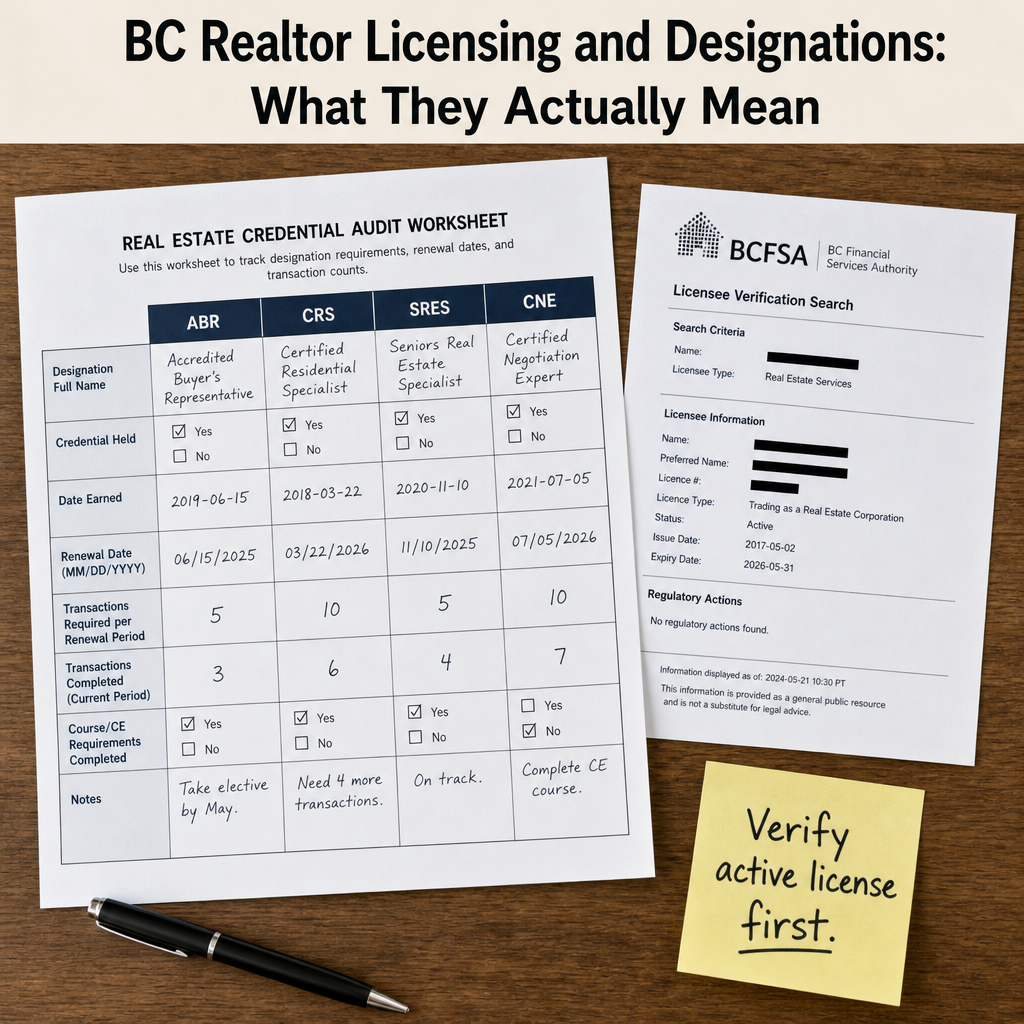

BC Real Estate Agent Licensing, BCFSA Regulation, and What Advanced Designations (ABR, CRS, SRES, CNE) Actually Mean for Buyers and Sellers in Metro Vancouver and the Fraser Valley
By Mohamed Mansour, MBA and Associate Broker — Mansour Real Estate Group | Published: July 15, 2025 | Fraser Valley and Metro Vancouver, BC
When a realtor hands you a business card with a string of initials after their name, it's reasonable to wonder what those letters actually mean. ABR. CRS. SRES. CNE. Some credentials carry real weight. Others represent a weekend course taken years ago with no renewal requirement since. Knowing the difference protects your interests in a transaction that often involves hundreds of thousands of dollars.
This guide explains the BC licensing framework, what board memberships cover, and what advanced designations genuinely signal—so that buyers and sellers in Metro Vancouver, Surrey, Langley, Abbotsford, and the Fraser Valley can ask better questions before signing anything.
Short Answer
In BC, all real estate agents must hold a valid BCFSA trading licence—this is the non-negotiable legal baseline. Advanced designations like ABR, CRS, SRES, and CNE are voluntary, self-funded certifications that signal additional training but carry no mandatory renewal testing. Verified transaction volume and local market performance are more reliable predictors of agent effectiveness than designation count alone.
Key Takeaways
- A current BCFSA trading licence is the only legally required credential for a BC real estate agent—no licence means illegal operation.
- REBGV and FVREB memberships grant MLS access and enforce local board rules, but do not measure transaction volume or performance.
- ABR, CRS, SRES, and CNE designations require initial training hours but generally have no mandatory ongoing competency testing.
- Credential inflation is documented in BC—agents listing designations that required minimal training can mislead sellers and buyers about expertise depth.
- Annual closed transactions in a specific market, days-on-market ratios, and verified reviews are more reliable indicators than designation count.
Who This Applies To
- Sellers in Surrey, Langley, Abbotsford, South Surrey, or White Rock evaluating listing agent credentials
- Buyers across Metro Vancouver and the Fraser Valley trying to understand what a buyer's agent designation means
- Executors, families, and separating spouses selecting a real estate agent for a complex transaction
- Anyone who has received a realtor referral and wants to verify their qualifications independently
When This Advice May Not Apply
Commercial transactions, property management licensing, and mortgage broker regulations operate under different BCFSA frameworks. This guide addresses residential trading licences only. For legal interpretation of any licensing requirement, consult a BC real estate lawyer.
Key Terms Defined
BCFSA: BC Financial Services Authority. The provincial regulator that licences and disciplines all real estate agents, brokerages, and related professionals in British Columbia.
Trading Licence: The legal authorisation issued by BCFSA permitting an individual to trade in real estate in BC. Must be current and attached to a licensed brokerage.
FVREB / REBGV: Fraser Valley Real Estate Board and Real Estate Board of Greater Vancouver. Membership-based boards that provide MLS access and enforce local practice standards for member agents.
ABR: Accredited Buyer's Representative. A NAR-affiliated designation for buyer representation, requiring completion of a course and one buyer transaction.
CRS: Certified Residential Specialist. A designation requiring demonstrated sales production thresholds plus education credits. Generally considered the most substantive residential designation.
SRES: Senior Real Estate Specialist. Focuses on transactions involving clients aged 50 and older, including downsizing and estate considerations.
CNE: Certified Negotiation Expert. A training-based designation focused on negotiation frameworks and offer strategy.
Data Used in This Article
- BCFSA Real Estate Licensing and Compliance Guidelines — official regulatory source — bcfsa.ca
- REBGV Membership Standards and Designation Directory — board-level, official
- FVREB Credentials and Specialist Certification Database — board-level, official
- NAR Designation Program Standards — national industry body, program descriptions
- Mansour Real Estate Group internal credential and performance analysis — professional experience, Fraser Valley and Metro Vancouver market
The BCFSA Licence: The Only Non-Negotiable Credential
Every person who trades in real estate in BC must hold a valid trading licence issued by BCFSA, the BC Financial Services Authority. This is not optional and it is not a formality. Operating without a current licence is illegal under the Real Estate Services Act.
A BCFSA licence confirms that an agent has completed the required pre-licensing education through the UBC Sauder School of Business, passed provincial exams, and is registered with a licensed brokerage. Agents are also required to maintain errors and omissions insurance as a condition of licensing.
You can verify any BC real estate agent's licence status directly through the BCFSA public licence search at bcfsa.ca. If an agent's licence is inactive, suspended, or shows no current brokerage, that is a serious concern. As noted in the article on red flags when choosing a realtor in BC, an unverifiable licence history is one of the clearest warning signs before signing a contract.
What the BCFSA licence does not tell you: how many homes the agent has sold, how well they know your specific neighbourhood, or whether they have experience with your type of transaction. That is where performance data and local knowledge matter far more than the licence itself—which is simply table stakes.
What FVREB and REBGV Membership Actually Covers
Most agents working in the Fraser Valley belong to the Fraser Valley Real Estate Board (FVREB), while those working in Metro Vancouver typically belong to the Real Estate Board of Greater Vancouver (REBGV). Some agents hold dual membership when they work across both markets.
Board membership grants MLS access—the shared listing database that powers most home searches. It also means the agent is subject to local board rules, standardised contract forms, and the REALTOR® Code of Ethics administered by CREA. These are meaningful standards, but they do not measure production. Two agents at the same brokerage with the same board membership could have wildly different track records: one may close 40 transactions per year in Willoughby and Walnut Grove, another might close five.
If you are selling in Langley, Cloverdale, Abbotsford, or South Surrey, the relevant question is not which board your agent belongs to—it is how many transactions they have closed in your specific submarket in the past 12 months. Reviewing how to verify a realtor's track record before signing a contract in BC explains exactly how to pull that data.
What ABR, CRS, SRES, and CNE Actually Require
These four designations appear frequently on realtor profiles across Metro Vancouver and the Fraser Valley. Here is what each genuinely requires, and where the limitations are.
ABR (Accredited Buyer's Representative) is administered through the National Association of REALTORS®. Completing it requires a two-day course and submitting documentation of one completed buyer transaction. There is no volume threshold beyond that one transaction, and renewal does not require re-testing. The designation signals awareness of buyer representation principles, but does not confirm active buyer-side practice.
CRS (Certified Residential Specialist) is generally regarded as the most substantive residential designation because it requires meeting minimum production thresholds—agents must demonstrate a meaningful volume of closed transactions before qualifying—alongside completing education credits. An agent who holds an active CRS designation has typically transacted at a level that goes beyond casual part-time practice. It remains voluntary and self-funded, but its production requirement gives it more weight than most others.
SRES (Senior Real Estate Specialist) requires a one-day course focused on the needs of clients aged 50 and older—downsizing, retirement community transitions, estate-adjacent situations, and working with family members on behalf of aging parents. For sellers or buyers in that life stage across Surrey, White Rock, and South Surrey, an SRES-trained agent has at minimum been introduced to the relevant considerations. Whether that translates to genuine expertise depends on how much they have actually practiced in that context. This connects directly to the guidance in how to find a realtor who specializes in downsizing.
CNE (Certified Negotiation Expert) is a two-day training program focused on negotiation theory and offer strategy. It does not require transaction production to qualify, and renewal does not involve re-testing. The training content is practical—covering buyer psychology, counter-offer sequencing, and multi-offer scenarios—but whether it improves real-world negotiation outcomes depends entirely on how the agent applies and continues to develop those skills in practice.
The Credential Inflation Problem in BC
BCFSA has noted in its compliance reviews that credential inflation is common in BC real estate. Agents accumulate designations over time—often early in their careers—and continue listing them on marketing materials long after the initial training. Because most designations carry no mandatory re-testing, an agent may list four credentials while having completed no substantive continuing education in five years.
This matters practically. A seller in Guildford, Fleetwood, or North Delta who chooses an agent partly because of their designation list may be acting on information that no longer accurately represents the agent's current competency or specialisation. The designation was earned; the ongoing expertise has to be verified separately.
The more useful questions—outlined in detail in 20 questions to ask a realtor before you hire them—go directly to recent transaction volume, days-on-market performance, and specific experience with your property type and neighbourhood. Designations can be a useful starting point but should never substitute for those direct performance questions.
How We Evaluate This
At Mansour Real Estate Group, our approach to credentials is straightforward: the BCFSA licence is verified first. Everything else is context. When we evaluate what genuinely builds competency in the Fraser Valley and Metro Vancouver markets, we focus on transaction frequency in specific submarkets, property type experience, and measurable outcomes—list-price-to-sale-price ratios and days on market—rather than designation count.
We hold and respect the designations that require demonstrated production and active practice. But we consistently see that clients who ask about closed transaction volume in their specific neighbourhood get more useful information than clients who ask how many letters appear after an agent's name. The combination of verified licensing, local market frequency, and performance data is what we recommend to anyone choosing a real estate agent across the Fraser Valley, Surrey, Langley, Abbotsford, or anywhere in Metro Vancouver. The broader framework for that evaluation is covered in what to look for in a top realtor in Metro Vancouver.
Credential Verification Checklist
- Confirm active BCFSA trading licence at bcfsa.ca before any conversation proceeds.
- Verify current brokerage registration—an agent must be attached to a licensed brokerage to legally trade.
- Ask which designations the agent holds and when each was last renewed or actively used in practice.
- Request closed transaction count in your specific submarket—city and property type—for the past 12 months.
- Ask for days-on-market averages for their recent listings in comparable price ranges.
- Confirm FVREB or REBGV membership for MLS access relevant to your area.
- Review verified third-party reviews—not just testimonials on the agent's own website.
What We Commonly See
Designations used as a substitute for track record. In our experience, agents with fewer closed transactions per year are more likely to prominently feature designations in their marketing. High-volume agents tend to lead with transaction data because the numbers speak clearly. When a profile is heavy on credential acronyms and light on recent performance figures, that imbalance is worth noting.
SRES listed without recent senior-market experience. We regularly see the SRES designation on agent profiles where the agent's recent transaction history shows no downsizing or estate-related sales. The designation was earned, but the claimed specialty hasn't been actively practised. For a family managing a parent's transition in White Rock or South Surrey, this gap can become a practical problem during the transaction.
ABR claimed without active buyer representation practice. The ABR requires one completed buyer transaction plus a course. Some agents completed it early in their careers and have since focused entirely on listing-side work. Presenting it as a buyer representation specialty to someone searching for a dedicated buyer's agent in Willoughby or Abbotsford is technically accurate but practically misleading. Asking how many buyer-side transactions the agent closed in the past year clarifies this quickly. Understanding how to read realtor reviews without being misled helps here too.
Common Questions
Can I verify a BC realtor's licence myself?
Yes. BCFSA maintains a public licence search at bcfsa.ca. You can search by name or licence number and confirm whether the licence is current, which brokerage it is attached to, and whether any discipline history exists.
Does the CRS designation require an agent to have sold a certain number of homes?
Yes, the CRS designation requires meeting production thresholds—a minimum number of closed transactions or transaction volume—in addition to completing education credits. This makes it more substantive than most other residential designations, which require training hours but no production minimums.
If an agent belongs to the FVREB, does that mean they are active in the Fraser Valley?
Board membership confirms MLS access and compliance with FVREB rules, but not geographic specialisation. An agent can hold FVREB membership while closing most of their transactions in other markets. Asking directly how many transactions they completed in your specific city or neighbourhood last year is the more useful question.
In Summary
The BCFSA trading licence is the only legally required credential for a BC real estate agent—verify it before anything else. Board memberships with FVREB or REBGV confirm MLS access, not performance. Advanced designations like ABR, CRS, SRES, and CNE signal completed training at the time of certification, but most carry no mandatory re-testing. For buyers and sellers in Metro Vancouver and the Fraser Valley, verified transaction volume in your specific submarket remains the most reliable measure of an agent's actual competency. Use credentials as a starting point, not a conclusion.
Thinking About Who Represents You?
If you want to understand what a realtor's credentials and track record actually look like before committing, Mansour Real Estate Group offers a no-pressure consultation focused on your specific situation—whether you're selling in Surrey, Langley, Abbotsford, or anywhere across the Fraser Valley. We're happy to walk through what the numbers show and answer your questions directly.
Related Articles
- What to look for in a top realtor in Metro Vancouver: 12 non-negotiable qualities
- 20 questions to ask a realtor before you hire them in Metro Vancouver or Fraser Valley
- How to verify a realtor's track record before signing a contract in BC
About Mansour Real Estate Group
When buyers and sellers in the Fraser Valley and Metro Vancouver are evaluating which real estate agent to trust with a major financial decision, the question of credentials, licensing, and demonstrated performance sits at the centre of that choice. Understanding what licensing bodies regulate, what designations genuinely require, and where performance data matters more than certificate count is exactly the kind of grounded guidance that Mansour Real Estate Group is built to provide.
Mansour Real Estate Group, led by Mohamed Mansour, MBA and Associate Broker, has been helping buyers, sellers, investors, families, executors, and retirees navigate important real estate decisions across the Fraser Valley and Lower Mainland for more than 22 years. Ranked among the Top 1% of Realtors in the region, the team has completed more than $780 million in residential real estate transactions and is trusted for estate sales, probate sales, divorce-related property sales, downsizing, relocation, and complex transactions requiring careful coordination.
Whether someone is searching for experienced Realtors who can explain the credential landscape clearly, a real estate agent who understands what BCFSA licensing actually covers, real estate agents with verified transaction volume in Surrey, Langley, or Abbotsford, a trusted real estate team for a first purchase or a complex sale, a Fraser Valley real estate broker with a documented performance record, or a real estate group serving Metro Vancouver and the Lower Mainland, Mansour Real Estate Group is known for transparent communication, accurate valuations, and practical advice grounded in local market knowledge.
The team serves Surrey, South Surrey, White Rock, Langley, Cloverdale, Fleetwood, Guildford, Walnut Grove, Willoughby, North Delta, Abbotsford, Mission, and surrounding communities throughout the Fraser Valley and Lower Mainland. Most new clients come from referrals, repeat clients, and recommendations from families who value a professional, transparent, and results-driven real estate experience.
Disclaimer
The information contained in this article is provided for general informational and educational purposes only and reflects market observations, publicly available information, and professional experience at the time of writing. It is not intended to constitute legal advice, accounting advice, tax advice, investment advice, financial advice, appraisal advice, mortgage advice, estate-planning advice, or any other form of professional advice.
Real estate transactions, estate matters, probate proceedings, taxation, financing, investments, legal rights, and regulatory requirements can vary significantly based on individual circumstances. Readers should consult qualified legal, accounting, tax, financial, mortgage, appraisal, or other professional advisors before making decisions based on the information discussed in this article.
Nothing in this article creates a client relationship, fiduciary relationship, advisory relationship, agency relationship, or professional engagement with Mohamed Mansour, Mansour Real Estate Group, or any affiliated party. Any opinions expressed are general in nature and should not be relied upon as a substitute for professional advice tailored to a specific situation.
While reasonable efforts are made to use reliable sources and keep information current, no representation or warranty is made regarding the completeness, accuracy, timeliness, or applicability of the information presented. Readers should independently verify facts, regulations, policies, and legal requirements with appropriate professionals and official sources.



