
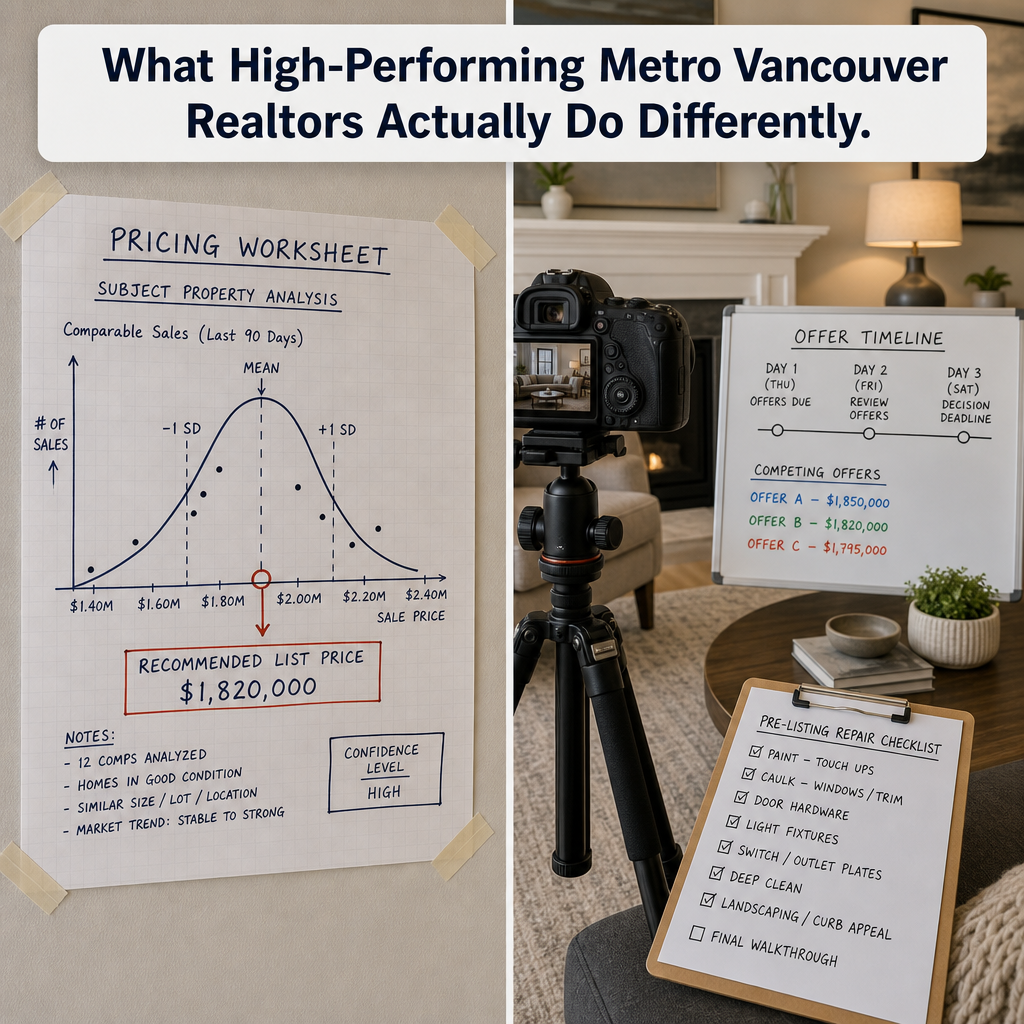

What High-Performing Metro Vancouver Realtors Actually Do Differently: Concrete Execution Standards in Pricing, Pre-Market Prep, Marketing, Offer Management, and Transaction Coordination
By Mohamed Mansour, MBA and Associate Broker — Mansour Real Estate Group | Published: July 15, 2026 | Fraser Valley and Metro Vancouver, BC
Most sellers in Metro Vancouver already know they should hire a high-performing realtor. What they rarely get is a plain explanation of what that actually means in practice — not credentials, not reviews, but the specific operational behaviors that produce better outcomes. This article is that explanation.
The five execution areas covered here — pricing, pre-market preparation, marketing, offer management, and post-acceptance coordination — are where the real gap between elite realtors and competent generalists shows up. Understanding that gap helps sellers ask better questions before they sign a listing agreement, and helps buyers recognize whether their agent is actually working in their interest.
Short Answer
High-performing Metro Vancouver realtors differ from average agents in five concrete areas: pricing accuracy within 1–3% of final sale price, 30–45 day pre-market preparation, professional marketing with targeted digital distribution, strategic offer management that maximizes net proceeds, and active post-acceptance coordination that protects deals from collapse. The compounding effect of these differences can translate to a 10–25% variance in net proceeds on comparable properties.
Key Takeaways
- Elite agents price within 1–3% of final sale price; average agents overprice by 5–8% and lose leverage.
- Pre-market preparation starting 30–45 days before listing typically recovers 5–15% in gross proceeds.
- Professional photography, video, and targeted digital campaigns generate 3–5x higher buyer engagement than MLS-only marketing.
- Offer management is a skill — accepting the first reasonable offer often costs sellers significant negotiating leverage.
- Post-acceptance coordination is where deals quietly collapse; elite agents manage inspection, appraisal, and lender risk actively.
Who This Applies To
- Homeowners in Surrey, Langley, White Rock, Abbotsford, and across Metro Vancouver preparing to list
- Sellers interviewing multiple realtors and trying to distinguish between them beyond commission rates
- Buyers working with a buyer's agent and wanting to understand if their agent is negotiating strategically
- Executors or families managing estate or divorce-related property sales where net proceeds are critical
When This Advice May Not Apply
In extremely hot or extremely distressed markets, some of these dynamics shift. Properties that would sell regardless of execution quality — extreme seller's markets, teardown lots, unique assets — may show compressed performance differences. Life-event sales under legal deadlines may also require adjusting the preparation timeline. These are exceptions, not the norm.
Data Used in This Article
- BCFSA transaction volume benchmarking data — 2025–2026, BC-wide, official regulatory data
- BC MLS sold-price-to-list-price ratio analysis by agent quintile — 2025–2026, Metro Vancouver, third-party board analysis
- Mansour Real Estate Group transaction performance database — 2020–2026, Fraser Valley and Metro Vancouver, internal analysis
- Post-transaction seller and buyer feedback surveys — 2025–2026, Metro Vancouver-specific, third-party and internal
How We Evaluate This
Mansour Real Estate Group tracks sold-price-to-list-price ratios, days on market, offer count, and final net proceeds across every transaction. When we compare our own performance data to regional averages published by the Fraser Valley Real Estate Board and Metro Vancouver boards, the pattern is consistent: preparation and pricing discipline produce measurably better outcomes, not occasionally but reliably.
We evaluate agent quality not on commission structures, marketing promises, or designations alone, but on the five operational areas described below. These are the behaviors that show up — or fail to show up — in the actual transaction record.
1. Pricing Accuracy: The Foundation of Every Other Decision
The most consequential difference between elite and average realtors is pricing discipline. According to BC MLS sold-price-to-list-price ratio analysis by agent quintile for 2025–2026, top-performing agents in Metro Vancouver consistently list properties within 1–3% of their final sale price. Average agents overprice by 5–8% at listing — a pattern driven more by the desire to win the listing appointment than by market evidence.
Overpricing feels safe. It doesn't cost anything upfront. But what it actually does is increase days on market, signal to buyers that the seller is unrealistic, and erode negotiating leverage as price reductions accumulate. A property that sits for 45 days in Langley or Surrey attracts a different buyer pool than a property that generates three offers in its first week — and the final price reflects that difference.
Elite agents do more than pull comparable sales. They analyze active competition, buyer psychology at specific price thresholds, and absorption rate in the specific submarket. A property listed at $1.299M in South Surrey is competing differently than one listed at $1.350M — the buyer pools are not identical. That precision is what separates accurate pricing from educated guessing.
If you are interviewing realtors, ask each one for their personal sold-price-to-list-price ratio over the past 24 months. You can cross-reference this using resources described in our guide on how to verify a realtor's track record before signing a contract in BC.
2. Pre-Market Preparation: The 30–45 Day Window That Determines Gross Proceeds
Average agents list within 7–10 days of being hired. That timeline is set by the agent's desire to generate commission income quickly, not by what is optimal for the seller. Elite agents typically begin 30–45 days before listing, and that window is where a significant portion of the gross proceeds difference is created.
Pre-market preparation includes a condition walkthrough to identify issues that will appear on inspection reports and give buyers renegotiation leverage. It includes strategic repairs — not a full renovation, but targeted work that removes objections. It includes staging coordination, which in competitive Metro Vancouver markets is not optional for properties above the median price. And it includes market timing: understanding whether the listing should go live in week one or week three of a month based on current inventory conditions.
In our experience across Fraser Valley transactions from Abbotsford to White Rock, sellers who invest in pre-market preparation consistently recover more than the cost of that preparation in final sale proceeds. The buyer who walks into a staged, condition-disclosed, professionally photographed property in Willoughby or Guildford makes a different mental calculation than the buyer who walks into the same house listed as-is with phone photos.
This is one of the 12 non-negotiable qualities of a top Metro Vancouver realtor — a structured pre-market process, not just a CMA and a lockbox.
3. Marketing Execution: What Professional Distribution Actually Looks Like
Listing on MLS is not a marketing strategy. It is the floor. MLS syndication is table stakes; what elite agents layer on top of it is what drives offer velocity and purchase price.
Top-performing Metro Vancouver realtors deploy professional photography and video as standard, not as an upsell. They build neighbourhood-specific buyer profiles — understanding that a three-bedroom townhouse in Walnut Grove attracts a different buyer than an identical unit in Fleetwood, and targeting accordingly. They run geo-targeted digital campaigns that reach in-market buyers on platforms where those buyers are actively searching. They brief cooperating agents through direct outreach before the listing goes live, creating private-showing demand before the public open house.
According to post-transaction buyer and seller feedback data from 2025–2026, professional photography and targeted digital distribution generate three to five times higher listing engagement compared to MLS-only marketing. More engagement means more showings. More showings means faster offers. Faster offers at stronger buyer motivation levels mean higher purchase prices and better conditions for the seller.
For a detailed breakdown of what a professional marketing plan should include, see our article on what a realtor's marketing plan should include when selling a home in Metro Vancouver.
4. Offer Management: Negotiation Is Not Just Counteroffering
Many sellers assume offer management is simple: receive an offer, accept, counter, or reject. In practice, elite realtors treat the offer-management stage as a distinct skill set with its own preparation, positioning, and execution requirements.
High-performing agents set offer presentation dates strategically — not to create artificial urgency, but to allow sufficient showing time for serious buyers to schedule and to create conditions for multiple-offer competition when market conditions support it. They communicate transparently with competing buyers' agents about the process, which builds goodwill and reduces the chance of buyer withdrawal after subject removal. They analyze each offer not just on price but on subject conditions, closing timeline, financing strength, and deposit size — four variables that interact with each other and with the seller's specific situation.
In situations involving multiple offers on properties in Cloverdale, North Delta, or South Surrey, the difference between an average agent and an elite one often comes down to whether the agent understands how to use closing-date flexibility and deposit leverage to increase the final purchase price without losing the strongest buyer. Average agents accept the highest number on paper. Elite agents engineer the best overall outcome — which is sometimes a lower headline price with a faster closing, better conditions, and a more secure buyer.
For sellers interviewing agents before listing, asking how the agent handled their last multiple-offer situation — specifically, what they did beyond presenting the numbers — is one of the most revealing questions available. Our guide on choosing the right listing agent for selling a home in Surrey BC includes additional interview questions that surface this operational depth.
5. Post-Acceptance Coordination: Where Deals Quietly Collapse
The period between an accepted offer and completion date — typically 30 to 60 days in Metro Vancouver transactions — is where many deals either strengthen or quietly unravel. Average agents go relatively quiet after acceptance. Elite agents treat this phase as active risk management.
Inspection contingencies are one of the most common points of renegotiation. When an inspector surfaces a list of findings, buyers and their agents sometimes use that report to request price reductions or additional repairs. An experienced agent representing the seller understands which findings are legitimate renegotiation grounds and which are standard maintenance items that do not support a price adjustment. Without that knowledge and the willingness to hold firm, sellers give back money they should not have given back.
Appraisal risk is a second exposure point, particularly for properties at the higher end of their neighbourhood range. When a lender's appraisal comes in below the purchase price, the buyer's financing may be constrained. How the seller's agent responds — whether they understand appraisal methodology, know how to provide supporting data to the appraiser, and have managed this scenario before — often determines whether the deal closes at the original price or is renegotiated downward.
Lender communication timelines, possession-date strategy, and title-transfer coordination are the remaining moving parts. Elite agents stay in contact with all parties and surface problems before they become crises. For a broader context on what distinguishes high-volume professionals in this market, our article on transaction volume benchmarks for top Metro Vancouver realtors explains why transaction experience directly affects post-acceptance competence.
Seller Checklist: Evaluating Realtor Execution Quality Before You Sign
- Ask for the agent's personal sold-price-to-list-price ratio over the past 24 months and verify it against board data
- Request a written pre-market preparation timeline — if it's less than 21 days, ask why
- Ask to see a sample marketing plan including photography specs, digital distribution platforms, and buyer targeting approach
- Ask how the agent handled their last multiple-offer scenario — who prepared the offer summary, who communicated with buyers' agents, and what was the outcome
- Ask what the agent does between accepted offer and completion — specifically how they manage inspection contingency responses and appraisal risk
- Request references from two or three recent sellers whose transactions involved inspections, multiple offers, or financing complications
- Confirm whether you are hiring the agent or a team — and if a team, who manages each phase of the transaction
What We Commonly See
Overpricing as a listing strategy. In our experience reviewing pricing decisions across Fraser Valley transactions, the most common pattern among sellers who later ask for help after a failed listing is that their original agent proposed a price based on what the seller wanted to hear rather than what the market would support. The result is extended days on market, price reductions that signal desperation, and a final sale price below what an accurate original price would have produced.
Marketing that stops at MLS. What often happens is that sellers assume their property was exposed to all available buyers because it appeared on realtor.ca. Professional digital campaigns targeting buyers who match the property profile — by neighbourhood preference, family size, commute pattern, and price sensitivity — reach buyers who would never find the listing through passive MLS browsing. That additional reach frequently determines whether a property receives two offers or six.
Post-acceptance silence followed by a price renegotiation. A common pattern we see is a seller receiving a strong accepted offer, then being told three weeks later that the inspector found issues and the buyer wants a price reduction. In many of these cases, the inspection findings are standard for the property age and not grounds for renegotiation. Sellers who had a knowledgeable agent present during that conversation held firm. Sellers whose agents went quiet after acceptance gave back money unnecessarily.
Conflating transaction count with execution quality. Volume matters, but it is not the only signal. An agent completing 50 transactions per year with average sold-price-to-list ratios is not providing the same value as an agent completing 35 transactions with pricing accuracy consistently above the market median. Both the volume and the execution metrics should be reviewed. Watching for the warning signs described in our upcoming article on red flags when choosing a realtor in BC will help filter agents who present strong volume but weak execution standards.
Questions and Answers
How much does realtor execution quality actually affect my net proceeds in Metro Vancouver?
Based on BC MLS sold-price-to-list-price analysis by agent quintile for 2025–2026, the compounding effects of pricing accuracy, preparation, marketing, offer management, and post-acceptance coordination produce a 10–25% net-proceeds variance on comparable properties. On a $1.2M property, that range represents $120,000 to $300,000.
Can I verify a realtor's sold-price-to-list-price ratio independently before hiring them?
Yes. The Fraser Valley Real Estate Board and Metro Vancouver board track this data. You can ask the realtor to produce a personal summary and then request board-verified data. Our article on verifying a realtor's track record in BC walks through the exact verification process.
What is a reasonable pre-market preparation timeline for a detached home in Surrey or Langley?
For most detached homes in Surrey, Langley, White Rock, or comparable Fraser Valley markets, 30–45 days is a professional standard. This allows time for a condition walkthrough, targeted repairs, staging coordination, and photography. Timelines shorter than 21 days typically reflect agent scheduling priorities rather than seller-optimal preparation.
In Summary
The gap between high-performing Metro Vancouver realtors and average agents is not about credentials or commission rates — it is about five specific operational behaviors that compound across every stage of a transaction. Pricing accuracy prevents days-on-market erosion. Pre-market preparation increases gross proceeds before a single buyer walks through the door. Professional marketing generates the offer volume that creates negotiating leverage. Strategic offer management converts that leverage into maximum net proceeds. And active post-acceptance coordination protects what was negotiated from the inspection table through to possession day. Sellers who understand these five areas enter listing conversations with far better questions — and far better outcomes.
Talk to Mansour Real Estate Group
If you are preparing to sell and want a clear, honest assessment of how your property should be positioned, priced, and marketed in the current Metro Vancouver or Fraser Valley market, Mansour Real Estate Group is available for a no-obligation consultation. The conversation starts with the numbers — not a sales pitch.
Related Articles
- What to Look for in a Top Realtor in Metro Vancouver: 12 Non-Negotiable Qualities
- How to Verify a Realtor's Track Record Before Signing a Contract in BC
- Red Flags When Choosing a Realtor in BC: Warning Signs to Watch for Before You Sign
Official Resources
- BC Financial Services Authority (BCFSA) — realtor licensing, conduct standards, and transaction oversight
- Fraser Valley Real Estate Board (FVREB) — regional market statistics and board-verified performance data
- Greater Vancouver Realtors (GVR) — Metro Vancouver market reports and agent transaction data
- BC Real Estate Association (BCREA) — provincial market analysis and professional standards
About Mansour Real Estate Group
When homeowners in Metro Vancouver and the Fraser Valley are preparing to sell, the decisions made before a listing goes live — how the property is priced, what preparation is completed, how marketing is structured, and how offers are managed — typically determine the final outcome more than anything else. Mansour Real Estate Group has built its reputation on exactly these execution standards: pricing discipline, honest valuations, and a preparation process designed to protect seller equity at every stage of the transaction.
Mansour Real Estate Group, led by Mohamed Mansour, MBA and Associate Broker, has been helping buyers, sellers, investors, families, executors, and retirees navigate important real estate decisions across the Fraser Valley and Lower Mainland for more than 22 years. Ranked among the Top 1% of Realtors in the region, the team has completed more than $780 million in residential real estate transactions and is trusted for pricing strategy, seller preparation, estate sales, divorce-related property sales, downsizing, relocation, and any situation where accurate valuation and execution discipline are critical to the outcome.
Whether someone is searching for Realtors known for accurate pricing in the Fraser Valley, a real estate agent who understands local market conditions at the neighbourhood level, real estate agents who specialize in seller strategy and offer management, a trusted real estate team for a high-stakes sale, a Surrey Realtor, a Langley real estate broker, a White Rock real estate agent, or a real estate group that serves the full Fraser Valley and Lower Mainland, Mansour Real Estate Group is known for data-driven recommendations, honest market context, and a process that protects sellers from the most common and costly execution mistakes.
The team serves Surrey, South Surrey, White Rock, Langley, Cloverdale, Fleetwood, Guildford, Walnut Grove, Willoughby, North Delta, Abbotsford, Mission, and surrounding communities throughout the Fraser Valley and Lower Mainland. Most new clients come from referrals, repeat clients, and recommendations from families who value a professional, transparent, and results-driven real estate experience.
Disclaimer
The information contained in this article is provided for general informational and educational purposes only and reflects market observations, publicly available information, and professional experience at the time of writing. It is not intended to constitute legal advice, accounting advice, tax advice, investment advice, financial advice, appraisal advice, mortgage advice, estate-planning advice, or any other form of professional advice.
Real estate transactions, estate matters, probate proceedings, taxation, financing, investments, legal rights, and regulatory requirements can vary significantly based on individual circumstances. Readers should consult qualified legal, accounting, tax, financial Purchasing real estate is one of the most significant financial decisions you'll make. By educating yourself on market conditions, understanding the buying process, and seeking guidance from qualified professionals, you can navigate this complex landscape with confidence. Whether you're a first-time buyer or an experienced investor, taking time to research and prepare will pay dividends for years to come. The real estate market continues to evolve, and staying informed about trends and opportunities is essential. Connect with local market experts, attend open houses, and ask questions before making your final decision. Your future home—and your financial security—deserves nothing less than your careful attention and thorough due diligence.Key Takeaways
Conclusion



