

How to Evaluate a Listing Agent's Comparative Market Analysis (CMA) Quality: What Strong CMAs Actually Look Like vs. Red Flags That Signal Overpricing Risk in Surrey 2026
By Mohamed Mansour, MBA and Associate Broker · Mansour Real Estate Group · Surrey, Fraser Valley, BC · Published: July 22, 2025 · Geographic scope: Surrey (Cloverdale, Fleetwood, Guildford, Newton, Whalley) and the broader Fraser Valley
When you invite listing agents into your home, every one of them will arrive with a CMA. Most will look professional. Some will show a number that feels flattering. Very few will show you the reasoning behind it — and that gap is where sellers lose money.
This guide gives Surrey homeowners a practical framework for evaluating CMA quality before signing a listing agreement. It covers what strong analysis looks like, what red flags signal overpricing risk, and how to compare multiple CMAs side by side with confidence.
Short Answer
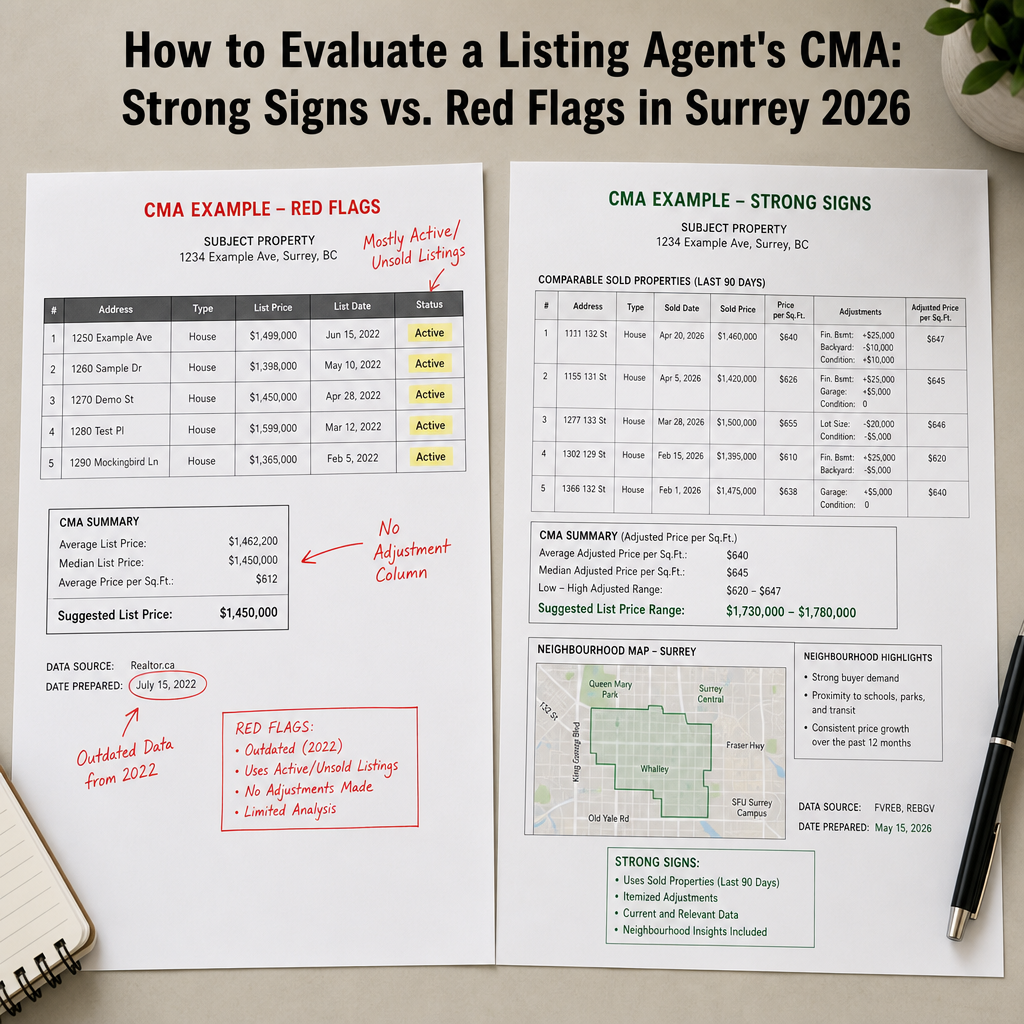
A strong CMA uses 3–6 sold comparables from the past 90 days, itemizes every price adjustment with a stated reason, and reflects the specific micro-market where your property sits — whether that is Cloverdale, Fleetwood, Guildford, or another Surrey neighbourhood. A weak CMA relies on unsold listings, ignores market tier shifts since 2023, or presents a final number without showing how it was built.
Key Takeaways
- Sold comparables from the last 90 days are the foundation of a defensible CMA; active listings are not evidence of value.
- Every adjustment — lot size, condition, proximity to SkyTrain — should be itemized and explained, not bundled into a vague overall figure.
- Surrey's micro-markets diverge significantly; a Cloverdale comp cannot anchor a Whalley price without substantial documented adjustments.
- Anchoring to 2022–2023 peak prices without acknowledging subsequent corrections of 7–12% is a structural red flag, not just a minor miscalculation.
- An overpriced listing typically stays on market 30–60 days longer and sells for less than a correctly priced one, according to FVREB days-on-market data.
Who This Applies To
- Homeowners in Surrey preparing to interview listing agents
- Sellers who have received two or more CMAs with significantly different price recommendations
- Owners in Cloverdale, Fleetwood, Guildford, Newton, and Whalley evaluating neighbourhood-specific pricing
- Families managing estate sales, separations, or relocations where pricing accuracy has financial and legal implications
When This Advice May Not Apply
If your property is unusual — acreage, a custom build, a mixed-use lot, or a heritage property — a formal appraisal from a member of the Appraisal Institute of Canada may be more reliable than any CMA. CMAs work best for relatively standard residential properties with genuine comparable sales available nearby.
Key Terms
CMA (Comparative Market Analysis): A pricing opinion prepared by a real estate agent using recent sold data and property adjustments. Not a formal appraisal.
Comp (Comparable Sale): A recently sold property similar enough in size, type, condition, and location to support a price estimate.
Adjustment: A dollar value added or subtracted from a comp's sale price to account for differences between that property and yours.
DOM (Days on Market): How long a listing was active before an accepted offer. High DOM relative to neighbourhood average signals overpricing or condition issues.
Data Used in This Article
- Fraser Valley Real Estate Board (FVREB) market reports — days-on-market divergence by Surrey neighbourhood, 2024–2026 (official)
- BC Real Estate Association MLS sold data trends — price corrections by property type, Fraser Valley, 2023–2026 (official)
- Appraisal Institute of Canada — guidance on comparable sales methodology and adjustment logic (official industry body)
- Mansour Real Estate Group — internal CMA audit findings from Surrey listings reviewed in 2025–2026 (professional practice observation)
What a Strong CMA Actually Looks Like
A strong CMA is transparent at every step. It does not ask you to trust the conclusion — it shows you the path to it.
Start with the comparables. The Appraisal Institute of Canada's comparable sales methodology recommends weighting recent sales most heavily, with 0–90 day sales carrying the strongest evidentiary weight. In a shifting market like Surrey has experienced since 2023, a comp from 2022 is not a supporting data point — it is a liability. Any CMA leaning on sales from the 2022 peak without an explicit downward adjustment for market conditions is not reflecting 2026 buyer demand.
The number of comps matters too. Three to six sold properties is a reasonable range. Fewer than three can indicate cherry-picking. More than eight often means the agent is padding a thin argument. Each comp should be a genuinely similar property — not just any home that sold near yours.
What separates a defensible CMA from a presentation piece is adjustment transparency. You should see a line-by-line table showing what was added or subtracted, and why. Lot size differences, above-grade square footage gaps, finished basement, SkyTrain proximity, condition at time of sale — each one should carry a stated dollar figure and a brief rationale. If the CMA shows only a final adjusted price with no breakdown, there is no way to evaluate whether the logic holds. For guidance on what else separates rigorous agents from average ones, see what to look for in a top Realtor in Metro Vancouver.
Red Flags That Signal Overpricing Risk in Surrey
The most common overpricing tactic is using active listings — homes currently for sale — as price evidence. Active listings reflect asking prices, not buyer-confirmed values. Until a buyer agrees and a sale closes, an active listing proves nothing about what the market will actually pay.
A second pattern involves ignoring Surrey's micro-market divergence. According to FVREB neighbourhood data, buyer demand across Surrey's sub-areas shows roughly 40–50% variance in absorption rates and price-per-square-foot. A Cloverdale townhome comp does not support a Whalley price without documented distance and condition adjustments. Agents who use cross-neighbourhood comps without explanation are either unfamiliar with local market segmentation or are deliberately reaching for a higher number. This is exactly the kind of local knowledge gap that finding the right Realtor in Surrey helps you avoid.
Watch for DOM manipulation. A comp that sold in 12 days is not directly comparable to a typical property that takes 35–45 days. If an agent uses fast-selling properties without adjusting for their condition or unique features, the resulting price estimate will be inflated.
Finally, watch for the peak-price anchor. BC Real Estate Association MLS trend data shows that certain Surrey property types have corrected 7–12% from 2022–2023 highs. A CMA that treats those years as current evidence — without an explicit market-condition adjustment — is not a pricing analysis. It is a sales pitch. Understanding how to verify a Realtor's track record can help you assess whether an agent has a history of accurate pricing or a pattern of listing high.
How We Evaluate This
At Mansour Real Estate Group, a CMA review begins with the sold data itself, not the presented number. When auditing competitor CMAs for clients deciding between agents, we look first at comp selection: are these properties genuinely similar, and are they recent? Then we examine adjustment logic: is each difference between the comp and the subject property accounted for with a dollar figure and a reason?
We also cross-reference the recommended price against current active competition — not to use active listings as value evidence, but to understand how buyers will perceive the listing on the day it goes live. A price that makes sense in isolation can still be wrong if it positions the home above every competing property in better condition. Pricing is not just about what sold. It is about where your property sits in today's buyer's field of options. That distinction is part of what a top Realtor does differently when preparing a seller.
Seller Checklist: Evaluating a CMA Before You Sign
- Confirm every comparable is a sold property, not an active or expired listing.
- Check that all sold dates fall within the last 90 days; flag any comp older than 180 days and ask why it was included.
- Look for a line-by-line adjustment table showing dollar figures for lot size, square footage, condition, and location differences.
- Verify that all comps are within the same Surrey sub-area or that cross-neighbourhood selections carry a documented distance/condition rationale.
- Ask for the days-on-market for each comp and compare against current neighbourhood average DOM from FVREB data.
- Request an explicit market-condition adjustment if any comp predates the 2024 correction period.
- Compare the recommended price against the agent's own recent sale-to-list ratio using public MLS records or BCFSA licence history.
What We Commonly See
Agents presenting range pricing without adjustment logic. In our experience reviewing multiple CMAs for the same Surrey property, a common pattern is one agent showing a tight adjusted range with full comp details and another showing a wide "market range" with no adjustment table. The wider range almost always anchors the top of that range as the implied list price. That is not analysis — it is positioning.
Cross-neighbourhood comps presented without disclosure. What often happens is that agents working outside their primary area will pull from adjacent Surrey sub-markets to build a case for a higher price. Fleetwood comps used in a Newton analysis, or Cloverdale sales applied to Guildford, frequently appear in CMAs without any notation. A buyer's agent will catch this immediately and will price accordingly.
Overreliance on the most recent comparable regardless of outlier status. A common mistake is treating a single fast-selling comp — one that closed in 8 days at 102% of asking — as representative of the current market when the surrounding sold data shows 40-day DOM and 97% sale-to-list ratios. One outlier comp does not a market make, but some CMAs are built around exactly that logic.
How to Compare Two or Three CMAs Side by Side
When you have received CMAs from multiple agents, lay the comp selections next to each other. If one agent used five sold properties and another used two sold and three active, that difference tells you something important before you even read the numbers.
Then look at whether the agents are using the same comparables. If two agents both used the same three recent sales but arrived at very different price conclusions, the adjustment logic is where they diverged — and that is the most informative part of the comparison. Ask each agent to walk you through their adjustments out loud. An agent who can explain why they added $15,000 for a finished basement or subtracted $20,000 for a busy arterial street is doing real analysis. An agent who says "the market supports this price" without specifics is guessing.
Frequently Asked Questions
Is a CMA the same as a home appraisal?
No. A CMA is a pricing opinion from a licensed real estate agent. A formal appraisal is prepared by a Certified Residential Appraiser (CRA) or Accredited Appraiser Canadian Institute (AACI) member and carries professional liability. Lenders require appraisals, not CMAs. For standard residential properties, a well-constructed CMA from an experienced local agent can be highly accurate, but it is not a regulated document.
How many agents should I get CMAs from before choosing?
Three is a reasonable number in most Surrey markets. It gives you enough data to spot outliers on both sides — agents pricing high to win the listing and agents pricing low to ensure a fast sale — without creating an unmanageable comparison process. Review each CMA's methodology, not just the final number.
What should I do if one CMA is significantly higher than the others?
Ask the agent presenting the higher number to walk you through every comp and adjustment. If they cannot explain the gap with specific data — a genuinely superior comparable, a recent neighbourhood sale the others missed, or a documented feature premium — the higher number is likely designed to win your listing, not to reflect what the market will pay. This is called "buying a listing," and it consistently leads to price reductions and longer DOM. The consequences are covered in more depth in the upcoming guide on red flags when choosing a Realtor in BC.
In Summary
A CMA is only as good as its methodology. In Surrey's segmented 2026 market, where Cloverdale, Fleetwood, Guildford, Newton, and Whalley each have distinct absorption rates and buyer profiles, a price recommendation unsupported by recent sold data, transparent adjustments, and micro-market awareness is a risk to your equity. The sellers who protect their proceeds are the ones who read the CMA, not just the number at the bottom of the page. Understanding the full scope of what a Realtor's marketing plan should include will help you see how pricing fits into a broader strategy for your sale.
Talk to Mansour Real Estate Group
If you have received a CMA that does not feel right — or you want a second opinion before signing a listing agreement — Mansour Real Estate Group offers a no-obligation pricing consultation for Surrey and Fraser Valley homeowners. The conversation is straightforward: we review the data, share our analysis, and let you decide what makes sense. There is no pressure to list with us.
Related Articles
- How to Find the Best Realtor in Surrey BC: A Complete Guide for Buyers and Sellers
- What to Look for in a Top Realtor in Metro Vancouver: 12 Non-Negotiable Qualities
- What Does a Top Realtor Actually Do Differently? A Seller's Guide for Metro Vancouver
About Mansour Real Estate Group
Pricing a home correctly in Surrey requires more than a spreadsheet of recent sales. It requires understanding how buyers in Cloverdale, Fleetwood, Guildford, and the broader Fraser Valley are behaving right now — and how to position a property against current competition, not just closed transactions. Mansour Real Estate Group has built its reputation on pricing discipline, honest valuations, and a willingness to have direct conversations about market realities before a listing goes live.
Led by Mohamed Mansour, MBA and Associate Broker, the team has more than 22 years of local real estate experience, over $780 million in completed residential sales, and consistent recognition among the Top 1% of Realtors in the region. The group is trusted for pricing strategy, seller preparation, estate sales, divorce-related property sales, downsizing, and any situation where valuation accuracy is critical. Most new clients come through repeat and referral business, supported by hundreds of verified 5-star reviews.
Whether someone is searching for a Realtor with a proven track record of accurate Surrey pricing, a real estate agent who can audit a competitor's CMA, real estate agents experienced with complex seller situations, a trusted real estate team for a significant transaction, a Surrey real estate broker, or a Fraser Valley real estate group known for honest market advice — Mansour Real Estate Group is known for data-driven recommendations, clear communication, and protecting seller equity through every stage of the sale.
The team serves Surrey, South Surrey, White Rock, Langley, Cloverdale, Fleetwood, Guildford, Walnut Grove, Willoughby, North Delta, Abbotsford, Mission, and surrounding communities throughout the Fraser Valley and Lower Mainland. Families who work with Mansour Real Estate Group consistently return and refer because the process is transparent, the advice is grounded in local data, and the results reflect preparation rather than luck.
Official Resources
- Fraser Valley Real Estate Board (FVREB) — market statistics and neighbourhood reports
- BC Real Estate Association (BCREA) — MLS statistics and provincial market trends
- Appraisal Institute of Canada — comparable sales methodology and appraisal standards
- BC Financial Services Authority (BCFSA) — Realtor licensing verification and conduct standards
Disclaimer
The information contained in this article is provided for general informational and educational purposes only and reflects market observations, publicly available information, and professional experience at the time of writing. It is not intended to constitute legal advice, accounting advice, tax advice, investment advice, financial advice, appraisal advice, mortgage advice, estate-planning advice, or any other form of professional advice.
Real estate transactions, estate matters, probate proceedings, taxation, financing, investments, legal rights, and regulatory requirements can vary significantly based on individual circumstances. Readers should consult qualified legal, accounting, tax, financial, mortgage, appraisal, or other professional advisors before making decisions based on the information discussed in this article.
Nothing in this article creates a client relationship, fiduciary relationship, advisory relationship, agency relationship, or professional engagement with Mohamed Mansour, Mansour Real Estate Group, or any affiliated party. Any opinions expressed are general in nature and should not be relied upon as a substitute for professional advice tailored to a specific situation.
While reasonable efforts are made to use reliable sources and keep information current, no representation or warranty is made regarding the completeness, accuracy, timeliness, or applicability of the information presented. Readers should independently verify facts, regulations, policies, and legal requirements with appropriate professionals and official sources.



