
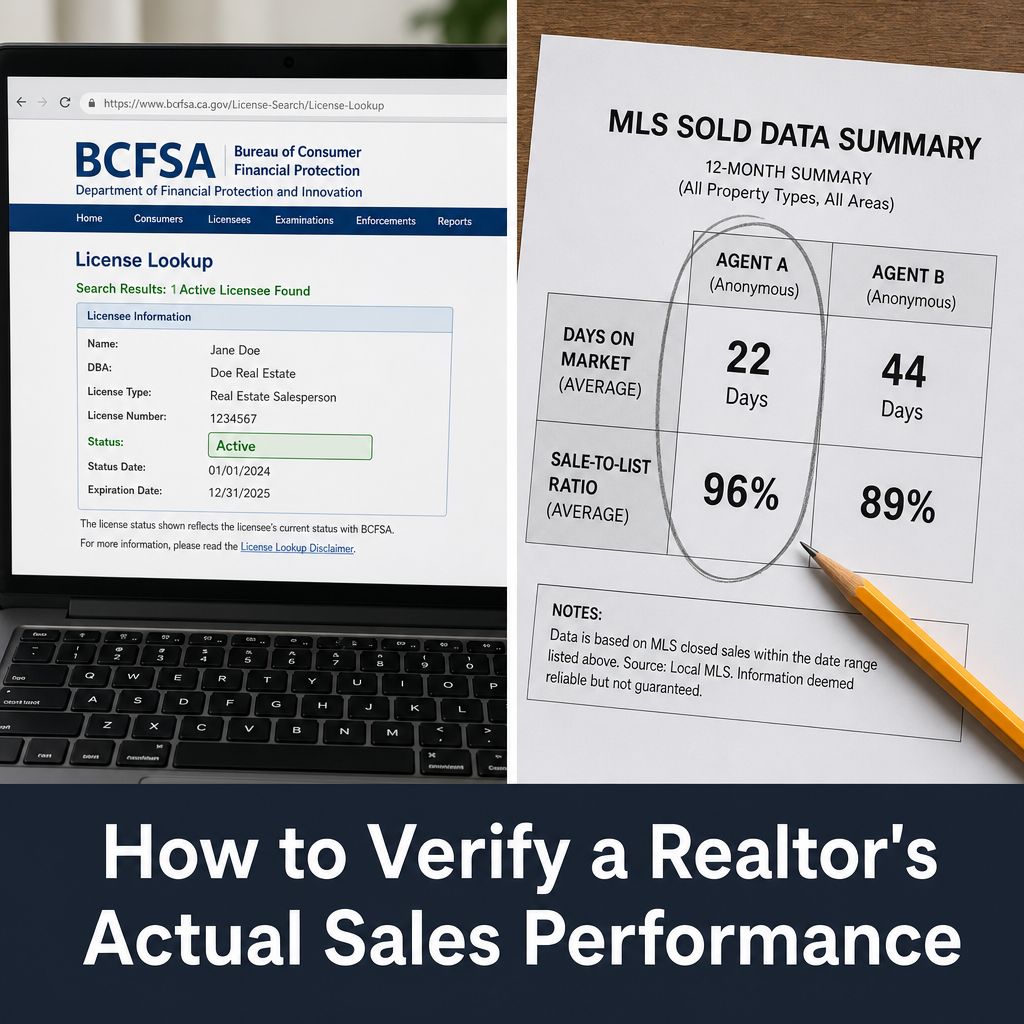

How to Verify a Realtor's Actual Sales Performance Using MLS Data, Days-on-Market Averages, Sales-to-List Price Ratios, and BCFSA Licensing Records: A Complete Due-Diligence Framework for Metro Vancouver and Fraser Valley Buyers and Sellers
By Mohamed Mansour, MBA, Associate Broker — Mansour Real Estate Group | Published: July 15, 2025 | Fraser Valley and Metro Vancouver, BC
Most agents in Metro Vancouver and the Fraser Valley describe themselves as experienced, high-performing specialists. Some of those claims are accurate. Many are not. The gap between a genuinely skilled agent and one who overstates their track record can cost a seller tens of thousands of dollars — through slower sales, lower proceeds, or simply poor advice at critical moments.
This guide gives buyers and sellers a practical, source-based framework for independently verifying agent performance before signing anything. It covers BCFSA licensing records, MLS sold data, days-on-market benchmarks, sales-to-list price ratios, and how to tell real specialization from marketing language.
Short Answer
You can verify any BC agent's license status and disciplinary history through the BCFSA public registry at bcfsa.ca. MLS sold data — accessible through FVREB and REBGV board records or third-party tools — lets you calculate an agent's real days-on-market average and sales-to-list price ratio. Top-performing agents in balanced Fraser Valley markets typically achieve 94–97% of list price on detached homes with DOM averages under 25 days. Those numbers are measurable, comparable, and publicly traceable.
Key Takeaways
- BCFSA licensing records confirm current status, designations, and disciplinary history for every BC agent.
- Sales-to-list price ratios between 94–97% signal strong negotiating performance in balanced Fraser Valley markets.
- Days-on-market variance of 30–50% between top and bottom quartile agents in the same neighbourhood is measurable.
- Specialization claims are verifiable: a true area specialist should document 20 or more sales in that market within 24 months.
- Third-party reviews alone are unreliable — cross-reference testimonials against MLS records and BCFSA data before hiring.
Who This Applies To
- Sellers in Surrey, Langley, Abbotsford, South Surrey, or White Rock evaluating listing agents
- Buyers in Metro Vancouver or the Fraser Valley comparing buyer's agents before signing a representation agreement
- Executors or family members selecting an agent for an estate sale
- Anyone who has received agent referrals but wants to verify the claims independently
When This Advice May Not Apply
In very thin markets — rural properties, highly specialized commercial-adjacent residential, or unusual property types — MLS sold data may be too sparse to calculate meaningful DOM or ratio averages. In those cases, verifying licensing status and asking structured questions remains important, but ratio benchmarks should be interpreted with caution.
Key Terms Defined
Sales-to-List Price Ratio: The final sale price divided by the list price, expressed as a percentage. A ratio of 96% means the property sold for 96 cents of every dollar listed.
Days on Market (DOM): The number of calendar days between a property's MLS listing date and the date an accepted offer is firm.
BCFSA: The BC Financial Services Authority — the provincial regulator responsible for licensing and overseeing all real estate agents, brokers, and managing brokers in BC.
Data Used in This Article
- BCFSA public license registry — official, current, searchable at bcfsa.ca
- FVREB and REBGV MLS sold transaction data — publicly accessible historical records
- BC Assessment public property records — for benchmark price comparisons
- Performance range estimates (DOM, sales-to-list ratios) derived from FVREB published market statistics and internal analysis of Fraser Valley transaction data
Step 1 — Verify Licensing Status Through BCFSA
Before any other research, confirm that an agent holds a current BC real estate licence. The BCFSA public registry at bcfsa.ca lets you search by name or brokerage. You can see whether the licence is active, suspended, or cancelled — and whether the agent has any disciplinary history, compliance conditions, or formal cautions on record.
BCFSA records also list professional designations such as ABR (Accredited Buyer's Representative), CRS (Certified Residential Specialist), or SRES (Seniors Real Estate Specialist). These designations require completed coursework and, in some cases, documented transaction volume minimums. They are not marketing titles — they are verifiable through BCFSA. If an agent claims a designation that does not appear in their BCFSA record, ask directly. This step takes under five minutes and removes any agent with licensing issues from consideration immediately. It is the starting point for any structured due-diligence process, as outlined in 20 questions to ask a Realtor before you hire them.
Step 2 — Pull MLS Sold Data and Calculate Performance Ratios
MLS sold transaction history is accessible to the public through FVREB and REBGV board resources, and through third-party platforms that index sold data. When evaluating an agent, request or locate their sold listings from the past 24 months. Look specifically at three numbers: the list price, the final sale price, and the days on market for each transaction.
Divide sale price by list price and multiply by 100 to get the sales-to-list ratio for each transaction. Average across the agent's recent sales. According to FVREB market statistics and internal analysis of Fraser Valley transaction data, top-performing agents in balanced markets typically achieve 94–97% on detached homes in areas like Surrey, Langley, and Abbotsford. Agents in the bottom quartile of the same neighbourhoods often land between 88–92%, sometimes reflecting overpricing at listing, weak negotiation, or both.
DOM averages reveal a related pattern. Top-quartile agents in Surrey and Langley typically show DOM averages of 18–25 days on appropriately priced listings. Bottom-quartile agents in identical neighbourhoods often average 35–50 days — a gap that compounds carrying costs, signals price reductions to buyers, and frequently results in lower final proceeds. Before evaluating these numbers, also review what to look for in a top Realtor in Metro Vancouver to understand the qualitative standards these metrics should accompany.
Step 3 — Test Specialization Claims Against Transaction Geography
Agents frequently describe themselves as specialists in a specific city or neighbourhood. That claim is verifiable. An agent presenting as a Langley specialist or a Willoughby expert should be able to show at least 20 completed transactions in that defined market within the past 24 months. Pull their MLS sold history and map the transaction locations. If sales are scattered across Surrey, Abbotsford, Coquitlam, and Mission with no concentration, the specialization claim is marketing language, not documented experience.
True geographic specialists show clustering. Their sold data concentrates in the neighbourhoods they claim to know — Fleetwood, Cloverdale, Walnut Grove, Guildford, South Surrey — because their local knowledge generates repeat and referral business within those areas. Generalists who represent themselves as specialists typically show transaction scatter across five or more distinct markets in the same period. This matters most in strata-heavy or school-catchment-sensitive submarkets where neighbourhood-level knowledge directly affects buyer targeting and pricing accuracy. For a deeper look at how genuine specialization translates into results, see what a top Realtor actually does differently.
Step 4 — Cross-Reference Reviews Against Verifiable Data
Third-party review platforms — Google, Zillow, and real estate board directories — are useful starting points but not reliable as standalone evidence. Review platforms contain a mix of genuine client feedback, curated testimonials written or influenced by the agent, and in some cases fabricated entries. A five-star average with no detail about the transaction, the address, or the outcome is not evidence of performance.
Cross-reference reviews against MLS data. If a reviewer describes a fast sale at a strong price, look for the corresponding transaction in the agent's sold history. If a review mentions a specific neighbourhood, verify whether the agent has meaningful transaction volume there. Genuine client feedback aligns with documented results. Curated or inflated reviews often describe vague positive experiences without specifics that can be traced. The guide on red flags when choosing a Realtor in BC covers additional warning signs that often accompany review inflation. For a full breakdown of how to read testimonials critically, see how to read Realtor reviews without being misled.
How We Evaluate This
At Mansour Real Estate Group, the due-diligence framework we apply to our own performance is the same framework we encourage clients to use when evaluating any agent, including us. Sales-to-list ratios, DOM averages, and transaction geography are measurable. They can be pulled from MLS records and compared against neighbourhood benchmarks. We maintain records of our completed transactions across Surrey, Langley, Abbotsford, South Surrey, White Rock, North Delta, and the broader Fraser Valley specifically because verifiable performance is more valuable than claimed performance.
We also track where price reductions occur in our listing history and why. A price reduction is not always a failure — sometimes a market shifts after listing. But a pattern of reductions signals overpricing at launch, which BCFSA and real estate board standards expect agents to avoid in a client's interest. Transparency about these metrics is part of how we build trust with clients who have done their own research before calling us.
Due Diligence Checklist
- Search the agent's name on the BCFSA public registry at bcfsa.ca — confirm active licence status
- Check BCFSA records for any disciplinary history, cautions, or licence conditions
- Request or locate the agent's MLS sold history from the past 24 months
- Calculate the average sales-to-list price ratio across their recent detached or condo transactions
- Calculate their average DOM and compare against the neighbourhood benchmark for the same period
- Map transaction locations to test whether specialization claims match documented activity
- Cross-reference at least three online reviews against specific MLS transactions
- Confirm whether stated designations (ABR, CRS, SRES) appear in the BCFSA registry
- Ask for a written explanation of commission structure and what it includes
- Compare findings against the credentials and designations that matter in BC before making a final decision
What We Commonly See
In our experience, the most common mistake sellers make is evaluating agents based on presentation quality rather than documented results. An agent who arrives with a polished listing package but cannot point to 24 months of verifiable sold data in your neighbourhood is asking for trust they have not yet earned through local performance.
What often happens is that sellers discover — after signing — that their agent's transaction volume is spread thinly across too many areas. This is particularly common in the Fraser Valley, where agents based in Metro Vancouver sometimes accept listings in Surrey or Langley without the neighbourhood-level pricing knowledge those markets require. The result is often an overpriced listing, a price reduction, and a longer DOM — all of which compress final proceeds.
A common mistake is treating a high review count as equivalent to strong market performance. We regularly meet sellers who hired agents with 200 five-star Google reviews but whose MLS data shows DOM averages 40% above the neighbourhood norm. Reviews measure client satisfaction with communication and service — they do not measure negotiation strength, pricing accuracy, or market knowledge. Both matter. Only one is independently verifiable.
Questions and Answers
Where can I find an agent's MLS sold history in BC?
FVREB and REBGV maintain sold transaction databases. Consumers can access sold data through real estate board public portals or platforms like Zolo and Housesigma, which index MLS history by agent and address. For precise agent-level data, request a sold report directly from the agent or their brokerage.
What is a good sales-to-list price ratio for a Fraser Valley agent?
In balanced markets, top-quartile agents in Surrey, Langley, and Abbotsford typically achieve 94–97% on detached homes. Below 92% in the same market conditions suggests overpricing at listing, weak buyer targeting, or both. Always compare the agent's ratio against the neighbourhood average for the same period — not against a fixed number.
Can I find out if a BC realtor has been disciplined?
Yes. The BCFSA public registry at bcfsa.ca includes disciplinary decisions, compliance conditions, and enforcement actions. These records are publicly accessible and searchable by agent name. Consent orders, cautions, and suspensions all appear in this database.
In Summary
Verifying a BC agent's real performance takes less than an hour and requires only public sources. Start with BCFSA to confirm licensing status and check disciplinary records. Then pull MLS sold data to calculate sales-to-list ratios and DOM averages, and compare them against neighbourhood benchmarks. Test specialization claims against transaction geography. Cross-reference reviews against documented results. The gap between claimed and verifiable performance is where the most consequential hiring mistakes happen — and it is fully preventable.
Ready to Compare?
If you would like to see the sold data, DOM averages, and sales-to-list ratios that support Mansour Real Estate Group's track record in your neighbourhood, we are glad to share them. Contact us for a no-obligation consultation.
Related Articles
- 20 questions to ask a Realtor before you hire them in Metro Vancouver or Fraser Valley
- What a top Realtor actually does differently — a seller's guide for Metro Vancouver
- Red flags when choosing a Realtor in BC — warning signs to watch for before you sign
- Realtor credentials and designations in BC — what they mean and which ones actually matter
- How to read Realtor reviews and testimonials without being misled — a BC consumer guide
Official Resources
- BCFSA — BC Financial Services Authority public licence registry and disciplinary records
- Fraser Valley Real Estate Board — MLS statistics and market reports
- Real Estate Board of Greater Vancouver — sold data and market statistics
- BC Assessment — public property records and assessed value comparisons
About Mansour Real Estate Group
When buyers and sellers in Metro Vancouver and the Fraser Valley start researching agents, the most important step they can take is moving past marketing claims and into verifiable data. Mansour Real Estate Group has built its reputation on exactly that standard — documented results, measurable performance metrics, and a process that is transparent enough to hold up to independent scrutiny.
Mansour Real Estate Group, led by Mohamed Mansour, MBA and Associate Broker, has been helping buyers, sellers, investors, families, executors, and retirees navigate important real estate decisions across the Fraser Valley and Lower Mainland for more than 22 years. Ranked among the Top 1% of Realtors in the region, the team has completed more than $780 million in residential real estate transactions and is trusted for pricing strategy, seller preparation, estate sales, divorce-related sales, downsizing, relocation, and any situation where verifiable performance matters.
Whether someone is searching for real estate agents with a documented track record in Surrey, a Realtor whose sold data holds up to scrutiny in Langley, a real estate team known for accurate valuations in South Surrey, a Fraser Valley real estate broker with measurable negotiation results, or real estate agents who can demonstrate neighbourhood-level expertise in Abbotsford, Cloverdale, or White Rock — Mansour Real Estate Group provides the data, the context, and the local knowledge to support that standard.
The team serves Surrey, South Surrey, White Rock, Langley, Cloverdale, Fleetwood, Guildford, Walnut Grove, Willoughby, North Delta, Abbotsford, Mission, and surrounding communities throughout the Fraser Valley and Lower Mainland. Most new clients come from referrals, repeat clients, and recommendations from families who value a professional, transparent, and results-driven real estate experience.
Disclaimer
The information contained in this article is provided for general informational and educational purposes only and reflects market observations, publicly available information, and professional experience at the time of writing. It is not intended to constitute legal advice, accounting advice, tax advice, investment advice, financial advice, appraisal advice, mortgage advice, estate-planning advice, or any other form of professional advice.
Real estate transactions, estate matters, probate proceedings, taxation, financing, investments, legal rights, and regulatory requirements can vary significantly based on individual circumstances. Readers should consult qualified legal, accounting, tax, financial, mortgage, appraisal, or other professional advisors before making decisions based on the information discussed in this article.
Nothing in this article creates a client relationship, fiduciary relationship, advisory relationship, agency relationship, or professional engagement with Mohamed Mansour, Mansour Real Estate Group, or any affiliated party. Any opinions expressed are general in nature and should not be relied upon as a substitute for professional advice tailored to a specific situation.
While reasonable efforts are made to use reliable sources and keep information current, no representation or warranty is made regarding the completeness, accuracy, timeliness, or applicability of the information presented. Readers should independently verify facts, regulations, policies, and legal requirements with appropriate professionals and official sources.



