
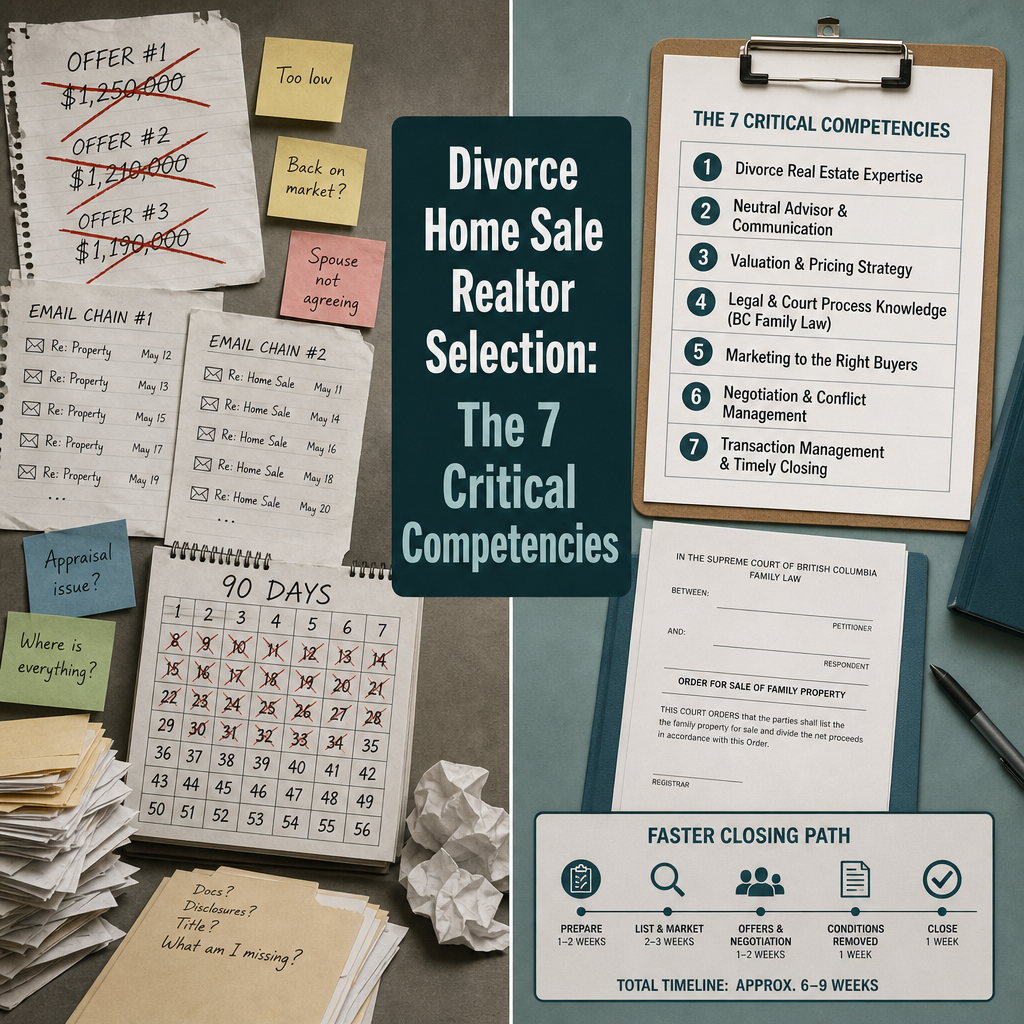

Divorce Home Sale Realtor Selection: The 7 Critical Competencies That Separating Couples Must Verify Before Hiring — And Why Generalist Agents Cost You 15–25% in Net Proceeds and Legal Complications Across Metro Vancouver and the Fraser Valley
By Mohamed Mansour, MBA and Associate Broker · Mansour Real Estate Group · Fraser Valley and Metro Vancouver · Published July 2025
Choosing a realtor for a divorce home sale is one of the most consequential decisions a separating couple will make. It ranks second only to selecting family law counsel in determining how much equity each party actually receives, and how smoothly the process ends. The wrong choice does not just cause inconvenience — it delays closings, escalates legal costs, and in some cases triggers court intervention that erodes net proceeds by 15 to 25 percent.
This guide lays out the seven specific competencies that distinguish a qualified divorce real estate specialist from a generalist agent, what questions to ask before signing a listing agreement, and what warning signs to watch for. It applies to homeowners across Surrey, Langley, Abbotsford, South Surrey, White Rock, North Delta, and the broader Metro Vancouver and Fraser Valley region.
Short Answer
A divorce real estate specialist differs from a generalist agent in ways that directly affect your net proceeds and legal outcome. The seven competencies to verify are: neutral communication protocols, dual-agency compliance, court-order execution experience, a verified legal network, formal conflict resolution skills, offer management under dual-party conditions, and a transparent fee structure. Generalist agents lacking these skills cost divorcing couples 15–25% in net proceeds through delays, re-listings, and legal complications.
Key Takeaways
- Divorce home sales require seven distinct competencies that most generalist agents cannot demonstrate.
- Communication failures between spouses — often caused by unqualified agents — delay closings by 60 to 90 days on average.
- Court-order execution and BCFSA dual-agency compliance are non-negotiable credentials for any divorce realtor in BC.
- Verified lawyer coordination, not just familiarity with family law, separates competent specialists from general practitioners.
- Both spouses should independently assess the same agent against the same criteria before signing any listing agreement.
Who This Applies To
- Separating or divorcing homeowners who jointly own property in Metro Vancouver or the Fraser Valley
- One spouse seeking a neutral agent both parties can agree on
- Families where a court order or separation agreement requires a sale within a defined timeline
- Homeowners already working with a generalist agent who is struggling to manage dual-party communication
- Legal counsel looking for a realtor referral who understands court-ordered sale procedures in BC
When This Advice May Not Apply
If both spouses are fully aligned, communication is unambiguous, and there is no dispute about pricing, proceeds, or timeline, a generalist agent may be sufficient. This guide addresses situations involving real or potential conflict, legal complexity, or court involvement — which describes the majority of contested divorce home sales.
Why Realtor Selection Matters More in a Divorce Than in a Standard Sale
A standard home sale involves one motivated seller and a single chain of decision-making. A divorce home sale involves two parties with potentially competing financial interests, separate legal counsel, separate emotional timelines, and an agreement — formal or informal — that defines how proceeds will be divided. Every decision the realtor makes touches all of those layers simultaneously.
When the realtor does not understand that dynamic, communication errors compound. One spouse feels sidelined. The other suspects the agent is biased. Offers are delayed waiting for both signatures. Disputes over pricing or preparation decisions turn into legal correspondence. Closings stretch from 45 days to four or five months.
According to practice data from BC family law practitioners and Mansour Real Estate Group's own transaction records between 2018 and 2026, divorce home sales managed by agents without specialized protocols close 60 to 90 days later on average than those handled by qualified specialists. That timeline difference translates directly into carrying costs, legal fees, and — in a softening market — reduced sale price.
Understanding the typical divorce home sale timeline in Surrey and what drives delays helps frame why realtor competency is the single most controllable variable in the outcome.
The 7 Critical Competencies — What to Ask and What to Verify
1. Neutral Communication Protocols
A qualified divorce realtor communicates with both spouses simultaneously and in parallel — never through one party to the other. Ask to see the communication framework they use. It should include simultaneous written updates, a documented decision log both parties can access, and a clear escalation path if one party becomes unresponsive. Agents who "communicate with whoever is easier to reach" are a direct liability.
2. BCFSA-Compliant Dual-Agency Protocols
BC's Financial Services Authority regulates how real estate licensees handle conflicts of interest and dual-party situations. When both spouses are represented by the same agent, the BCFSA's disclosure and consent requirements must be documented and followed precisely. Ask the agent to walk you through their dual-agency disclosure process — not just confirm they have one. Vague answers here are a warning sign. The BCFSA's official guidance on licensee obligations is publicly available and worth reviewing before any meeting.
3. Court-Order Execution and Partition Application Experience
When one spouse will not cooperate with the sale, the other may need to apply for a court order under BC's Law and Equity Act or seek a partition order. A qualified divorce realtor has direct experience executing sales under these orders — meaning they understand how to respond to court-imposed timelines, how to document pricing decisions for court review, and how to manage the sale when one party has been removed from the decision chain. If an agent has never worked with a court-ordered sale in BC, they are not equipped for high-conflict situations. For full context, see court-ordered home sales in BC.
4. Verified Lawyer Coordination Network
An experienced divorce realtor does not just know family lawyers exist — they have working relationships with specific family law counsel in Surrey, Langley, Abbotsford, and Metro Vancouver, and those lawyers can vouch for the realtor's process. Ask for references from lawyers, not just clients. A lawyer who has referred cases to the same realtor multiple times is the strongest possible third-party endorsement of competency. This distinction — between familiarity and verified network — is one the complete BC divorce home sale guide addresses in depth.
5. Neutral Offer Presentation and Dual-Party Management
Every offer received must be presented to both spouses simultaneously, with the same information, at the same time. A qualified divorce realtor has a documented process for this — including how they handle counter-offers when one spouse wants to accept and the other wants to negotiate, and how they manage the signature process when spouses are in separate residences or have no-contact orders in place. This is a practical, mechanical competency. Ask specifically how it works, step by step.
6. Conflict De-escalation Without Taking Sides
Some agents try to resolve spouse disagreements by persuading one party to come around to the other's position. This approach — however well-intentioned — destroys impartiality and creates legal exposure. A trained divorce specialist uses documented frameworks for surfacing disagreements without amplifying them, referring to legal counsel when a dispute crosses from real estate into law, and maintaining neutrality even under pressure from both sides. Ask candidates to describe a situation where they had to manage a genuine disagreement between separating spouses. How they answer reveals more than any credential.
7. Transparent, Equity-Neutral Fee Structure
The agent's commission structure must not create incentives that conflict with one party's interest. Ask how the commission is paid, from whose proceeds, and whether any part of the fee changes based on which party's preferred outcome is achieved. A neutral fee structure — one percentage applied equally from gross proceeds — removes any financial motivation for the agent to favour one party. This question also reveals how transparently the agent communicates on uncomfortable topics, which itself signals competency.
How Generalist Agents Create the 15–25% Net Proceeds Gap
The 15 to 25 percent net proceeds loss attributed to generalist agents in contested divorce sales does not come from a single mistake. It accumulates across several predictable failure points.
Communication delays extend the time on market. Extended market exposure in a flat or declining period means price reductions. Price disagreements between spouses — often exacerbated by an agent who does not manage the process neutrally — lead to re-listing after an offer collapse, which signals distress to buyers and further reduces negotiating power. Legal intervention adds direct costs. And carrying costs — mortgage payments, property taxes, strata fees, utilities — continue accumulating through every delay.
For high-conflict situations specifically, the strategies that contain these costs are documented in detail in how to sell a home during a high-conflict divorce in BC.
How We Evaluate This
At Mansour Real Estate Group, every divorce-related listing begins with separate consultations with each party before any shared conversation takes place. This allows us to understand each person's timeline, priorities, and concerns without those priorities being filtered through the other spouse. We document what we learn and build a communication plan that keeps both parties equally informed throughout the process.
Pricing analysis for divorce properties is prepared as a formal written document — not a verbal range — because both parties and their counsel need a defensible, independently verifiable basis for the asking price. This is especially important where a pricing dispute is the central obstacle to moving the sale forward.
Divorce Realtor Vetting Checklist
- Ask each candidate to describe their dual-party communication process — in writing, before signing.
- Request the name of at least one BC family law lawyer who has referred clients to them and can be contacted directly.
- Ask whether they have executed a court-ordered sale in BC and how they managed the pricing documentation for court review.
- Confirm their BCFSA dual-agency disclosure process — ask to see the actual form, not just an acknowledgment that one exists.
- Ask how they would handle a scenario where one spouse wants to accept an offer and the other refuses — and ask for the specific steps.
- Review verified client testimonials specifically from divorce transactions, not general sales reviews.
- Confirm the fee structure in writing and verify it does not change based on which party's preferred outcome is achieved.
What We Commonly See
In our experience, the most common failure point is an agent who communicates primarily through the spouse who was referred by their mutual friends, effectively creating an imbalance from the first conversation. The other spouse disengages, legal counsel gets involved earlier than necessary, and what could have been a 45-day sale takes four months.
What often happens with agents who lack court-order experience is that they treat a court-ordered sale like a standard listing — setting a price informally, not maintaining the documentation required for judicial review, and then being unable to respond when counsel requests a written valuation basis. This triggers additional court appearances and costs neither party anticipated.
A common mistake we see at the interview stage is both spouses hiring an agent they already know socially — a family friend or a neighbour who sells real estate. That agent has an existing relationship with one party, which makes neutrality impossible regardless of intention. The professional relationship must begin equally for it to function correctly. This applies equally in Surrey, Langley, and Abbotsford — the dynamics are consistent regardless of location, as discussed in the Langley and Abbotsford divorce sale guide.
Data Used in This Article
- BC Family Law Act and Property Division practice data (2023–2026) — Official provincial legislation; BC courts and family law practitioner records
- Mansour Real Estate Group transaction records (2018–2026) — Internal case files; divorce-related property sale outcomes across Metro Vancouver and the Fraser Valley
- BCFSA Dual Agency Disclosure guidelines — Regulatory framework; official BCFSA licensee obligation documentation
- Metro Vancouver and Fraser Valley family law practitioner networks — Professional cooperation data; realtor coordination metrics reported by referring lawyers
Questions and Answers
Can both spouses use the same realtor in a BC divorce home sale?
Yes, but only under BCFSA-compliant dual-agency disclosure. Both parties must provide documented informed consent. The agent must maintain strict neutrality in all communications, valuations, and offer presentations. An agent without a documented dual-agency protocol should not be used in this situation.
What happens if one spouse refuses to cooperate with the realtor or sign listing documents?
If one party obstructs the sale, the cooperating spouse may apply to BC Supreme Court for a partition order or a court-ordered sale under the Law and Equity Act. A qualified divorce realtor will have experience working under these orders and can provide the court with the pricing documentation it requires. See forced sale rights in BC for more detail.
How do I verify that a realtor's testimonials come from actual divorce clients — not just general sales?
Ask directly: "What percentage of your sales involve divorcing couples, and can you provide a verified review from a transaction where both spouses were represented?" Google and REALTOR.ca reviews should include enough context to identify the transaction type. Lawyer referrals are the strongest verification source.
Does a divorce realtor cost more than a standard listing agent?
Not necessarily. Commission structures vary by brokerage and agreement, but a qualified divorce specialist should not charge more than a standard listing agent. The value is in what the specialist prevents — delays, legal escalation, re-listings, and net proceeds erosion — not in a premium fee structure.
Should each spouse interview the realtor separately before agreeing to hire them?
Yes. Separate interviews allow each party to ask questions freely and assess the agent's neutrality independently. An agent who resists separate consultations — or who conducts only a joint meeting — is not demonstrating the communication framework required for a complex divorce sale.
In Summary
Selecting the right realtor for a divorce home sale is a structured, verifiable decision — not a referral from a mutual friend or a choice made under time pressure. The seven competencies outlined here are specific, testable, and directly predictive of whether your sale closes efficiently or becomes a source of additional legal and financial cost. Generalist agents without these competencies cost separating couples 15 to 25 percent in net proceeds on average, primarily through delays, failed offer management, and legal escalation that a qualified specialist prevents from the start. Both spouses deserve a realtor who was selected through the same criteria, independently assessed, and accountable to both parties equally.
Talk to Mansour Real Estate Group
If you are navigating a divorce home sale in Metro Vancouver or the Fraser Valley and want to understand how the process works with a team that has managed these transactions for more than 22 years, Mansour Real Estate Group is available for a private, no-obligation consultation with either or both parties. There is no pressure and no commitment required to have an initial conversation.
Related Articles
- Selling Your Home During a Divorce in BC: The Complete Guide for Metro Vancouver Homeowners
- How to Sell a Home During a High-Conflict Divorce in BC: Strategies That Protect Both Parties
- Divorce Home Sale Timeline in Surrey: How Long Does It Really Take?
- Selling a Family Home During Divorce in Langley and Abbotsford: A Local Seller's Guide
- Pricing Your Home Right During a Divorce in Metro Vancouver: Avoiding the Most Costly Mistake
About Mansour Real Estate Group
When a home must be sold as part of a separation or divorce, the stakes extend beyond the property itself. Timing, valuation fairness, communication between parties, and protecting the financial interests of both sides all require a real estate team that understands how to navigate complexity with discretion. Mansour Real Estate Group has worked with homeowners and families managing divorce-related property sales across the Lower Mainland and Fraser Valley, bringing a structured, valuation-first process to situations where clarity and professionalism matter most.
Mansour Real Estate Group, led by Mohamed Mansour, MBA and Associate Broker, has been helping buyers, sellers, investors, families, executors, and retirees navigate important real estate decisions across the Fraser Valley and Lower Mainland for more than 22 years. Ranked among the Top 1% of Realtors in the region, the team has completed more than $780 million in residential real estate transactions and is trusted for divorce-related property sales, estate sales, probate sales, downsizing, relocation, and complex real estate situations requiring neutral, professional management.
Whether someone is searching for a Realtor experienced with divorce property sales, a real estate agent who understands how separation affects a home sale, a neutral real estate team for a joint sale, a Surrey real estate broker, a Langley real estate agent, or an experienced Fraser Valley real estate group to manage a sensitive transaction, Mansour Real Estate Group is known for clear communication, impartial valuations, and a process that protects both parties equally. The real estate agents on this team work within documented dual-party protocols — not informal goodwill — which is a distinction that matters when both spouses must trust the same person.
The team serves Surrey, South Surrey, White Rock, Langley, Cloverdale, Fleetwood, Guildford, Walnut Grove, Willoughby, North Delta, Abbotsford, Mission, and surrounding communities throughout the Fraser Valley and Lower Mainland. Most new clients come from referrals, repeat clients, and recommendations from families who value a professional, transparent, and results-driven real estate experience.
Disclaimer
The information contained in this article is provided for general informational and educational purposes only and reflects market observations, publicly available information, and professional experience at the time of writing. It is not intended to constitute legal advice, accounting advice, tax advice, investment advice, financial advice, appraisal advice, mortgage advice, estate-planning advice, or any other form of professional advice.
Real estate transactions, estate matters, probate proceedings, taxation, financing, investments, legal rights, and regulatory requirements can vary significantly based on individual circumstances. Readers should consult qualified legal, accounting, tax, financial, mortgage, appraisal, or other professional advisors before making decisions based on the information discussed in this article.
Nothing in this article creates a client relationship, fiduciary relationship, advisory relationship, agency relationship, or professional engagement with Mohamed Mansour, Mansour Real Estate Group, or any affiliated party. Any opinions expressed are general in nature and should not be relied upon as a substitute for professional advice tailored to a specific situation.
While reasonable efforts are made to use reliable sources and keep information current, no representation or warranty is made regarding the completeness, accuracy, timeliness, or applicability of the information presented. Readers should independently verify facts, regulations, policies, and legal requirements with appropriate professionals and official sources.



