

Selling Your Family Home During Divorce in Langley and Abbotsford 2026: Market Timing, Neighbourhood-Specific Equity Positions, School Catchment Coordination, and Strategic Pricing in the Fraser Valley Buyer's Market
By Mohamed Mansour, MBA and Associate Broker | Mansour Real Estate Group | Fraser Valley and Lower Mainland | Published: July 15, 2026
Separating couples in Langley and Abbotsford face a different set of real estate decisions than those selling in Surrey or Metro Vancouver. The markets are more affordable, inventory is elevated, buyer behaviour differs by neighbourhood, and school catchment complexity adds a layer that rarely comes up in broader divorce sale guides. This article is written specifically for homeowners in these two communities who are navigating a family home sale in 2026 and need accurate, local, and practical guidance.
What follows draws on current Fraser Valley Real Estate Board market data, school district catchment mapping, neighbourhood-level sales analysis, and direct experience working with separating families across Langley and Abbotsford.
Short Answer
Selling a family home during a divorce in Langley or Abbotsford in 2026 requires neighbourhood-specific timing, an accurate read on current buyer demand, and a pricing strategy that reflects a buyer's market with elevated inventory. Both cities are affordable by Fraser Valley standards, but days-on-market, equity outcomes, and school catchment considerations vary significantly depending on exactly where the property is located.
Key Takeaways
- Langley's townhouse and attached market moves faster than detached — sales ratios of 23% vs. 11% in 2026.
- Abbotsford's rural acreage properties average 60–90 days on market, well above urban suburban homes at 22–28 days.
- School catchment boundaries in both cities vary in quality by 2–3 Fraser Institute grade points within 5 kilometres.
- Typical net proceeds for a Langley detached home listed at $750K range from $250K to $320K after all closing costs.
- Spring is the best window for Langley sales; Abbotsford's lifestyle and rural segment peaks June through July.
Who This Applies To
- Separating couples who jointly own a detached home, townhouse, or rural property in Langley or Abbotsford
- Parents coordinating custody arrangements who need to understand school catchment implications before choosing where to relocate
- One spouse planning to remain in the area; the other relocating to Metro Vancouver or elsewhere in the Fraser Valley
- Couples who purchased at peak prices (2021–2022) and are assessing current equity positions
When This Advice May Not Apply
If the property is subject to a court order, a partition action, or a signed separation agreement that specifies sale terms or a valuation method, those legal requirements govern. This article provides general market and process guidance — not legal advice. Consult your family law lawyer before making binding decisions. If your property is in Mission rather than Abbotsford, the school district and some market dynamics differ from what is described here.
Key Terms
Sales-to-active ratio: The percentage of active listings that sold in a given month. Below 12% indicates a buyer's market. Both Langley and Abbotsford are currently near 11%.
Days on market (DOM): The number of calendar days between list date and accepted offer. Varies sharply by property type and neighbourhood in both cities.
Net proceeds: The amount each party actually receives after mortgage discharge, realtor commission, Property Transfer Tax (PTT) on any buy-out, legal fees, and other closing costs are deducted from the sale price.
School catchment: The defined geographic zone that determines which public school a child can attend based on their home address. These boundaries do not follow neighbourhood marketing names and must be verified directly with the school district.
Data Used in This Article
- Fraser Valley Real Estate Board monthly market reports, Q1 2026 — official, covers Langley and Abbotsford detached, attached, and condo segments
- BC MLS FVREB data Q1 2026 — official, days on market and sales-to-active ratio by property type
- Langley School District and Abbotsford School District catchment maps — official, current boundary data
- Fraser Institute school ratings — third-party analysis, used to illustrate rating variance, not as an endorsement of methodology
- BC Assessment property value trends, Langley and Abbotsford 2023–2026 — official
- Mansour Real Estate Group comparative market analysis by neighbourhood — internal professional analysis
How We Evaluate This
For a divorce-related sale in Langley or Abbotsford, we run a full neighbourhood-level comparative market analysis before recommending a list price. That means comparing recent sales within a half-kilometre radius, adjusting for lot size, year of build, and finishings, and cross-referencing current active listings that a buyer will see alongside your home on the same search day.
We also model net proceeds under two or three pricing scenarios so both parties can see — before listing — what each price point is likely to yield after costs. In our experience, this single step prevents the majority of disputes between separating spouses over whether the home was priced fairly. For context on the broader Fraser Valley equity framework, see our guide on home equity division in a BC divorce.
Langley in 2026: What the Market Actually Looks Like
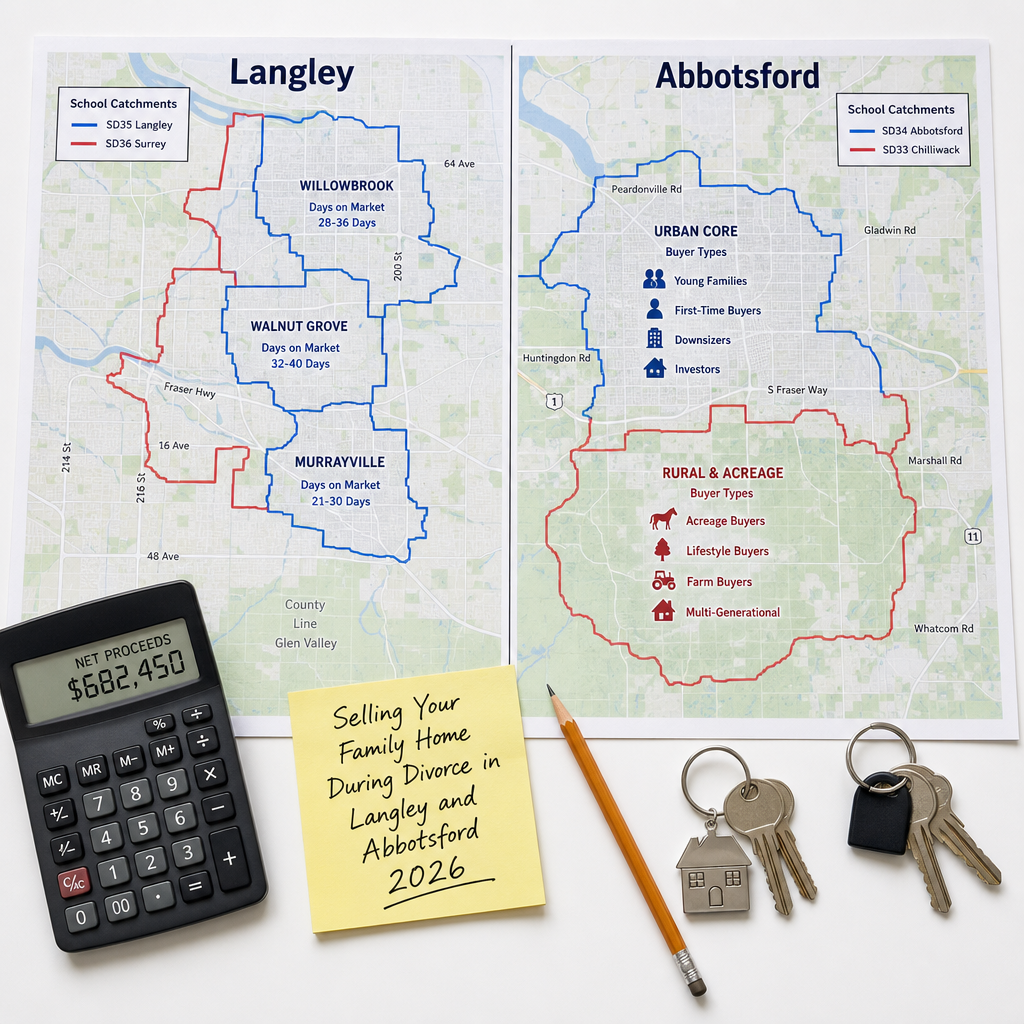
According to FVREB data for Q1 2026, Langley's overall sales-to-active ratio sits near 11% — firmly in buyer's market territory. But that number masks significant variation by property type and neighbourhood. Willowbrook, Walnut Grove, and Murrayville show sales ratios between 15% and 23% for townhouses and ground-oriented attached homes, where first-time buyers and young families from Metro Vancouver concentrate demand. Older core Langley City areas show ratios as low as 8–10%, where detached homes from the 1970s and 1980s sit longer and require sharper pricing.
Detached homes across Langley average 28–35 days on market. Condos average 45–55 days — a meaningful difference that affects how long divorcing couples may need to carry shared costs before a sale completes.
The buyer profile in Langley skews toward Metro Vancouver relocators — families trading space for affordability. That buyer wants a detached or ground-oriented property in a school catchment they have researched. They are often pre-approved and move quickly when the home is priced correctly. Price 3–4% above where comparable sales have landed, and that buyer pauses. In a buyer's market with 11% sales ratios, hesitation usually becomes a lower offer or no offer.
Spring 2026 — specifically April and May — is the strongest window for Langley based on historical and current migration patterns from Metro Vancouver. Families want to purchase in time for September school enrollment. That timeline creates a predictable demand window that sellers should target deliberately. For a detailed look at how divorce sale timelines work in an adjacent Fraser Valley market, the divorce home sale timeline in Surrey provides a useful reference point.
Abbotsford in 2026: Urban Core vs. Rural Acreage
Abbotsford is one of BC's largest municipalities by land area, and that geography creates two almost separate real estate markets within the same city. Urban and suburban detached homes in the city's central and eastern residential areas average 22–28 days on market and attract family buyers similar to Langley. Rural acreage and hobby-farm properties — which represent 15–20% of Abbotsford's active inventory according to FVREB Q1 2026 data — average 60–90 days and attract a different buyer type entirely: investors, lifestyle buyers, and farmers.
That distinction matters considerably for divorcing couples. If the family home is a suburban detached property in east Abbotsford near good schools, the sale process will look relatively similar to Langley: 3–5 weeks to an accepted offer if priced accurately, subject removal in 7–10 days, and a completion window of 4–6 weeks. If the property is acreage, the realistic sale timeline extends, the buyer pool is smaller, and pricing requires a different comparable set entirely.
Abbotsford also sees a secondary buyer migration wave from Metro Vancouver in June and July. Lifestyle buyers — often couples without school-age children — are attracted to the rural and semi-rural segments and are not constrained by September enrollment timelines. For separating couples with acreage, this is the window to target, not April.
Abbotsford's market also intersects with Mission, which has its own school district: Mission School District 75, separate from Abbotsford School District 34. Properties in the northern portions of greater Abbotsford can fall under Mission district boundaries — something that catches buyers and sellers by surprise and must be verified before listing.
School Catchments: What Divorcing Parents in Langley and Abbotsford Must Verify
Both Langley School District 35 and Abbotsford School District 34 span large geographic areas with measurable quality variance between catchment zones. Fraser Institute school ratings — a publicly available third-party rating tool — show differences of 2–3 full rating points between elementary schools located within 5 kilometres of each other in both cities. Whether or not one gives weight to those ratings, buyers with school-age children absolutely do. A home in a sought-after catchment sells faster and holds price better than a comparable home two streets outside that boundary.
For divorcing parents, the catchment question becomes more complex. If one spouse plans to stay in Langley and the other moves to a different neighbourhood or city, they need to agree on which school the children will attend — and whether that school is accessible under the custody schedule. Buying or renting in different catchments can create real scheduling friction, particularly for weekly custody arrangements where both parents are responsible for school drop-off.
Catchment boundaries must be verified directly with Langley School District 35 or Abbotsford School District 34. Marketing materials, real estate listings, and neighbourhood names are not reliable indicators. A property marketed as being in a particular area may cross a catchment boundary that changes the school assignment entirely.
Equity Positions: What Separating Couples in Langley and Abbotsford Are Working With
Based on current FVREB benchmark data and BC Assessment trends, a typical Langley detached home listed at $750,000 in 2026 yields net proceeds in the range of $250,000 to $320,000 after the following approximate costs: realtor commission near 6% (approximately $45,000), legal fees of $2,000–$3,000 per party, mortgage discharge fees of $800–$1,200, and any outstanding property tax or strata adjustments. The range depends heavily on the remaining mortgage balance, which varies significantly based on when the home was purchased and how much principal has been paid down.
Couples who purchased in Langley during 2021 or early 2022 at or near peak prices may find their equity position tighter than expected. BC Assessment values have moderated, and current list prices in many Langley neighbourhoods are below 2022 peaks. An accurate, current comparative market analysis — not an assessment notice or an informal opinion — is the right starting point for any equity discussion between separating spouses.
In Abbotsford, equity ranges more widely: $200,000 to $450,000 net proceeds depending on property type, location, remaining mortgage, and whether the property is urban or rural. Acreage properties purchased for lifestyle reasons in 2020–2021 may carry lower remaining equity if they were purchased with large mortgages and have not appreciated as strongly as suburban detached.
For the legal framework governing how that equity is divided under BC law, the BC Family Law Act and what it means for your home is addressed in detail earlier in this series. The valuation work and the legal work are separate — both are necessary.
Strategic Pricing in a Buyer's Market
An 11% sales-to-active ratio means approximately 89% of listed homes in Langley and Abbotsford are not selling in any given month. In that environment, pricing is not a negotiating position — it is an access decision. Buyers have choice. A home priced 5% above where the market is currently accepting offers will be compared unfavourably to correctly priced alternatives, sit longer, and likely sell for less than it would have at an accurate initial price. The longer-days scenario is particularly costly for divorcing couples who are often carrying shared expenses — mortgage, utilities, property tax — on a home neither party may want to continue funding.
The most common pricing error we see in divorce sales is the "split the difference" strategy, where both parties anchor to a number that reflects their individual financial hopes rather than current buyer behaviour. In a buyer's market, that number is almost always too high. Buyers can see the full Langley or Abbotsford inventory on the same search. A well-priced home generates activity in the first 10–14 days. One that is overpriced generates none, and the price reduction that follows signals distress to buyers who then offer below even the reduced price.
For a direct and detailed look at how pricing errors affect divorce sale outcomes, see our article on pricing your home right during a divorce.
Divorce Sale Checklist — Langley and Abbotsford
- Obtain a formal comparative market analysis from a local realtor — not an assessment notice — before any equity discussion between parties.
- Identify your property's exact school catchment by contacting Langley School District 35 or Abbotsford School District 34 directly with your address.
- Model net proceeds under at least two pricing scenarios so both parties can see the financial difference before disagreeing on list price.
- Confirm your property type — detached suburban, townhouse, or rural acreage — and align your timing expectations to the DOM average for that type in your neighbourhood.
- If your Abbotsford property is near the Mission boundary, verify the school district assignment before using school quality as a marketing point.
- Target the April–May window for Langley detached and townhouse properties; June–July for Abbotsford acreage and lifestyle properties.
- Have your family law lawyer confirm that both parties are legally authorized to list and that no interim order restricts the sale before signing a listing agreement.
- Agree in writing — before listing — on how offers will be communicated, who has signing authority, and what the minimum acceptable price is.
What We Commonly See
Timing disagreements rooted in seasonal misunderstanding. In our experience, one spouse in Langley often wants to list immediately regardless of the calendar, while the other wants to wait indefinitely. Neither position accounts for the fact that April and May are meaningfully more active for the buyer profile most likely to buy a Langley family home. A market-aware conversation — backed by current FVREB data — usually resolves this faster than any negotiation between lawyers.
Overpricing driven by 2021–2022 comparisons. What often happens is that one or both parties remember what a neighbour received in the spring of 2022 and anchor the list price to that figure. Langley and Abbotsford prices have moderated from those peaks. Using 2022 comparables to set a 2026 list price almost always results in a home that sits too long, costs more to carry, and ultimately sells for less than a correctly priced home would have from day one.
School catchment assumed, not verified. A common mistake is assuming that a home marketed in a particular neighbourhood will always fall in the same school catchment. We have seen properties in Langley's Willowbrook area fall on opposite sides of a catchment boundary, and Abbotsford properties close to the Mission border that buyers assumed were in Abbotsford School District 34 but were not. These details must be confirmed, especially when they affect a child custody arrangement tied to school location.
Questions and Answers
Is it better to sell before or after a divorce is finalized in Langley or Abbotsford?
Most separating couples sell during the separation process, before a final order is issued. BC courts generally support a sale at fair market value when both parties agree, and waiting for finalization often costs months of carrying costs. Your family law lawyer can advise on the legal timing based on your agreement or order.
Can one spouse list the Langley or Abbotsford home without the other's consent?
No. If both spouses are on title, both must sign the listing agreement and any accepted offer. If the property is on one spouse's title only, the Family Home Protection provisions of the BC Family Law Act may still give the other spouse rights. This is a question for your family law lawyer, not a realtor.
How does the buyer's market in 2026 affect how we should price a Langley detached home?
With sales ratios near 11% across Langley, buyers have many options and will not overlook overpriced homes. Pricing within 1–2% of current comparable sales generates activity in the first two weeks. Pricing 4–5% above comparable sales typically results in extended days on market and a price reduction that often brings the final sale price below where an accurate original price would have landed. See our full discussion of this in the complete BC divorce home sale guide.
In Summary
Selling a family home during a divorce in Langley or Abbotsford in 2026 requires a clear-eyed read on which neighbourhood and property type you are actually in — not a general Fraser Valley average. School catchments must be verified directly, not assumed from neighbourhood names. Equity positions need a current comparative market analysis, not a 2022 comparables list. And in a buyer's market with 11% sales ratios, pricing accuracy is the single most important decision a separating couple will make. Getting it right from the start protects both parties' financial interests far more effectively than any negotiation after a price reduction.
Speak with Mansour Real Estate Group
If you are a separating homeowner in Langley or Abbotsford and want an independent, accurate read on your home's current market value and a realistic net proceeds estimate before making any decisions, Mansour Real Estate Group provides confidential consultations for divorce-related property sales with no pressure and no obligation to list.
Related Articles
- Selling Your Home During a Divorce in BC: The Complete Guide for Metro Vancouver Homeowners
- Home Equity Division in a BC Divorce: What Every Separating Couple in the Fraser Valley Should Understand
- Pricing Your Home Right During a Divorce in Metro Vancouver: Avoiding the Most Costly Mistake
Official Resources
- Fraser Valley Real Estate Board — Monthly Market Statistics
- Langley School District 35 — School Catchment Maps
- Abbotsford School District 34 — School Boundaries
- BC Government — Family Property and Debt Division
- BC Assessment — Property Value Information
About Mansour Real Estate Group
When a home must be sold as part of a separation or divorce in Langley or Abbotsford, the process involves more than listing the property. Equity positions need to be modelled accurately, pricing must reflect current neighbourhood-level buyer behaviour — not general averages — and both parties need to trust that the real estate team is working toward a fair outcome rather than a fast commission. Mansour Real Estate Group has worked with separating families across the Fraser Valley and Lower Mainland for over two decades, bringing a structured, valuation-first process to divorce-related property sales where clarity and neutrality matter most.
Final Thoughts
The real estate market continues to evolve, and staying informed is essential for making sound investment decisions. Whether you're a first-time buyer, seasoned investor, or homeowner looking to sell, understanding current market dynamics and working with experienced professionals will help you achieve your real estate goals.
Don't hesitate to reach out to a qualified real estate agent who can provide personalized guidance tailored to your specific situation and local market conditions.
Disclaimer: This article is for informational purposes only and does not constitute legal, financial, or real estate advice. Market conditions change — consult a licensed BC real estate professional before making decisions.



