
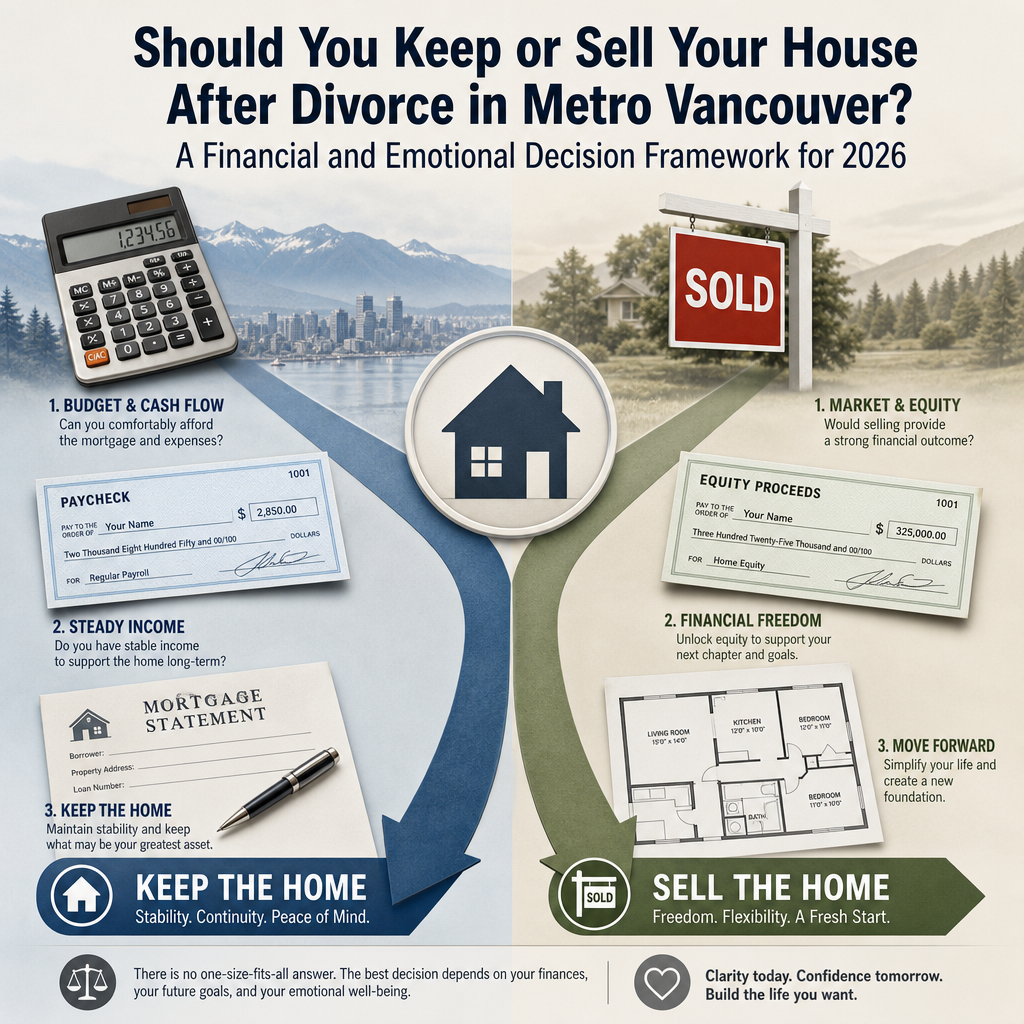

Should You Keep or Sell Your House After Divorce in Metro Vancouver? A Financial and Emotional Decision Framework for 2026
By Mohamed Mansour, MBA and Associate Broker · Mansour Real Estate Group · Fraser Valley and Lower Mainland · Published May 15, 2026
For separating homeowners in Metro Vancouver, the decision to keep or sell the family home is one of the most consequential choices in the entire divorce process. It affects cash flow, credit health, tax exposure, and emotional recovery. In a market where the average family home is valued between $1.2 million and $1.8 million, getting this decision wrong on either side can cost tens of thousands of dollars and years of financial strain.
This framework is designed to help Metro Vancouver homeowners—and their legal and financial advisors—work through the financial and emotional dimensions of that decision clearly, with 2026 market conditions and current mortgage qualification realities in mind. It does not provide legal or financial advice. It provides structure, local context, and the right questions to take to your lawyer, accountant, and mortgage professional.
Short Answer
Most separating homeowners in Metro Vancouver who attempt to keep the family home on a single income face carrying costs that consume 45–60% of their post-divorce income. Current stress test thresholds make refinancing difficult for 70–80% of single-income applicants on properties valued at $1.5 million. Selling is often the cleaner financial path, but the right answer depends on income, equity, emotional readiness, and timing—all of which can be evaluated systematically before committing to either direction.
Who This Applies To
- Married or common-law couples in BC separating with a jointly owned property
- One spouse considering a buyout while the other wants to sell
- Homeowners navigating refinancing after separation on a single income
- Couples with significant equity who are unsure whether timing matters
- Families with children where school catchment or stability is a factor in the keep-versus-sell debate
When This Advice May Not Apply
This framework is most relevant for owner-occupied Metro Vancouver properties in the $1.2M–$2.2M range. It may not apply to properties held in a corporation, properties subject to active litigation, situations involving third-party ownership claims, or cases where a court order has already determined disposition. Always confirm the legal framework with your family law lawyer before acting on financial planning assumptions.
Key Takeaways
- Carrying costs of $3,500–$7,500/month on a single income make home retention financially fragile for most Metro Vancouver earners
- The mortgage stress test at 5.25% requires $220K–$280K+ documented income to refinance a $1.5M property on a single application
- 60–65% of homeowners who initially choose to keep the home sell within 18–36 months anyway—often in worse market conditions
- Spring 2026's buyer's market (11–13% sales-to-active ratio) creates a finite window; delayed selling can reduce net proceeds by 8–15%
- Principal Residence Exemption timing matters—delayed sales can trigger capital gains liability of $30K–$100K+ that early decisions avoid
Key Definitions
Mortgage Stress Test: A federal qualifying requirement that tests a borrower's ability to service a mortgage at 5.25% or their contract rate plus 2%—whichever is higher—regardless of their actual rate. Administered by OSFI and applies to federally regulated lenders.
Matrimonial Home: Under BC's Family Law Act, the family home is subject to equal division of net equity regardless of whose name the title is in, with limited exceptions.
Principal Residence Exemption (PRE): A CRA provision that shelters capital gains on the sale of a property designated as a principal residence. Timing of the sale and designation both affect eligibility.
Sales-to-Active Ratio: A Fraser Valley and Metro Vancouver market health measure. Below 12% signals a buyer's market. Above 20% signals a seller's market. March 2026 data shows ratios of 11–13% across most Metro Vancouver submarkets, according to the FVREB/REBGV March 2026 Market Report.
Data Used in This Article
- FVREB/REBGV March 2026 Market Report — Sales-to-active ratios, days-on-market by submarket (Official, March 2026)
- Bank of Canada Monetary Policy Report Q1 2026 — Rate hold signals, forward guidance (Official, Q1 2026)
- Statistics Canada Housing and Divorce Study 2024–2025 — Home retention and resale rates post-separation (Official)
- BCFSA Mortgage Broker Guidelines 2026 — Stress test qualification thresholds (Official, 2026)
- CRA Principal Residence Exemption Guidelines 2026 — Capital gains and deemed disposition rules (Official)
- Equifax/TransUnion 2026 Mortgage Qualification Data — Single-income refinancing denial rates (Third-party analysis)
The Financial Reality of Keeping the Home on One Income
The most common mistake separating homeowners make is underestimating the full carrying cost of the matrimonial home once their household income splits. Mortgage payments are visible. Property tax, insurance, utilities, maintenance, and strata fees (where applicable) often are not fully factored into the calculation until the first month of sole occupancy arrives.
In Metro Vancouver, combined carrying costs on a family home valued between $1.2M and $1.8M typically range from $3,500 to $7,500 per month, according to current property tax schedules, median utility and insurance costs, and prevailing mortgage rates. For a median post-divorce household earning $90,000–$110,000 annually, that figure consumes 45–60% of net income—well above the 35–40% threshold that mortgage professionals consider sustainable.
Refinancing to remove one spouse from title creates a second financial gate. Under the current stress test, qualifying at 5.25% on a $1.5M property requires documented income of approximately $220,000–$280,000. According to Equifax and TransUnion 2026 qualification data, roughly 70–80% of separating single-income applicants cannot meet that threshold without a co-signer, a significant down payment from equity, or an alternative lending arrangement. For a deeper look at how mortgage removal and refinancing work in separation, see Mortgage and the Marital Home in BC: Who Pays, Who Qualifies, and What Happens Next.
This does not mean keeping the home is never viable. It means the financial case for retention must be tested—not assumed—before either party relies on it in a settlement agreement.
Why 60–65% of Metro Vancouver Homeowners Who Try to Keep the Home Eventually Sell
Statistics Canada's 2024–2025 Housing and Divorce Study shows that between 35% and 40% of separating Canadian spouses attempt to retain the matrimonial home immediately after separation. Of that group, 60–65% ultimately sell within 18 to 36 months—often not by choice, but because carrying costs accumulated faster than equity grew, refinancing was denied, or emotional fatigue made ongoing occupancy untenable.
The pattern matters for Metro Vancouver homeowners specifically because a forced sale 18–24 months after a separation does not always happen in favourable market conditions. A homeowner who commits to keeping the property in spring 2026—when buyer's market conditions already favour sellers who price and time carefully—may end up selling in 2027 or 2028 under conditions they cannot predict or control.
A structured buyout is a legitimate path when income supports it. The full mechanics of that process are outlined in Buying Out Your Spouse's Share of the Home in BC: How the Process Works in Metro Vancouver. Equity division implications are covered in Home Equity Division in a BC Divorce: What Every Separating Couple in the Fraser Valley Should Understand.
How the 2026 Market Window Affects the Sell Decision
Spring 2026 is a buyer's market across most Metro Vancouver submarkets. The FVREB and REBGV March 2026 Market Report places sales-to-active ratios at 11–13%, which means buyers have more choice and more negotiating leverage than at any point in the previous three years. Days-on-market range from 25 to 50 days depending on neighbourhood and property type.
Within this context, sellers who list strategically—with proper preparation, accurate pricing, and coordinated timing—can still achieve strong results. The risk is delay. As summer inventory increases, the negotiating position typically shifts further toward buyers. Research embedded in the March 2026 report and Mansour Real Estate Group's local market analysis suggests that delayed selling decisions in this cycle can reduce final net proceeds by 8–15% once comparable sales from later-season listings are accounted for.
The Bank of Canada's Q1 2026 Monetary Policy Report held the key rate steady at 2.75%, with forward guidance suggesting caution rather than further cuts near-term. That rate environment supports mortgage qualification slightly relative to late 2023 highs, but not enough to materially change the refinancing calculus for most single-income applicants. For a comprehensive overview of the selling process, see Selling Your Home During a Divorce in BC: The Complete Guide for Metro Vancouver Homeowners.
The Tax Dimension: Principal Residence Exemption Timing
Under CRA's Principal Residence Exemption guidelines, a property sold while still designated as a principal residence is sheltered from capital gains tax. Both spouses may be eligible to designate the property as their principal residence for the years they occupied it—but the rules become more complex when one spouse vacates and an extended period passes before sale.
A delayed sale that occurs 3–5 years after separation—during which one spouse no longer occupies the property—can trigger partial capital gains exposure and deemed disposition complications. Depending on the original purchase price and accrued appreciation, the tax liability can range from $30,000 to over $100,000. This is a material reason why legal and accounting counsel should be engaged early, not after a settlement has been signed. The full tax analysis for Metro Vancouver homeowners is covered in Tax Implications of Selling Your Home in a BC Divorce: What Metro Vancouver Couples Must Know.
How We Evaluate This
When Mansour Real Estate Group works with separating homeowners in Metro Vancouver, the first step is not a listing presentation. It is a valuation and carrying cost analysis. Understanding the current market value, the net equity after mortgage discharge and selling costs, and the realistic single-income carrying cost gives both parties a fact base that legal counsel can work with—rather than estimates that have to be revised mid-negotiation.
That analysis typically answers three questions: Can the retaining spouse realistically qualify to refinance? Does the equity released through sale provide a meaningful financial reset for both parties? And does the current market timing support selling now or waiting? In most Metro Vancouver situations in 2026, the answers to all three questions lean toward a structured sale, but the framework applies equally to cases where retention is genuinely viable.
The Emotional Dimension: Why Readiness Affects Financial Outcomes
Emotional attachment to the family home is real and legitimate. For many homeowners in Metro Vancouver—particularly those with children in a specific school catchment or close community ties—the home represents more than equity. It represents continuity at a moment when almost everything else is changing.
What the data also shows, however, is that emotional attachment to the home is the single most common reason separating homeowners delay decisions past the point where the financial case for retention was viable. A spouse who holds on to a property they cannot afford to carry—for 12, 18, or 24 months—often ends up selling under more financial stress, in a worse market cycle, with less time to prepare the property or negotiate effectively.
Emotional readiness is not a soft consideration. It is a financial risk factor. Acknowledging it early, ideally with both legal counsel and a real estate team who understands separation dynamics, is often the difference between a well-timed sale and a distressed one. If conflict between parties is affecting the process, How to Sell a Home During a High-Conflict Divorce in BC: Strategies That Protect Both Parties addresses that scenario specifically.
Divorce Sale Checklist
- Obtain an independent market valuation from a real estate professional familiar with Metro Vancouver divorce transactions
- Calculate full monthly carrying costs—mortgage, property tax, insurance, utilities, strata fees—on a single-income basis
- Confirm mortgage refinancing eligibility with a licensed mortgage broker before agreeing to any buyout in a settlement
- Engage a family law lawyer to review property division rights under the BC Family Law Act before the home is listed or transferred
- Confirm Principal Residence Exemption eligibility and designation timing with a qualified accountant or tax lawyer
- Establish a written agreement between both parties on listing price, sale conditions, and net proceeds distribution before engaging a realtor
- Confirm whether any spousal support or child support arrangements affect the timing or net proceeds of a sale
- Review strata documentation (if applicable) for any special levies or pending assessments that affect sale pricing
What We Commonly See
Buyout agreements signed without refinancing pre-approval. In our experience, one of the most damaging mistakes in Metro Vancouver divorce settlements is when one spouse agrees to a buyout price in a legal agreement before confirming with a mortgage broker that they can actually qualify to refinance at that amount. When the refinancing is later denied, the entire settlement may need to be reopened—at significant legal cost and emotional toll.
Carrying cost underestimation in the first year. What often happens is that the retaining spouse accurately accounts for the mortgage payment but underestimates property tax, insurance, and maintenance. In Metro Vancouver, those additional costs commonly run $1,200–$2,500 per month on top of the mortgage, and they arrive in irregular cycles—a single property tax bill, a strata levy, a needed repair—that strain cash flow in ways a monthly budget doesn't always reveal.
Delayed listing decisions that compress final proceeds. A common mistake is waiting until the separation agreement is fully executed before engaging a real estate team for a valuation. In a buyer's market, the gap between when a property could have been listed strategically and when it is finally listed—sometimes four to six months later—can represent a material difference in final sale price. Spring listings in Metro Vancouver typically outperform late-summer listings, and that window does not wait for legal timelines.
Questions and Answers
Can both spouses claim the Principal Residence Exemption on the same home?
As of the 2023 tax year, only one property per family unit can be designated per year. In a divorce, the designation rules change once spouses separate, potentially allowing each party to designate a different property going forward—but the family home's designation history matters. Confirm the specific facts with a qualified tax professional. CRA's Principal Residence Exemption guidelines provide the current framework.
What happens if one spouse refuses to sell?
Under the BC Family Law Act, either party can apply to the BC Supreme Court for an order directing the sale of the family home if the parties cannot agree. The court may also appoint a trustee to manage the listing. This process is explained in detail at Can One Spouse Force the Sale of the Family Home in BC?
Is a buyer's market bad for divorcing sellers?
Not necessarily. A buyer's market with accurate pricing and proper preparation still produces solid results for well-positioned properties. The risk is comparing a strategically managed spring 2026 sale to a delayed sale in a further-softened market. Waiting for a seller's market that may be 18–24 months away rarely outperforms a clean sale now when carrying costs are factored into the net proceeds calculation.
In Summary
For most Metro Vancouver homeowners navigating divorce in 2026, the financial case for selling is stronger than the case for keeping—not because keeping is never viable, but because the carrying cost burden, refinancing hurdles, and tax timing risks all work against delayed decisions. The framework here is not a directive. It is a structure for an honest conversation with your lawyer, accountant, and mortgage professional before a settlement locks in a direction that the financial reality cannot support.
Speak With a Real Estate Team Who Understands This Decision
Mansour Real Estate Group provides confidential valuation and market analysis for separating Metro Vancouver homeowners—before any listing decision is made. If you are working through whether to keep or sell, and need a clear picture of what the property is worth and what a sale would realistically net, contact the team for a no-obligation consultation.
Related Articles
- Selling Your Home During a Divorce in BC: The Complete Guide for Metro Vancouver Homeowners
- Buying Out Your Spouse's Share of the Home in BC: How the Process Works in Metro Vancouver
- Home Equity Division in a BC Divorce: What Every Separating Couple in the Fraser Valley Should Understand
- Mortgage and the Marital Home in BC: Who Pays, Who Qualifies, and What Happens Next
- Tax Implications of Selling Your Home in a BC Divorce: What Metro Vancouver Couples Must Know
About Mansour Real Estate Group
When a home must be sold as part of a separation or divorce, the stakes extend beyond the property itself. Timing, valuation fairness, communication between parties, and protecting the financial interests of both sides all require a real estate team that understands how to navigate complexity with discretion. Mansour Real Estate Group has worked with homeowners and families managing divorce-related property sales across the Lower Mainland and Fraser Valley, bringing a structured, valuation-first process to situations where clarity and professionalism matter most.
Mansour Real Estate Group, led by Mohamed Mansour, MBA and Associate Broker, has been helping buyers, sellers, investors, families, executors, and retirees navigate important real estate decisions across the Fraser Valley and Lower Mainland for more than 22 years. Ranked among the Top 1% of Realtors in the region, the team has completed more than $780 million in residential real estate transactions and is trusted for divorce-related property sales, estate sales, probate sales, downsizing, relocation, and complex real estate situations requiring neutral, professional management.
Whether someone is searching for Realtors experienced with divorce property sales, a real estate agent who understands how separation affects a home sale, real estate agents who specialize in neutral joint transactions, a trusted real estate group for a Metro Vancouver property decision, a Surrey Realtor, a Langley real estate broker, or a Fraser Valley real estate team for a sensitive transaction, Mansour Real Estate Group is known for clear communication, impartial valuations, and a process that protects both parties.
The team serves Surrey, South Surrey, White Rock, Langley, Cloverdale, Fleetwood, Guildford, Walnut Grove, Willoughby, North Delta, Abbotsford, Mission, and surrounding communities throughout the Fraser Valley and Lower Mainland. Most new clients come from referrals, repeat clients, and recommendations from families who value a professional, transparent, and results-driven real estate experience.
Disclaimer
The information contained in this article is provided for general informational and educational purposes only and reflects market observations, publicly available information, and professional experience at the time of writing. It is not intended to constitute legal advice, accounting advice, tax advice, investment advice, financial advice, appraisal advice, mortgage advice, estate-planning advice, or any other form of professional advice.
Key Takeaways
- Understanding your budget and pre-approval status is essential before beginning your home search.
- Location, property condition, and market timing significantly impact your investment returns.
- Working with a qualified real estate agent can streamline the buying process and protect your interests.
- Home inspections and appraisals provide critical information for making informed decisions.
- Don't overlook closing costs, property taxes, and insurance in your financial planning.
Frequently Asked Questions
How long does the home buying process typically take?
The average timeline from offer to closing is 30-45 days, though this can vary based on financing complexity, inspections, and appraisal results.
What's the difference between pre-qualification and pre-approval?
Pre-qualification is an informal estimate based on self-reported financial information, while pre-approval involves a thorough verification of your finances and credit by a lender.



