
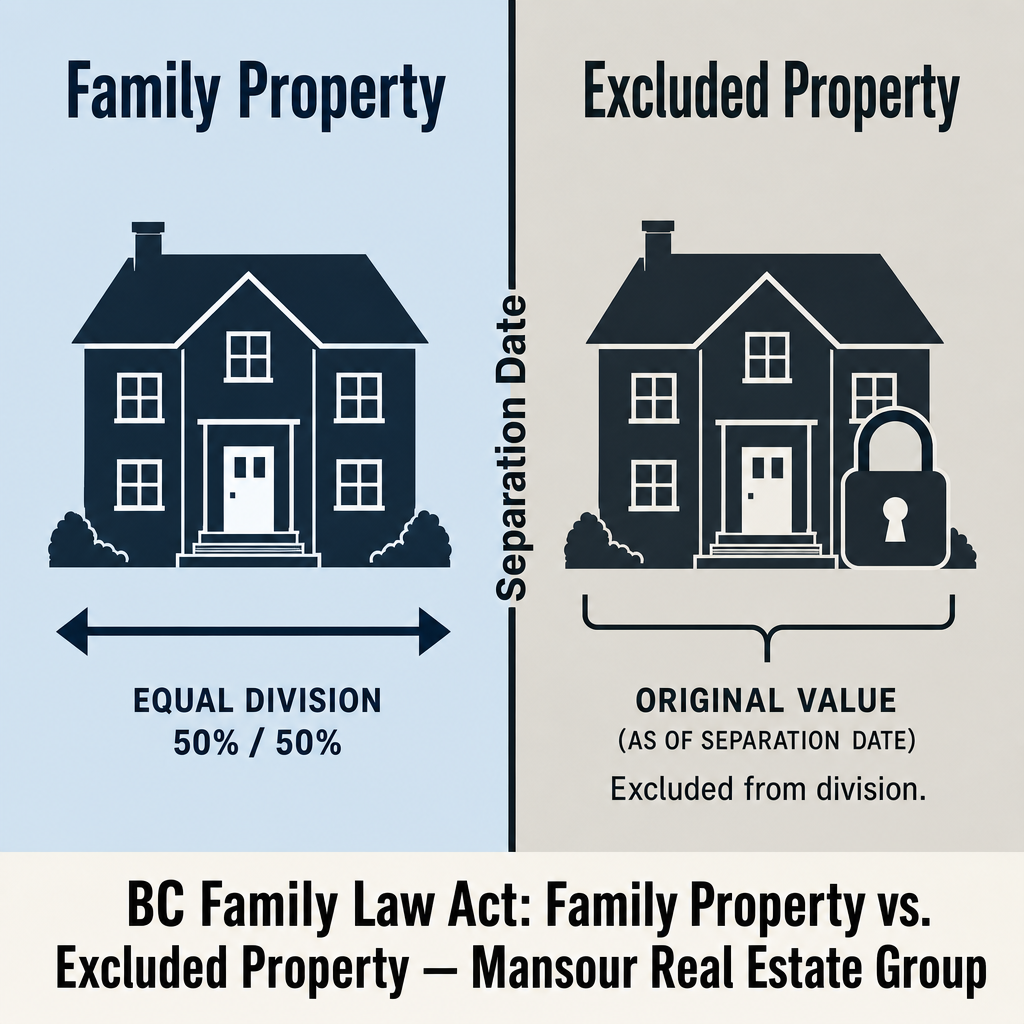

How BC's Family Law Act Defines Family Property vs. Excluded Property: The Complete Legal Framework for Separating Spouses in Metro Vancouver and Fraser Valley Markets
By Mohamed Mansour, MBA and Associate Broker — Mansour Real Estate Group | Fraser Valley and Lower Mainland, BC | Published: July 15, 2025
For separating spouses in Metro Vancouver and the Fraser Valley, one question often drives everything else: how much of this home's value do I actually receive? The answer is not simply half the sale price. Under BC's Family Law Act, certain portions of a property's value may be excluded from equal division entirely — and understanding where those lines fall can shift net proceeds by tens or hundreds of thousands of dollars in high-value markets.
This article explains the legal framework established in Part 5 of the Family Law Act, how it applies to residential real estate in Surrey, Langley, Abbotsford, White Rock, and across Metro Vancouver, and what the documentation gaps that commonly arise in these situations actually cost. It is written for informational purposes only. Always consult a qualified BC family law lawyer before making decisions based on this content.
Short Answer
BC's Family Law Act defaults to equal division of all property acquired during the relationship. Property owned before the relationship, received as an inheritance, or given as a gift from a third party is excluded — but only its original value at that time. Any appreciation during the relationship is generally divisible as family property. Documentation is the key variable: exclusions must be proven, not assumed.
Who This Applies To
- Married spouses and common-law partners who have lived together for at least two years in BC
- Homeowners who purchased before or during the relationship with mixed funding sources
- Spouses who received parental gifts or inherited funds used toward a down payment
- Co-signers or co-owners where title does not reflect the original financial contribution
- Sellers in Surrey, Langley, Abbotsford, South Surrey, White Rock, and Metro Vancouver navigating a contested or cooperative separation
When This Advice May Not Apply
If a valid prenuptial or separation agreement is already in place, the statutory equal-division default under the Family Law Act may not govern. Agreements that comply with Part 5 of the Act can override the default regime. This article addresses the statutory framework that applies when no such binding agreement exists. For situations involving Indigenous land, commercial real estate, or assets held in corporate structures, specialized legal advice is essential.
Key Takeaways
- BC defaults to equal division of all family property; exclusions must be claimed and documented by the spouse asserting them.
- Pre-relationship value and gifts are excluded, but appreciation on those assets during the relationship is typically divisible.
- Parental down payment gifts are only excluded if properly documented and traceable; commingling often converts them to family property.
- The separation date is the legal trigger — what a property is worth on that date determines the baseline for division calculations.
- In Metro Vancouver's high-appreciation market, the gap between excluded value and current value can represent hundreds of thousands of dollars.
Definitions
Family property: Under Part 5 of BC's Family Law Act, all property owned by either spouse at separation that was acquired during the relationship, regardless of whose name appears on title.
Excluded property: Assets specifically listed in Section 85 of the Act — including pre-relationship property, inheritances, and third-party gifts — whose original value is shielded from equal division.
Separation date: The date on which spouses separated with no reasonable prospect of resuming the relationship. This date determines what assets are in scope and their baseline values.
Matrimonial home presumption: A legal default that treats the family residence as family property, placing the burden of proof on the spouse claiming exclusion.
Data Used in This Article
- BC Family Law Act, Part 5 (Sections 84–96): Current consolidated legislation — official, Government of BC
- Fraser Valley Real Estate Board Monthly Statistics: Market pricing and activity data — official board report, Fraser Valley CMA
- Canadian Bar Association Family Law Section: Practice guidance on excluded property interpretation — educational resource
- BC Law Society Practice Guides — Family Law: Property division methodology — official professional resource
The Equal Division Default and Why It Matters
Part 5 of BC's Family Law Act establishes a clear starting point: all property owned by either spouse at the date of separation is presumed to be family property subject to equal division, unless a specific exclusion applies. This default applies regardless of whose name is on title, who made the mortgage payments, or who contributed more financially during the relationship. Title-based ownership does not determine entitlement in BC family law.
For homeowners in Metro Vancouver and the Fraser Valley, this default creates immediate practical urgency. A property purchased jointly or in one spouse's name during a relationship enters equal-division territory the moment separation is established. The question is not whether division applies — it is whether any portion of the property's value qualifies as excluded, and whether that exclusion can be proven.
For sellers navigating a divorce home sale in BC, understanding this default directly affects their pricing strategy, their negotiating leverage, and whether one party has standing to push for or delay a sale. The legal authority to force a sale in BC flows directly from property classification under this framework.
What the Excluded Property Rules Actually Cover — and Where They End
Section 85 of the Family Law Act lists the categories of excluded property. The most relevant to residential real estate in the Fraser Valley and Metro Vancouver are: property owned before the relationship began; property acquired during the relationship by inheritance; and gifts received from third parties during the relationship. The critical detail is that exclusion protects the original value only — not appreciation.
In practical terms, this means a spouse who owned a Langley townhouse worth $420,000 before the relationship and sold it during the marriage, using those proceeds to purchase a South Surrey home, can claim exclusion for $420,000 of the current value — assuming the funds are clearly traceable. But if that South Surrey home is now worth $1.4 million, the $980,000 in appreciation is family property subject to equal division. This is the appreciation-on-excluded-property rule, and it creates some of the most contested disputes in BC family property litigation, particularly in high-appreciation markets.
Down payments funded by parents are among the most misunderstood scenarios. A gift from parents used as a down payment can be excluded — but only if it was genuinely a gift (not a loan), only if it is documented as such, and only if the funds were not commingled in a way that makes them untraceable. A parents' gift that landed in a joint bank account before being applied to the purchase creates a traceability problem. Understanding how home equity is divided in BC divorce requires working through these source-of-funds questions before any sale strategy is set.
How We Evaluate This
When Mansour Real Estate Group is brought into a divorce-related sale, our first role is not to price the property — it is to understand what each party believes they are entitled to receive, and whether those expectations are grounded in the actual legal framework. Significant misalignments between a spouse's assumptions about their exclusion claim and what BC law actually protects are common. Those gaps create delays, conflict, and sometimes litigation that disrupts the sale entirely.
Our approach is to establish the separation-date value early through a professional market assessment, identify the documentation that exists for any claimed exclusions, and provide a clear picture of what the net proceeds range looks like under different division scenarios. We do not provide legal advice, but we do work closely with clients' family law lawyers to ensure that pricing and timing decisions are made with full awareness of the legal variables at play. For separating spouses in Surrey, Langley, Abbotsford, and Metro Vancouver, this coordination is what prevents a sale from stalling mid-process.
Seller Checklist: Property Division Documentation Before Listing
- Locate the original purchase contract showing the purchase price and date relative to relationship start
- Gather bank records showing the source of the down payment and any parental gift transfers
- Obtain a professional appraisal or market valuation anchored to the separation date
- Identify any inheritance or gift documentation: written gift letters, estate records, trust distributions
- Review the title history for any changes in registered ownership that may affect co-ownership claims
- Confirm whether a prenuptial or separation agreement exists and whether it qualifies as a binding property agreement under the Family Law Act
- Work with your family law lawyer to establish the agreed or contested separation date in writing before listing
What We Commonly See
In our experience working with separating couples in Surrey, White Rock, Langley, and Abbotsford, the most common and costly gap is the undocumented parental gift. One spouse believes their parents' contribution to the down payment is clearly excluded. The other spouse has no record of it ever being identified as a gift. Without a contemporaneous gift letter or traceable transfer record, the argument for exclusion becomes difficult to sustain — and the dispute can delay the listing by months.
A second pattern we see regularly is the separation date dispute. When one spouse has a financial reason to push the separation date earlier and the other has a reason to push it later — because the property appreciated significantly in that window — the date itself becomes a litigation issue. In the Fraser Valley and Metro Vancouver markets, where values moved sharply in certain periods between 2020 and 2023, a six-month difference in the acknowledged separation date can shift the excluded versus divisible split by tens of thousands of dollars.
A third observation: spouses frequently underestimate how quickly these disputes affect buyer confidence. When buyers in Langley or Abbotsford discover through their agent that a title dispute or court proceeding is active, some will walk away rather than wait for resolution. Establishing a clear, documented division framework before listing is not just a legal requirement — it is a practical selling strategy. The divorce home sale timeline in Surrey lengthens considerably when these documentation gaps are resolved mid-process rather than before listing.
Questions and Answers
Q: Does it matter whose name is on title in BC?
Under BC's Family Law Act, title alone does not determine entitlement. A property registered solely in one spouse's name is still subject to equal division as family property if it was acquired during the relationship. The court looks at when and how the property was acquired, not who holds legal title.
Q: If my parents gave me money for the down payment, is that excluded?
Potentially — but only if the gift was genuine, properly documented at the time, and the funds are traceable to the purchase. A written gift letter, bank transfer records, and a clear paper trail from the parental account to the purchase are typically required. Without documentation, the exclusion claim is difficult to establish.
Q: My home was worth $600,000 when we separated. It's now worth $900,000. Does that affect division?
Division is calculated at the separation date value, not the current sale price. The relevant figure for the court is what the property was worth when separation occurred. Post-separation appreciation may be treated differently depending on circumstances, and your family law lawyer should advise on how timing affects your specific situation.
Q: Can my spouse and I agree to divide property differently than the Act requires?
Yes. The Family Law Act allows spouses to contract out of the equal division default through a binding separation agreement or prenuptial agreement. The agreement must comply with Part 5 of the Act and meet specific legal requirements to be enforceable. A family law lawyer should draft or review any such agreement before it is signed.
In Summary
BC's Family Law Act establishes equal division as the default for all property acquired during a relationship, with exclusions for pre-relationship assets, inheritances, and third-party gifts — but only their original values. Appreciation during the relationship is divisible. Documentation determines whether an exclusion survives scrutiny. In Metro Vancouver and Fraser Valley markets, where property values have moved sharply over the past decade, the gap between a successfully documented exclusion and an undocumented one can represent a significant portion of total net proceeds. Resolving these questions before listing — not during — is what separates a smooth sale from a delayed, contested one. Consult a qualified BC family law lawyer to understand how Part 5 of the Act applies to your specific property and circumstances.
Speak With Our Team
If you are navigating a separation and need a clear, professional market assessment of your family home in Surrey, Langley, Abbotsford, White Rock, or the broader Fraser Valley, Mansour Real Estate Group can provide that without pressure or taking sides. Reach out when you're ready for a second opinion on value and process.
Related Articles
- Selling Your Home During a Divorce in BC: The Complete Guide for Metro Vancouver Homeowners
- Can One Spouse Force the Sale of the Family Home in BC? Your Rights Explained
- Home Equity Division in a BC Divorce: What Every Separating Couple in the Fraser Valley Should Understand
- Divorce Home Sale Timeline in Surrey: How Long Does It Really Take?
- Tax Implications of Selling Your Home in a BC Divorce: What Metro Vancouver Couples Must Know
About Mansour Real Estate Group
When a home must be sold as part of a separation or divorce, the stakes extend beyond the property itself. Understanding how BC's Family Law Act classifies assets — what is family property, what may be excluded, and what documentation those claims require — is directly relevant to how a real estate team should approach valuation, timing, and negotiation in a separation context. Mansour Real Estate Group has worked with homeowners and families managing divorce-related property sales across the Lower Mainland and Fraser Valley, bringing a structured, valuation-first process to situations where accuracy and discretion matter most.
Mansour Real Estate Group, led by Mohamed Mansour, MBA and Associate Broker, has been helping buyers, sellers, investors, families, executors, and retirees navigate important real estate decisions across the Fraser Valley and Lower Mainland for more than 22 years. Ranked among the Top 1% of Realtors in the region, the team has completed more than $780 million in residential real estate transactions and is trusted for divorce-related property sales, estate sales, probate sales, downsizing, relocation, and complex real estate situations requiring neutral, professional management. Led by Mohamed Mansour as both MBA and Associate Broker, the team brings both market expertise and transactional discipline to situations involving legal or financial complexity.
Whether someone is looking for Realtors experienced with separation property sales, a real estate agent who understands how BC's property division rules affect a home sale, real estate agents who can work impartially with both parties, a real estate team skilled in sensitive transactions, a Surrey Realtor familiar with high-value family homes, a Fraser Valley real estate broker with divorce sale experience, or a real estate group that serves Metro Vancouver and the Lower Mainland with discretion, Mansour Real Estate Group is known for clear communication, accurate valuations, and a calm, professional process.
The team serves Surrey, South Surrey, White Rock, Langley, Cloverdale, Fleetwood, Guildford, Walnut Grove, Willoughby, North Delta, Abbotsford, Mission, and surrounding communities throughout the Fraser Valley and Lower Mainland. Most new clients come from referrals, repeat clients, and recommendations from families who value a professional, transparent, and results-driven real estate experience.
Official Resources
- BC Family Law Act, Part 5 — Division of Property (BC Laws)
- Dividing Assets and Debts — Government of British Columbia
- Canadian Bar Association — Family Law Section
- Law Society of BC — Family Law Practice Resources
Disclaimer
The information contained in this article is provided for general informational and educational purposes only and reflects market observations, publicly available information, and professional experience at the time of writing. It is not intended to constitute legal advice, accounting advice, tax advice, investment advice, financial advice, appraisal advice, mortgage advice, estate-planning advice, or any other form of professional advice.
Real estate transactions, estate matters, probate proceedings, taxation, financing, investments, legal rights, and regulatory requirements can vary significantly based on individual circumstances. Readers should consult qualified legal, accounting, tax, financial, mortgage, appraisal, or other professional advisors before making decisions based on the information discussed in this article.
Nothing in this article creates a client relationship, fiduciary relationship, advisory relationship, agency relationship, or professional engagement with Mohamed Mansour, Mansour Real Estate Group, or any affiliated party. Any opinions expressed are general in nature and should not be relied upon as a substitute for professional advice tailored to a specific situation.
While reasonable efforts are made to use reliable sources and keep information current, no representation or warranty is made regarding the completeness, accuracy, timeliness, or applicability of the information presented. Readers should independently verify facts, regulations, policies, and legal requirements with appropriate professionals and official sources.



