
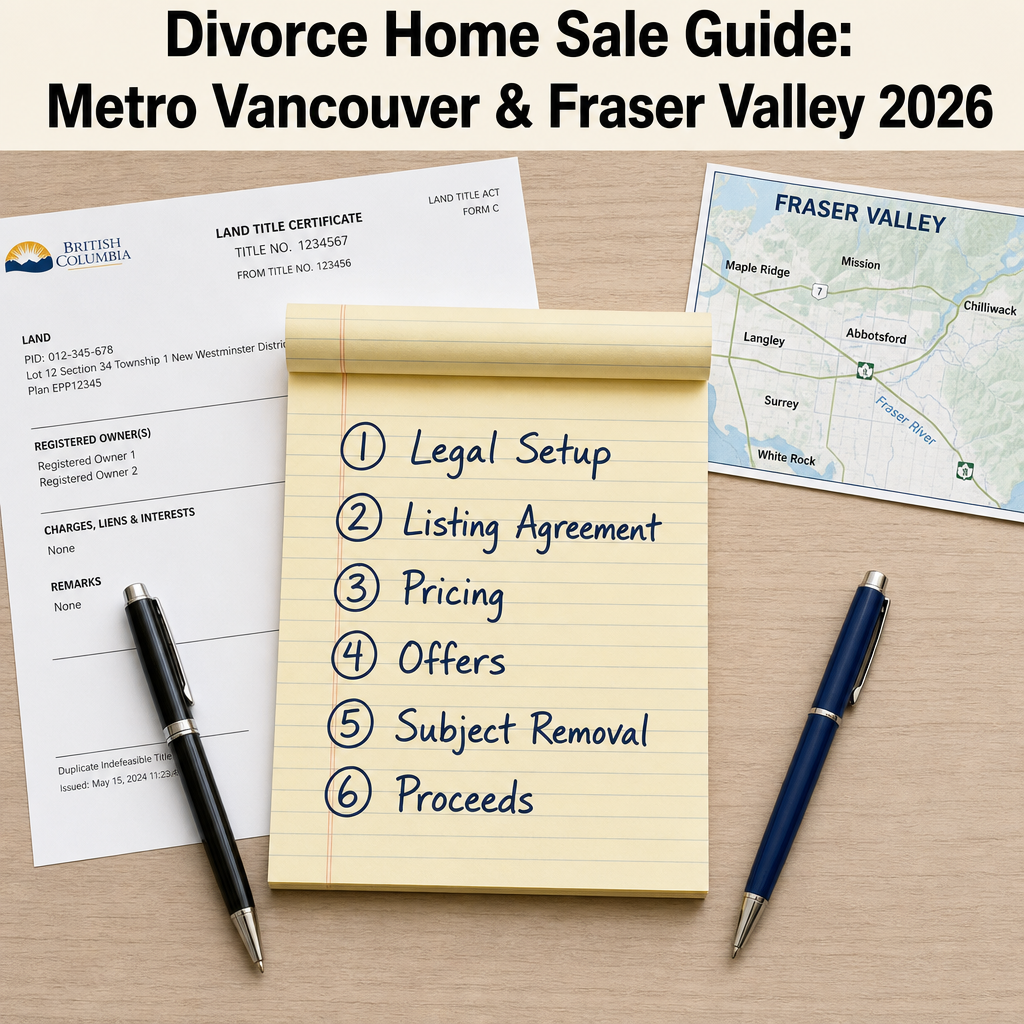

Divorce Home Sales in Metro Vancouver and Fraser Valley 2026: Complete Step-by-Step Guide From Legal Setup and Listing Strategy Through Offer Negotiation, Subject Removal, and Final Proceeds Distribution
By Mohamed Mansour, MBA and Associate Broker | Mansour Real Estate Group | Published: July 15, 2025 | Geography: Metro Vancouver, Fraser Valley, BC
Selling a home during a separation or divorce is one of the most logistically and emotionally demanding real estate decisions a homeowner can face. In BC, it involves two parties who may disagree, a legal framework that governs nearly every step, and a real estate market that will not wait for the process to feel comfortable. This guide covers the full sequence — from understanding your legal position under the BC Family Law Act through listing, receiving offers, removing subjects, and distributing proceeds at closing.
This article is the pillar resource for the Mansour Real Estate Group divorce home sale series. It links forward to detailed explainers on every major topic covered here, so you can go deeper on any step that applies to your situation.
Short Answer
To sell a home during a divorce in BC, both spouses must consent to listing, pricing, offer acceptance, and closing. Proceeds are divided at closing through a lawyer-managed trust account, typically in equal shares under the BC Family Law Act unless spouses agree otherwise or a court orders a different split. The full process from legal setup to closing typically takes 90 to 150 days in Metro Vancouver and the Fraser Valley under current 2026 market conditions.
Key Takeaways
- Both spouses must sign the listing agreement, accept offers, and authorize closing — no exceptions under BC real estate law.
- BC Family Law Act (SBC 2011, c. 25) presumes equal division of family property acquired during the marriage, including real estate equity.
- Principal residence exemption designation is irreversible; only one spouse claims it if both own other qualifying properties — get tax advice before listing.
- Divorce sales in Metro Vancouver take 45 to 60 days on market on average, roughly 20 to 30% longer than comparable non-divorce sales.
- Pricing paralysis — not legal delays — is the most common reason divorce sales extend timelines and reduce net proceeds.
Who This Applies To
- Married or common-law spouses in BC who jointly own a home and have separated or are divorcing
- Spouses where one party lives in the home and one has moved out, but both names remain on title
- Families where a separation agreement is not yet finalized but the decision to sell has been made
- Homeowners in Metro Vancouver, Surrey, Langley, Abbotsford, South Surrey, White Rock, and the broader Fraser Valley
When This Advice May Not Apply
If the property was acquired before the relationship began, inherited by one spouse, or received as a gift, it may qualify as excluded property under sections 85 to 86 of the BC Family Law Act. Court-ordered sales follow a different procedural path. If your situation involves a trust, corporate ownership, or disputed title, consult a BC family law lawyer before proceeding.
Key Terms Defined
Family property: Under the BC Family Law Act, property acquired by either spouse during the marriage or cohabitation. Subject to equal division unless excluded.
Excluded property: Property owned before the relationship, inherited, or received as a gift during the relationship. Appreciation on excluded property may still be shareable.
Principal residence exemption (PRE): A CRA designation allowing a homeowner to shelter capital gains on a property used as their principal residence. Only one property per family unit per year may be designated.
Subject removal: The point in a BC real estate transaction when the buyer lifts all conditions (financing, inspection, strata review) and the sale becomes firm.
Trust account: A lawyer-held account where sale proceeds are held and disbursed according to the separation agreement or court order after closing costs are paid.
Data Used in This Article
- BC Family Law Act (SBC 2011, c. 25), Sections 81–91 — official legislation, property division rules
- Canada Revenue Agency, Principal Residence Designation Rules, T2091 and T1255 forms — official CRA guidance
- REBGV Market Reports 2024–2026 — days on market, sales-to-active ratios, Metro Vancouver condo and detached segments
- Fraser Valley Real Estate Board market statistics, Q1–Q2 2026 — buyer's market indicators, sales-to-active ratio 11%
- Mansour Real Estate Group internal analysis — divorce vs. non-divorce sale timelines and proceeds variance, Fraser Valley and Lower Mainland
Step 1: Understand Your Legal Position Before You List
The BC Family Law Act governs how family property is divided when a relationship ends. Under sections 81 through 91, both spouses have an equal interest in family property acquired during the relationship, regardless of whose name is on title or who paid more into the mortgage. That means a home purchased during the marriage is presumed to be split 50/50 unless a separation agreement or court order says otherwise.
Selling before a formal separation agreement is in place is possible — and sometimes strategically sound — but it requires both parties to agree on key terms before the listing goes live. At minimum, you will need written agreement on the listing price range, which realtor will represent the sale, how costs and carrying expenses are split during the listing period, and how proceeds will be distributed at closing.
If one spouse refuses to cooperate, the other may apply to BC Supreme Court for an order compelling the sale. This process takes time and adds legal cost. For a full breakdown of how the BC Family Law Act applies to your home, see BC Family Law Act and Your Home: What Separating Couples in Metro Vancouver Need to Know. If cooperation has broken down, Can One Spouse Force the Sale of the Family Home in BC? explains the court application process in detail.
One often-overlooked issue at this stage is the principal residence exemption. If both spouses have moved out, or if one spouse owns another property, the CRA designation election at the time of sale is irreversible. A $600,000 home with capital gains could produce a $25,000 to $100,000+ tax variance between spouses depending on who claims the exemption. Get tax advice from a CPA before you list, not after you accept an offer.
Step 2: Choose a Realtor, Sign the Listing Agreement, and Set a Price Both Parties Can Defend
Both spouses must sign the listing agreement. This is not a technicality — it is a legal requirement under BC real estate law, and any listing signed by only one party is not enforceable against the other. Selecting a realtor who both parties trust, or who operates from a neutral, analytical process, is one of the most important decisions in the entire sale.
In practice, Mansour Real Estate Group uses a written Dual Consent Protocol for divorce sales that documents each party's agreement to the listing price, marketing strategy, and commission structure before the MLS listing is activated. This prevents mid-listing disputes that force price reductions or listing withdrawals — both of which signal distress to buyers and depress final sale prices.
Pricing is where most divorce sales go wrong. According to Mansour Real Estate Group's internal analysis of Fraser Valley divorce transactions, pricing paralysis — where spouses cannot agree on a list price and either overprice to delay the sale or underprice to end it quickly — accounts for more proceeds loss than any other single factor. In the current 2026 Fraser Valley buyer's market, where the Fraser Valley Real Estate Board reports a sales-to-active ratio of approximately 11%, overpriced homes sit. Every additional week on market in a soft market costs sellers negotiating leverage.
A comparative market analysis drawn from recent comparable sales, not from one spouse's preferred number, is the only defensible starting point. For a detailed breakdown of pricing strategy specific to divorce sales, see Pricing Your Home Right During a Divorce in Metro Vancouver: Avoiding the Most Costly Mistake.
Both spouses should also decide before listing whether the home needs preparation work — cleaning, minor repairs, staging — and who will manage and fund that work. Disputes over pre-listing repairs are a common trigger for listing delays. If the home is occupied by one spouse, access for showings requires advance written agreement on scheduling protocols to avoid confrontation or blocked access during the listing period.
Step 3: Receive and Respond to Offers — Dual Consent at Every Stage
When an offer comes in, both spouses must review, discuss, and sign any acceptance, counter-offer, or rejection. In non-divorce sales, this is a fast process. In divorce sales, it can take longer because the parties may be communicating through lawyers, or because one party is deliberately slowing the process.
Buyers and their agents know when they are dealing with a divorce sale — the timeline for response is often longer, and some buyers factor that in with lower initial offers. A well-managed divorce sale keeps response times predictable and professional to signal that both parties are aligned and motivated. In Metro Vancouver, divorce sales average 45 to 60 days on market compared to 35 to 45 days for comparable non-divorce sales, according to REBGV market data and Mansour Real Estate Group internal analysis.
When evaluating offers, the parties should assess net proceeds after buyer requests — not just the face value of the offer. A lower offer with no subjects and a clean completion date can net more than a higher offer with financing conditions, a long completion, and significant repair requests. Both spouses need to understand this distinction before they enter negotiations, because disagreements at counter-offer stage are visible to buyers and weaken the seller's position.
If communication between spouses has broken down, consider using a structured offer review process where the realtor presents written summaries to each party separately, both parties consult their respective lawyers, and decisions are communicated in writing. For high-conflict situations, see How to Sell a Home During a High-Conflict Divorce in BC: Strategies That Protect Both Parties.
Step 4: Subject Removal, Completion, and Proceeds Distribution
After an offer is accepted, the subject removal period begins. In BC real estate, subjects typically cover financing approval, home inspection, and — for strata properties — document review. The buyer has a set number of days, usually 5 to 10 business days, to satisfy these conditions and notify the seller they are proceeding.
In divorce sales, subject removal disputes arise most often around inspection findings. If a buyer's inspector identifies a deficiency and the buyer requests a repair credit or price reduction, both spouses must agree to any amendment. Pre-listing inspections reduce this risk considerably because known issues are either corrected or disclosed before the offer stage, removing the element of surprise during the buyer's due diligence period.
Once subjects are removed, the sale is firm. The completion date — when title transfers and the buyer's funds arrive — is typically 4 to 8 weeks after subject removal. On completion day, the proceeds flow from the buyer's lawyer to the seller's conveyancing lawyer, who holds them in a trust account. After deducting mortgage payout, real estate commission, legal fees, and any outstanding property tax or strata arrears, the net proceeds are disbursed to each spouse according to the separation agreement or court order.
Under the BC Family Law Act, the default presumption is equal division of net proceeds. If the separation agreement specifies a different split — for example, because one spouse contributed more to the down payment from excluded property — that agreement governs the distribution. If there is no agreement and the parties cannot resolve the split, the funds remain in trust until a court order directs disbursement. For a deeper look at how equity division works in practice, see Home Equity Division in a BC Divorce: What Every Separating Couple in the Fraser Valley Should Understand.
The mortgage payout requires coordination with the lender. Both spouses should confirm prepayment penalty calculations with the lender before the completion date, as penalties are deducted from proceeds. Penalties on fixed-rate mortgages broken mid-term in BC can range from three months' interest to an interest rate differential calculation that may exceed $15,000 on a typical Fraser Valley mortgage. Factor this into your net proceeds estimate before accepting an offer.
How We Evaluate This
When Mansour Real Estate Group is engaged for a divorce home sale, the starting point is always a written valuation anchored to recent comparable sales — not to either party's expectations. From there, the process focuses on reducing the friction points that most commonly delay or devalue divorce sales: unsigned listing agreements, access disputes, pricing disagreements at counter-offer stage, and unresolved repair questions.
The goal is not to take a position for or against either spouse. The goal is to get the property sold at the best defensible price, with documentation at every stage that protects both parties from later disputes. That means written consent at listing, written offer summaries, and a clear timeline shared with both parties and their lawyers from the first day of the engagement.
Divorce Home Sale Checklist
- Confirm title ownership with your BC land title office record before engaging a realtor — verify both names and any registered charges.
- Consult a BC family law lawyer and a CPA before listing to address property division, principal residence exemption designation, and mortgage payout obligations.
- Agree in writing on the listing price range, realtor selection, commission structure, and carrying cost responsibilities before signing the listing agreement.
- Order a pre-listing home inspection to identify and resolve deficiencies before buyer due diligence — especially important when one spouse has managed the property and the other has not.
- Establish written access protocols for showings, including advance notice requirements, if one spouse is still occupying the home.
- Agree in advance on the minimum acceptable net proceeds threshold and how repair credits or price reductions requested by buyers will be evaluated and approved.
- Confirm mortgage prepayment penalty calculation with your lender so net proceeds estimates are accurate before you accept an offer.
- Ensure the separation agreement or interim court order clearly directs proceeds distribution before the completion date, so funds are not held in trust indefinitely.
What We Commonly See
Pricing paralysis overrides market timing. In our experience, the single most damaging pattern in divorce sales is when spouses use the list price as a proxy for negotiating leverage with each other rather than as a strategic market decision. One spouse wants to price high to delay the sale; the other prices low to force a quick exit. Neither strategy protects net proceeds. The home that sits for 60 days in a buyer's market will rarely recover its original asking price.
Tax planning is left until after acceptance. What often happens is that both spouses assume the principal residence exemption applies automatically and fully. In cases where one spouse has already moved out and purchased another property, the exemption may not cover both parties, and the capital gains exposure can be significant. This should be resolved with a CPA before the listing is signed — not after an offer is on the table.
Court-ordered sales result in lower prices on average. A common mistake is assuming a court-ordered sale protects value because a judge is involved. In reality, court-ordered sales typically command 5 to 15% lower prices than cooperative sales because buyer agents know the sellers are compelled and time-pressured. Cooperative sales managed with professional neutrality consistently outperform court-ordered sales on net proceeds. See Court-Ordered Home Sales in BC: What to Expect When a Judge Decides the Outcome for a detailed breakdown.
Frequently Asked Questions
Can I list my home for sale before my separation agreement is finalized in BC?
Yes. Both spouses can agree to sell and list the home before a formal separation agreement is signed. You will need written agreement on the key sale terms — price, realtor, and proceeds distribution — to prevent disputes mid-listing. Many couples in Metro Vancouver and the Fraser Valley sell the home as one of the first steps in their separation because it removes a shared financial obligation and simplifies subsequent asset division.
What happens if one spouse refuses to sign the listing agreement?
If one spouse withholds consent, the other may apply to BC Supreme Court under the Family Law Act for an order authorizing or directing the sale. This is called a partition and sale order. The process adds legal cost and time — typically 60 to 120 additional days — and the court has discretion to set terms including the list price and realtor selection. See Can One Spouse Force the Sale of the Family Home in BC? for the full process.
How are proceeds divided if the separation agreement is not yet signed at closing?
If there is no signed separation agreement or court order directing the split at the time of closing, the conveyancing lawyer holds net proceeds in trust until the parties reach agreement or a court order is issued. The funds are secure, but inaccessible. This is a common and resolvable situation — but it underscores why having the proceeds distribution agreed upon before the completion date matters. Delays in accessing proceeds add stress and, in some cases, complicate the ability to purchase a new property.
In Summary
Selling a home during a divorce in Metro Vancouver or the Fraser Valley follows a predictable sequence: establish your legal position, agree on a realtor and list price, receive and respond to offers with dual consent, remove subjects, and close with proceeds distributed through a lawyer-managed trust account. The steps are manageable, but the friction at each stage is real, and the cost of delays in a buyer's market is measurable. A neutral, experienced real estate team, coordinated legal representation, and proactive tax planning before listing reduce that friction and protect the net outcome for both parties. The articles in this series go deeper on every step covered here — start with the topic most relevant to where you are now.
Ready to Talk Through Your Situation?
If you are trying to understand your options before committing to any path, Mansour Real Estate Group offers a no-obligation consultation where we walk through a current market valuation, a realistic timeline, and what the process would look like for your specific property. There is no pressure to list — just clear, local, experience-based guidance.
Related Articles
- BC Family Law Act and Your Home: What Separating Couples in Metro Vancouver Need to Know
- Should You Sell or Keep the House After a Divorce in Metro Vancouver? A Financial Breakdown
- How to Sell a Home During a High-Conflict Divorce in BC: Strategies That Protect Both Parties
- Court-Ordered Home Sales in BC: What to Expect When a Judge Decides the Outcome
- Pricing Your Home Right During a Divorce in Metro Vancouver: Avoiding the Most Costly Mistake
About Mansour Real Estate Group
When a home must be sold as part of a separation or divorce, the stakes extend beyond the property itself. Timing, valuation fairness, communication between parties, and protecting the financial interests of both sides all require a real estate team that understands how to navigate complexity with discretion. Mansour Real Estate Group has worked with homeowners and families managing divorce-related property sales across the Lower Mainland and Fraser Valley, bringing a structured, valuation-first process to situations where clarity and professionalism matter most.
Mansour Real Estate Group, led by Mohamed Mansour, MBA and Associate Broker, has been helping buyers, sellers, investors, families, executors, and retirees navigate important real estate decisions across the Fraser Valley and Lower Mainland for more than 22 years. Ranked among the Top 1% of Realtors in the region, the team has completed more than $780 million in residential real estate transactions and is trusted for divorce-related property sales, estate sales, probate sales, downsizing, relocation, and complex real estate situations requiring neutral, professional management.
Whether someone is searching for a Realtor experienced with divorce property sales, a real estate agent who understands how separation affects a home sale, a neutral real estate team for a joint sale, a Surrey Realtor, a Langley real estate agent, or an experienced Fraser Valley real estate broker to manage a sensitive transaction, Mansour Real Estate Group is known for clear communication, impartial valuations, and a process that protects both parties. Families looking for real estate agents who handle separation-related sales with professionalism consistently find that a structured approach — not personal advocacy for either side — produces better outcomes for everyone.
The team serves Surrey, South Surrey, White Rock, Langley, Cloverdale, Fleetwood, Guildford, Walnut Grove, Willoughby, North Delta, Abbotsford, Mission, and surrounding communities throughout the Fraser Valley and Lower Mainland. Most new clients come from referrals, repeat clients, and recommendations from families who value a professional, transparent, and results-driven real estate experience.
Final Thoughts
Whether you're a first-time buyer, seasoned investor, or homeowner looking to understand the current market, staying informed is your best asset. Real estate decisions have lasting implications, so take the time to research, ask questions, and seek professional guidance when needed.
Disclaimer: This article is for informational purposes only and does not constitute legal, financial, or real estate advice. Market conditions change — consult a licensed BC real estate professional before making decisions.



