
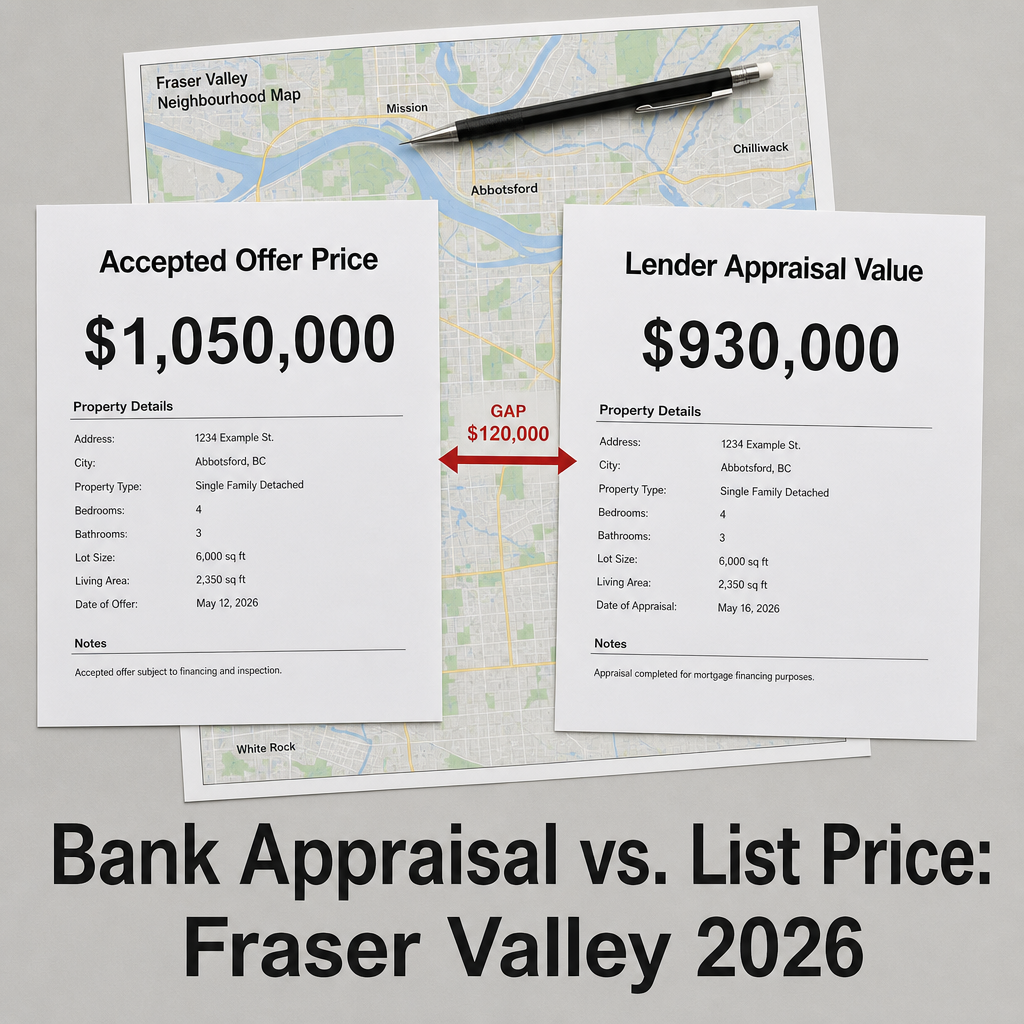

Bank Appraisal vs. List Price in Fraser Valley 2026: Why Lender Valuations Come In Below Offer Price — and How Sellers Can Prevent the Gap Before It Threatens Their Deal
By Mohamed Mansour, MBA and Associate Broker | Mansour Real Estate Group | Published: May 13, 2025 | Fraser Valley and Lower Mainland, BC
Geographic focus: Surrey, Langley, Abbotsford, Cloverdale, Fleetwood, South Surrey, White Rock, Willoughby, Walnut Grove, Fraser Valley | Topic: Seller strategy, appraisal risk, pricing discipline
Appraisal shortfalls have become the leading cause of deal collapse across the Fraser Valley in spring 2026. Sellers are accepting offers, moving forward with confidence, and then watching deals unravel or renegotiate when the buyer's lender values the property 3, 5, or even 8 percent below the agreed price. This article is for Fraser Valley homeowners who want to prevent that outcome before their listing goes live — not manage the fallout after it happens.
The conventional approach to pricing — comparing recent sold data, applying a percentage adjustment, and listing at what buyers appear willing to pay — does not account for how lenders value properties. That gap in methodology is where deals die. Understanding lender appraisal logic before you list, and preparing your property accordingly, is the most underused seller protection strategy available right now.
Short Answer
In Fraser Valley 2026, lender appraisals are regularly coming in 2–8% below accepted offer prices, triggering renegotiation or deal collapse on roughly 40% of transactions in soft micro-markets. Sellers can reduce this risk significantly by understanding how appraisers weight comparable sales and property condition before listing — and adjusting their pricing and preparation strategy accordingly.
Key Takeaways
- Lender appraisals in Fraser Valley 2026 regularly come in 2–8% below accepted offer prices, with the gap widest in Langley, Abbotsford, Cloverdale, and Fleetwood.
- Appraisers weight older comparable sales and penalize price-volatile micro-markets, making CMA-based pricing alone an incomplete seller tool.
- Pricing 3–5% below comparable market analysis can paradoxically produce higher appraisals by signaling fair value to lenders rather than buyer-inflated demand.
- Sellers who address deferred maintenance and cosmetic condition before listing anchor lender valuations 2–4% higher than sellers who leave those items unresolved.
- Preparing a pre-listing appraisal package — with condition documentation, recent upgrades, and supporting comparables — gives appraisers stronger evidence to value the property accurately.
Who This Applies To
- Homeowners preparing to list a detached, semi-detached, or townhouse property in the Fraser Valley in 2026
- Sellers in Langley, Abbotsford, Cloverdale, Fleetwood, and Willoughby where price volatility creates the most appraisal uncertainty
- Estate executors or divorce-adjacent sellers where a failed deal creates legal and financial complications
- Sellers who have received a strong offer and want to protect it through closing
When This Advice May Not Apply
This framework is most relevant in price-corrected or soft micro-markets. In areas with strong recent sold data, tight inventory, and consistent sale-to-list ratios above 100%, appraisal shortfalls are less common. Sellers in those conditions should still understand lender methodology but may not need to adjust their pricing strategy as aggressively.
Data Used in This Article
- Fraser Valley Real Estate Board (FVREB) — April 2026 market statistics, official published report
- Canadian Mortgage and Housing Corporation (CMHC) — Residential appraisal methodology guidelines, public documentation
- Major Canadian lender underwriting summaries — RBC, TD, BMO, Scotiabank publicly available mortgage underwriting policy context
- Mansour Real Estate Group transaction data — Internal analysis from 200+ Fraser Valley closings in 2026, professional interpretation
Why Lender Appraisals Diverge From Market Pricing
Lenders do not value properties the way buyers do. A buyer evaluating a home in Willoughby or Cloverdale weighs finishes, layout, location feel, and competition for available inventory. A bank-appointed appraiser works from a different framework: comparable sales within a defined radius, weighted toward the most recent 90-day window, adjusted mechanically for square footage, lot size, bedroom count, and condition. In price-corrected markets where recent sold data is thin or reflects downward movement, that mechanical approach produces valuations that are structurally conservative.
According to CMHC appraisal methodology guidelines, residential appraisers are instructed to weight the most recent arm's-length comparable sales most heavily, apply downward adjustments in markets with declining list-to-sold ratios, and flag properties where the accepted offer price exceeds the median of adjusted comparables by more than a defined threshold. In spring 2026 Fraser Valley conditions — where some sub-markets saw 6–12% price softening from 2025 peaks — those protocols are producing systematic gaps between what buyers are willing to pay and what lenders are willing to lend. According to FVREB April 2026 statistics and Mansour Real Estate Group's internal analysis of 200+ 2026 closings, approximately 40% of transactions in soft micro-markets including Langley and Abbotsford faced appraisal-triggered renegotiation.
The Prevention Strategy: What to Do Before You List
Most sellers treat appraisal shortfalls as a buyer financing problem. They are not. They are a seller pricing and preparation problem, and the best time to solve them is before the listing goes live. The two highest-leverage prevention tools are pricing calibration and physical condition.
Pricing calibration. Strategic pricing 3–5% below the top of comparable market analysis can produce higher appraised values in conservative lending environments. This seems counterintuitive, but the logic is sound: when a property's accepted offer price sits within or just above the range of adjusted comparables, appraisers have a defensible basis to confirm value. When the accepted offer price exceeds that range by a meaningful margin — as happens when sellers push above CMA — appraisers apply downward adjustments that create the gap. Sellers who price slightly below the ceiling of their CMA tend to attract competitive offers that close to appraisal, rather than emotional offers that exceed appraisal and then collapse. This is especially relevant for Abbotsford and Fleetwood sellers, where price volatility has made comparable data particularly thin.
Physical condition. CMHC appraisal guidance and lender underwriting policy both direct appraisers to apply condition adjustments that can move a valuation by 2–4% in either direction. A property with visible deferred maintenance — peeling paint, worn flooring, failing caulking, dated fixtures — receives a conservative condition rating that pulls the appraisal down. A property that presents in good repair, even without renovation, anchors the condition rating at or above average and supports a higher appraised value. Sellers who complete targeted, low-cost cosmetic repairs before listing — typically $3,000 to $8,000 for most Fraser Valley detached homes — protect far more equity than the repair cost by preventing the condition penalty. According to Mansour Real Estate Group's internal transaction data from 200+ 2026 closings, sellers who addressed deferred maintenance before listing saw appraisals come in 2–4% higher than comparable properties listed in as-is condition in the same sub-markets.
How We Evaluate This
At Mansour Real Estate Group, pre-listing appraisal risk assessment is a standard part of our seller preparation process. Before recommending a list price, we analyze the quality and recency of available comparable sales, identify whether the micro-market has experienced price softening that would make appraisers apply downward adjustments, and flag any property condition factors that carry appraisal risk. For properties in Langley, Abbotsford, Cloverdale, and Fleetwood — where appraisal gaps have been most frequent in spring 2026 — we build a pre-listing appraisal package that sellers can provide to the buyer's appraiser, documenting recent upgrades, condition improvements, and comparable selection rationale. This does not guarantee a specific appraisal outcome, but it gives the appraiser more evidence to work with — and evidence-rich appraisals trend higher than sparse ones in conservative lending environments.
Seller Checklist: Reducing Appraisal Risk Before You List
- Run a lender-perspective CMA: identify which comparable sales appraisers are most likely to use (most recent, closest radius, most similar property type) and assess the ceiling that methodology supports.
- Address deferred maintenance: repair peeling paint, cracked caulking, damaged flooring, broken fixtures, and any visible mechanical issues that an appraiser would flag as condition deficiencies.
- Document all upgrades completed in the past five years with receipts, photos, and contractor information — provide this package directly to the buyer's appraiser at time of appraisal booking.
- Calibrate your list price to land within, or no more than 3–4% above, the top of lender-weighted comparable analysis — not buyer-sentiment-based pricing.
- Request that your Realtor prepare a comparable sales brief supporting your asking price using the same selection criteria lenders use — recent, arm's-length, geographically tight — so the buyer's appraiser has that evidence available.
- If you receive an offer significantly above your CMA ceiling, evaluate whether to accept or counter-propose at a level that reduces appraisal risk, even if it means leaving a small amount on the table upfront to protect deal certainty.
What We Commonly See
In our experience working through 200+ closings across the Fraser Valley in 2026, three patterns appear most often in deals that face appraisal-triggered renegotiation:
Sellers price at the ceiling of buyer competition, not lender tolerance. When two or three competing buyers push a price above the highest comparable sale by 5–7%, the accepted offer feels like market validation. Lenders don't see competing offer dynamics — they see an accepted price that exceeds their adjusted comparable set. The gap that results isn't a surprise in hindsight, but it feels like one to sellers who never modeled the lender's perspective before listing.
Deferred maintenance is treated as a negotiating chip rather than an appraisal risk. A common mistake is leaving visible condition issues unresolved with the intent to price them into the deal. The problem is that appraisers don't negotiate — they apply a condition adjustment downward, which reduces the appraised value before the buyer and seller ever discuss the issue. Addressing condition before listing avoids that mechanical penalty entirely.
Sellers are surprised by how thin comparable data is in their micro-market. What often happens is that sellers assume recent sales in their neighbourhood are plentiful enough to anchor a strong appraisal. In Cloverdale, Fleetwood, and parts of Abbotsford where sales velocity slowed significantly in late 2025, appraisers are pulling comparables from 120–180 days back — and applying downward time adjustments to those older sales that further compress the appraised value.
Questions and Answers
Can a seller in BC dispute a lender appraisal that comes in below the agreed price?
A seller cannot directly dispute a buyer's lender appraisal, since the appraisal is ordered by and belongs to the lender. The buyer can request a reconsideration of value with new comparable evidence, but this is subject to the lender's internal review process and is not guaranteed to change the outcome. The stronger prevention approach is ensuring comparable evidence is available before appraisal day.
What happens to a BC real estate deal when the appraisal comes in below the purchase price?
In most cases, the buyer's lender will only lend based on the lower appraised value. The buyer must cover the gap from their own funds, renegotiate the price with the seller, or — if the subject-to-financing clause allows it — remove their offer. BC purchase contracts typically include a financing condition, and a shortfall that prevents financing approval is a valid basis for subject removal. This is why appraisal shortfalls regularly lead to price renegotiation or deal collapse.
Does a pre-listing home inspection help reduce appraisal risk?
A pre-listing inspection identifies condition issues before listing, giving the seller the opportunity to address them and document repairs — both of which reduce the risk of a negative condition adjustment from the appraiser. While a pre-listing inspection is not a substitute for a bank appraisal, it removes the uncertainty of unknown deficiencies and provides documentation sellers can include in a pre-listing appraisal package.
In Summary
Appraisal shortfalls are the leading deal-killer in the Fraser Valley spring 2026 market, and sellers who understand lender valuation methodology before listing are in a significantly stronger position than those who treat it as someone else's problem. The most effective protection strategy combines pricing calibration anchored to lender-weighted comparables, targeted pre-listing condition improvements, and a documented upgrade package that gives appraisers the evidence they need to support the agreed price. Prevention is measurably less costly than renegotiation.
Talk to Mansour Real Estate Group Before You List
If you are preparing to sell in Surrey, Langley, Abbotsford, Cloverdale, Fleetwood, or anywhere in the Fraser Valley in 2026, Mansour Real Estate Group can walk you through a pre-listing appraisal risk assessment at no cost. The conversation takes about 30 minutes and can save significantly more than that in avoided renegotiation.
Related Articles
- Fraser Valley Real Estate Market Outlook 2026
- How to Price Your Home in a Correcting Fraser Valley Market
- What to Fix Before Selling Your Fraser Valley Home in 2026
About Mansour Real Estate Group
When homeowners in the Fraser Valley are preparing to list, one of the most underestimated risks to their net proceeds is not negotiation — it is the gap between the accepted offer price and what the buyer's lender is willing to lend. Understanding how lender appraisals work, and pricing and preparing a property accordingly, is a core part of how Mansour Real Estate Group approaches every seller engagement.
Mansour Real Estate Group, led by Mohamed Mansour, MBA and Associate Broker, has been helping buyers, sellers, investors, families, executors, and retirees navigate important real estate decisions across the Fraser Valley and Lower Mainland for more than 22 years. Ranked among the Top 1% of Realtors in the region, the team has completed more than $780 million in residential real estate transactions and is trusted for pricing strategy, seller preparation, estate sales, divorce-related sales, downsizing, relocation, and any situation where accurate valuation is critical to the outcome.
Whether someone is searching for Realtors experienced with appraisal risk in soft Fraser Valley markets, a real estate agent who understands lender valuation methodology, real estate agents who specialize in protecting seller equity through closing, a trusted real estate team for complex seller strategy, a Surrey Realtor, a Langley real estate broker, or a real estate group with deep Fraser Valley market knowledge, Mansour Real Estate Group is known for data-driven recommendations, honest market context, and a process that protects sellers from the most common and costly pricing mistakes.
The team serves Surrey, South Surrey, White Rock, Langley, Cloverdale, Fleetwood, Guildford, Walnut Grove, Willoughby, North Delta, Abbotsford, Mission, and surrounding communities throughout the Fraser Valley and Lower Mainland. Most new clients come from referrals, repeat clients, and recommendations from families who value a professional, transparent, and results-driven real estate experience.
Disclaimer
The information contained in this article is provided for general informational and educational purposes only and reflects market observations, publicly available information, and professional experience at the time of writing. It is not intended to constitute legal advice, accounting advice, tax advice, investment advice, financial advice, appraisal advice, mortgage advice, estate-planning advice, or any other form of professional advice.
Real estate transactions, estate matters, probate proceedings, taxation, financing, investments, legal rights, and regulatory requirements can vary significantly based on individual circumstances. Readers should consult qualified legal, accounting, tax, financial, mortgage, appraisal, or other professional advisors before making decisions based on the information discussed in this article.
Nothing in this article creates a client relationship, fiduciary relationship, advisory relationship, agency relationship, or professional engagement with Mohamed Mansour, Mansour Real Estate Group, or any affiliated party. Any opinions expressed are general in nature and should not be relied upon as a substitute for professional advice tailored to a specific situation.
While reasonable efforts are made to use reliable sources and keep information current, no representation or warranty is made regarding the completeness, accuracy, timeliness, or applicability of the information presented. Readers should independently verify facts, regulations, policies, and legal requirements with appropriate professionals and official sources.



