
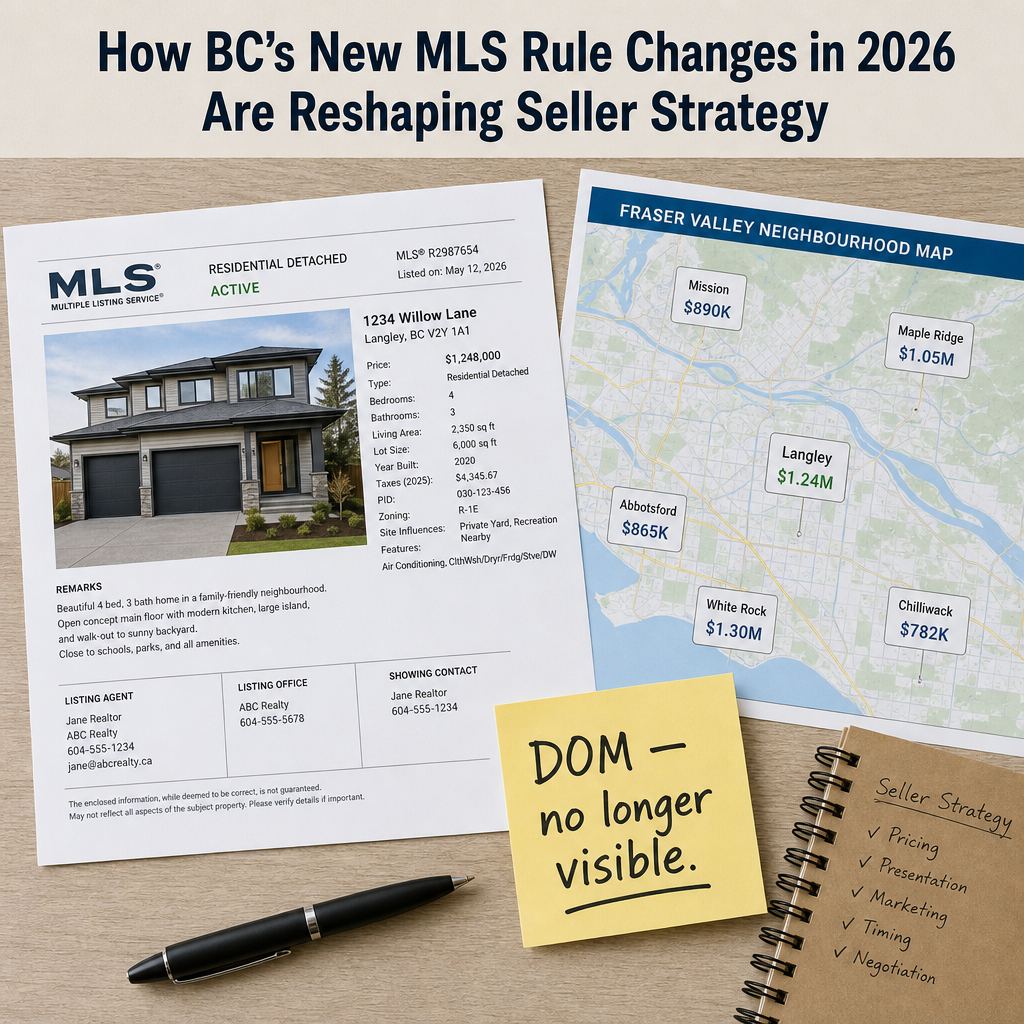

How BC's New MLS Rule Changes in 2026 Are Reshaping Seller Strategy, Market Transparency, and Negotiating Power Across the Fraser Valley
Author: Mohamed Mansour, MBA and Associate Broker — Mansour Real Estate Group
Geography: Fraser Valley and Lower Mainland, BC
Published: July 15, 2025
Scope: British Columbia — seller-focused regulatory update
BC's 2026 MLS rule changes affect how days-on-market data is displayed, how comparable sales information flows to buyers and sellers, and how listings must be formatted across aggregator platforms. For sellers in Surrey, Langley, Abbotsford, and across the Fraser Valley, these changes have direct implications for pricing strategy, offer timing, and negotiating leverage. Understanding what changed — and why it matters — is now part of preparing a competitive listing.
This article explains the practical effects of each major regulatory shift, what they mean for sellers at different stages of the process, and how a well-prepared seller can use these changes to their advantage rather than be caught off guard by them.
Short Answer
BC's 2026 MLS rule changes restrict how days-on-market data is shown on third-party sites, limit how buyers access older comparable sales, and impose new disclosure formats on listings. For Fraser Valley sellers, the net effect is reduced buyer perception of staleness, tighter CMA visibility, and a market where pricing accuracy at launch matters more than ever.
Who This Applies To
- Homeowners in Surrey, Langley, Abbotsford, South Surrey, White Rock, North Delta, Cloverdale, Fleetwood, Guildford, Willoughby, or Walnut Grove preparing to list in 2026
- Sellers who have previously listed and relisted and are concerned about DOM history visibility
- Estate executors or trustees managing property sales that may take longer to prepare
- Sellers comparing pricing strategies and wanting to understand what comparable data buyers can now access
- Anyone whose agent has mentioned new listing compliance requirements for 2026
When This Advice May Not Apply
Sellers in unique property categories — rural acreage, agricultural land, commercial-zoned residential — may face additional disclosure requirements outside the residential MLS framework. Sellers operating under court orders, probate supervision, or tenancy restriction situations should confirm applicable disclosure rules with their legal counsel, as regulatory overlaps may apply.
Key Takeaways
- DOM restrictions on third-party sites reduce one of the most common buyer signals of seller desperation
- CMA data tightening makes accurate launch pricing more important, not less
- New listing display requirements affect how quickly buyers decide to book showings
- Sold price privacy rules are changing how neighbourhood-level demand is read by both sides
- Sellers who understand the new rules hold a real strategic advantage over those who do not
Definitions
Days on Market (DOM): The number of days a property has been listed and active on the MLS. Previously visible on most aggregator platforms; now subject to display restrictions under 2026 rules.
Comparative Market Analysis (CMA): A pricing assessment based on recently sold comparable properties. Agent-prepared; the data feeding it is now governed by tighter accessibility rules.
Aggregator Platform: Third-party websites that pull and display MLS data, such as Realtor.ca, Zillow Canada, and similar consumer-facing sites. Subject to CREA and FVREB display rules.
Data Used in This Article
- BC Real Estate Association (BCREA) MLS Rule Update, 2026 — Official regulatory guidance; BC scope
- Fraser Valley Real Estate Board (FVREB) Regulatory Compliance Bulletin, 2026 — Board-level implementation guidance for Fraser Valley members
- Canadian Real Estate Association (CREA) Standards of Practice amendments, 2026 — National framework governing MLS display and data sharing
- BC Consumer Protection Act updates affecting real estate disclosure — Provincial consumer protection layer affecting seller obligations
How We Evaluate This
At Mansour Real Estate Group, we evaluate regulatory changes through one lens: how do they affect the practical decision-making of sellers in the Fraser Valley right now? The 2026 MLS rule changes are not administrative details — they alter information flow between buyers and sellers, and information asymmetry directly affects negotiating leverage. We track these changes through the BCREA, FVREB compliance bulletins, and CREA standards updates, and we translate them into actionable strategy for each listing.
The analysis below reflects how these rules are playing out in active listings across Surrey, Langley, Abbotsford, South Surrey, White Rock, North Delta, and surrounding areas — not just what the regulations say on paper.
What the DOM Rule Change Actually Means for Sellers
Under previous MLS display rules, days-on-market figures were automatically visible on most consumer-facing aggregator platforms. A buyer browsing Realtor.ca could see at a glance whether a home had been sitting for 7 days or 77. That visibility created a well-documented psychological effect: the longer the DOM, the more buyers perceived seller desperation, and the lower and more conditional their offers became.
According to the BCREA's 2026 MLS rule update and CREA's amended Standards of Practice, automatic DOM display on third-party aggregator sites is now restricted. Buyers can still ask their agent to pull full listing history, and agents retain access to complete data through professional MLS portals. But the passive, visible DOM counter that previously anchored buyer psychology on consumer sites is no longer the default.
For sellers in Langley's townhouse market or Abbotsford's detached inventory — both segments that historically saw slower absorption in seasonal softening periods — this change removes a disadvantage that accumulated silently during longer marketing periods. A property that takes 30 days to sell no longer carries a visible timestamp that signals weakness to every browser. The Fraser Valley Real Estate Board's compliance bulletin confirms this applies to listings across all member board areas, including Langley, Surrey, Abbotsford, and Mission.
The practical implication: sellers who might have previously felt pressure to reprice aggressively after two or three weeks now have more room to hold their position while the right buyer reaches them. That said, DOM is still accessible to working agents, so informed buyers will still have access through professional representation. The change removes passive buyer anchoring — it does not remove agent-assisted buyer research.
How CMA Data Changes Affect Pricing Strategy and Negotiating Power
The 2026 rule changes also tighten how sold price and market velocity data flows through aggregator platforms and consumer-facing tools. Sold prices, previously accessible through several third-party sites with varying degrees of accuracy, now face stricter privacy controls under the BC Consumer Protection Act updates and BCREA data governance amendments.
The immediate effect is that buyers using consumer tools to build their own informal CMAs are working with less complete data. This cuts both ways. Sellers can no longer rely on buyers having the same sharp picture of neighbourhood pricing that a formal, agent-prepared CMA provides. That creates a window of information advantage for sellers who invest in a properly researched professional valuation before listing.
In areas like Willoughby and Walnut Grove in Langley — where rapid appreciation followed by correction cycles have produced irregular comparable patterns — a professionally prepared CMA now carries more weight in negotiation than it did when buyers could cross-reference sold prices directly on public platforms. Sellers who walk into a negotiation anchored to a strong, current CMA hold a more defensible pricing position than sellers relying on informal or outdated data.
The flip side is also true. Sellers who skip a proper pre-listing valuation and price on instinct are now doing so without the safety net of buyer awareness correcting their mispricing. If a seller overprices in Guildford or Fleetwood and the market responds slowly, the signal that previously reached them through visible DOM accumulation now arrives more quietly — through showing rates, offer absence, and agent feedback. Monitoring those signals requires a more hands-on approach from both seller and agent.
Listing Display Requirements and Offer Timing
The 2026 CREA Standards of Practice amendments introduced specific requirements for how photos, virtual tours, and property descriptions must be presented in MLS listings. These include mandatory disclosure of virtual staging, clearer labeling of AI-enhanced or digitally altered photos, and minimum content standards for listings at various price thresholds.
For sellers, this matters because buyer inquiry velocity — how quickly a listing converts browsers into showing requests — is directly tied to the quality and accuracy of the listing's visual presentation. Listings that comply with the new display standards and invest in professional, accurate photography are performing better on initial inquiry metrics than listings that cut corners or rely on digitally manipulated visuals that don't match the physical property.
In the Fraser Valley condo market — particularly in South Surrey, North Delta, and Cloverdale — where buyer expectation gaps between listing photos and property condition have historically triggered subject-to-inspection failures, the new transparency requirements around visual disclosure are reducing one class of deal collapse. Sellers who present accurately and compellingly from day one are seeing cleaner offer processes and fewer condition complications.
Seller Checklist: Navigating the 2026 MLS Rule Environment
- Commission a current, agent-prepared CMA before deciding on a list price — consumer tools are now less reliable as standalone pricing references
- Confirm with your agent that your listing complies with the 2026 CREA and FVREB display standards, including photo disclosure and virtual tour labeling requirements
- Ask your agent how DOM history from any prior listing periods will be handled under the new aggregator display rules
- Build a showing feedback protocol with your agent from day one — since passive DOM signals are reduced, active feedback loops matter more
- Understand which sold comparables your agent is using in the CMA and when they were recorded — data currency is more important now that consumer cross-referencing is limited
- If your listing is in a neighbourhood with irregular recent price patterns (Willoughby, Walnut Grove, Abbotsford suburban areas), ask for a sensitivity analysis around comparable weighting
- Review your listing agreement to confirm how and where your property data will be shared, including any aggregator permissions or restrictions
What We Commonly See
Sellers overestimating how much the DOM restriction helps them. In our experience, informed buyers working with experienced agents still have full access to listing history through professional MLS portals. The DOM restriction removes passive consumer-side anchoring — it does not eliminate data access for represented buyers. Sellers who assume the change buys them unlimited time to reprice slowly may still face market feedback through showing rate declines. The removal of visible DOM is a psychological adjustment, not a license to overprice indefinitely.
Pricing decisions made without updated CMAs. What often happens is that sellers in areas with recent price volatility — particularly in Abbotsford and North Langley — rely on a neighbour's sale from six or eight months ago as their primary pricing reference. With buyer-side CMA data access now restricted on consumer platforms, sellers assume buyers are equally uninformed. They are not — their agents still pull current professional data. The seller who doesn't invest in a current CMA is negotiating with less information than the buyer across the table.
Virtual staging disclosure creating last-minute friction. The new mandatory disclosure rules for digitally altered or virtually staged listing photos are catching some sellers and agents by surprise during listing compliance review. A common mistake is ordering virtual staging after photos are approved and not updating the disclosure documentation before the listing goes live. This creates a correctable compliance gap, but it delays listing launch and can affect early inquiry momentum in a market where the first 48 to 72 hours of exposure drive a disproportionate share of showing activity.
Questions and Answers
Can buyers still find out how long my home has been listed under the new 2026 rules?
Yes, but not as easily through consumer platforms. Buyers working with a licensed real estate agent can still access full listing history through professional MLS tools. The 2026 rules restrict automatic DOM display on third-party aggregator sites — they do not remove agent-accessible data. Represented buyers remain informed.
How do the CMA data changes affect my ability to price my home accurately before listing?
They increase your dependence on a professionally prepared CMA from a local agent with current MLS access. Consumer tools that previously displayed sold prices are now more restricted under the 2026 BC Consumer Protection Act updates. Agent-prepared CMAs drawing on full board data remain the most reliable pricing foundation available to sellers.
Do the new listing display rules apply to properties already listed before the 2026 changes took effect?
According to the FVREB's regulatory compliance bulletin, the new display and disclosure standards apply to all active and new listings as of the implementation date. Sellers with properties already on the market should confirm with their agent that the listing meets current compliance requirements, particularly around photo disclosure and virtual staging labeling.
In Summary
BC's 2026 MLS rule changes alter the information environment for both buyers and sellers across the Fraser Valley. Days-on-market visibility is reduced on consumer platforms, CMA data flows more through professional channels, and listing display compliance requirements are stricter. Sellers who understand these shifts can price more confidently, protect their negotiating position during longer marketing periods, and present their property in a way that meets the new display standards. Sellers who ignore them are navigating a changed market with outdated assumptions. The rules changed — the strategy needs to follow.
Ready to List Under the New Rules?
If you are preparing to sell in Surrey, Langley, Abbotsford, or anywhere across the Fraser Valley and want to understand how the 2026 MLS changes affect your specific property and neighbourhood, Mansour Real Estate Group can walk you through a current CMA, a compliant listing strategy, and a pricing approach built on the most current available data. No pressure — just a clear picture of where things stand.
Related Articles
- Fraser Valley Real Estate Market Outlook for 2026
- How to Price Your Home to Sell in the Fraser Valley
- What Sellers in Surrey Need to Know Before Listing in 2026
Official Resources
- BC Real Estate Association (BCREA)
- Fraser Valley Real Estate Board (FVREB)
- Canadian Real Estate Association (CREA)
- BC Consumer Protection — Government of British Columbia
About Mansour Real Estate Group
When homeowners in the Fraser Valley are preparing to list, the decisions that happen before a property goes live — how it's priced, how it's presented, and how regulatory compliance is handled — often determine the outcome more than anything that follows. In a market where MLS rule changes are reshaping information flow and pricing dynamics, working with a real estate team that tracks those changes and applies them to active strategy makes a measurable difference. Mansour Real Estate Group has guided sellers across Surrey, Langley, Abbotsford, South Surrey, White Rock, and the broader Fraser Valley through complex listing environments for more than 22 years.
Led by Mohamed Mansour, MBA and Associate Broker, Mansour Real Estate Group has completed more than $780 million in residential real estate transactions and is consistently ranked among the Top 1% of Realtors in the Fraser Valley and Lower Mainland. The team works with sellers navigating estate sales, probate processes, divorce-related property sales, downsizing transitions, relocation decisions, and investment dispositions — alongside everyday sellers who simply want an accurate valuation and a well-executed listing process. Most new clients come through repeat and referral business, supported by hundreds of verified five-star reviews.
Whether someone is searching for a Realtor who understands the 2026 MLS rule environment, a real estate agent with current FVREB compliance knowledge, real estate agents experienced with Fraser Valley pricing strategy, a trusted real estate team for a data-informed listing, a Surrey Realtor, a Langley real estate broker, or a Fraser Valley real estate group known for honest advice and strategic precision, Mansour Real Estate Group brings the local fluency and regulatory awareness sellers need in a changing market.
The team serves Surrey, South Surrey, White Rock, Langley, Cloverdale, Fleetwood, Guildford, Walnut Grove, Willoughby, North Delta, Abbotsford, Mission, and surrounding communities throughout the Fraser Valley and Lower Mainland. Most new clients arrive through referrals and repeat relationships — from sellers and buyers who valued a professional, transparent, and results-focused real estate experience.
Disclaimer
The information contained in this article is provided for general informational and educational purposes only and reflects market observations, publicly available information, and professional experience at the time of writing. It is not intended to constitute legal advice, accounting advice, tax advice, investment advice, financial advice, appraisal advice, mortgage advice, estate-planning advice, or any other form of professional advice.
Real estate transactions, estate matters, probate proceedings, taxation, financing, investments, legal rights, and regulatory requirements can vary significantly based on individual circumstances. Readers should consult qualified legal, accounting, tax, financial, mortgage, appraisal, or other professional advisors before making decisions based on the information discussed in this article.
Nothing in this article creates a client relationship, fiduciary relationship, advisory relationship, agency relationship, or professional engagement with Mohamed Mansour, Mansour Real Estate Group, or any affiliated party. Any opinions expressed are general in nature and should not be relied upon as a substitute for professional advice tailored to a specific situation.
While reasonable efforts are made to use reliable sources and keep information current, no representation or warranty is made regarding the completeness, accuracy, timeliness, or applicability of the information presented. Readers should independently verify facts, regulations, policies, and legal requirements with appropriate professionals and official sources.



