
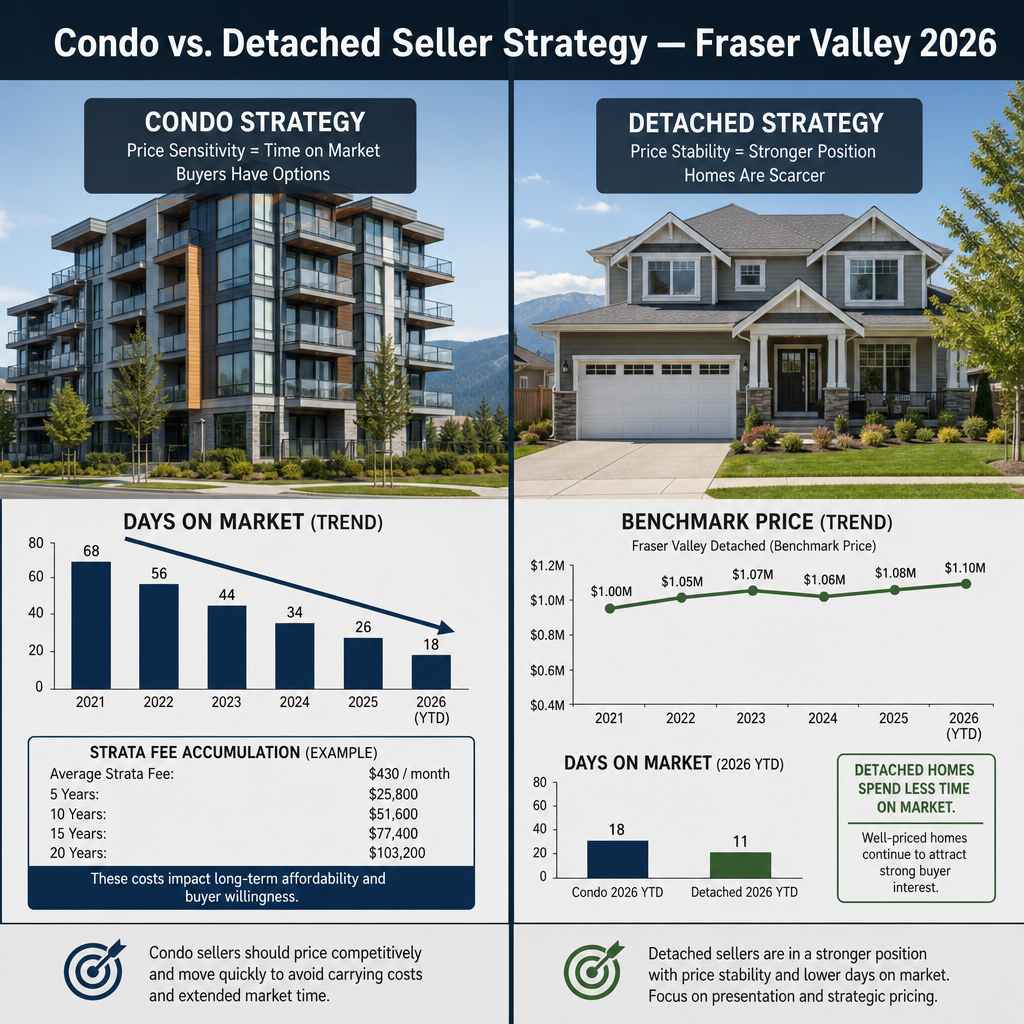

Condo vs. Detached Home Seller Strategy in the Fraser Valley 2026: Why Property Type Fundamentally Reshapes Days-on-Market, Carrying Costs, Buyer Profiles, and Net Proceeds Recovery Timeline When Market Conditions Diverge
By Mohamed Mansour, MBA and Associate Broker — Mansour Real Estate Group | Published: May 27, 2025 | Geography: Fraser Valley, Surrey, Langley, Abbotsford, South Surrey, White Rock, Cloverdale, Willoughby, North Delta
If you own a condo in the Fraser Valley and you're weighing whether to sell in 2026, the strategic calculus is materially different from what a detached homeowner faces down the street. The market data, the buyer pool, the financing obstacles, and the carrying cost exposure all point in different directions — and using the wrong strategy for your property type can erode tens of thousands of dollars from your net proceeds.
This article breaks down the key divergences between condo and detached home selling conditions in the Fraser Valley through 2026, and explains how to calibrate your timing, pricing, and risk tolerance based on what you actually own.
Short Answer
In 2026, Fraser Valley condo sellers face pronounced buyer advantage, longer days-on-market, strata-specific financing barriers, and accumulating monthly carrying costs — all of which reward early, aggressive pricing. Detached home sellers face a steadier recovery path, buyer competition at accessible price points, and stronger offer certainty. Property type determines strategy. The same approach applied to both will underperform one of them.
Key Takeaways
- Condo sales-to-active ratios (6–8%) are 25–40% below detached homes (10–11%), signalling a buyer-advantaged condo market in 2026.
- Condo sellers face 50+ days-on-market versus 25–30 for detached in comparable Fraser Valley neighbourhoods.
- Strata red flags trigger buyer financing denial in 15–25% of condo offers; detached homes face appraisal obstacles far less frequently.
- Condo carrying costs during extended holds run $3,000–$4,800 per year in strata fees alone, making speed-to-sale urgency high.
- Detached recovery points toward Q2–Q3 2026 stabilization; condo recovery extends into 2027, reshaping how each seller should price and time their exit.
Who This Applies To
- Condo owners in Surrey, Langley, Abbotsford, or Guildford evaluating whether to sell now or wait for recovery
- Detached homeowners weighing a 2026 listing date against potential price improvement
- Sellers relocating, downsizing, or separating who need to maximize net proceeds in a diverging market
- Investors holding strata units facing elevated carrying costs and extended time-on-market
When This Advice May Not Apply
A condo in a well-maintained, recently depreciation-reported building with a healthy reserve fund behaves differently from one with deferred maintenance and levy exposure. A detached home priced above the $1.5M threshold in a slow micro-market faces its own set of buyer constraints. Always confirm how these principles apply to your specific building, neighbourhood, and price point before acting.
Data Used in This Article
- Fraser Valley Real Estate Board (FVREB): April 2026 market statistics — sales volumes, active listings, days-on-market, sales-to-active ratios by property type
- CMHC Housing Market Outlook 2026–2027: Recovery timeline forecasts for condo and detached segments, BC regional analysis
- MLS Days-on-Market Variance Analysis: Internal analysis of Fraser Valley property type DOM divergence, Q1–Q2 2026
- Mortgage lender feedback on strata financing denials: Professional observation data on strata-specific financing obstacle rates, 2026
Why the Fraser Valley Condo and Detached Markets Are Diverging in 2026
According to FVREB data through April 2026, detached home sales volumes are running approximately 7% ahead of the same period in 2025 despite benchmark prices sitting roughly 10% below their peak. Buyers who were priced out at higher levels are returning at current prices, and that demand absorption is tightening detached inventory faster than condo inventory. The detached sales-to-active ratio sits at approximately 10–11%, which places the segment at the edge of balanced-to-slight-seller-advantage conditions.
Condos tell a different story. Active condo listings in the Fraser Valley remain elevated, and sales volumes have not kept pace with inventory replenishment. The result is a sales-to-active ratio of 6–8% — well inside buyer's market territory. According to CMHC's 2026–2027 housing market outlook for BC, detached home prices in the Fraser Valley are expected to stabilize by mid-2026, while the condo segment's recovery timeline extends into 2027, reflecting the structural inventory overhang and financing barriers that suppress demand at the entry-level end of the market.
This divergence is not uniform across every neighbourhood or building. Condo listings in Willoughby, Fleetwood, and Guildford attract different buyer profiles with different financing profiles. A well-documented newer building in Willoughby moves differently than a 1990s-era condo in Guildford with an aging mechanical system and a reserve fund sitting below the level required by lenders who scrutinize depreciation reports. Detached homes in North Delta and Cloverdale face different buyer pools than those in South Surrey's upper price ranges.
How Carrying Costs Force a Different Urgency Calculation by Property Type
Carrying cost exposure is one of the most underestimated differences between condo and detached sellers in a slow market. A detached homeowner who delays a listing by 12 months faces approximately $1,800–$3,000 in incremental property tax. That is real cost, but it is bounded and predictable. A condo seller who delays 12 months faces that same tax exposure plus $3,000–$4,800 in strata fees, depending on the complex — and that assumes no special levy is called during the hold period.
Special levies in older Fraser Valley buildings can range from a few thousand dollars to $15,000–$40,000 for major capital repairs such as roof replacement, elevator refurbishment, or building envelope work. A seller who holds through a levy call faces that cost directly, and any pending or anticipated levy disclosed in the Form B will suppress buyer offers or trigger financing denial from lenders who treat underfunded reserves as material risk. This is one reason why condo sellers benefit from reviewing their strata's most recent depreciation report before deciding whether to list quickly or wait. The waiting period carries layered financial exposure that detached sellers simply do not face at the same level.
Strata Financing Barriers and What They Mean for Offer Certainty
Buyer financing for condos is subject to layers of lender scrutiny that don't apply to detached purchases. When a buyer's lender reviews a strata property, they examine the depreciation report, the reserve fund adequacy, whether a special levy has been called or is anticipated, the percentage of units that are owner-occupied versus rented, and building age relative to loan term. Any of these can trigger a financing condition failure — meaning a deal collapses not because the buyer changed their mind, but because their lender declined the specific building.
Professional observation from mortgage brokers working in the Fraser Valley condo market in 2026 suggests that strata-related financing obstacles affect approximately 15–25% of condo offers at some stage, compared to a much lower rate for detached properties where the primary obstacle is appraisal gap rather than building-level lender policy. For condo sellers, this means that even a well-priced listing in a buyer-advantaged market can lose multiple offers before closing, compounding the days-on-market problem. Sellers who understand this dynamic price with offer certainty in mind — and prepare their strata documentation proactively to reduce friction at the financing stage.
How We Evaluate This
When a seller approaches Mansour Real Estate Group with a condo to list, the first analysis is not what comparable condos sold for last month. It is whether the building's documentation — depreciation report, Form B, reserve fund balance, pending bylaw changes, and rental cap — is currently compatible with standard lender approval for the buyer pool most likely to offer. A property that prices at market but loses two or three buyers to financing denials ends up selling for less than one that was priced 2–3% lower with clean documentation presented upfront.
For detached sellers, the evaluation shifts toward absorbed supply, directional pricing momentum in the micro-neighbourhood, and whether list-price calibration should target a single strong offer or a structured offer date. Those are strategy-first questions, not documentation-first. The framework is genuinely different, and applying the wrong one costs money.
Condo Seller Checklist
- Obtain the most recent depreciation report and review it before setting your list price — lenders will
- Confirm the reserve fund balance is within acceptable range for lender financing approval on a standard purchase
- Request Form B from strata management and review all disclosed levies, pending work orders, and bylaw restrictions
- Determine whether the building has a rental cap restriction that narrows your buyer pool to owner-occupants only
- Price against closed sales within 60 days, not 90 — condo pricing drifts quickly in a buyer-advantaged market
- Stage the unit for the likely buyer profile: first-time buyer or downsizer, not investor
- Plan for 50+ days-on-market and budget carrying costs accordingly before choosing a list price floor
Detached Home Seller Checklist
- Anchor pricing to the 90-day sales-to-active trend in your specific neighbourhood, not Fraser Valley averages
- Evaluate whether a pre-inspection reduces subject removal friction and strengthens buyer confidence
- Confirm whether your price point falls within the active demand band where buyer competition is currently concentrated
- Plan for 25–35 days-on-market and assess whether a price reduction threshold should be pre-set before listing
- Assess suite legality or income suite disclosure requirements under Surrey, Langley, or Abbotsford municipal requirements
- Prepare title and mortgage discharge paperwork early to avoid completion delays if a fast sale occurs
What We Commonly See
Condo sellers who price optimistically and wait: In our experience, condo sellers who list at or above the upper end of comparable sales in a buyer-advantaged market accumulate days-on-market quickly, absorb full carrying costs including strata fees, and ultimately reduce price to a level lower than where an aggressive early price would have landed. The compounded cost — strata fees plus price reduction — routinely exceeds the perceived "hold" benefit.
Detached sellers who under-price out of anxiety: What often happens with detached home sellers who have been watching condo market news is that they apply condo-market urgency to a detached property. In a neighbourhood where detached inventory is tightening, this leaves money on the table. The market segments are genuinely divergent, and the same anxiety framework does not apply to both.
Financing collapse from undisclosed strata documentation: A common pattern we see is offers accepted on condos — sometimes with subjects waived — where the buyer's lender subsequently declines the building rather than the buyer. This is almost always traceable to a depreciation report red flag or reserve fund shortfall that was not addressed proactively before listing. A seller who prepares documentation and discloses it upfront eliminates most of this risk before it becomes a collapsed deal.
Questions and Answers
Should I sell my condo now or wait for the market to recover?
CMHC's 2026–2027 BC housing outlook suggests condo recovery extends into 2027, while carrying costs accumulate monthly. For most Fraser Valley condo sellers, waiting 12–18 months means $3,000–$4,800 in strata fees plus potential special levy exposure, often without meaningful price improvement. Waiting rewards patience for detached sellers in stabilizing neighbourhoods — it typically does not reward condo sellers in the current environment.
What is a sales-to-active ratio and why does it matter to my selling strategy?
The sales-to-active ratio compares the number of sales in a given period to the number of active listings. A ratio below 12% generally indicates buyer's market conditions with downward price pressure. Fraser Valley condos sit at 6–8% as of April 2026, according to FVREB data. Detached homes sit at 10–11%. A condo seller in a 7% ratio market is competing against more listings with fewer buyers — meaning price accuracy from day one matters more than in a balanced market.
How does a depreciation report affect my condo sale?
Lenders in BC review the depreciation report to assess building condition and reserve fund adequacy before approving financing on a strata unit. A report that flags deferred maintenance, aging systems, or a reserve fund shortfall can cause financing denial even when the buyer is otherwise qualified. Sellers benefit from reviewing the report before listing, understanding what it discloses, and pricing with those disclosures already factored in.
Are detached home sellers in a better position than condo sellers in 2026?
Generally, yes — in the Fraser Valley, detached home sellers face shorter days-on-market, lower financing obstacle rates, and a recovery trajectory that CMHC projects stabilizing by mid-2026. That said, detached pricing in the $1.5M+ range faces its own demand compression, and over-pricing a detached home in a slow micro-market still results in extended sit time. Position matters within both segments.
What does Form B tell a buyer about my condo?
Form B is a strata corporation information certificate that discloses strata fees, special levies (current and anticipated), bylaws, and the reserve fund balance. It is provided by strata management and reviewed by buyers and their lenders. Material disclosures in Form B — particularly pending levies or bylaw restrictions — affect buyer decisions and lender approval. Sellers who review Form B before listing avoid last-minute surprises that can collapse a deal or force a renegotiation.
In Summary
Fraser Valley condo and detached home markets are diverging meaningfully in 2026, and that divergence demands fundamentally different seller strategies. Condo sellers face buyer-advantaged conditions, extended days-on-market, strata financing barriers, and accumulating monthly carrying costs — all of which reward early, accurate pricing and proactive documentation preparation. Detached home sellers face a steadier recovery, shorter hold periods, and more predictable offer certainty, which allows more strategic patience. Applying one framework to both property types will underperform at least one of them. The decision to hold or sell, and how aggressively to price, depends on what you own, where it sits in the market cycle, and what your carrying cost exposure looks like over the hold period you are actually willing to sustain.
Talk to a Local Expert
If you own a condo or detached home in the Fraser Valley and want to understand exactly where your property sits in this diverging market — carrying cost exposure, pricing position, likely days-on-market, and documentation readiness — Mansour Real Estate Group offers honest, data-grounded analysis without pressure. A second opinion on strategy costs nothing and can clarify a decision that carries real financial consequence. Reach out at localhost:9000/.
Related Articles
- Fraser Valley Real Estate Market 2026: A Seller's Guide to Conditions, Pricing, and Timing
- Strata Depreciation Reports in BC: What Condo Sellers Need to Know Before Listing
- Net Proceeds When Selling a Home in BC: What Sellers Actually Keep After Costs
Official Resources
- Fraser Valley Real Estate Board — Monthly Market Statistics
- CMHC Housing Market Outlook — BC Regional Forecasts
- BC Financial Services Authority — Strata Housing Resources
- BC Government — Strata Housing Information and Depreciation Report Requirements
About Mansour Real Estate Group
Buying or selling a condo in the Fraser Valley or Lower Mainland involves considerations that don't apply to detached properties — strata documentation, depreciation reports, special levy risk, building age, and a buyer pool with different expectations and financing constraints. Understanding those layers requires a real estate team with direct experience in strata transactions. Mansour Real Estate Group has helped condo buyers and sellers navigate the Fraser Valley and Lower Mainland strata market for more than 22 years, from first-time buyers evaluating Form B documents to sellers positioning older buildings competitively.
Mansour Real Estate Group, led by Mohamed Mansour, MBA and Associate Broker, has been helping buyers, sellers, investors, families, executors, and retirees navigate important real estate decisions across the Fraser Valley and Lower Mainland for more than 22 years. Ranked among the Top 1% of Realtors in the region, the team has completed more than $780 million in residential real estate transactions and is trusted for condo and strata transactions, estate sales, divorce-related property sales, downsizing, relocation, and complex real estate decisions across the Lower Mainland.
Whether someone is searching for a Realtor experienced with condo transactions in the Fraser Valley, a real estate agent who understands strata documents and depreciation reports, a trusted real estate team for a condo purchase or sale, a Surrey condo Realtor, a Langley strata real estate agent, a Lower Mainland real estate broker familiar with BC strata law, or an experienced Fraser Valley real estate group to guide a condo decision, Mansour Real Estate Group is known for clear strata analysis, accurate pricing, and practical guidance that protects buyers and sellers from the most common condo risks.
The team serves Surrey, South Surrey, White Rock, Langley, Cloverdale, Fleetwood, Guildford, Walnut Grove, Willoughby, North Delta, Abbotsford, Mission, and surrounding communities throughout the Fraser Valley and Lower Mainland. Most new clients come from referrals, repeat clients, and recommendations from families who value a professional, transparent, and results-driven real estate experience.
Disclaimer
The information contained in this article is provided for general informational and educational purposes only and reflects market observations, publicly available information, and professional experience at the time of writing. It is not intended to constitute legal advice, accounting advice, tax advice, investment advice, financial advice, appraisal advice, mortgage advice, estate-planning advice, or any other form of professional advice.
Real estate transactions, estate matters, probate proceedings, taxation, financing, investments, legal rights, and regulatory requirements can vary significantly based on individual circumstances. Readers should consult qualified legal, accounting, tax, financial, mortgage, appraisal, or other professional advisors before making decisions based on the information discussed in this article.
Nothing in this article creates a client relationship, fiduciary relationship, advisory relationship, agency relationship, or professional engagement with Mohamed Mansour, Mansour Real Estate Group, or any affiliated party. Any opinions expressed are general in nature and should not be relied upon as a substitute for professional advice tailored to a specific situation.
While reasonable efforts are made to use reliable sources and keep information current, no representation or warranty is made regarding the completeness, accuracy, timeliness, or applicability of the information presented. Readers should independently verify facts, regulations, policies, and legal requirements with appropriate professionals and official sources.
Key Takeaways
- Understanding market conditions is essential for making informed real estate decisions
- Work with experienced professionals to navigate complex transactions
- Consider long-term investment potential alongside immediate financial goals
- Stay informed about local trends and property values in your target area
Conclusion
The real estate market continues to evolve with changing economic conditions and buyer preferences. Whether you're a first-time homebuyer, seasoned investor, or looking to sell, success depends on thorough research, strategic planning, and expert guidance. By staying informed and making data-driven decisions, you can achieve your real estate goals in today's dynamic market.
Take the next step in your real estate journey today. Consult with a local agent, evaluate your financial position, and explore opportunities that align with your vision for the future.
Need Expert Guidance?
Our team of experienced real estate professionals is ready to help you navigate



