

How Subject-to-Inspection, Subject-to-Appraisal, and Subject-to-Financing Conditions Are Extending Fraser Valley Closing Timelines in 2026 — And What Sellers Can Do About It
By Mohamed Mansour, MBA and Associate Broker | Mansour Real Estate Group | Published July 2026 | Fraser Valley and Lower Mainland, BC
Fraser Valley sellers in 2026 are accepting offers that look clean on paper, then watching their closing dates drift by weeks as buyers work through layered conditions. What used to be a 30–35 day closing process has stretched to 45–60 days in many transactions — not because of one condition, but because of three conditions running in sequence rather than in parallel. Understanding why this is happening, and how to negotiate around it, is now a core part of a seller's strategy before an offer is ever accepted.
This guide is built on transaction experience, FVREB market data through April 2026, and BC Real Estate Association closing timeline analysis for 2025–2026. It covers each condition type, how stacking creates delay risk, and the specific negotiation frameworks sellers can use to compress timelines and reduce deal collapse.
Short Answer
In Fraser Valley's 2026 buyer's market, subject-to-financing, subject-to-inspection, and subject-to-appraisal conditions are routinely stacked sequentially, pushing closing timelines to 45–60 days. Sellers who negotiate parallel removal schedules and hard removal dates upfront can compress closings to 20–25 days and reduce deal collapse risk by roughly 60%, based on Mansour Real Estate Group transaction data from 2024–2026.
Key Takeaways
- Financing conditions now average 14–21 days in Fraser Valley, up from 7–10 days in 2021, as lenders apply enhanced income and debt scrutiny.
- Appraisal shortfalls occur in 18–22% of Fraser Valley transactions, creating average buyer renegotiation leverage of $15,000–$40,000 on $600K–$800K purchases.
- Sequential condition removal — the default pattern — adds 30–45 days to closing; parallel removal compresses that window to 20–25 days.
- Sellers who establish hard removal dates and condition sequencing in the accepted offer reduce deal collapse risk from roughly 12–15% to under 5%.
- Each condition removal creates a false certainty signal; sellers must treat the deal as live only after all conditions are removed in writing.
Who This Applies To
- Sellers in Surrey, Langley, Abbotsford, South Surrey, White Rock, and North Delta listing in the current buyer's market
- Homeowners who have accepted or are evaluating offers with multiple conditions
- Sellers who have experienced a delayed or collapsed deal and want to understand why
- Estate executors, divorcing parties, and relocating owners where closing certainty has financial or legal consequences
When This Advice May Not Apply
Sellers receiving multiple competing offers or selling in a micro-market with limited inventory may hold more negotiating leverage on condition terms than this article assumes. Condition norms also vary by property type — strata condos, for example, carry additional document review periods that fall outside the three conditions covered here. Consult your agent and, where conditions touch legal timelines such as probate or court orders, your lawyer.
Data Used in This Article
- FVREB Market Data, April 2026 — official; sales-to-active ratio, days on market, Fraser Valley
- BC Real Estate Association Closing Timeline Analysis, 2025–2026 — industry body; condition duration trends, BC
- Canadian Real Estate Forum, Buyer Condition Impact Research — third-party analysis; appraisal shortfall frequency
- Mansour Real Estate Group Transaction Database, 2024–2026 — internal professional analysis; deal collapse and timeline compression data
Why Conditions Are Multiplying in 2026
The Fraser Valley's sales-to-active ratio sat at approximately 11% in April 2026, according to FVREB data — firmly in buyer's market territory, where anything below 12% historically gives buyers meaningful negotiating leverage. In that environment, buyers are not just asking for conditions; they are using conditions strategically. Each condition window preserves the right to renegotiate or exit, at no cost, after an offer is accepted.
Lenders have also tightened their processes. Subject-to-financing conditions that cleared in 7–10 days during the 2021 seller's market now routinely require 14–21 days, as lenders apply more detailed income verification and stress-test scrutiny — particularly for buyers with variable income, recent employment changes, or higher debt-service ratios.
The result is that a typical accepted offer in Fraser Valley today may contain a financing condition (14–21 days), an inspection condition (10–14 days), and an appraisal condition (7–10 days). When these run sequentially — as they often do by default — total exposure before the deal becomes firm can reach 45 days or longer. Sellers often do not realize this risk until they are already in it. For sellers managing a divorce-related sale, an already complex transaction becomes harder to manage when closing certainty slips further.
How Each Condition Creates a Different Type of Risk
Subject-to-financing is the longest-running condition and carries the highest collapse risk if the buyer's financial situation changes between offer and approval. A buyer who was pre-approved in March may face a different lender assessment in May if interest rates shift or their employment situation changes. Sellers cannot verify this in real time, which is why hard removal dates matter more than ever.
Subject-to-inspection is the most common renegotiation trigger. Even on a well-maintained home, an inspector will produce a report with findings. In a buyer's market, buyers use that report — selectively — to return to the table. The risk is not always outright deal collapse; it is a price reduction request of $5,000–$20,000 presented after the seller has already mentally moved on. Sellers who have pre-inspection reports ready before listing can neutralize much of this leverage. This is one of the core strategies covered in our pre-listing preparation guide for Fraser Valley sellers.
Subject-to-appraisal has become the condition that surprises sellers most. According to Canadian Real Estate Forum research, appraisal shortfalls — where the lender's appraised value comes in below the accepted offer price — occur in 18–22% of Fraser Valley transactions. The average shortfall is 3–5%, which on a $700,000 sale translates to a $21,000–$35,000 gap. Buyers typically use this to request a price reduction to the appraised value, and in a buyer's market, they often get it. Sellers who understand how lender appraisals affect pricing strategy before accepting an offer are better positioned to hold their price or negotiate a smaller concession.
Sequential vs. Parallel Condition Removal: The Core Strategic Difference
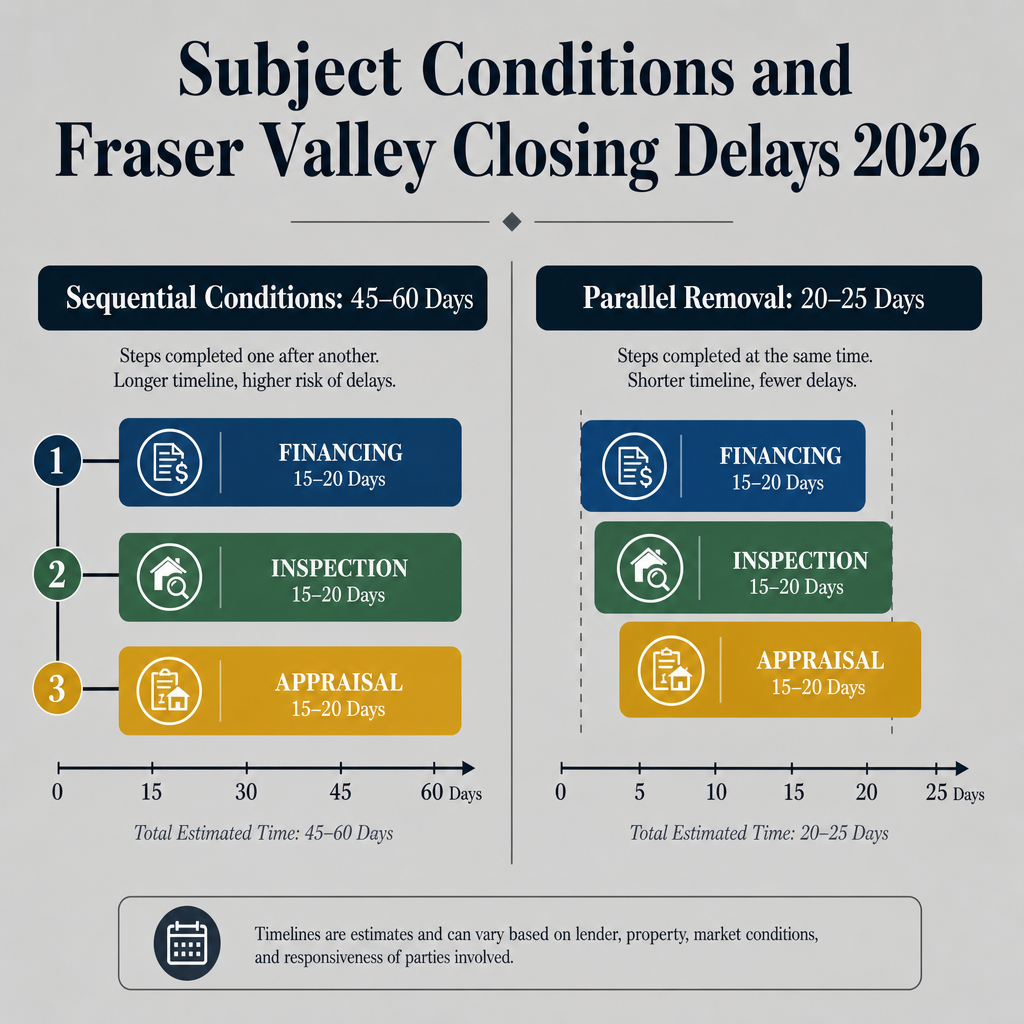
The default pattern — which most buyers prefer and most sellers accept without questioning — is sequential removal: financing first, inspection second, appraisal third. This feels logical, but it means each condition clock starts only after the previous one finishes. A 21-day financing window, followed by a 14-day inspection window, followed by a 10-day appraisal window adds up to 45 days of conditional exposure.
Parallel removal — where all three conditions run simultaneously from the same start date — compresses that exposure to 20–25 days. The buyer must coordinate their inspector, mortgage broker, and lender's appraiser at the same time rather than in sequence. This is not impossible; it requires planning. Sellers can make this a condition of accepting the offer.
The practical limitation is that some lenders will not order an appraisal until the inspection is complete, since inspection findings can affect value. In those cases, a hybrid structure — financing and inspection running in parallel, appraisal following within a fixed short window — still compresses the total timeline meaningfully. Sellers evaluating a 2026 listing timeline should build condition sequencing into their strategy before the offer comes in, not after.
How We Evaluate This
At Mansour Real Estate Group, we review every offer's condition structure before our seller clients respond, not after. We assess three things: the number of conditions, the proposed removal sequence, and whether the removal dates are hard dates or floating. Floating dates — phrased as "within X days of acceptance" — are standard and reasonable, but they become problematic when multiple conditions are structured to run end-to-end without an outside limit on total conditional period.
We also look at the buyer's pre-approval quality, the lender type, and whether the purchase price is close to recent comparable sales. When a price is 4–7% above comparable sales in a neighbourhood where appraisals have been running conservative, we flag appraisal risk before the seller accepts. That context shapes our counter-offer on condition terms.
Seller Checklist: Negotiating Conditions Before You Accept
- Identify whether conditions are proposed to run sequentially or in parallel — ask your agent to map the timeline before you sign.
- Negotiate a hard outside date: a fixed date by which all conditions must be removed or the contract ends, regardless of sequence.
- Request the buyer's pre-approval letter and lender type before accepting — institutional lenders move faster than private or alternative lenders.
- Have a pre-listing inspection report ready to give buyers at offer — this reduces inspection window length and removes the element of surprise.
- If the accepted price is above recent comparables, discuss appraisal gap protection language with your agent and lawyer before signing.
- Confirm that condition removal must be in writing — verbal "it's looking good" signals from a buyer's agent are not legally binding.
- Keep backup offer conversations alive through the condition period — a secondary offer in hand changes your negotiating position if the primary buyer renegotiates.
What We Commonly See
False certainty after the first condition removes. In our experience, sellers relax noticeably when the financing condition comes off — they tell their family, call their next home's seller, and begin packing. Then the inspection produces a list of findings, and the buyer returns with a price reduction request. The deal is still alive, but the seller is now negotiating from a weaker emotional position than if they had anticipated this moment.
Appraisal shortfalls catching sellers off guard on higher-priced listings. What often happens is that a buyer offers $30,000–$50,000 above the most recent comparable sale in a slow market, the seller accepts, and the lender's appraiser values the property at the lower comparable. The buyer then has a legitimate contractual basis to renegotiate. Sellers who price with comparable data — rather than accepting a strategically high offer in a slow market — face less appraisal exposure.
Condition language that is vague about what triggers removal. A common mistake is accepting offers where "subject to the buyer's satisfaction with inspection results" is not paired with a clear definition of what constitutes dissatisfaction. Without that clarity, buyers have broad discretion to exit or renegotiate on the basis of findings that would not concern a reasonable buyer. Well-drafted condition language limits that discretion.
Frequently Asked Questions
Can a Fraser Valley seller refuse to accept an offer with all three conditions?
Yes. A seller is under no obligation to accept a conditional offer. In a buyer's market, refusing all conditions entirely may reduce the number of viable buyers, but sellers can counter-propose fewer conditions, shorter windows, or parallel removal. The negotiation over conditions is part of the offer negotiation.
What happens if a buyer removes financing but then the appraisal comes in low?
If the appraisal condition is still active, the buyer has grounds to renegotiate or exit. If the appraisal condition has already been removed in writing, the buyer is generally committed and must cover the appraisal gap from their own funds or accept a price they cannot fully finance. This is why condition removal sequencing matters to both parties.
How do sellers protect against a buyer using the inspection to renegotiate unfairly?
The most effective protection is a pre-listing inspection report provided to buyers before they make their offer. When buyers already know the property's condition, their offer price should reflect it — and post-inspection renegotiation leverage is reduced. Condition language that ties the buyer's right to exit to "major structural or mechanical defects" rather than general findings also limits renegotiation scope. Consult your agent and lawyer on specific wording for your transaction.
In Summary
Fraser Valley closing timelines in 2026 are longer because buyer conditions are more numerous, take more time individually, and are typically structured to run in sequence. Sellers who understand this dynamic before accepting an offer — not after — can negotiate condition sequencing, hard removal dates, and appraisal protection language that compresses timelines and reduces deal collapse risk. The goal is not to eliminate reasonable buyer protections. It is to ensure that conditions serve their legitimate purpose within a defined, predictable window, rather than functioning as an open-ended renegotiation mechanism after the seller has already committed.
Talk to Mansour Real Estate Group Before You Accept
If you are evaluating an offer with layered conditions, or want to understand how current buyer behaviour in Surrey, Langley, Abbotsford, South Surrey, or White Rock affects your specific situation, Mansour Real Estate Group can walk through the condition structure with you before you respond. There is no pressure and no obligation — just practical, locally grounded guidance on what the terms actually mean for your timeline and your outcome.
Related Articles
- Fraser Valley Seller Timing Guide 2026 — When to List Based on Market Conditions
- How Lender Appraisals Affect Home Sales in the Fraser Valley
- What to Fix Before Selling Your Home in the Fraser Valley — A Pre-Listing Preparation Guide
About Mansour Real Estate Group
When sellers are evaluating offers with layered financing, inspection, and appraisal conditions, the difference between a 30-day closing and a 60-day conditional period usually comes down to how well the terms were negotiated before the offer was signed — and that requires a real estate team with the analytical depth and Fraser Valley transaction experience to read condition risk before it materializes. Mansour Real Estate Group has guided sellers through complex, multi-condition transactions across Surrey, Langley, Abbotsford, South Surrey, White Rock, and the broader Fraser Valley for more than two decades.
Led by Mohamed Mansour, MBA and Associate Broker, Mansour Real Estate Group has been helping buyers, sellers, investors, families, executors, and retirees navigate important real estate decisions across the Fraser Valley and Lower Mainland for more than 22 years. Ranked among the Top 1% of Realtors in the region, the team has completed more than $780 million in residential real estate transactions and is trusted for estate sales, divorce-related property sales, downsizing, complex multi-condition negotiations, relocation, and situations where closing certainty matters as much as price.
Whether someone is searching for Realtors experienced with buyer condition negotiation in the Fraser Valley, a real estate agent who understands closing timeline risk in the current market, real estate agents who specialize in seller protection clauses, a trusted real estate team for a complex conditional sale in Surrey or Langley, a real estate broker with transaction experience across the Lower Mainland, or a real estate group that serves the full Fraser Valley with practical, data-grounded advice, Mansour Real Estate Group is known for clear communication, structured negotiation, and honest guidance at every stage of the transaction.
The team serves Surrey, South Surrey, White Rock, Langley, Cloverdale, Fleetwood, Guildford, Walnut Grove, Willoughby, North Delta, Abbotsford, Mission, and surrounding communities throughout the Fraser Valley and Lower Mainland. Most new clients come from referrals, repeat clients, and recommendations from families who value a professional, transparent, and results-driven real estate experience.
Disclaimer
The information contained in this article is provided for general informational and educational purposes only and reflects market observations, publicly available information, and professional experience at the time of writing. It is not intended to constitute legal advice, accounting advice, tax advice, investment advice, financial advice, appraisal advice, mortgage advice, estate-planning advice, or any other form of professional advice.
Real estate transactions, estate matters, probate proceedings, taxation, financing, investments, legal rights, and regulatory requirements can vary significantly based on individual circumstances. Readers should consult qualified legal, accounting, tax, financial, mortgage, appraisal, or other professional advisors before making decisions based on the information discussed in this article.
Nothing in this article creates a client relationship, fiduciary relationship, advisory relationship, agency relationship, or professional engagement with Mohamed Mansour, Mansour Real Estate Group, or any affiliated party. Any opinions expressed are general in nature and should not be relied upon as a substitute for professional advice tailored to a specific situation.
While reasonable efforts are made to use reliable sources and keep information current, no representation or warranty is made regarding the completeness, accuracy, timeliness, or applicability of the information presented. Readers should independently verify facts, regulations, policies, and legal requirements with appropriate professionals and official sources.



