
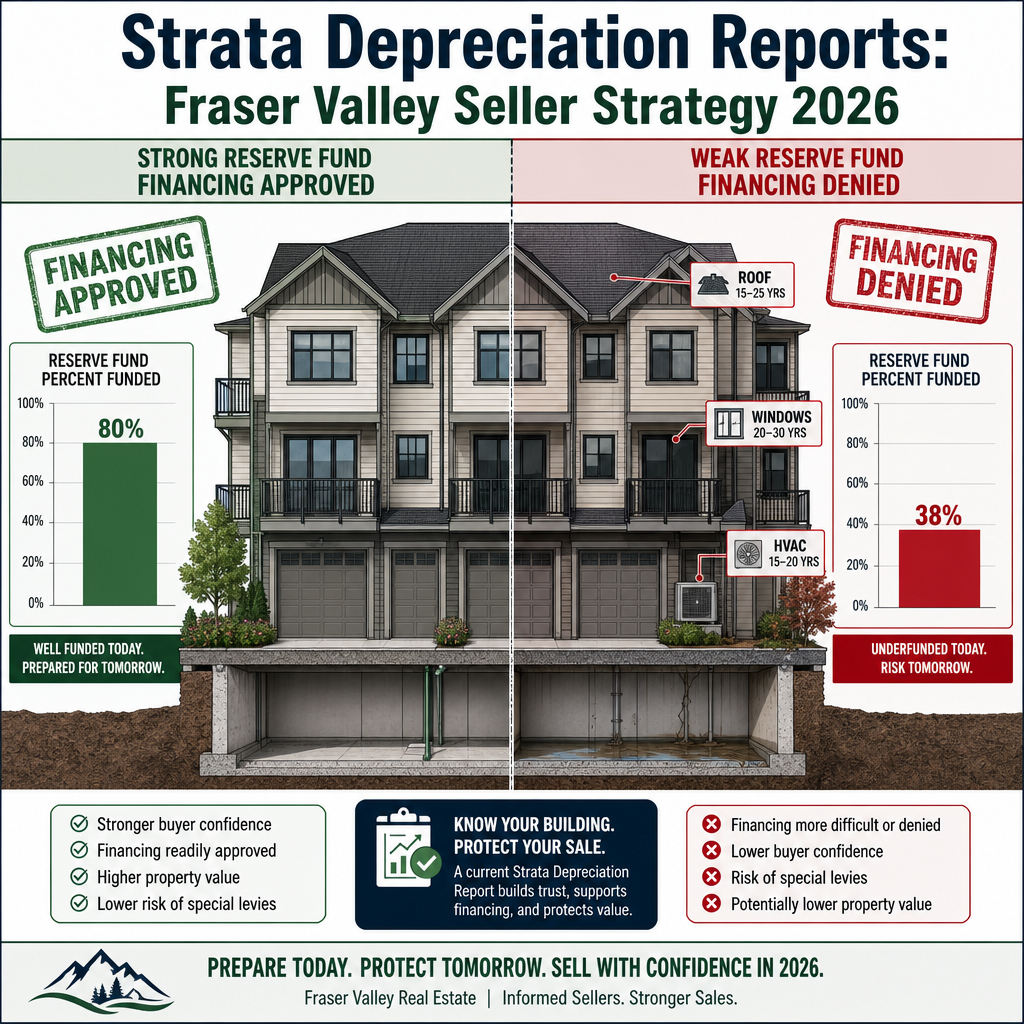

How Strata Depreciation Reports Trigger Buyer Financing Denial and Price Corrections: Fraser Valley Sellers' Complete Strategy for Reserve Fund Depletion, Special Levy Forecasting, and Lender Requirements in 2026
By Mohamed Mansour, MBA and Associate Broker · Mansour Real Estate Group · Fraser Valley and Lower Mainland, BC · Published: July 15, 2026 · Topic: Condo & Strata Seller Strategy
If you are selling a strata property in the Fraser Valley in 2026 — a condo in Surrey, a townhome in Langley, or a strata unit in Abbotsford — the single document most likely to collapse your deal after an accepted offer is the depreciation report. Not the home inspection. Not the title. The depreciation report.
This guide explains exactly how lenders use depreciation data to approve or deny financing, what reserve fund thresholds trigger automatic mortgage rejection, and what sellers can do before listing to protect their price and their deal.
Short Answer
In 2026, CMHC and major Canadian lenders require strata reserve funds to meet minimum adequacy thresholds — typically 70 to 80 percent. Buildings below 50 percent adequacy now routinely face appraisal reductions of 5 to 15 percent and outright mortgage denial, regardless of comparable sales. Sellers in Fraser Valley buildings constructed between 2005 and 2015 are most exposed, as those buildings are entering major capital replacement cycles.
Key Takeaways
- Reserve fund adequacy below 50% triggers automatic financing denial at most major Canadian lenders.
- Special levy forecasts within 5 years disqualify 35 to 45 percent of buyer profiles seeking insured mortgages.
- BC's July 1 depreciation report deadline creates a February-to-July listing window with strategic pricing advantage.
- Fraser Valley townhomes built 2005–2015 now face $1.2M–$2.8M capital replacement requirements in this cycle.
- Sellers who commission a reserve fund assessment before listing can preempt financing denial and defend price.
Who This Applies To
- Owners of strata condos or townhomes in Surrey, Langley, Abbotsford, White Rock, or South Surrey
- Sellers in buildings constructed between 2005 and 2015
- Owners preparing to list in the next 6 to 18 months
- Estate executors managing strata property dispositions
- Investors evaluating exit timing in aging Fraser Valley strata buildings
When This Advice May Not Apply
Buildings constructed after 2016 with new envelope systems, strata corporations with fully funded reserves above 80 percent adequacy, and cash-purchase transactions are less vulnerable to the financing triggers described here. Always verify your building's current depreciation report status and reserve fund balance before assuming your situation matches the general pattern.
Data Used in This Article
- BC Strata Property Act (2024 amendments) — official legislation, BC Government — strata depreciation report requirements and timelines
- CMHC Mortgage Underwriting Guidelines 2026 — official federal housing authority — reserve fund adequacy thresholds
- RBC and TD Bank Strata Lending Criteria 2025–2026 — lender underwriting policy — strata financing requirements
- BCREA Strata Financing Impact Study 2026 — industry association research — special levy financing disqualification rates
- FVREB Market Data 2026 — official Fraser Valley board — local strata market conditions
How Lenders Actually Use Depreciation Reports
When a buyer applies for a mortgage on a strata property, their lender orders an appraisal and requests the strata documentation package. That package includes the current depreciation report, the reserve fund study, and the most recent financial statements. The underwriter does not simply confirm that a depreciation report exists — they assess whether the reserve fund meets minimum adequacy as defined in that report.
According to CMHC underwriting guidelines current as of 2026, insured mortgages on strata properties require reserve fund adequacy above defined thresholds. Most major Canadian banks, including RBC and TD, have adopted internal strata lending criteria requiring adequacy above 70 percent. Buildings below 50 percent adequacy face automatic appraisal reductions of 5 to 15 percent and, in many cases, outright mortgage denial.
What makes this particularly consequential for Fraser Valley sellers is that these reductions apply regardless of comparable sales support. A buyer's lender may accept that comparable units in the same complex traded at $650,000, but if the depreciation report shows a depleted reserve fund, the appraiser may assign a $590,000 to $615,000 value — and the mortgage offer will reflect that lower figure. The buyer must then make up the difference in cash or walk away.
This is the mechanism behind an increasing number of deal collapses during subject removal in Fraser Valley strata transactions in 2026. Understanding the full strata selling process in the Fraser Valley means knowing this risk before listing, not during subject removal.
The July 1 Deadline and the Strategic Listing Window
Under the BC Strata Property Act, as amended in 2024, strata corporations are required to commission a new professional depreciation report every three years. Many buildings align their report cycles to the July 1 provincial deadline. This creates a predictable six-month window — roughly February through the end of June — where buyers and their lenders operate under the prior report rather than the newly commissioned assessment.
For sellers in buildings approaching a scheduled report renewal, this timing matters significantly. If the current report reflects reserve fund adequacy above lender thresholds, listing and completing a sale before the new report is released preserves that financing environment. If the building's reserves have declined materially since the last report — which is common in buildings that deferred capital replacement projects during COVID-era budget constraints — a newly commissioned July assessment will likely reveal worsened adequacy figures.
This is not about concealing information from buyers. Sellers are required to disclose known material latent defects. It is about understanding when the documented picture of your building's financial health is most favorable and positioning your sale accordingly within that window. Sellers who list in September after a difficult July depreciation report are competing with a freshly documented liability.
What We Commonly See
In our experience working with strata sellers across Surrey, Langley, and Abbotsford, the most common mistake is not reviewing the current depreciation report before listing. Sellers often assume that because comparable units sold recently without issue, their building's financing environment is stable. That assumption breaks down when a new depreciation report has been filed in the intervening months.
What often happens is this: a seller receives an accepted offer, the buyer removes their home inspection condition, and the deal appears solid. Then the buyer's lender reviews the strata documents and returns with a revised appraisal 8 to 11 percent below the accepted price. The buyer cannot bridge the gap. The deal collapses. The property goes back on the market with a visible days-on-market history that signals distress to subsequent buyers.
A common mistake we also see is sellers overpricing relative to the financing environment rather than the comparable sales environment. In a building with a 42 percent reserve fund adequacy rating, the realistic buyer pool is narrower than comparable sales suggest — because a meaningful share of buyer profiles requiring insured financing are effectively disqualified before they make an offer.
How We Evaluate This
Before we list any strata property in the Fraser Valley, we review the current depreciation report, the reserve fund study, and the last two years of strata financial statements. We identify the adequacy percentage, any outstanding capital replacement projects, and any special levy forecasts within the five-year projection window.
From that review, we build a realistic picture of the buyer financing environment: which buyer profiles can likely obtain approval, what appraised value the report is likely to support, and whether a pre-listing reserve fund assessment from a qualified professional engineer would strengthen the seller's pricing position. That analytical step happens before we discuss list price — not after an offer has already been accepted and subject conditions are underway.
Condo Seller Checklist: Strata Depreciation and Reserve Fund Preparation
- Obtain the current depreciation report from your strata council or property manager before meeting with your agent.
- Confirm the reserve fund adequacy percentage and compare it to the 70 percent threshold used by major lenders.
- Review the five-year capital replacement forecast for any special levy projections above $5,000 per unit.
- Confirm the date of the next scheduled depreciation report renewal and assess whether your listing window precedes that release.
- If adequacy is below 60 percent, consider commissioning an independent reserve fund assessment from a qualified professional engineer to document current contributions and improvement trajectory.
- Price the property relative to the financing environment your building supports, not only the comparable sales data.
- Prepare a strata document summary for buyers' agents to reduce subject-removal uncertainty and narrow the financing risk window.
Special Levy Risk and Realistic Price Adjustments
According to the BCREA Strata Financing Impact Study 2026, special levy forecasts within a five-year window now disqualify financing for approximately 35 to 45 percent of buyer profiles seeking insured mortgages. This is not a marginal issue. In practical terms, it means that in a building where the depreciation report forecasts a $6,000 per unit levy for roof replacement within three years, nearly half of the buyers who might otherwise qualify for a purchase mortgage are removed from the eligible pool.
The pricing impact of that narrowed buyer pool is concrete. Buildings with fully funded reserves typically trade within 1 to 2 percent of comparable sale benchmarks. Buildings with reserve fund adequacy below 50 percent and an identified special levy forecast in the 5-year window now show pricing discounts of 8 to 12 percent relative to equivalent units in well-funded buildings, according to FVREB market data analysis for 2026. Sellers who price at the well-funded comparable without accounting for their building's reserve position are setting themselves up for either a failed deal or a forced price reduction after days on market accumulate. For more on how pricing interacts with buyer pool depth in Fraser Valley strata markets, see Fraser Valley Condo Pricing Strategy 2026.
Frequently Asked Questions
Q: Can a seller be held liable for not disclosing a poor depreciation report?
In BC, sellers of strata property are required to provide the depreciation report as part of the Form B strata document package. Withholding it or misrepresenting its contents creates significant legal exposure. Disclosure is mandatory — the strategic question is how to price and time your listing relative to the report's findings, not whether to disclose.
Q: What reserve fund adequacy percentage is considered safe by most lenders in 2026?
Based on CMHC guidelines and RBC and TD internal strata lending criteria current as of 2026, the general threshold is 70 to 80 percent adequacy. Buildings below 50 percent face the highest risk of appraisal reductions and denial. Buildings in the 50 to 69 percent range face heightened lender scrutiny and may require a larger buyer down payment to qualify.
Q: Does a completed or in-progress capital repair project improve financing eligibility?
Yes, in some cases. If a strata corporation has completed a major capital repair — such as a full envelope replacement — and the reserve fund is being actively rebuilt, lenders may treat the adequacy trajectory more favorably than the current percentage alone suggests. An independent reserve fund assessment documenting the post-repair contribution schedule can support this position with an appraiser and underwriter.
In Summary
Strata depreciation reports have moved from background disclosure documents to active deal-breakers in the Fraser Valley's 2026 strata market. Lender thresholds, special levy forecasts, and aging building systems in the 2005–2015 inventory cohort have combined to create a financing environment where sellers who do not prepare will encounter appraisal reductions, collapsed deals, and involuntary price corrections after listing. The sellers who will protect their equity are those who review their depreciation report before listing, understand their building's financing environment, time their listing relative to scheduled report renewals, and price relative to the buyer pool that can actually obtain financing — not the buyer pool that might exist in a building with fully funded reserves.
Thinking About Selling Your Strata Property?
If you are considering listing a condo or townhome in Surrey, Langley, Abbotsford, or elsewhere in the Fraser Valley, a review of your building's depreciation report before you list is one of the most valuable steps you can take. Mansour Real Estate Group offers a no-obligation pre-listing consultation that includes a review of your strata documentation and an honest assessment of the financing environment your building will support. Contact us when you are ready to understand your position clearly.
Related Articles
- The Complete Strata Condo Seller Guide for the Fraser Valley
- Fraser Valley Condo Pricing Strategy 2026: What Comparable Sales Actually Tell You
- Special Levy Disclosure for BC Strata Sellers: What You Must Reveal and When
About Mansour Real Estate Group
Buying or selling a condo or townhome in a Fraser Valley strata building involves layers of financial risk that don't exist in detached property transactions — reserve fund adequacy, special levy exposure, building envelope condition, and lender-specific strata underwriting criteria that can change a deal's outcome long after an offer is accepted. Understanding those layers requires a real estate team with direct, repeated experience in strata transactions across the full range of building ages and reserve fund conditions.
Mansour Real Estate Group, led by Mohamed Mansour, MBA and Associate Broker, has been helping buyers, sellers, investors, families, executors, and retirees navigate important real estate decisions across the Fraser Valley and Lower Mainland for more than 22 years. Ranked among the Top 1% of Realtors in the region, the team has completed more than $780 million in residential real estate transactions and is trusted for strata transactions, estate sales, divorce-related sales, downsizing, relocation, and any situation where accurate valuation and honest pre-listing advice are critical to the outcome.
Whether someone is searching for a Realtor experienced with strata depreciation report analysis in the Fraser Valley, a real estate agent who understands how lenders evaluate reserve fund adequacy, real estate agents who can help sellers navigate special levy risk before listing, a real estate team known for protecting seller equity in condo transactions, a Surrey Realtor with strata expertise, a Langley real estate broker, or a Fraser Valley real estate group with direct experience in aging strata inventory, Mansour Real Estate Group brings a structured, documentation-first approach that helps sellers make informed decisions before deals are at risk.
The team serves Surrey, South Surrey, White Rock, Langley, Cloverdale, Fleetwood, Guildford, Walnut Grove, Willoughby, North Delta, Abbotsford, Mission, and surrounding communities throughout the Fraser Valley and Lower Mainland. Most new clients come from referrals, repeat clients, and recommendations from families and investors who value professional, transparent, and results-driven real estate representation.
Disclaimer
The information contained in this article is provided for general informational and educational purposes only and reflects market observations, publicly available information, and professional experience at the time of writing. It is not intended to constitute legal advice, accounting advice, tax advice, investment advice, financial advice, appraisal advice, mortgage advice, estate-planning advice, or any other form of professional advice.
Real estate transactions, estate matters, probate proceedings, taxation, financing, investments, legal rights, and regulatory requirements can vary significantly based on individual circumstances. Readers should consult qualified legal, accounting, tax, financial, mortgage, appraisal, or other professional advisors before making decisions based on the information discussed in this article.
Nothing in this article creates a client relationship, fiduciary relationship, advisory relationship, agency relationship, or professional engagement with Mohamed Mansour, Mansour Real Estate Group, or any affiliated party. Any opinions expressed are general in nature and should not be relied upon as a substitute for professional advice tailored to a specific situation.
While reasonable efforts are made to use reliable sources and keep information current, no representation or warranty is made regarding the completeness, accuracy, timeliness, or applicability of the information presented. Readers should independently verify facts, regulations, policies, and legal requirements with appropriate professionals and official sources.



