

First-Time Home Sellers in Langley 2026: Avoiding Overpricing, Timeline Mistakes, and Emotional Decisions Without Professional Guidance
By Mohamed Mansour, MBA and Associate Broker — Mansour Real Estate Group | Fraser Valley & Lower Mainland | Published: May 20, 2025
Most first-time home sellers in Langley don't lose equity because of a bad market. They lose it because of a pricing decision made before their first showing, a timeline choice made while waiting for conditions to improve, or an emotional attachment that makes it hard to hear what current buyers are actually willing to pay. This article is written for homeowners selling in Langley for the first time in 2026 who want to understand what the real risks are — before they become expensive ones.
Langley's 2026 market rewards sellers who price accurately from day one and penalizes those who test the ceiling. Understanding why first-time sellers consistently overprice — and how to avoid the same pattern — is the most valuable thing you can do before you list.
Short Answer
First-time sellers in Langley most often lose equity by anchoring price to previous assessment values rather than current comparable sales, delaying listing decisions while waiting for price recovery, and resisting price adjustments after the listing stalls. In Langley's 2026 buyer's market, these three patterns consistently lead to longer days on market, lower final sale prices, and higher carrying costs than a well-priced listing from the start.
Key Takeaways
- First-time sellers in Langley typically overprice by 8–15% by anchoring to assessments rather than current sold comparables.
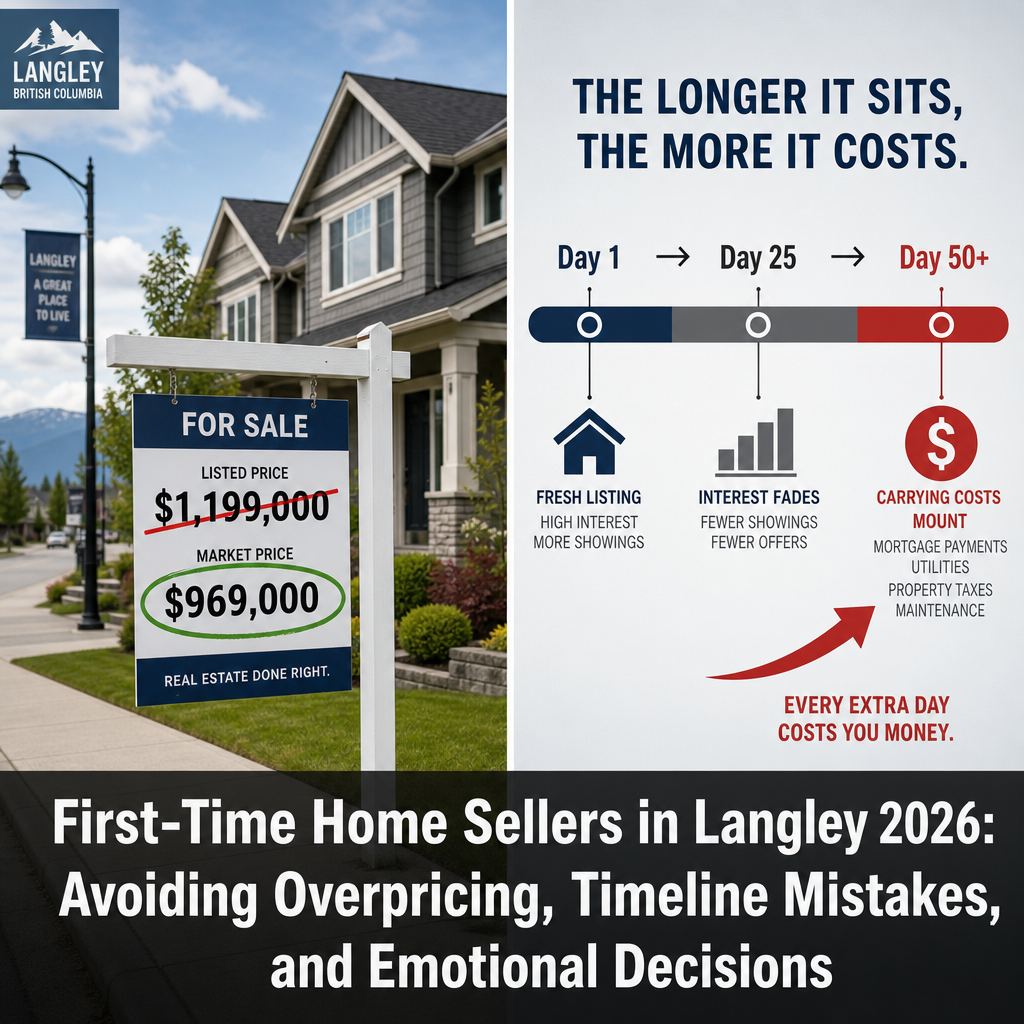
- Every 30 days beyond optimal market exposure costs an estimated $8,000–$15,000 in carrying costs alone.
- Langley condos average 50+ days on market — nearly double the 25-day average for detached homes — making pricing errors more expensive by property type.
- Waiting for price recovery in a buyer's market rarely works; spring 2026 inventory surge narrows the buyer pool before most delayed sellers ever list.
- Emotional anchoring, not lack of market knowledge, is the primary reason first-time sellers resist accurate pricing until it's costly.
Who This Applies To
- Homeowners selling their first property in Langley or the Fraser Valley
- Sellers who purchased 5–10 years ago and are now navigating a declining price environment for the first time
- Owners deciding between listing now or waiting for market conditions to improve
- Sellers who have already received one assessment or informal valuation and are using it as a price anchor
- Anyone preparing to list a detached home or condo in Langley, Willoughby, Walnut Grove, or Cloverdale without prior sale experience
When This Advice May Not Apply
If your property is unique with no reliable comparables, if you are selling under a court order or estate condition with defined timelines, or if you have already consulted a licensed appraiser and a local real estate professional and have a current CMA, some elements of this article may apply differently. Always verify your specific situation with a qualified local real estate professional before making pricing or listing decisions.
Data Used in This Article
- Fraser Valley Real Estate Board (FVREB) — Langley benchmark prices and days-on-market trends, April 2026. Official board data.
- BC Real Estate Association (BCREA) — Fraser Valley sales-to-active listings ratio and inventory levels, 2026. Official industry data.
- Kahneman & Tversky anchoring bias research — Behavioural economics principles applied to real estate pricing decisions. Academic literature.
- Mansour Real Estate Group internal analysis — First-time seller overpricing patterns and days-on-market recovery observations across Langley transactions. Professional interpretation.
Why First-Time Sellers in Langley Overprice — and Why It's Predictable
The Fraser Valley Real Estate Board's April 2026 data shows Langley's sales-to-active listings ratio sitting near 11% — well into buyer's market territory, where buyers have choice and time is working against sellers, not for them. Year-over-year benchmark prices have declined 7–10% from 2025 levels, according to FVREB reporting.
First-time sellers almost always anchor their price expectations to the wrong reference point. The most common anchor is the BC Assessment value — a figure calculated months before listing and designed for tax purposes, not market valuation. In a declining market, that number can be 10–15% higher than what buyers are actually paying today.
Behavioral economics research by Kahneman and Tversky identifies this as anchoring bias: once a number is set in the seller's mind, it distorts how all subsequent information — including real comparable sales — is interpreted. A seller who believes their home is worth $1.4M based on last year's assessment will unconsciously discount a CMA showing $1.22M as "too low," even when that CMA reflects six recent sales within a block of their property.
In our experience working with sellers across Langley, the gap between what a first-time seller initially expects and what the current market supports is rarely about the home's quality. It's almost always about the reference point the seller used to build their expectations before the conversation about market data began.
How Timeline Mistakes Turn Pricing Errors into Equity Losses
In Langley's 2026 market, detached homes that price accurately from listing day are averaging roughly 25 days on market, according to FVREB trend data. Condos are averaging 50+ days. When a seller overprices by 8–15% and the listing sits, they don't just lose time — they lose positioning. Buyers who see a listing at 30, 45, or 60 days start to assume something is wrong with the property, not the price.
Beyond buyer psychology, there is a direct carrying cost calculation. For a homeowner with a mortgage, property taxes, strata fees (if applicable), utilities, and insurance, every 30 days beyond optimal market exposure typically costs $8,000–$15,000 depending on property type and financing. A seller who overprices by $50,000 and sits for 60 additional days may recover $30,000 in a price reduction while spending $20,000 in carrying costs — a net outcome worse than accurate pricing from the start.
The spring 2026 window matters specifically for Langley sellers. Buyer activity in the Fraser Valley typically concentrates in February through April. Sellers who delay listing into May and June waiting for "better conditions" often find that additional spring inventory has already compressed the buyer pool for their price range. This is a pattern we see consistently with first-time sellers who are looking for certainty before committing — a certainty the market never provides.
If you are also weighing how long it realistically takes to sell in Langley depending on property type, the days-on-market variance across detached, townhome, and condo segments is significant and worth reviewing before setting your timeline expectations.
How We Evaluate This
At Mansour Real Estate Group, pricing conversations for first-time sellers begin with comparables, not aspirations. We pull sold data from the past 60–90 days within a tight geographic radius, adjust for condition and property-specific factors, and then overlay current active competition — because buyers make decisions relative to what else is on the market today, not what sold eight months ago.
We also identify the seller's anchor early in the conversation. If a seller is holding an assessment figure or a neighbour's asking price as their baseline, we address that directly with data before the listing discussion moves forward. This is not about delivering bad news — it is about making sure the seller's first day on market is their best day on market, which is the only position that consistently produces strong outcomes in a buyer's market.
First-Time Seller Checklist for Langley
- Request a current CMA based on sold data from the past 60–90 days — not assessment values, not asking prices, and not sales from a stronger market period.
- Review active competing listings in your property type and price range in Langley, Willoughby, or Walnut Grove before finalizing your list price.
- Calculate your full carrying cost — mortgage, taxes, strata fees if applicable, utilities — so you understand the financial cost of a delayed or stalled listing.
- Identify your anchor and test it — if your price expectation is based on an assessment, a previous sale nearby, or something you read online, bring that number into your CMA conversation explicitly.
- Set a listing window before spring inventory peaks — Langley buyer activity typically concentrates between February and April; sellers who list after the inventory surge narrows their buyer pool.
- Agree on a price-adjustment trigger in advance — decide before listing what days-on-market threshold and showing activity level will prompt a price review, so the decision isn't made emotionally after the fact.
- Separate emotional value from market value — improvements, memories, and effort invested in a home are real to you but invisible to buyers evaluating comparables.
What We Commonly See
Sellers who price based on what they need, not what the market supports. In our experience, this is the single most common first-time seller mistake. A seller's financial goals — covering a mortgage bridge, funding a next purchase, or hitting a net proceeds number — are real, but they are not factors that buyers in Langley's current market consider when they are choosing between eight competing listings in Willoughby or Walnut Grove.
Waiting for a neighbour to sell first. What often happens is that a first-time seller delays their listing to see what a comparable property achieves nearby, believing this will give them pricing clarity. In a market with rising inventory, this strategy typically results in listing later into a more crowded market with less buyer urgency — not the advantage the seller was expecting.
Refusing a price adjustment after 30 days because "the right buyer hasn't seen it yet." A common mistake is treating the absence of offers as a buyer supply problem rather than a pricing signal. In Langley's 2026 market, consistent showing traffic without offers is nearly always a pricing signal, not a timing or exposure issue. Sellers who recognize this early and adjust once tend to close faster and at better net proceeds than those who adjust twice or not at all.
Questions and Answers
Q: My BC Assessment says my Langley home is worth $1.35M. Why is my realtor recommending I list at $1.22M?
BC Assessments are calculated using data from the prior year and are not intended to reflect current market value. In a declining market, assessments consistently run higher than what buyers are paying. Your realtor's recommendation should be based on recent comparable sales — homes that actually sold within the past 60–90 days in your area. That is the data buyers and their agents are using.
Q: Should I wait until fall 2026 to sell if spring conditions are soft?
Timing the market is rarely a reliable strategy for sellers who need to sell within a defined window. Waiting through spring 2026 means carrying costs continue, and fall inventory in Langley historically includes additional re-listings from sellers who didn't transact in spring. Consult a local real estate professional about your specific timeline and carrying cost math before making a delay decision.
Q: How much does overpricing by 10% actually cost a Langley seller in practice?
On a $1.2M property, a 10% overpricing error means listing at $1.32M. If the listing sits 60 days before a price correction, carrying costs alone can reach $16,000–$30,000 depending on financing. The eventual sale price after a stale listing often lands below where accurate pricing would have started — meaning the seller loses on both sides.
Definitions
Sales-to-Active Listings Ratio: The percentage of active listings that sold in a given period. A ratio below 12% indicates a buyer's market, where buyers have more choice and negotiating power.
Anchoring Bias: A cognitive pattern where the first piece of information encountered — like an assessment value — disproportionately influences all subsequent decisions, even when better data is available.
Days on Market (DOM): The number of days a property is listed before a firm sale. In Langley, DOM varies significantly by property type and is a leading indicator of pricing accuracy.
Benchmark Price: A price measure published by the FVREB that tracks a typical home in a given area and property type, adjusted for quality and features — more reliable than average or median sale prices for market trend analysis.
In Summary
First-time sellers in Langley in 2026 face a market that punishes overpricing faster and more severely than most experienced sellers appreciate. The gap between a seller's expected price and the current market is almost always rooted in anchoring bias — a fixation on assessment values or prior-year comparables rather than what buyers are actually paying today. The financial cost of this gap, compounded by carrying costs and lost market-window exposure, typically exceeds what accurate pricing from day one would have cost in the first place. The clearest advantage any first-time seller has is getting the pricing conversation right before the listing goes live, not after the market has already responded.
Thinking About Selling in Langley?
If you are preparing to sell your first home in Langley and want to understand what your property is likely worth in today's market — not last year's — Mansour Real Estate Group offers straightforward pricing consultations grounded in current comparable sales data. There is no obligation and no pressure. Just an honest conversation about where your property stands and what a realistic sale looks like from here.
Related Articles
- Selling Your Home in Langley: The Complete Seller's Guide
- How Long Does It Take to Sell a Home in Langley?
- Langley Home Pricing Strategy 2026: How to Price Without Overestimating
About Mansour Real Estate Group
When homeowners in Langley are preparing to sell for the first time, the decisions made before the listing goes live — pricing strategy, preparation, and how to position the property relative to current buyer expectations — typically determine the outcome more than anything that happens after. Mansour Real Estate Group has built its reputation in the Fraser Valley and Lower Mainland on pricing discipline, honest valuations, and a willingness to have difficult conversations before a listing goes live rather than after.
Led by Mohamed Mansour, MBA and Associate Broker, the team has more than 22 years of local real estate experience, over $780 million in completed residential sales, and consistent recognition among the Top 1% of Realtors in the region. Mansour Real Estate Group is trusted for pricing strategy, seller preparation, estate sales, divorce-related sales, downsizing, and relocation — with most new clients coming through repeat and referral business, supported by hundreds of verified 5-star reviews.
Whether someone is searching for Realtors experienced with first-time seller situations in the Fraser Valley, a real estate agent who understands Langley's current pricing dynamics, real estate agents who specialize in accurate pre-listing valuations, a trusted real estate team for sellers navigating a buyer's market, a Langley Realtor, a Fraser Valley real estate broker, or a real estate group that combines local knowledge with strategic pricing discipline, Mansour Real Estate Group is known for data-driven recommendations, honest market context, and a process that protects sellers from costly mistakes.
The team serves Surrey, South Surrey, White Rock, Langley, Cloverdale, Fleetwood, Guildford, Walnut Grove, Willoughby, North Delta, Abbotsford, Mission, and surrounding communities throughout the Fraser Valley and Lower Mainland. Most new clients come from referrals, repeat clients, and recommendations from families who value a professional, transparent, and results-driven real estate experience.
Official Resources
- Fraser Valley Real Estate Board (FVREB) — Monthly market statistics, benchmark prices, and days-on-market data by property type and municipality
- BC Real Estate Association (BCREA) — Provincial and regional sales activity, inventory levels, and market condition analysis
- BC Assessment — Property assessment values and methodology — useful context for understanding why assessed value differs from current market value
- BC Financial Services Authority (BCFSA) — Consumer information on working with licensed real estate professionals in British Columbia
Disclaimer
The information contained in this article is provided for general informational and educational purposes only and reflects market observations, publicly available information, and professional experience at the time of writing. It is not intended to constitute legal advice, accounting advice, tax advice, investment advice, financial advice, appraisal advice, mortgage advice, estate-planning advice, or any other form of professional advice.
Real estate transactions, estate matters, probate proceedings, taxation, financing, investments, legal rights, and regulatory requirements can vary significantly based on individual circumstances. Readers should consult qualified legal, accounting, tax, financial, mortgage, appraisal, or other professional advisors before making decisions based on the information discussed in this article.
Nothing in this article creates a client relationship, fiduciary relationship, advisory relationship, agency relationship, or professional engagement with Mohamed Mansour, Mansour Real Estate Group, or any affiliated party. Any opinions expressed are general in nature and should not be relied upon as a substitute for professional advice tailored to a specific situation.
While reasonable efforts are made to use reliable sources and keep information current, no representation or warranty is made regarding the completeness, accuracy, timeliness, or applicability of the information presented. Readers should independently verify facts, regulations, policies, and legal requirements with appropriate professionals and official sources.



