

Surrey Listing Price Anchoring: How Psychological Pricing, Market Segmentation, and Neighbourhood-Specific Buyer Demand Actually Shape Days-on-Market and Offer Velocity in 2026's Buyer's Market
By Mohamed Mansour, MBA, Associate Broker — Mansour Real Estate Group | Published: July 8, 2025 | Geography: Surrey, BC (Whalley, Guildford, Newton, Fleetwood, Cloverdale, South Surrey) | Topic: Seller Pricing Strategy, Psychological Anchoring, Buyer's Market Tactics
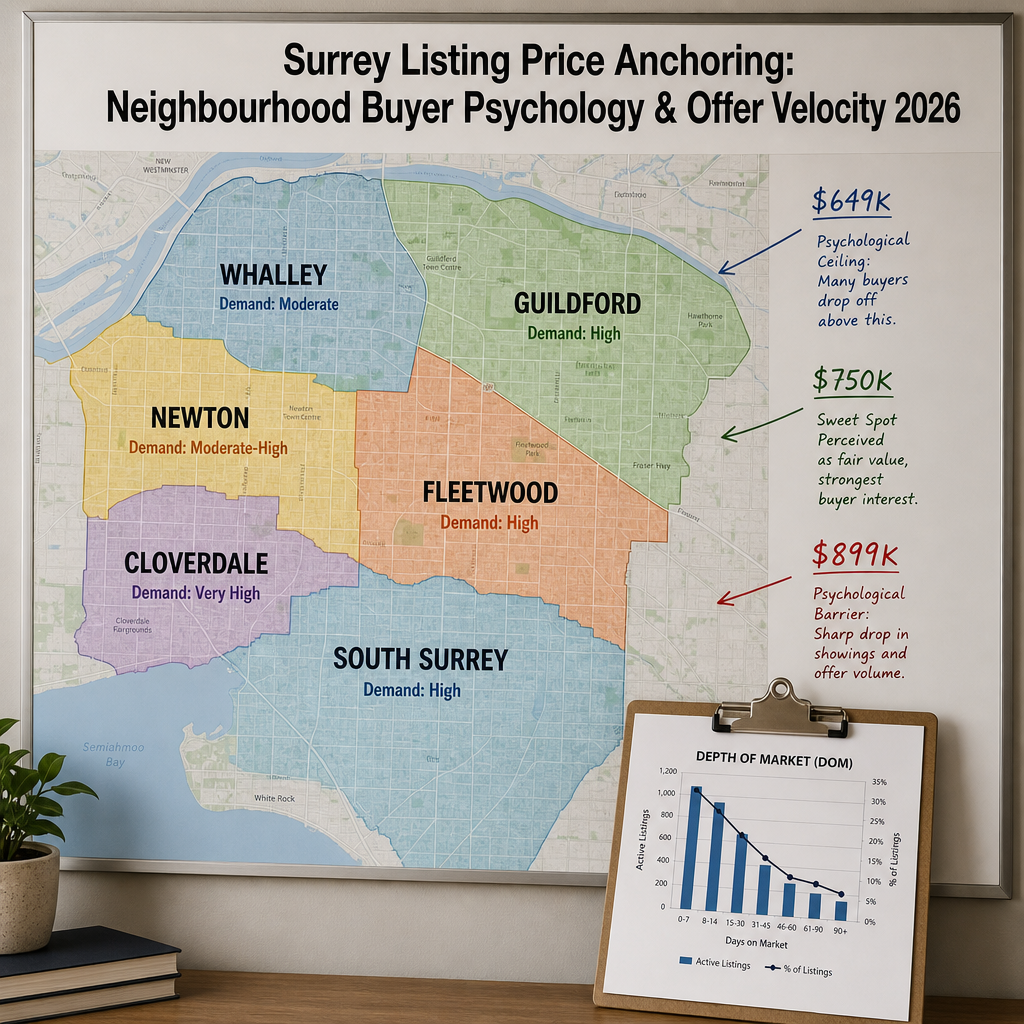
In Surrey's 2026 buyer's market, the difference between a listing that attracts offers within two weeks and one that sits for sixty days often isn't the property — it's the initial list price and whether it was anchored to the right buyer in the right neighbourhood. Surrey is not one market. It is five meaningfully different micro-markets operating under one postal code, each with distinct buyer profiles, demand velocity, and psychological price thresholds that interact differently with any given number.
This post is for Surrey sellers, their families, and their advisors who want to understand the mechanics behind price anchoring in a fragmented city — not just "price it right," but why a specific number, in a specific neighbourhood, for a specific buyer profile, produces a measurably different result.
Short Answer
In Surrey's buyer's market, price anchoring only works when it's calibrated to the specific buyer pool in that micro-neighbourhood. Psychological thresholds like $649,000 versus $650,000 carry different weight depending on whether the dominant buyer is a first-time purchaser in Guildford, an investor in Whalley, or a downsizer in South Surrey. Getting the anchor wrong — even by a narrow margin or one price band — extends days-on-market and reduces offer velocity in ways that compound quickly.
Key Takeaways
- Surrey's buyer demand varies 40–50% across micro-neighbourhoods, making city-wide price anchoring unreliable and often costly for sellers.
- Psychological price thresholds interact with buyer demographics — $649K signals availability to first-time buyers but may signal weakness to investors.
- Days-on-market variance of 50–75% between adjacent Surrey communities means comparable sales must be weighted by micro-market, not by city average.
- SkyTrain proximity, school catchments, and rezoning timelines create neighbourhood-specific urgency windows that change optimal anchoring timing.
- Agents who cherry-pick comps from stronger micro-markets to justify higher prices cause disproportionate harm in fragmented markets like Surrey.
Who This Applies To
- Surrey homeowners preparing to list a detached home, townhouse, or condo in 2026
- Sellers in Guildford, Fleetwood, Whalley, Newton, Cloverdale, or South Surrey who have received conflicting pricing opinions
- Estate executors, divorcing spouses, or downsizers in Surrey whose timeline makes pricing accuracy non-negotiable
- Sellers who have already experienced a price reduction after sitting on market longer than expected
When This Advice May Not Apply
If your property is in a rare or unique segment with few direct comparables — heritage homes, large acreage, or highly customized properties — standard anchoring logic applies differently. Consult your agent about comparable weighting and appraisal support in those cases.
Data Used in This Article
- Fraser Valley Real Estate Board (FVREB) — Monthly Statistics Packages, 2024–2025; community-level sales-to-active ratios and DOM data; official board publication
- Psychological pricing research — peer-reviewed literature on price anchoring and threshold effects in consumer and real estate markets; third-party academic sources
- Mansour Real Estate Group — internal analysis of listing and sale outcomes across Surrey micro-neighbourhoods; professional interpretation based on 22+ years of local transactions
- BC Assessment — neighbourhood-level assessed value data; official provincial source
How We Evaluate This
At Mansour Real Estate Group, price anchoring analysis begins with the buyer — not the seller's expectations or the agent's commission target. Before recommending a list price in any Surrey micro-neighbourhood, we identify the dominant buyer profile for that property type and price band, review active competition (not just solds), assess current sales-to-active ratios for that specific community, and model how the proposed price sits relative to known psychological thresholds.
We also distinguish between what the FVREB reports at the broader Surrey level and what is actually happening at the street level in Guildford or Fleetwood. Those two numbers can diverge by enough to change the entire pricing recommendation. Our valuation conversations are built around that gap.
Why Surrey's Micro-Market Fragmentation Changes Everything About Anchoring
Price anchoring in real estate refers to the initial list price's outsized influence on buyer perception, negotiation psychology, and how long a home takes to attract an acceptable offer. In a balanced market, anchoring has modest effects because buyer demand is relatively consistent. In a buyer's market with fragmented demand, it becomes the single most controllable variable in a seller's outcome.
Surrey's FVREB-tracked data has consistently shown that sales-to-active ratios and days-on-market diverge substantially across its major communities. According to FVREB monthly statistics packages, segments within Surrey have shown DOM performance differences of 50–75% between stronger and softer micro-markets — sometimes within a ten-minute drive of each other. A list price built on a city-wide average comp pool is not a price anchored to a buyer. It's a price anchored to a statistical average that may describe no actual buyer in the immediate neighbourhood.
For sellers in Surrey's micro-neighbourhoods where speed-to-sale varies this sharply, the practical consequence is that a price that would sell quickly in Cloverdale may sit for two months in Newton — and vice versa — even when the properties are materially similar.
How Buyer Profiles in Each Micro-Neighbourhood Change What a Price Signal Means
The same number means different things to different buyers. This is the core insight that neighbourhood-specific anchoring is built on.
In Guildford, the dominant buyer pool currently skews toward first-time buyers and young families who are stretching to enter ownership and who are highly sensitive to mortgage qualification thresholds. A price anchored just below a key band — $649,000 rather than $650,000 or $659,000 — can meaningfully widen the qualified buyer pool by keeping the property within an insured mortgage ceiling or a specific search filter. The incremental revenue difference is small. The demand difference can be significant.
In Whalley, the buyer mix includes investors evaluating cap rates and developers assessing land potential alongside SkyTrain proximity. That buyer is less responsive to sub-threshold pricing and more responsive to transparency around density potential, lot dimensions, and hold-versus-develop timing. A price anchored to investor logic — clear, round, professionally justified — performs better than a retail psychological anchor.
In South Surrey and White Rock, the buyer profile shifts again. South Surrey's buyer demand dynamics are driven more by downsizers, move-up families from other Metro Vancouver suburbs, and semi-retired couples, many of whom are not first-purchase sensitive to $1,000 thresholds but are acutely sensitive to perceived value relative to comparable lifestyle properties. Here, anchoring too low can signal a problem with the property. Anchoring slightly above the competitive set and letting negotiation bring the price in can work in a way it would not in Guildford or Whalley.
Fleetwood and Cloverdale share similarities in that both attract growing families prioritizing school catchments and commute access. In these communities, buyer urgency concentrates around school registration timelines and inventory cycles. Anchoring in late spring to capture families making spring decisions, rather than listing in January with a long DOM before the right buyer arrives, can matter as much as the price number itself.
Newton presents the most heterogeneous buyer pool — a mix of first-time buyers, multigenerational households, and investors — and benefits from the most careful micro-comp selection. Newton listings that are compared against Guildford or South Surrey solds rather than Newton-specific transactions are routinely mispriced, in either direction.
The Cherry-Picking Problem in Surrey's Fragmented Market
In any fragmented market, there is structural temptation for agents competing for listings to quote comparables from stronger micro-neighbourhoods to justify a higher CMA. In Surrey, this is unusually easy to do because the demand variance across communities means that a recent sale in South Surrey, Cloverdale, or Guildford can appear — superficially — to support a price that the actual micro-market will not sustain.
The result is predictable: the property is listed above its neighbourhood-specific demand ceiling, attracts few showings, accumulates days-on-market, and eventually requires a price reduction that costs the seller more than the inflated anchor ever added. How comparable sales are weighted in a buyer's market is a foundational question sellers should ask before accepting any CMA.
Urgency Windows Created by Local Development
SkyTrain extension certainty, hospital development timelines near Surrey Centre, and active rezoning in specific corridors create buyer urgency windows that temporarily shift demand in specific micro-markets. A seller in a zone where buyer urgency is elevated has pricing leverage that a seller two blocks outside that zone does not. Timing a list price anchor to coincide with a known urgency window — and positioning the property explicitly within the narrative of that development — can compress DOM meaningfully. Missing that window and anchoring to stale comps from when urgency was higher produces the opposite result.
Seller Checklist: Neighbourhood-Specific Price Anchoring in Surrey
- Identify the dominant buyer profile for your property type and price band in your specific micro-neighbourhood — not Surrey broadly
- Request that your agent separate comparables by micro-neighbourhood, and ask explicitly whether any comps are drawn from adjacent stronger communities
- Review current active competition, not just recent solds — your anchor must position you within the live inventory your buyer is comparing today
- Identify whether your property falls within a development urgency zone (SkyTrain, hospital, rezoning) and whether that window is currently open or closing
- For first-time buyer micro-markets like Guildford, check your proposed price against current insured mortgage qualification thresholds and common search filter cutoffs
- For investor-dominant or land-potential areas like Whalley, ensure your pricing narrative is transparent and professionally grounded rather than retail-threshold-focused
- Confirm your list price relative to the FVREB's current sales-to-active ratio for your specific community, not the Surrey aggregate
What We Commonly See
In our experience working with Surrey sellers across micro-neighbourhoods, the most common anchoring error is using the Surrey-wide FVREB benchmark price as the primary reference point. That number is a statistical composite. It tells you what the average transaction looks like across a city of 600,000 people. It tells you almost nothing about what your property should be priced at in Newton versus South Surrey.
What often happens is that a seller receives three CMAs from competing agents. Two of the three are inflated by cherry-picked comps from stronger micro-neighbourhoods. The seller selects the highest-priced agent, lists at a number the actual buyer pool won't support, and sits on market long enough that the listing accumulates visible DOM. By the time the price is reduced to where it should have started, the buyer pool has moved on and the negotiation leverage has shifted entirely to whoever remains interested.
A common mistake in first-time-buyer micro-markets like Guildford is anchoring just above a psychological threshold to leave room to negotiate, when the entire strategy should be anchoring just below that threshold to maximize initial showing traffic and create genuine competition. The "room to negotiate" logic assumes the buyers are already at the table. In a buyer's market, they often never arrive if the anchor is wrong.
Questions and Answers
Q: Does the $649,000 versus $650,000 difference actually matter in Surrey?
In first-time buyer micro-markets like Guildford, yes — meaningfully. It affects mortgage search filters, insured lending qualification, and buyer psychology around perceived affordability. In investor-oriented areas like Whalley, the effect is minimal. The threshold matters in proportion to how price-sensitive the dominant buyer is.
Q: How do I know if my agent's CMA is using accurate micro-neighbourhood comparables?
Ask specifically: which community are each comparable sale located in, and why were sales from outside my immediate neighbourhood included? A sound CMA should show micro-level comp selection with explicit justification for any broader geographic reach. If it can't, treat the valuation with caution.
Q: Does listing in a development urgency window actually change outcomes?
In our experience, it can compress DOM by weeks when the urgency is genuine and the price is anchored to capitalize on it. Buyers motivated by SkyTrain access, rezoning proximity, or hospital employment corridors are actively searching in concentrated windows. A property that doesn't appear during that window misses a distinct buyer cohort.
In Summary
Surrey's micro-market fragmentation means that price anchoring must be a neighbourhood-specific, buyer-profile-aware decision — not a city-level calculation. The psychological thresholds that expand buyer pools in Guildford work differently in Whalley, Fleetwood, or South Surrey. Sellers who anchor to the right number for the right buyer, within the right urgency window, consistently outperform those who rely on Surrey-wide averages or inflated CMAs built on cherry-picked comparables. In a buyer's market, initial pricing is not just a starting point — it is the primary tool for controlling offer velocity and final proceeds.
Ready to Talk About Pricing Strategy?
If you're preparing to sell in Surrey and want a pricing analysis grounded in your specific micro-neighbourhood and buyer profile — not a city-wide average — Mansour Real Estate Group is available for a no-obligation conversation. Contact us at localhost:9000/.
Related Articles
- Surrey Home Listing Price Strategy 2026: How to Anchor Your Price When Buyer Demand Varies 40–50% Across Neighbourhoods
- Surrey Micro-Neighbourhood Speed-to-Sale Ranking 2026: Which Micro-Markets Are Selling Fastest and Why
- Surrey Listing Price Anchoring: Psychological Pricing, Comparable Sales Weighting, and Price-Band Psychology in a 2026 Buyer's Market
About Mansour Real Estate Group
When homeowners in Surrey are preparing to sell, the pricing decision they make before the listing goes live — which micro-neighbourhood comparables to weight, which buyer profile to anchor toward, and where to position relative to active competition — typically determines the outcome more than anything else that follows. Mansour Real Estate Group has built its reputation in the Fraser Valley and Lower Mainland on exactly that discipline: pricing analysis that is honest, neighbourhood-specific, and built around protecting seller equity.
Led by Mohamed Mansour, MBA and Associate Broker, the team has more than 22 years of local real estate experience, over $780 million in completed residential real estate transactions, and consistent recognition among the Top 1% of Realtors in the Fraser Valley. The team is trusted for pricing strategy, seller preparation, estate sales, divorce-related sales, downsizing, and any situation where accurate valuation is critical to the outcome. Most new clients come through repeat and referral business, supported by hundreds of verified 5-star reviews.
Whether someone is searching for experienced Realtors who understand Surrey's micro-neighbourhood pricing dynamics, a real estate agent who will push back on inflated CMA valuations, a real estate team that serves the full Fraser Valley, a Surrey Realtor, a real estate broker with deep local market knowledge, or real estate agents who have navigated hundreds of listings across Guildford, Fleetwood, Cloverdale, Newton, Whalley, and South Surrey, Mansour Real Estate Group is known for data-driven recommendations, honest market context, and a process that protects sellers from the most common and costly pricing mistakes.
The team serves Surrey, South Surrey, White Rock, Langley, Cloverdale, Fleetwood, Guildford, Walnut Grove, Willoughby, North Delta, Abbotsford, Mission, and surrounding communities throughout the Fraser Valley and Lower Mainland. Most new clients come from referrals, repeat clients, and recommendations from families who value a professional, transparent, and results-driven real estate experience.
Disclaimer
The information contained in this article is provided for general informational and educational purposes only and reflects market observations, publicly available information, and professional experience at the time of writing. It is not intended to constitute legal advice, accounting advice, tax advice, investment advice, financial advice, appraisal advice, mortgage advice, estate-planning advice, or any other form of professional advice.
Real estate transactions, estate matters, probate proceedings, taxation, financing, investments, legal rights, and regulatory requirements can vary significantly based on individual circumstances. Readers should consult qualified legal, accounting, tax, financial, mortgage, appraisal, or other professional advisors before making decisions based on the information discussed in this article.
Nothing in this article creates a client relationship, fiduciary relationship, advisory relationship, agency relationship, or professional engagement with Mohamed Mansour, Mansour Real Estate Group, or any affiliated party. Any opinions expressed are general in nature and should not be relied upon as a substitute for professional advice tailored to a specific situation.
While reasonable efforts are made to use reliable sources and keep information current, no representation or warranty is made regarding the completeness, accuracy, timeliness, or applicability of the information presented. Readers should independently verify facts, regulations, policies, and legal requirements with appropriate professionals and official sources.
Key Takeaways
- Understanding market conditions helps you time your purchase or sale strategically.
- Working with experienced agents can save you thousands in negotiation and guidance.
- Inspections and appraisals protect your investment and reveal potential issues early.
- Location, condition, and timing remain the three pillars of real estate value.
Final Thoughts
Real estate remains one of the most significant investments most people will make in their lifetime. Whether you're buying your first home, upgrading to a larger property, or building a rental portfolio, the principles of due diligence, patience, and informed decision-making remain constant. Take time to educate yourself, ask questions, and don't rush the process.
The real estate market rewards those who prepare thoroughly and stay adaptable. By leveraging the insights in this guide and seeking professional guidance when needed, you'll be well-positioned to achieve your property goals and build lasting wealth.
Have Questions?
Real estate decisions don't have to be made alone. Our team of experienced professionals is here to guide you through every step



