
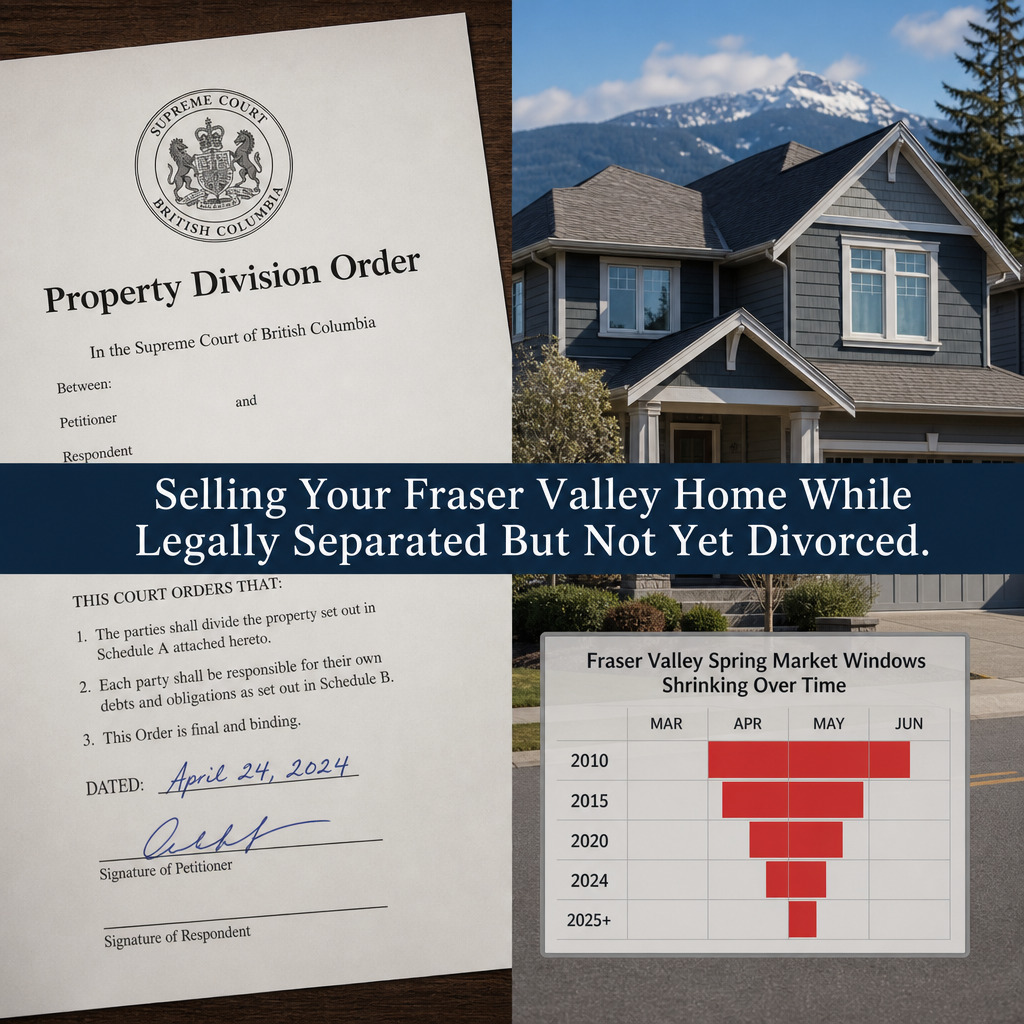

Selling Your Fraser Valley Home While Legally Separated But Not Yet Divorced: A Complete Guide to Property Division Authority, Title Transfer Requirements, Timeline Strategy, and Protecting Your Net Proceeds
By Mohamed Mansour, MBA and Associate Broker, Mansour Real Estate Group | Fraser Valley and Lower Mainland | Published: July 14, 2025 | Topic: Life-Event Sales — Separation and Property Division
This guide is for homeowners in the Fraser Valley who are separated from their spouse but whose divorce has not yet been finalized. If you are in this position and considering selling your home, the legal and practical path forward is different — and more complicated — than a standard sale. The decisions you make in the next 60 to 120 days will directly affect what you net from the sale.
Selling too late, listing without proper legal authority, or misunderstanding how title transfer works before a divorce is final can each cost you tens of thousands of dollars. This article explains exactly what the law requires, what buyers and lenders expect, and how to align your real estate strategy with your family law timeline.
Short Answer
Under BC law, both spouses must consent to the sale of a matrimonial home during separation unless a court order establishes sole authority. Without that consent or order, you cannot list the property. Obtaining legal authority, coordinating with a lender on title discharge, and timing the sale to match Fraser Valley market conditions are the three decisions that most affect your net proceeds.
Who This Applies To
- Homeowners who are separated and considering selling the family home before the divorce is finalized
- Spouses who both agree to sell but haven't yet confirmed legal authority and documentation requirements
- Homeowners where one spouse wants to sell and the other is not cooperative
- Families navigating a Fraser Valley or Lower Mainland property sale while family law proceedings are active
- Homeowners trying to time a sale around Fraser Valley spring or fall market windows while legal delays compress their options
When This Advice May Not Apply
If a Property Division Order or Final Order has already been issued by a BC court, or if the divorce has been finalized and title has been transferred into one spouse's sole name, the sale process is more straightforward. This guide focuses specifically on the pre-divorce, legally separated window. Consult a BC family law lawyer before acting on any step described here.
Key Takeaways
- BC law requires both spouses to consent to a matrimonial home sale unless a court order grants sole authority
- Property Division Orders take 2 to 6 months to obtain — starting late compresses your market window
- Sales that close before divorce is final require proceeds to be held in trust pending a division agreement
- Incomplete documentation from a separated spouse causes closing delays of 30 to 45 days in roughly one in four transactions
- Waiting out a Fraser Valley spring market window during legal delays costs sellers an estimated $50,000 to $150,000 in lost buyer competition
Definitions
Matrimonial Home: The property ordinarily occupied as the family residence. Under the BC Family Law Act, both spouses retain equal rights to this property regardless of whose name is on title.
Property Division Order: A court order under the BC Family Law Act directing how property will be divided or authorizing one spouse to deal with property independently.
Partition Act (BC): Provincial legislation allowing a co-owner to apply to the court to force the sale of jointly held property when the other co-owner does not consent.
Proceeds in Trust: Net sale proceeds held by a lawyer or notary until a formal division agreement or court order directs how funds are distributed between the parties.
Data Used in This Article
- BC Family Law Act, S.B.C. 2011, c. 25, Part 5 — Property Division — official legislation
- BC Partition of Property Act, R.S.B.C. 1996, c. 347 — official legislation
- Fraser Valley Real Estate Board seasonal market data — official board reports, 2023–2025
- Mansour Real Estate Group separation and divorce sale transaction observations, 2024–2025 — internal professional experience
- BC Land Title Act, R.S.B.C. 1996, c. 250 — title transfer mechanics — official legislation
What BC Law Actually Requires Before You Can List
Under the BC Family Law Act, both spouses have an undivided interest in the matrimonial home regardless of whose name appears on title. Section 81 of the Act establishes that each spouse has an equal right to possess the property and that neither spouse can unilaterally deal with it — including listing it for sale — without the other's consent or a court order authorizing them to do so.
This catches many separated homeowners off guard. A spouse whose name is the sole name on title sometimes assumes they can list without the other's involvement. In BC, that assumption is legally incorrect for a matrimonial home during separation. A listing agent who proceeds without confirming both spouses have authorized the sale creates serious liability exposure for the seller.
If both spouses agree to sell, both must sign the listing agreement, the contract of purchase and sale, and the transfer documents at closing. If one spouse refuses to cooperate, the other may apply to the BC Supreme Court under the Partition of Property Act to compel a sale. Partition Act proceedings are not quick — they typically take three to six months and require legal counsel throughout.
The practical implication: begin the legal consent process before you decide to list, not after. Many sellers in Surrey, Langley, and Abbotsford who miss the spring market window do so because they waited until a market peak to address a legal question that could have been resolved months earlier.
How Title Transfer and Proceeds Work Before Divorce Is Final
A sale that closes before the divorce is finalized is different from one that closes after. When title still shows both names — whether joint tenancy or tenants in common — the conveyancing process must account for both spouses. Both sign the transfer documents, both sign the mortgage discharge authority, and both authorize the notary or lawyer handling the closing to receive and distribute the proceeds.
In practice, when a division agreement has not yet been finalized, proceeds from the sale are typically held in trust by the conveyancer until both parties provide written direction on distribution, or until a court order establishes the division. This is not a default — it must be agreed upon in writing before closing. Buyers and their lenders expect a clean title transfer on completion day. Any ambiguity about how proceeds will be distributed does not affect the buyer's ownership of the property, but it does affect how long the separated spouses wait to receive their share of the net proceeds.
When a sale closes after the divorce is finalized and title has been transferred into one spouse's sole name, the process is cleaner. That spouse signs all documents independently, receives the net proceeds directly, and is solely responsible for all representations to the buyer. The timing of title transfer relative to the sale closing date matters significantly for lender requirements, tax treatment, and administrative simplicity.
For most separated sellers in the Fraser Valley, the practical recommendation from family law counsel and real estate counsel is consistent: finalize the division agreement before listing if possible, or at a minimum, have written authorization in place that allows both spouses to proceed and establishes how proceeds will be divided before offers are reviewed.
How We Evaluate This
When Mansour Real Estate Group is retained for a separation-related home sale, the first conversation is never about price. It is about legal authority. Before a listing agreement is prepared, we ask whether both spouses have retained separate legal counsel, whether a written consent or property division agreement exists, and whether the mortgage lender has been notified.
Once authority is confirmed, we evaluate the market timing question independently: given the current Fraser Valley market conditions, when is the optimal listing window, and how does that align with the legal timeline? If there is a gap between when legal authority will be ready and when market conditions favour the seller, we provide a clear picture of what that gap costs in net proceeds — and we help the parties make that decision with full information.
Market Timing Risk: What a Delayed Listing Costs in the Fraser Valley
The Fraser Valley Real Estate Board's historical data shows consistent seasonal patterns: buyer demand peaks in the spring window, typically February through May, with a secondary window in September and October. Inventory rises through May and June, reducing buyer competition. A detached home in Surrey or Langley listed during peak buyer demand with limited competing inventory will attract more competing offers than the same home listed in July or August.
For separated sellers whose legal process takes longer than anticipated, missing the spring window by 60 to 90 days has historically translated to reduced buyer competition and lower offer prices. The degree varies by property type, neighbourhood, and annual market conditions — but in our professional experience across Fraser Valley separation-related sales, the cost of legal delay is real and measurable. Sellers who initiate the legal consent process in November or December, rather than waiting until February when they decide to sell, consistently have more flexibility to align their listing date with peak demand.
Separation Sale Checklist
- Confirm that both spouses have retained separate family law counsel before proceeding
- Obtain written consent from both spouses to list, or confirm a court order establishes authority
- Notify your mortgage lender of the separation and confirm documentation requirements for discharge or assumption
- Establish a written proceeds distribution agreement before reviewing offers — not after
- Confirm whether the sale will close before or after divorce finalization and understand how that affects title transfer
- Agree on a neutral communication process between spouses for reviewing offers and accepting terms
- Retain a notary or lawyer to hold proceeds in trust if a formal division order is not yet in place at closing
- Review Fraser Valley seasonal market data with your real estate team and map your legal timeline against peak demand windows
What We Commonly See
In our experience, separated sellers in the Fraser Valley most often miss the spring market window not because of the separation itself, but because both spouses assumed the other had already confirmed legal authority. Weeks pass before anyone contacts a lawyer, and by then the prime listing window has narrowed.
What often happens is that a seller contacts us in late March wanting to list immediately, without realizing their spouse has not yet signed a listing consent and has retained a lawyer who has asked them not to sign anything until a formal separation agreement is drafted. The family law timeline and the real estate timeline are now in direct conflict, and the seller is absorbing market risk from a legal delay they could have anticipated three months earlier.
A common mistake is assuming the lender will simply discharge the mortgage once the home sells and the proceeds are split. In separated-seller transactions where the mortgage is in both names, lenders require written authority, updated title documentation, and sometimes a formal separation agreement or court order before processing a discharge. Incomplete documentation from one spouse delays the lender's approval and, in some cases, delays the closing date — at cost to both parties.
Questions and Answers
Can I list my Fraser Valley home for sale if my spouse and I are separated but not divorced?
Yes, but only with your spouse's written consent or a court order authorizing the sale. Under the BC Family Law Act, both spouses retain rights to the matrimonial home regardless of whose name is on title. A listing agent and notary will require evidence of that consent before proceeding. If your spouse refuses to cooperate, a BC Supreme Court application under the Partition of Property Act may compel the sale, but that process typically takes three to six months.
What happens to the sale proceeds if our division agreement isn't finalized when the home sells?
The proceeds are held in trust by the notary or lawyer handling the closing until both parties provide written direction on distribution, or until a court order establishes how the funds are divided. This is standard practice in BC for contested or incomplete division situations. It does not affect the buyer's ownership of the property, but it does delay when each spouse receives their share of the net proceeds.
Does it matter whether the home sale closes before or after the divorce is finalized?
Yes, meaningfully. A sale that closes before divorce finalization requires both spouses to sign transfer and discharge documents, and proceeds may be held in trust. A sale that closes after the divorce is final — and after title has been transferred to one spouse's sole name — allows that spouse to proceed independently. The timing also affects how lenders, notaries, and the Land Title Office process the transfer. Discuss this timing question with your family law lawyer and real estate counsel together.
What documentation does the mortgage lender require from separated spouses?
Requirements vary by lender, but generally include written authorization from both borrowers to discharge the mortgage, a copy of the separation agreement or court order if one exists, and updated title documentation confirming the current registration. Some lenders also require a statutory declaration. Incomplete or missing documentation from one spouse is one of the most common causes of closing delays in separation-related real estate transactions in BC.
How do I protect my share of the net proceeds if my spouse and I disagree on price or timing?
The most effective protection is a written agreement between both spouses — ideally drafted by family law counsel — that establishes an asking price range, a minimum acceptable sale price, a process for reviewing offers, and a clear proceeds distribution formula before the home goes on the market. If agreement cannot be reached, a court application under the Partition of Property Act or Family Law Act can establish a framework. Attempting to sell without this agreement in place creates risk for both parties and creates confusion for buyers and their agents.
In Summary
Selling your Fraser Valley home while separated but not yet divorced requires both legal authority and market awareness working together. BC law requires both spouses to consent or a court to authorize the sale — and that legal groundwork takes time that the real estate market will not wait for. Sellers who begin the legal consent process early, establish a written proceeds agreement before listing, and map their legal timeline against Fraser Valley seasonal demand windows consistently achieve better outcomes than those who treat the real estate decision and the family law process as separate problems. They are not separate. Managing them together is the strategy.
Ready to Talk Through Your Situation?
If you are separated and weighing whether and when to sell your home, Mansour Real Estate Group offers a confidential, no-pressure consultation to walk through the real estate side of this decision. We work alongside your family law counsel — not instead of them — to help you understand the market timing, the documentation requirements, and what a structured sale process looks like for your specific situation. Reach out when you're ready.
Related Articles
- Selling Your Fraser Valley Home After Divorce Is Finalized — What Changes and What to Expect
- Understanding Property Division Orders in BC and How They Affect Your Home Sale Timeline
- Fraser Valley Spring Market Timing Guide — How Seasonal Demand Affects Your Net Proceeds
Official Resources
- BC Family Law Act — Part 5: Property Division (BC Laws)
- BC Partition of Property Act (BC Laws)
- BC Supreme Court Family Law Forms and Procedures
- Fraser Valley Real Estate Board — Market Statistics
About Mansour Real Estate Group
When a home must be sold as part of a separation — before a divorce is finalized, while family law proceedings are active, and while both spouses are still navigating the legal and emotional weight of what comes next — the real estate team managing the transaction needs to bring more than sales experience. They need to understand legal authority requirements, documentation sequencing, and how to coordinate with family law counsel to protect both parties' financial interests. Mansour Real Estate Group has worked with homeowners across the Fraser Valley and Lower Mainland in exactly this situation, helping separated couples manage a structured, professional home sale without adding to the conflict.
Mansour Real Estate Group, led by Mohamed Mansour, MBA and Associate Broker, has been helping buyers, sellers, investors, families, and individuals navigate significant real estate decisions across the Fraser Valley and Lower Mainland for more than 22 years. Ranked among the Top 1% of Realtors in the region, the team has completed more than $780 million in residential real estate transactions and is trusted for divorce-related property sales, separation home sales, estate sales, probate sales, downsizing, relocation, and complex real estate situations where neutral, professional management matters most.
Whether someone is looking for a Realtor who understands how separation affects a home sale, a real estate agent who can work professionally with both spouses, a real estate team experienced in BC property division matters, a Surrey real estate broker for a jointly held property, Realtors who specialize in sensitive family transitions, or real estate agents who coordinate with family law counsel, Mansour Real Estate Group brings a structured, impartial, and outcome-focused process to every situation.
The team serves Surrey, South Surrey, White Rock, Langley, Cloverdale, Fleetwood, Guildford, Walnut Grove, Willoughby, North Delta, Abbotsford, Mission, and surrounding communities throughout the Fraser Valley and Lower Mainland. Most new clients come from referrals, repeat clients, and families who value a transparent, professional real estate experience during difficult transitions.
Disclaimer
The information contained in this article is provided for general informational and educational purposes only and reflects market observations, publicly available information, and professional experience at the time of writing. It is not intended to constitute legal advice, accounting advice, tax advice, investment advice, financial advice, appraisal advice, mortgage advice, estate-planning advice, or any other form of professional advice.
Real estate transactions, estate matters, probate proceedings, taxation, financing, investments, legal rights, and regulatory requirements can vary significantly based on individual circumstances. Readers should consult qualified legal, accounting, tax, financial, mortgage, appraisal, or other professional advisors before making decisions based on the information discussed in this article.
Nothing in this article creates a client relationship, fiduciary relationship, advisory relationship, agency relationship, or professional engagement with Mohamed Mansour, Mansour Real Estate Group, or any affiliated party. Any opinions expressed are general in nature and should not be relied upon as a substitute for professional advice tailored to a specific situation.
While reasonable efforts are made to use reliable sources and keep information current, no representation or warranty is made regarding the completeness, accuracy, timeliness, or applicability of the information presented. Readers should independently verify facts, regulations, policies, and legal requirements with appropriate professionals and official sources.



