

Willoughby Langley Strata Special Levy Timing and Buyer Financing Impact: How the July 1 Depreciation Report Deadline Creates Critical Pricing Windows and When Rising Special Levies Trigger Buyer Financing Denial Before New Construction Competition Peaks in 2026
By Mohamed Mansour, MBA and Associate Broker — Mansour Real Estate Group | Fraser Valley & Lower Mainland | Published: July 15, 2026 | Topic: Willoughby Strata Seller Strategy | BC Scope
If you own a strata unit in Willoughby and are thinking about selling in 2026, there is a specific deadline on the calendar that will affect your price, your buyer pool, and how long your property sits on the market. That deadline is July 1 — the point at which updated depreciation reports become formally available and lenders begin applying stricter financing criteria to strata purchases. This article explains why the window between May 1 and June 15 matters, what happens to buyer financing when special levies surface in Form B documents, and how new construction competition compounds the pressure for sellers who wait.
Mansour Real Estate Group works regularly with strata sellers across Willoughby, Walnut Grove, and Langley, and this post reflects what we are seeing on the ground in 2026 — not theory.
Short Answer
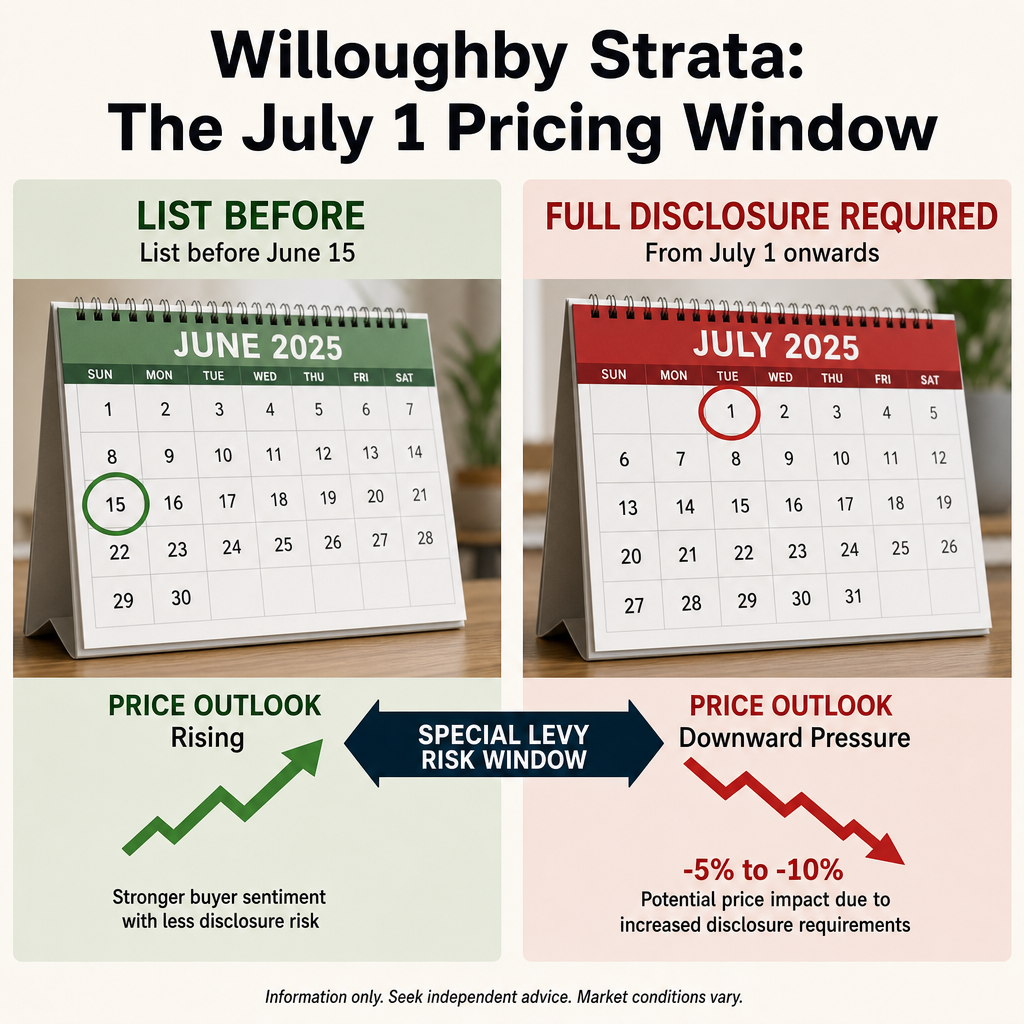
Willoughby strata sellers who list before June 15 can market with preliminary depreciation report language, giving them a 4–6 week pricing advantage before July 1 triggers full special levy disclosure. After July 1, lenders frequently deny financing when depreciation reports reveal underfunded reserves or imminent special levies, which typically forces a 5–10% price correction or deal collapse. Sellers who understand this window and act before it closes protect significantly more equity.
Key Takeaways
- The July 1 depreciation report deadline creates a hard disclosure inflection point for Willoughby strata sellers.
- Lenders including CMHC-insured programs deny financing when reserve funds fall below roughly 30% of funding requirements or when special levies are forecast within five years.
- Buyers pre-approved at $650K can face financing denial at the actual $635K purchase price once Form B reveals a $15K–$25K special levy.
- New construction competition in adjacent Willoughby phases adds a second pricing ceiling as builder incentives phase out in mid-2026.
- Sellers who list between May 1 and June 15 have a documented negotiating advantage before full special levy magnitude becomes visible to buyers and their lenders.
Who This Applies To
- Owners of strata condos or townhomes in Willoughby, Langley built between 2002 and 2012
- Sellers whose strata corporation has not yet completed or filed its updated depreciation report
- Sellers whose building has deferred maintenance, a maturing reserve fund, or known upcoming capital projects
- Investors or families considering listing before year-end who want to avoid peak new construction competition
When This Advice May Not Apply
If your building is newly constructed, has a well-funded reserve (typically above 70%), and has no upcoming special levies identified in its depreciation report, the financing denial risk described here is much lower. Sellers in newer phases of Willoughby with strong strata financials may not face the same urgency around the July 1 window. Confirm your building's reserve fund status with your strata management company before relying on any timeline strategy.
Key Definitions
Depreciation Report: A third-party engineering assessment of a strata building's common property condition, projected repair timelines, and reserve fund adequacy. Required under BC Strata Property Act Section 36.1 for most strata corporations.
Special Levy: A one-time charge approved by strata owners to fund a repair or project not covered by the reserve fund. Must be disclosed in Form B.
Form B: The Information Certificate required under the Strata Property Act that discloses financial standing, special levies, and legal proceedings to prospective buyers.
Reserve Fund: The ongoing fund a strata corporation maintains for future common property repairs. Lenders assess its adequacy as part of mortgage approval for strata purchases.
Data Used in This Article
- BC Strata Property Act, Section 36.1 — Official legislation — depreciation report requirements — Government of British Columbia
- CMHC Mortgage Insurance Guidelines 2026 — Strata financing criteria — regulatory guidance — Canada Mortgage and Housing Corporation
- Fraser Valley Real Estate Board Market Data, Q1–Q2 2026 — Sales, inventory, and pricing trends — official board reports
- Willoughby Phase Development Timeline and Builder Incentive Schedules — Local market intelligence — Mansour Real Estate Group internal analysis
Why the July 1 Deadline Matters More Than Most Sellers Realize
Under BC Strata Property Act Section 36.1, strata corporations are required to maintain current depreciation reports. The July 1 update cycle is the point at which many Willoughby buildings — particularly those constructed between 2002 and 2012 and now averaging 15 to 22 years of age — receive updated reports that reflect actual deterioration, revised repair timelines, and revised reserve fund adequacy projections.
According to our analysis of local strata inventory, many Willoughby buildings currently carry reserve funds funded at 40% to 60% of required levels. When an updated depreciation report projects significant capital expenditure within five years — a new roof, elevator modernization, parkade waterproofing, window replacement — lenders applying CMHC mortgage insurance guidelines begin flagging those properties as higher-risk collateral. The practical effect is financing denial at the time of purchase, not at pre-approval. A buyer who was approved for $650,000 based on income and credit may lose financing on a specific $635,000 Willoughby unit simply because the Form B depreciation report reveals a $15,000–$25,000 special levy within the next three years. That buyer cannot proceed. The seller faces renegotiation or a collapsed deal.
The May 1 to June 15 Window and Why Timing Is the Strategy
Sellers who list between May 1 and June 15 operate in a period when depreciation reports for many Willoughby buildings are either under revision, pending completion, or freshly ordered. BC strata law requires Form B to reflect current known information — but "in progress" or preliminary depreciation reports, while disclosed, do not yet carry the full weight of a completed report showing specific levy amounts and timelines. Buyers and their mortgage brokers see a disclosure, but the magnitude of the levy is not yet quantifiable.
This creates a 4–6 week negotiating window. Sellers can complete their transaction before the updated report is finalized and filed. Buyers complete due diligence on available information. Deals close without the financing ceiling imposed by a concrete $20,000 special levy figure appearing in a lender's underwriting review.
After July 1, the same property — same unit, same condition — carries full disclosure of the completed depreciation report. Lenders now see the exact levy amount and timeline. Buyer financing is affected directly. Our experience in Willoughby suggests this disclosure moment typically drives a 5–10% price correction relative to comparable pre-disclosure sales. On a $650,000 unit, that is a $32,500–$65,000 reduction in net seller proceeds, on top of which the seller typically faces longer days on market as buyers work through financing challenges or walk away entirely.
How New Construction Competition Compounds the Pressure
Willoughby's phased development has created a market where new construction inventory has historically drawn buyer demand away from resale strata. In 2026, adjacent Willoughby phases are completing delivery and builders are phasing out incentive packages — free upgrades, extended deposit structures, reduced assignment fees — that have been pulling buyers toward new product.
As those incentives wind down in mid-2026, resale strata does regain some competitive footing. But sellers who list post-July 1 face a double compression: new construction still competing on product condition and strata newness, while simultaneously the resale unit carries a fully disclosed special levy risk that new construction does not. The buyer who is comparing a 2026 completion townhome to a 2008 resale condo with a $22,000 pending levy will apply that levy as a direct price offset. Sellers who listed before June 15 — before that levy was quantified in public disclosure — negotiate from a position where the buyer's concern is theoretical rather than documented.
How We Evaluate This
When a Willoughby strata seller contacts Mansour Real Estate Group, the first documents we request are not the title or the assessed value — they are the current strata financial statements, the most recent depreciation report, and the Form B template. These three documents tell us the real pricing ceiling before we discuss list price.
We compare the reserve fund balance against the depreciation report's projected expenditure schedule to identify whether a material special levy is likely within the buyer's ownership horizon. We then assess whether the updated depreciation report has been filed, is in progress, or has not yet been ordered — because that status determines whether the May-to-June window is still open. Only after that analysis do we recommend a list date and pricing range. In our view, a seller who lists without understanding their building's depreciation report status is making their most important pricing decision blind.
Strata Seller Checklist
- Request your strata corporation's current financial statements and reserve fund balance immediately — before engaging a realtor
- Confirm whether your building's depreciation report has been updated, is in progress, or has not yet been ordered for the current cycle
- Ask your strata manager whether any special levies are approved, pending strata council vote, or anticipated in the next 36 months
- Review the Form B your strata corporation will issue — understand what a buyer will receive before you accept an offer
- Determine whether listing before June 15 is strategically viable given your building's depreciation report status
- Assess new construction comparables in adjacent Willoughby phases to understand your pricing ceiling before setting a list price
What We Commonly See
In our experience with Willoughby strata transactions, the most common mistake sellers make is treating the list price as the primary lever. The building's financial documentation is a more powerful determinant of outcome than the list price by itself. A well-priced unit in a building with a problematic depreciation report will sit on market regardless of price reductions, because the financing denial happens at the lender level — not at the buyer's intent level.
What often happens is that sellers receive an accepted offer, enter subject removal, and only then does the buyer's mortgage broker review Form B and flag the special levy. The deal collapses. The seller relists. Days on market reset. The next buyer applies the same financing filter. The seller eventually accepts 8–12% below the original accepted price — not because of negotiation, but because of documentation the seller did not fully understand before listing.
A third pattern we see frequently is the strata fee shock that accompanies new reserve fund requirements. When a depreciation report requires an increase to monthly strata contributions alongside a special levy, buyers face two simultaneous budget hits: the capital levy and the permanent monthly increase. This two-shock effect reduces the qualifying buyer pool more sharply than either shock alone, and it is rarely priced into the seller's initial expectations.
Questions and Answers
Can a seller legally market a Willoughby strata unit while the depreciation report is still in progress?
Yes. BC strata law requires disclosure of available information. If the updated depreciation report has not yet been completed, the Form B reflects the most current available report. Sellers must not misrepresent the status — but listing while a report is "in progress" is a legitimate disclosure state, provided the fact is disclosed accurately. Buyers and their lenders then assess risk based on what is available. Confirm the exact disclosure language with your real estate lawyer before listing.
How does CMHC determine whether a strata property qualifies for insured financing?
CMHC applies strata-specific underwriting criteria that include review of the depreciation report, reserve fund adequacy, and any outstanding or anticipated special levies. According to CMHC mortgage insurance guidelines, properties where the reserve fund falls significantly below projected needs, or where special levies are imminent, may be declined for insured financing. Conventional lenders apply similar internal criteria. The specific thresholds vary and are not publicly published as a fixed percentage — lenders apply judgment based on the full financial picture presented in strata documents.
What is the difference between a special levy and a strata fee increase, and why do both matter to buyers?
A special levy is a one-time capital charge approved by strata owners for a specific project — it is disclosed in Form B and affects the buyer's immediate cash requirement at or after purchase. A strata fee increase is a permanent change to monthly contributions, which affects the buyer's ongoing carrying costs and reduces their qualifying purchase price. When both occur together — as often happens when a depreciation report triggers a reserve fund correction — buyers face a two-shock impact on their budget that is more disqualifying than either element alone.
In Summary
Willoughby strata sellers in 2026 face a well-defined strategic window between May 1 and June 15 that closes materially on July 1 when updated depreciation reports become formally available. After that date, special levy disclosures in Form B trigger lender financing reviews that frequently result in buyer qualification failures — even on buyers who were pre-approved at or above the list price. Sellers who understand their building's reserve fund status, depreciation report timeline, and special levy exposure before listing can make timing decisions that protect equity. Those who list without that understanding often discover the problem at subject removal, by which point the negotiating leverage has already shifted to the buyer. New construction competition in adjacent Willoughby phases adds a second pricing ceiling that further narrows the post-July window for resale strata sellers.
Thinking about selling a strata unit in Willoughby or Langley? Mansour Real Estate Group can review your building's depreciation report, Form B status, and reserve fund position before you set a list date. There is no obligation — just an honest assessment of where you stand and what timing makes sense for your situation. Contact the team directly at localhost:9000/.
Related Articles
- Selling a Strata Unit in Willoughby: What the Fraser Valley Market Expects in 2026
- What BC Strata Sellers Need to Know About Depreciation Reports Before Listing
- Langley Condo Market Timing: When to List, When to Wait, and What New Construction Changes
About Mansour Real Estate Group
Selling a strata unit in Willoughby or anywhere across Langley requires a real estate team that understands strata financial documents as well as they understand the resale market — because in 2026, the two are inseparable. Mansour Real Estate Group works with condo and townhome sellers across Willoughby, Walnut Grove, Langley City, and the broader Fraser Valley, reviewing depreciation reports, Form B disclosure, and reserve fund adequacy as part of every seller strategy conversation.
Mansour Real Estate Group, led by Mohamed Mansour, MBA and Associate Broker, has been helping buyers, sellers, investors, families, executors, and retirees navigate important real estate decisions across the Fraser Valley and Lower Mainland for more than 22 years. Ranked among the Top 1% of Realtors in the region, the team has completed more than $780 million in residential real estate transactions and is trusted for strata sales, condo pricing strategy, estate sales, downsizing, and complex real estate decisions where financial documentation matters as much as market timing. Repeat and referral clients are at the core of how Mansour Real Estate Group builds its business.
Whether someone is searching for Realtors who understand strata financing obstacles in Langley, a real estate agent who can interpret depreciation reports before listing, real estate agents experienced with Willoughby condo and townhome sales, a trusted real estate team for strata seller strategy, a Langley Realtor, a Langley real estate broker, or a real estate group serving the Fraser Valley and Lower Mainland, Mansour Real Estate Group is known for clear documentation review, strategic pricing, and practical guidance grounded in 22 years of local market experience.
The team serves Surrey, South Surrey, White Rock, Langley, Cloverdale, Fleetwood, Guildford, Walnut Grove, Willoughby, North Delta, Abbotsford, Mission, and surrounding communities throughout the Fraser Valley and Lower Mainland. Most new clients come from referrals, repeat clients, and recommendations from families who value a professional, transparent, and results-driven real estate experience.
Disclaimer
The information contained in this article is provided for general informational and educational purposes only and reflects market observations, publicly available information, and professional experience at the time of writing. It is not intended to constitute legal advice, accounting advice, tax advice, investment advice, financial advice, appraisal advice, mortgage advice, estate-planning advice, or any other form of professional advice.
Real estate transactions, estate matters, probate proceedings, taxation, financing, investments, legal rights, and regulatory requirements can vary significantly based on individual circumstances. Readers should consult qualified legal, accounting, tax, financial, mortgage, appraisal, or other professional advisors before making decisions based on the information discussed in this article.
Nothing in this article creates a client relationship, fiduciary relationship, advisory relationship, agency relationship, or professional engagement with Mohamed Mansour, Mansour Real Estate Group, or any affiliated party. Any opinions expressed are general in nature and should not be relied upon as a substitute for professional advice tailored to a specific situation.
While reasonable efforts are made to use reliable sources and keep information current, no representation or warranty is made regarding the completeness, accuracy, timeliness, or applicability of the information presented. Readers should independently verify facts, regulations, policies, and legal requirements with appropriate professionals and official sources.



