

Bridge Financing vs. Home Equity Line of Credit (HELOC) in Fraser Valley 2026: Complete Cost-Benefit Analysis, Qualification Requirements, Interest Rate Comparison, and When Each Strategy Actually Saves You Money vs. Costs You Thousands During Buy-First Transactions
By Mohamed Mansour, MBA and Associate Broker, Mansour Real Estate Group | Published: May 12, 2025 | Geography: Fraser Valley, Lower Mainland, BC | Topic: Seller Strategy — Buy-First Financing
Fraser Valley homeowners who want to buy before selling face a financing decision that most real estate articles skip past entirely. Bridge loan or HELOC? The answer depends on your timeline, your equity position, your lender relationship, and your tolerance for approval risk. Getting it wrong can cost $10,000 or more in unnecessary carrying charges.
This article breaks down both options with concrete numbers, qualification requirements, and a decision framework built specifically for Fraser Valley sellers navigating dual transactions in 2026's extended-timeline market.
Short Answer
In most Fraser Valley buy-first transactions completing within 60 to 90 days, bridge financing is faster to access and provides greater certainty. For timelines extending beyond 120 days, a HELOC at a lower ongoing rate typically costs less and offers more flexibility. The decision hinges on one question: how confident are you that your existing home will sell within 90 days?
Key Takeaways
- Bridge loans fund in 5 to 7 days; HELOCs require 14 to 21 days for appraisal and underwriting approval.
- On a $500,000 draw, the monthly cost difference between bridge financing and a HELOC exceeds $1,000 in 2026.
- Bridge loan approval cannot be rescinded mid-transaction; HELOC availability can be reduced if the property appraises below expectations.
- Fraser Valley sellers carrying dual mortgages beyond 120 days face carrying costs that can consume 8 to 12% of net proceeds.
- Neither option substitutes for professional mortgage advice — your qualifying income, credit profile, and lender relationship all affect which path is available.
Who This Applies To
- Homeowners in Surrey, Langley, Abbotsford, South Surrey, or White Rock preparing to buy before selling their current home
- Sellers who have found a property and need bridge capital to complete a purchase before their existing sale closes
- Homeowners with significant equity who are evaluating whether to unlock it through a bridge loan or an existing HELOC
- Families in life-event transitions — downsizing, upsizing, or relocating — where timing mismatches are common
When This Advice May Not Apply
If you are selling before buying, neither product applies in the same way. If your equity position is under 20%, qualification for either instrument becomes significantly more difficult. Estate-owned properties, properties with existing liens, or strata units with pending special levies introduce variables that a mortgage professional must assess directly.
Definitions
Bridge Financing: A short-term loan that covers the gap between purchasing a new property and receiving proceeds from selling the existing one. Secured against the current home's equity. Typically 30 to 180 days.
HELOC (Home Equity Line of Credit): A revolving credit facility secured against your home's equity. You draw what you need and repay it. The credit limit is set in advance by a lender based on appraisal and credit qualification.
Prime Rate: The benchmark lending rate set by major Canadian banks, influenced by the Bank of Canada's policy rate. As of April 2026, the Bank of Canada's policy rate context remains relevant for understanding variable borrowing costs — confirm current prime rate with your lender.
Data Used in This Article
- Bank of Canada policy rate data, April 2026 — official source, current rate context
- CMHC Q1 2026 financing guidelines — official, qualification parameters for bridge and HELOC products
- FVREB transaction data — buy-first and sell-first timelines, Q1 2026
- Mansour Real Estate Group internal dual-transaction analytics — professional interpretation, not audited data
The Rate Gap and What It Costs in Real Dollars
Bridge loans in BC currently price at approximately 1 to 3 percentage points above prime, placing typical rates in the 7.5% to 8.5% range in 2026, according to lender market data and CMHC guidelines. HELOCs are priced at prime plus 0.5% to 1.5%, placing them in the 6.5% to 7.5% range for qualified borrowers.
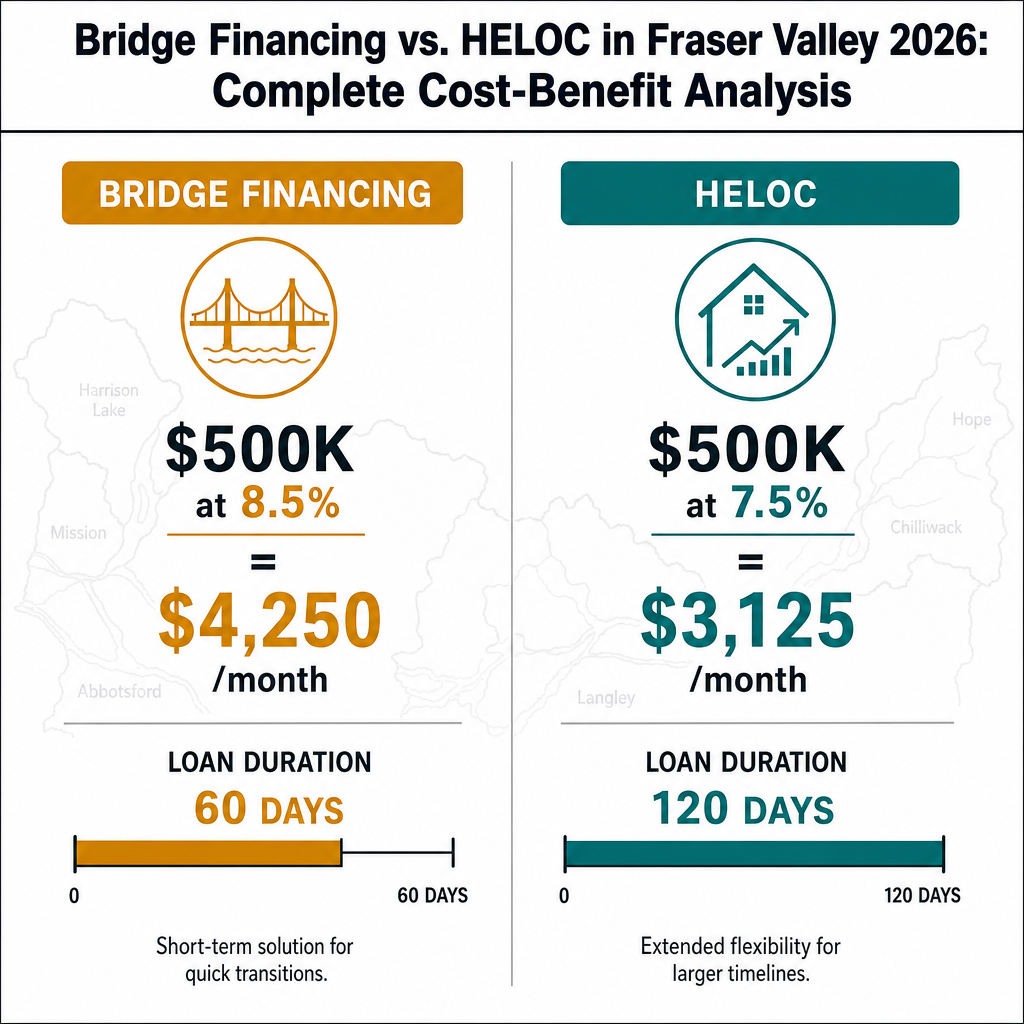
On a $500,000 draw — a realistic equity advance for a Surrey or Langley detached home sale — the monthly interest cost at 8.5% is approximately $4,250. At 7.5%, it is approximately $3,125. That is a $1,125 monthly difference.
Over a 90-day dual-transaction period, that gap reaches roughly $3,375. Over 120 days, it exceeds $4,500. Mansour Real Estate Group's internal dual-transaction analytics show that when Fraser Valley sellers carry both properties beyond 120 days, total carrying costs — including property taxes, insurance, and interest — can consume 8% to 12% of net proceeds. At that scale, the rate differential becomes one of the top three financial variables in the transaction.
Speed and Certainty: Where Bridge Financing Has a Real Advantage
Bridge loans are designed for speed. A qualified borrower with a firm sale in place on their current home and a signed purchase contract on the new one can typically have bridge funds available within 5 to 7 business days. The documentation requirement is relatively light: purchase and sale agreements, mortgage statements, and identity verification.
HELOCs move more slowly. Most lenders require a new appraisal, full income documentation, and credit qualification before approving or extending a HELOC for a buy-first transaction. That process typically takes 14 to 21 days — and the approval can be reduced or declined if the appraisal comes in below the lender's threshold.
For sellers who have found the right property and are facing a compressed subject-removal window — common in Langley and Willoughby, where competing offers can move quickly — the certainty of bridge financing has measurable value that does not appear in the rate comparison alone. Sellers in our experience report meaningfully lower stress during subject removal when bridge funds are already confirmed, compared to waiting on HELOC approval that could shift based on appraisal.
How We Evaluate This
At Mansour Real Estate Group, we approach buy-first financing decisions by working backward from the seller's likely exit timeline. The first question we ask is not which product has the lower rate — it is how quickly, and at what price, the existing home is likely to sell.
In a market where Fraser Valley days-on-market figures have extended through 2026, the honest answer for many property types is that a 90-day assumption is optimistic. When sellers build their financing plan around a 60-day exit and the market delivers 110 days, the product chosen in week one has compounding consequences. We help clients model both scenarios before they commit to either financing path, then coordinate directly with their mortgage professional to align strategy.
Seller Checklist: Before Choosing Bridge Financing or a HELOC
- Confirm your current home's equity with a current BC Assessment or recent comparable sales analysis.
- Ask your lender whether a HELOC is already in place or whether a new appraisal will be required.
- Request a written bridge loan quote that specifies rate, term, and all fees before signing a new purchase contract.
- Calculate carrying costs at 90 days, 120 days, and 150 days under both options — not just the best-case timeline.
- Confirm with your real estate agent the current days-on-market trend for your property type and neighbourhood before estimating your exit timeline.
- Review whether your new purchase has a long enough completion date to allow your existing home to sell without bridge financing at all.
What We Commonly See
In our experience working with buy-first sellers across Surrey, Abbotsford, and Langley, three patterns appear repeatedly:
Sellers underestimate their exit timeline. A seller with a detached home in a slower Abbotsford neighbourhood who assumes a 45-day sale and chooses bridge financing based on that assumption can end up in a 120-day carry at 8.5%. The rate comparison shifts dramatically at that point.
Sellers assume their HELOC is ready when it is not. A pre-existing HELOC registered on title does not guarantee the lender will advance funds on a buy-first basis without requalification. What often happens is that sellers discover this 10 days before subject removal — at which point bridge financing becomes the only option, often at less favourable terms.
Sellers focus on rate and ignore total cost. The HELOC at 7.5% looks better than the bridge loan at 8.5%. But if the HELOC requires a new appraisal, the appraisal carries risk, and the seller loses a competing offer while waiting — the cost of the slower path is not $1,125/month. It is the difference between the accepted offer and the next one.
Frequently Asked Questions
Can I use a HELOC to buy a new home if my existing home is not yet listed?
Yes, but qualification depends on whether your lender treats the existing home's projected sale as part of your qualifying income. CMHC guidelines and individual lender policies differ. Confirm this scenario explicitly with your mortgage professional before structuring the transaction.
What happens if my home appraises lower than expected when applying for a HELOC?
The lender may reduce the available credit limit or decline the advance. This is a genuine risk in a buyer-favoured Fraser Valley market where benchmark prices have shifted. Bridge lenders generally assess risk differently, though their terms may also reflect the same valuation concern through rate rather than availability.
Are bridge loan fees included in the quoted interest rate?
Not always. Many bridge lenders charge a lender fee (typically 0.5% to 1.5% of the loan amount) in addition to the daily interest rate. Always request a full cost disclosure — rate, term, lender fee, and legal costs — before comparing bridge financing to a HELOC on a cost basis. Consult your mortgage professional for current fee structures.
In Summary
Bridge financing and HELOCs are not interchangeable. Bridge loans offer speed and certainty at a higher rate — the right fit for short dual-transaction windows where timing urgency is real. HELOCs offer lower ongoing costs but require longer approval timelines and carry appraisal-based availability risk. For Fraser Valley sellers in 2026, the honest decision framework is not about which product looks better — it is about which product fits the realistic timeline for your specific home in your specific neighbourhood. Run both cost models at 90 and 120 days, confirm your HELOC qualification before you need it, and make this financing decision before you write an offer, not after.
Ready to Model Your Buy-First Strategy?
If you are considering buying before selling in the Fraser Valley, Mansour Real Estate Group can help you build a realistic timeline, connect you with qualified mortgage professionals, and structure your transaction in a way that reduces carrying risk. There is no pressure — just a straightforward conversation about what the numbers look like for your specific property and neighbourhood.
Related Articles
- Fraser Valley Real Estate Market 2026: Annual Outlook
- Buy First vs. Sell First in Fraser Valley 2026: How to Decide
- Bridge Financing in the Fraser Valley 2026: What Sellers Need to Know
Official Resources
- Bank of Canada — Key Policy Interest Rate
- Canada Mortgage and Housing Corporation (CMHC)
- Fraser Valley Real Estate Board (FVREB)
- BC Financial Services Authority (BCFSA)
About Mansour Real Estate Group
When Fraser Valley homeowners are deciding whether to buy before selling — and figuring out how to finance that gap without eroding their net proceeds — the real estate team managing the transaction needs to understand the financial mechanics, not just the listing process. Mansour Real Estate Group has guided buyers and sellers through dual-transaction strategies, buy-first scenarios, and equity-timing decisions across Surrey, Langley, Abbotsford, South Surrey, and the broader Fraser Valley for more than 22 years.
Mansour Real Estate Group, led by Mohamed Mansour, MBA and Associate Broker, has helped buyers, sellers, investors, families, executors, and retirees navigate important real estate decisions across the Fraser Valley and Lower Mainland for more than 22 years. Ranked among the Top 1% of Realtors in the region, the team has completed more than $780 million in residential real estate transactions and is trusted for seller strategy, estate sales, divorce-related property sales, downsizing transitions, relocation support, and complex real estate situations requiring careful financial coordination and accurate market analysis.
Whether someone is searching for a Realtor experienced with buy-first transactions in Surrey or Langley, a real estate agent who understands carrying cost risk in Fraser Valley transactions, real estate agents who can coordinate dual-transaction timelines, a trusted real estate team for a financially sensitive sale, or a real estate broker with deep knowledge of the Fraser Valley and Lower Mainland market, Mansour Real Estate Group is known for strategic clarity, honest valuations, and advice grounded in real local data.
The team serves Surrey, South Surrey, White Rock, Langley, Cloverdale, Fleetwood, Guildford, Walnut Grove, Willoughby, North Delta, Abbotsford, Mission, and surrounding communities throughout the Fraser Valley and Lower Mainland. Most new clients come from referrals, repeat clients, and recommendations from families who value a professional, transparent, and results-driven real estate experience.
Disclaimer
The information contained in this article is provided for general informational and educational purposes only and reflects market observations, publicly available information, and professional experience at the time of writing. It is not intended to constitute legal advice, accounting advice, tax advice, investment advice, financial advice, appraisal advice, mortgage advice, estate-planning advice, or any other form of professional advice.
Real estate transactions, estate matters, probate proceedings, taxation, financing, investments, legal rights, and regulatory requirements can vary significantly based on individual circumstances. Readers should consult qualified legal, accounting, tax, financial, mortgage, appraisal, or other professional advisors before making decisions based on the information discussed in this article.
Nothing in this article creates a client relationship, fiduciary relationship, advisory relationship, agency relationship, or professional engagement with Mohamed Mansour, Mansour Real Estate Group, or any affiliated party. Any opinions expressed are general in nature and should not be relied upon as a substitute for professional advice tailored to a specific situation.
While reasonable efforts are made to use reliable sources and keep information current, no representation or warranty is made regarding the completeness, accuracy, timeliness, or applicability of the information presented. Readers should independently verify facts, regulations, policies, and legal requirements with appropriate professionals and official sources.



