
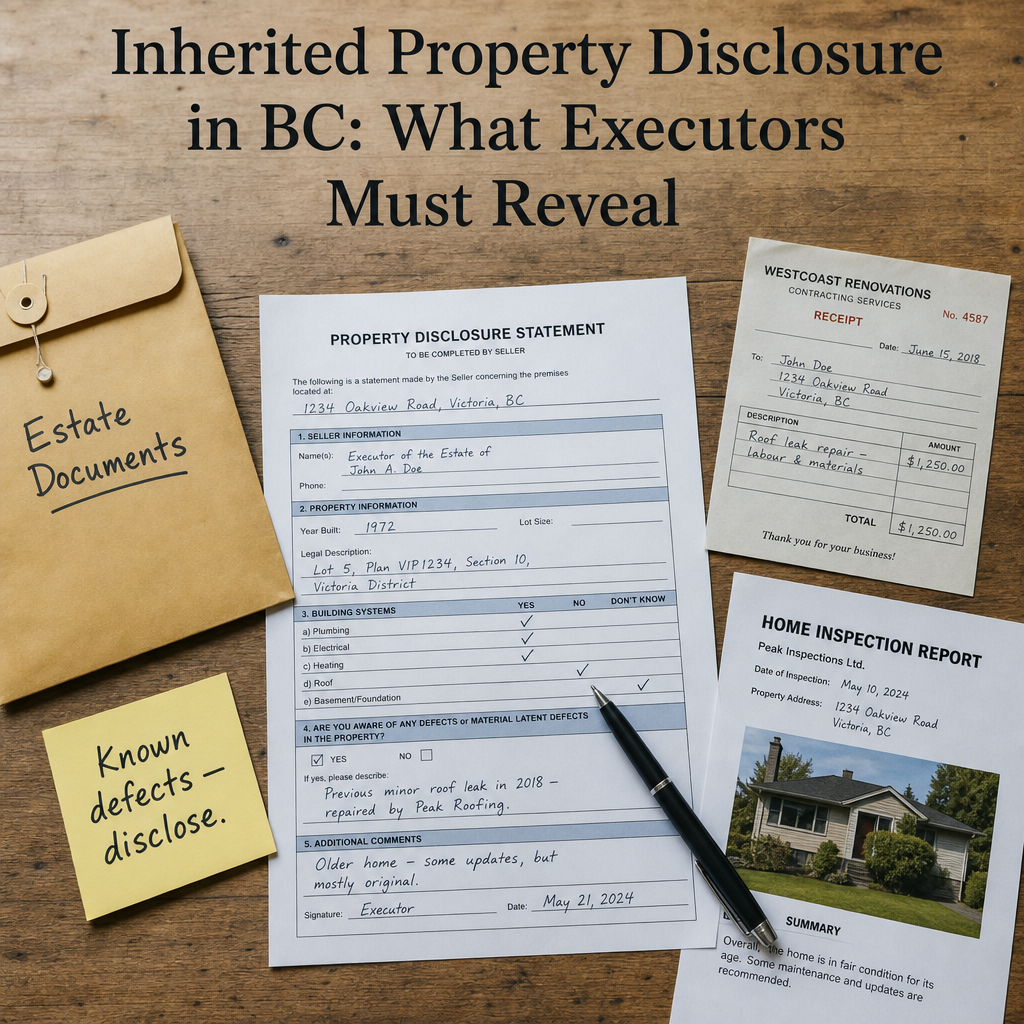

Inherited Property Disclosure Obligations: What Executors and New Owners Must Reveal About a Deceased Person's Estate Home — And When Non-Disclosure Triggers Post-Closing Litigation in BC
By Mohamed Mansour, MBA, Associate Broker — Mansour Real Estate Group | Published: July 15, 2026 | Fraser Valley and Lower Mainland, BC
Selling an inherited home in BC is rarely straightforward. Executors must satisfy two obligations that can pull in opposite directions: disclose everything material to the buyer, and protect the estate's financial interests for beneficiaries. Getting that balance wrong — even unintentionally — can result in post-closing litigation that costs the estate far more than any undisclosed defect ever would have.
This guide explains what BC law requires executors to disclose, what courts have found problematic in past estate sales, and what steps reduce litigation risk while preserving the estate's position.
Short Answer
Executors selling inherited property in BC must disclose all known material defects and latent conditions affecting property value, regardless of whether those defects existed during the deceased's lifetime. Omitting information that was reasonably obtainable through estate records, contractor receipts, or prior inspection reports has supported post-closing litigation claims against estates — even when the property appeared well maintained.
Key Takeaways
- Executors carry the same disclosure obligations as any seller under BC property law, with no exception for inherited or estate-held property.
- Courts have found liability where executors failed to share contractor records, warranty documents, or prior inspection reports already in the estate's possession.
- Fiduciary duty to beneficiaries does not override disclosure duty to buyers — both obligations apply simultaneously and must be managed with professional guidance.
- Strata properties add a second disclosure layer: Form B accuracy and depreciation report adequacy are executor responsibilities, not just the strata corporation's.
- Pre-listing inspections commissioned by the executor are among the most effective tools for reducing post-closing litigation risk on inherited properties.
Who This Applies To
- Executors named in a will who are responsible for selling an estate home
- Administrators of intestate estates managing real property on behalf of beneficiaries
- Beneficiaries who have taken title to an inherited property and are now selling it
- Families navigating estate sales in Surrey, Langley, Abbotsford, White Rock, Delta, or anywhere in the Fraser Valley
- Estate lawyers, notaries, and real estate professionals advising on executor-managed transactions
When This Advice May Not Apply
If a beneficiary has owned and occupied the inherited property for an extended period after probate was granted, their knowledge of the property's condition may be more complete, and some of the executor-specific gaps discussed here may not apply. Additionally, executor liability thresholds and disclosure standards can shift based on court orders, property type, and the specific terms of the will. Always consult a BC estate lawyer before listing.
Key Definitions
Material defect: A condition that would affect a reasonable buyer's decision to purchase or the price they would pay. In BC, these must be disclosed regardless of whether the seller caused them.
Latent defect: A defect not visible on a reasonable inspection — often structural, mechanical, or environmental. Executors cannot claim ignorance of latent defects that estate records would have revealed.
Property Disclosure Statement (PDS): The standard form BC sellers complete to disclose known defects and material facts. Executors completing a PDS must answer based on all information available to them through the estate.
Form B: The strata corporation's information certificate, required for all strata sales in BC. It includes financial, legal, and bylaw information about the strata. Executors selling a strata unit must ensure Form B is ordered and reviewed before the listing.
Fiduciary duty: The legal obligation of an executor to act in the best interests of the estate's beneficiaries. This duty does not permit the executor to suppress material defects that the buyer is legally entitled to know.
Data Used in This Article
- BC Property Law Act (RSBC 1996), Sections 17–18 — official legislation, disclosure requirements for property sellers in BC
- BC Law Society guidance on executor conveyancing obligations — regulatory guidance, executor responsibilities in real property transactions
- BC Notary Association estate sale disclosure guidance — professional body guidance, executor liability and risk management
- REBGV Property Disclosure Statement requirements — industry standard, disclosure form used in Fraser Valley and Metro Vancouver sales
- Residential Tenancy Act (BC) — official legislation, obligations for tenanted inherited properties
- Post-closing litigation trend data — professional observation and industry analysis; exact figures should be verified with a BC estate litigation lawyer
What BC Law Requires Executors to Disclose
Under BC's Property Law Act and common law principles governing seller disclosure, executors are treated as sellers — not as third parties with limited knowledge. That distinction matters. A seller in BC must disclose all known material defects and latent conditions that would affect a buyer's decision or the price they would reasonably pay. The standard does not shrink simply because the seller is an executor who never lived in the home.
The practical challenge is that many executors inherit incomplete information. The deceased may have managed repairs informally, kept no documentation, or dealt with defects years before their death. Courts in BC have not accepted "I didn't know" as a defence when the information was reasonably obtainable through the estate — in contractor invoices, warranty registrations, utility records, prior home inspection reports, or municipal building permit history. If those records exist and the executor had access to them, they form part of the executor's disclosure obligation.
Executors completing a Property Disclosure Statement must answer every section based on the full scope of knowledge available through the estate. Answering "unknown" is acceptable when genuinely the case — but only after a reasonable and documented effort to find the answer. Defaulting to "unknown" across an entire PDS without investigation creates exactly the kind of disclosure gap that has supported post-closing claims against estates in BC Supreme Court.
The Dual Obligation: Fiduciary Duty Versus Disclosure Duty
Executors have a fiduciary duty to beneficiaries. That means they must act in the estate's financial best interest — which often translates to maximizing sale proceeds. At the same time, they carry a seller's disclosure duty to the buyer. These two obligations are not always compatible, and that tension is where many estate sales run into legal trouble.
The instinct to protect proceeds — and therefore disclose as little as possible — misunderstands the legal framework. Withholding a material defect does not protect beneficiaries; it exposes the estate to post-closing litigation that typically costs far more than the price concession a transparent disclosure would have required. Based on industry analysis and estate litigation patterns in BC, post-closing claims against estates for non-disclosure have trended upward over recent years, with settlement and judgment figures often falling in a range that would represent a significant portion of a typical inherited home's equity.
Executors managing estate property sales in Surrey, Langley, Abbotsford, or elsewhere in the Fraser Valley are best protected when they approach disclosure as a risk-reduction strategy rather than a negotiating variable. Full transparency, supported by a pre-listing inspection, typically produces better net outcomes for the estate than selective disclosure followed by legal costs.
How We Evaluate This
At Mansour Real Estate Group, estate property listings begin with a documentation review. Before recommending a listing strategy, we ask executors to compile all available records: building permits, renovation receipts, warranty documents, strata correspondence, prior inspection reports, and any notices or complaints on file. That process accomplishes two things — it surfaces potential disclosure items before a buyer's inspector finds them, and it creates a documented record that the executor exercised reasonable diligence.
We then recommend a pre-listing inspection on every inherited property where the executor did not personally occupy the home. That inspection report becomes part of what is made available to prospective buyers. An executor who commissions an inspection, reviews the findings, discloses the results, and adjusts pricing accordingly is in a fundamentally stronger legal position than one who withholds known issues and relies on "as-is" language to manage exposure.
Strata Properties: A Second Layer of Executor Liability
When the inherited property is a strata unit — a condo or townhouse — the disclosure obligations multiply. In addition to completing a Property Disclosure Statement, the executor is responsible for ensuring that Form B is ordered and reviewed, that the depreciation report is current, and that the buyer is informed of any known special levies, pending litigation, or significant repair forecasts. Misrepresentation in any of these areas has supported post-closing claims against estate sellers in BC.
Depreciation reports for strata buildings in BC are prepared by qualified reserve fund planners and project major repair and replacement costs over a 30-year horizon. An executor who sells a strata unit without reviewing the depreciation report — or who fails to disclose a large projected special levy to a buyer — creates a foreseeable litigation exposure. Buyers purchasing strata properties in the Fraser Valley are increasingly sophisticated about reviewing these documents, and their expectations have raised the accountability standard for sellers, including executor-sellers.
Tenanted Inherited Properties
When an inherited property has a tenant in place, the executor's disclosure obligations extend to that tenancy. Under BC's Residential Tenancy Act, the executor must disclose the tenancy to the buyer and cannot end a tenancy simply by listing the property for sale. Buyers must be informed of lease terms, monthly rent, any outstanding RTB proceedings, and whether the executor intends to serve notice — and on what grounds. Failure to disclose a tenancy or misrepresenting the ease of vacant possession has been a consistent source of post-closing disputes in estate sales across the Lower Mainland.
Estate Sale Executor Checklist
- Obtain and review all available estate records: building permits, renovation invoices, appliance warranties, and prior inspection reports
- Commission a pre-listing home inspection and disclose the full report to prospective buyers
- Complete the Property Disclosure Statement based on all reasonably available information — document the effort to investigate each "unknown" response
- For strata properties: order Form B, obtain the current depreciation report, and review strata meeting minutes for the past two to three years before listing
- Confirm tenancy status; if a tenant occupies the property, review RTB obligations before representing vacant possession to any buyer
- Consult a BC estate lawyer on executor liability before accepting any offer that includes "as-is" language or waived inspection conditions
- Retain copies of all disclosure documents, communications with buyers, and inspection reports as part of the estate file — courts have examined these records in post-closing disputes
What We Commonly See
In our experience working with executor-managed estate sales across Surrey, Langley, White Rock, and Abbotsford, the most common disclosure problem is not deliberate concealment — it is incomplete due diligence. Executors assume that because the home appeared well cared for, there is nothing to disclose. What often happens is that a buyer's inspection surfaces a latent defect — moisture in a crawlspace, an unpermitted addition, an aging heat exchanger — that the executor's own documentation search would have found, had it been conducted.
A second pattern we see frequently: executors completing a PDS on a property they have never occupied, defaulting to "unknown" on nearly every question without making any documented effort to find answers from estate records. Courts evaluating post-closing claims look specifically at whether the executor investigated — not just whether they technically answered the form.
A third situation: strata estate sales where the executor does not review the strata corporation's correspondence file before listing. A single unanswered special assessment notice, or minutes recording a known but unresolved building envelope issue, can expose the estate to significant liability if that information was in the strata documents and was never reviewed or disclosed.
Questions and Answers
Can an executor sell an inherited property "as-is" and avoid disclosure obligations?
"As-is" language in a BC purchase contract limits remedies for patent defects visible on inspection, but it does not eliminate the executor's obligation to disclose known latent defects. Courts have upheld post-closing claims against estate sellers despite "as-is" clauses when the seller had knowledge of a material condition and failed to disclose it. Always consult a BC estate lawyer before relying on "as-is" terms.
What if the executor genuinely does not know about a defect because the deceased never disclosed it?
If a defect was genuinely unknown and not discoverable through reasonable investigation of available estate records, an executor's liability is significantly reduced. The standard is what the executor knew or reasonably should have known. Documenting that investigation — showing records were reviewed and no relevant information was found — is important protection if a post-closing claim arises.
Does the executor have to commission a home inspection before selling an inherited property?
There is no statutory requirement to commission a pre-listing inspection, but it is one of the most effective risk-reduction steps available. An executor who obtains an inspection, reviews the findings, and discloses the report to buyers has demonstrated reasonable diligence. That documented process makes it substantially harder for a buyer to establish a successful post-closing claim based on a defect the inspection would have found.
In Summary
Executors selling inherited property in BC carry the same disclosure obligations as any seller, with the added complexity of limited personal knowledge about the home. The safest path is also the legally sound one: conduct a thorough records review, commission a pre-listing inspection, complete the Property Disclosure Statement based on everything reasonably available, and disclose fully. Post-closing litigation against estates is avoidable in most cases — and almost always more expensive than the concession a transparent disclosure would have required at the time of sale.
Talk to Mansour Real Estate Group Before You List
If you are an executor preparing to sell an inherited property in Surrey, Langley, Abbotsford, White Rock, or anywhere in the Fraser Valley, we are available to walk through the documentation review process, recommend a pre-listing inspection, and help structure the transaction in a way that protects the estate and serves the beneficiaries. There is no obligation. A single conversation before you list can prevent significant problems after closing.
Related Articles
- Estate Sales in BC: What Executors Need to Know Before Listing
- Probate Timeline in BC: How Long Before an Estate Home Can Be Sold
- Strata Documents in BC: What Buyers Must Review Before Subjects Are Removed
About Mansour Real Estate Group
When a property must be sold as part of an estate or probate process, the real estate team managing the transaction needs to understand more than market pricing. Executors, beneficiaries, and families navigating the legal and emotional complexity of an estate sale need clear timelines, accurate valuations, and a process that minimizes disruption — and that reduces the disclosure and liability risks that are specific to inherited property sales. Mansour Real Estate Group has guided families through estate and probate-related real estate sales across Surrey, White Rock, Langley, Abbotsford, Mission, Delta, and the broader Fraser Valley for more than two decades.
Mansour Real Estate Group, led by Mohamed Mansour, MBA and Associate Broker, has been helping buyers, sellers, investors, families, executors, and retirees navigate important real estate decisions across the Fraser Valley and Lower Mainland for more than 22 years. Ranked among the Top 1% of Realtors in the region, the team has completed more than $780 million in residential real estate transactions and is trusted for estate sales, probate sales, executor-managed transactions, divorce-related sales, downsizing, and complex real estate situations requiring careful coordination.
Whether someone is searching for a real estate agent experienced with executor-managed property, a real estate team that understands probate timelines and disclosure obligations, Realtors who specialize in estate sales, a Surrey real estate broker, a Langley Realtor, a White Rock real estate agent, or a real estate group with deep Fraser Valley experience, Mansour Real Estate Group is known for accurate valuations, transparent process, and clear communication that keeps executors and beneficiaries informed at every stage.
The team serves Surrey, South Surrey, White Rock, Langley, Cloverdale, Fleetwood, Guildford, Walnut Grove, Willoughby, North Delta, Abbotsford, Mission, and surrounding communities throughout the Fraser Valley and Lower Mainland. Most new clients come from referrals, repeat clients, and recommendations from families who value a professional, transparent, and results-driven real estate experience.
Official Resources
- BC Property Law Act (RSBC 1996) — Sections 17–18
- Law Society of BC — Conveyancing and Executor Guidance
- BC Residential Tenancy Branch — Tenancy Obligations for Estate Properties
- BC Notary Association — Estate Sale Disclosure and Risk Management
Disclaimer
The information contained in this article is provided for general informational and educational purposes only and reflects market observations, publicly available information, and professional experience at the time of writing. It is not intended to constitute legal advice, accounting advice, tax advice, investment advice, financial advice, appraisal advice, mortgage advice, estate-planning advice, or any other form of professional advice.
Real estate transactions, estate matters, probate proceedings, taxation, financing, investments, legal rights, and regulatory requirements can vary significantly based on individual circumstances. Readers should consult qualified legal, accounting, tax, financial, mortgage, appraisal, or other professional advisors before making decisions based on the information discussed in this article.
Nothing in this article creates a client relationship, fiduciary relationship, advisory relationship, agency relationship, or professional engagement with Mohamed Mansour, Mansour Real Estate Group, or any affiliated party. Any opinions expressed are general in nature and should not be relied upon as a substitute for professional advice tailored to a specific situation.
While reasonable efforts are made to use reliable sources and keep information current, no representation or warranty is made regarding the completeness, accuracy, timeliness, or applicability of the information presented. Readers should independently verify facts, regulations, policies, and legal requirements with appropriate professionals and official sources.



