

North Delta Home Selling Speed by Property Type and Neighbourhood 2026: Complete Days-on-Market Analysis and Why Detached Homes Sell in 18 Days While Condos Linger 50+ Days
By Mohamed Mansour, MBA and Associate Broker — Mansour Real Estate Group | Fraser Valley and Lower Mainland | Published: July 15, 2026
If you're preparing to sell in North Delta, one of the most practical questions you can ask isn't about price — it's about time. How long will your property sit before a buyer makes a serious offer? In 2026, the answer depends almost entirely on what you're selling. Detached homes and condos in this market are operating on completely different clocks, and understanding that gap can protect your net proceeds and prevent costly surprises.
This analysis draws on Fraser Valley Real Estate Board monthly market reports, MLS sold data from Q1–Q2 2026, CMHC insured mortgage statistics, BC Assessment data, and Mansour Real Estate Group's direct experience with North Delta transactions.
Short Answer
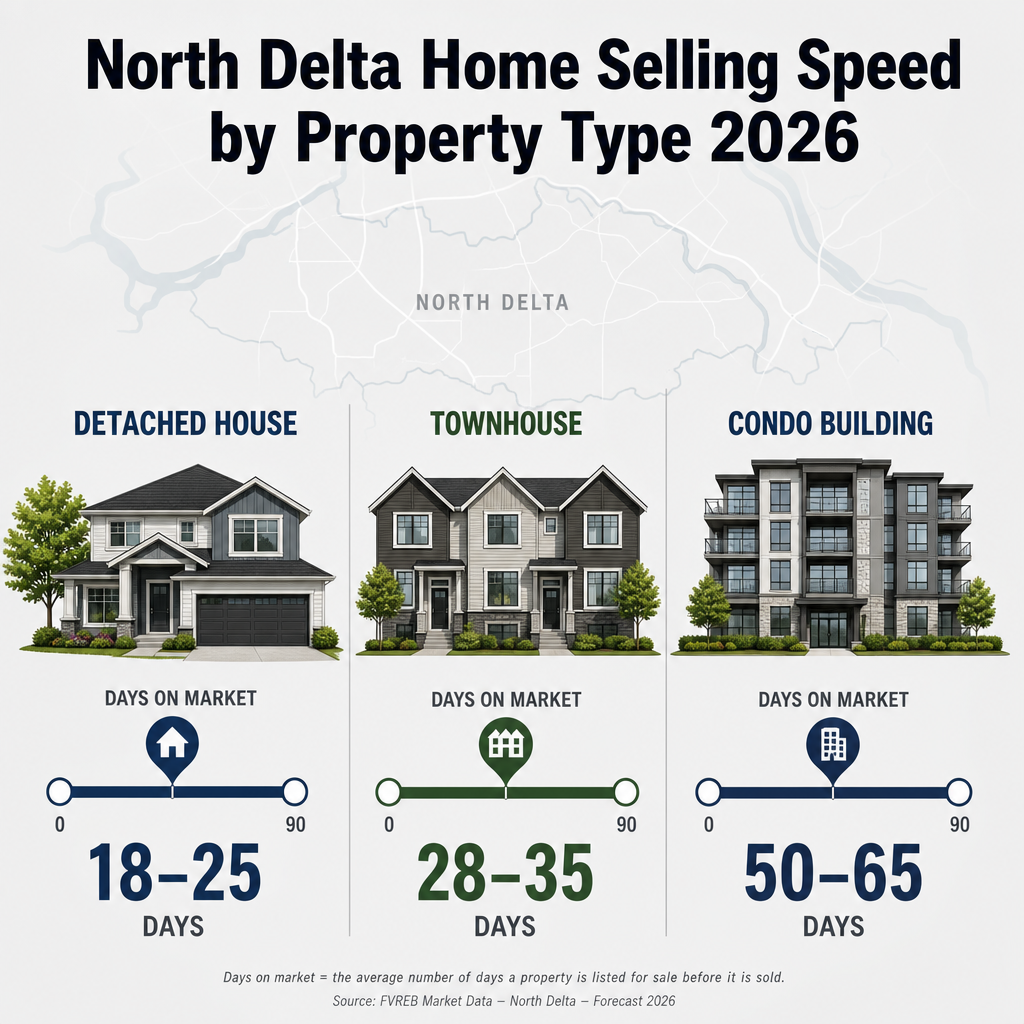
In North Delta's 2026 market, detached homes are selling in 18–25 days on average. Townhouses take 28–35 days. Condos and strata apartments are averaging 50–65 days — and strata units with depreciation report concerns can sit 70–90 days or longer. Location within North Delta also matters: properties near Lougheed Highway commercial nodes are selling 25–30% faster than interior neighbourhood listings.
Key Takeaways
- Detached homes in North Delta hold a 65–75% speed advantage over condos in the same market.
- Strata properties with special levy notices or depreciation red flags can linger 70–90+ days.
- Transit and Lougheed Highway proximity creates a measurable 25–30% selling speed premium.
- Mortgage stress test thresholds systematically create appraisal shortfalls on condos priced above $600K.
- Townhouses attract both family buyers and investors, giving them a broader buyer pool than condos.
Who This Applies To
- Homeowners in North Delta preparing to list a detached home, townhouse, or condo in 2026
- Sellers who need to estimate a realistic closing timeline for financial or relocation planning
- Investors evaluating carrying cost risk on a strata property that hasn't sold quickly
- Estate executors managing a North Delta property who need timeline clarity before listing
When This Advice May Not Apply
These timelines reflect current North Delta market conditions based on Q1–Q2 2026 FVREB and MLS data. Significant Bank of Canada rate changes, a sudden supply surge, or major local policy shifts could alter DOM patterns. Individual property conditions — major deferred maintenance, unusual strata bylaw restrictions, or title complications — can also extend timelines beyond the averages discussed here. Consult a qualified local real estate professional for an assessment specific to your property.
Data Used in This Article
- Fraser Valley Real Estate Board monthly reports, 2026 — official regional MLS data, Q1–Q2
- MLS sold data, North Delta, Q1–Q2 2026 — internal analysis of days-on-market by property type
- CMHC insured mortgage statistics by property type — buyer financing qualification patterns
- BC Assessment comparison tool — assessed value benchmarks, North Delta residential
- Strata Property Act (BC) — Form B and depreciation report disclosure requirements
Why Detached Homes in North Delta Sell So Quickly
North Delta's detached market in 2026 is driven by genuine scarcity relative to demand. Entry-level pricing in the $650K–$850K range attracts first-time buyers who qualify under current CMHC insured mortgage rules, investors converting to rental, and move-up buyers being priced out of Surrey and Burnaby. That concentration of buyer types on a limited pool of listings creates conditions where well-priced detached homes reach conditional offers within 10–14 days and firm sale within 18–25 days.
According to FVREB data for North Delta in Q1–Q2 2026, detached homes priced within 3–5% of assessed value are attracting multiple offers in several sub-areas, particularly near Scott Road and the Annieville corridor. Overpriced listings still sit, but correctly priced detached homes are not sitting long. The practical implication: if you own a detached home in North Delta, your timeline window is tight and the cost of mispricing is primarily in speed, not final price — because buyers are active and alternatives are limited.
Why Condos and Strata Units Are Sitting 50–65 Days or Longer
North Delta's condo market faces a structural problem that isn't unique to this community but is particularly visible here. Many of the apartment buildings in North Delta are aging stock — 1980s and 1990s construction — and their depreciation reports often flag deferred maintenance, capital reserve shortfalls, or imminent special levies. Under the BC Strata Property Act, strata corporations must disclose these reports through Form B when requested by a buyer or buyer's agent. When that disclosure reveals funding gaps, buyers and their lenders pause — and in some cases, lenders decline to finance the unit entirely.
On top of strata document risk, CMHC data shows that condos priced above $600K in this market regularly trigger appraisal shortfalls when buyers are using insured financing. The gap between list price and appraised value forces renegotiation, which adds 15–20 days to the transaction. Together, these factors explain why MLS data for North Delta condos shows median days on market of 50–65 days in the first half of 2026 — and why units with known strata issues can sit 70–90 days before a firm sale.
Neighbourhood and Location Effects on Selling Speed
Within North Delta, location creates a secondary DOM differential that sellers often overlook. Properties within walkable distance of Lougheed Highway commercial nodes — including the 72nd Avenue and 120th Street corridor — benefit from transit proximity, retail access, and planned mixed-use development zones that attract a wider buyer pool. Based on MLS sold data analysis for Q1–Q2 2026, these locations are selling 25–30% faster than comparable properties in interior residential pockets farther from transit. For detached homes, this difference is less pronounced because demand is broad. For condos and townhouses, the transit proximity premium is significant — it expands the buyer pool to include car-free households, younger buyers, and investors targeting rental demand from transit users.
How We Evaluate This
At Mansour Real Estate Group, we approach North Delta DOM analysis by layering property type, strata status, price band, and micro-location before advising sellers on realistic timelines. A detached home in Annieville at $749K has a fundamentally different timeline profile than a 1988 condo on 84th Avenue at $585K. We track active listings, price reductions, and expired listings alongside sold data to understand where buyer resistance is concentrated — because DOM averages can obscure significant variability within property categories. Our sellers get a property-specific timeline estimate, not a market average, before they decide when and how to list.
Seller Checklist
- Confirm your property type and identify which DOM category applies — detached, townhouse, or condo
- For strata properties, obtain and review the current depreciation report and Form B before listing
- Check whether your strata has active or pending special levies — disclose these proactively
- Request a comparative market analysis anchored to recent North Delta sold data, not list prices
- Factor your micro-location into pricing — transit proximity and Lougheed corridor access affect buyer pool size
- Build a realistic timeline buffer into your financial and relocation planning based on your property type's actual DOM pattern
What We Commonly See
In our experience, the sellers who are most surprised by extended timelines in North Delta are condo owners who priced based on their original purchase price or a neighbour's list price — neither of which reflects current buyer financing limits or strata document risk. What often happens is that the first 30 days generate showings but no offers, the price drops, and the DOM counter continues running while carrying costs accumulate.
A common mistake for detached sellers is the opposite problem: assuming that because the market is moving fast, any price will work. In our experience, overpriced detached homes in North Delta still sit 35–50 days — well above the neighbourhood average — because buyers in the $650K–$850K range are sensitive to value and have limited flexibility above stress-test qualification thresholds.
What we also commonly see is sellers of interior-located condos and townhouses underestimating how much transit proximity matters to their buyer pool. A unit 15 minutes from the nearest bus route has meaningfully fewer qualified buyers than the same unit near the 72nd Avenue corridor — and that difference shows up directly in days on market.
Questions and Answers
Q: Why do North Delta condos take so much longer to sell than detached homes?
The gap comes from three converging factors: aging strata buildings with depreciation report red flags, CMHC appraisal shortfalls on units priced above $600K, and a narrower buyer pool that is more sensitive to monthly strata fees and special levy risk than detached buyers are.
Q: Does the neighbourhood within North Delta actually change how fast my home sells?
Yes, measurably. MLS sold data for Q1–Q2 2026 shows properties near Lougheed Highway commercial and transit nodes selling 25–30% faster than comparable properties in interior residential areas farther from transit access.
Q: What is a depreciation report and why does it affect my condo's selling speed?
A depreciation report is a mandated document under BC's Strata Property Act that assesses the long-term capital repair needs of a strata building. When it reveals underfunded reserves or major upcoming repairs, buyers and their lenders treat the property as higher risk — extending due diligence timelines and sometimes preventing financing approval altogether.
In Summary
North Delta's 2026 real estate market is operating on three separate clocks: detached homes at 18–25 days, townhouses at 28–35 days, and condos at 50–65 days or beyond. The gap is structural — driven by financing constraints, strata document risk, buyer pool depth, and micro-location factors like transit access. Sellers who understand their property's actual DOM profile can price accurately, plan their timeline realistically, and avoid the carrying cost spiral that comes from mispricing in a slower-moving segment. The most useful thing any North Delta seller can do before listing is get a property-specific market analysis that reflects their exact property type and neighbourhood — not a Fraser Valley average.
Ready to Know Your Property's Timeline?
If you're preparing to sell in North Delta and want a clear, property-specific estimate of how long your home is likely to take — and what pricing strategy fits your timeline — Mansour Real Estate Group offers straightforward market analysis with no obligation. Reach out when you're ready to talk through the numbers.
Related Articles
- Fraser Valley Seller Guide 2026: What to Expect Before You List
- North Delta Real Estate Market 2026: Prices, Inventory, and Buyer Demand
- BC Strata Documents Explained: What Every Seller Needs to Know Before Listing
About Mansour Real Estate Group
When homeowners in North Delta are deciding when and how to sell — whether they own a detached home expecting multiple offers within two weeks or a condo facing a more challenging strata document review — the quality of their market timeline analysis determines how well they plan and how much they protect in net proceeds. Understanding the DOM divergence between property types in this specific market requires a real estate team with direct, current North Delta transaction experience, not a generalized Fraser Valley average.
Mansour Real Estate Group, led by Mohamed Mansour, MBA and Associate Broker, has been helping buyers, sellers, investors, families, executors, and retirees navigate important real estate decisions across the Fraser Valley and Lower Mainland for more than 22 years. Ranked among the Top 1% of Realtors in the region, the team has completed more than $780 million in residential real estate transactions and is trusted for detached home sales, condo and strata transactions, estate sales, divorce-related property sales, downsizing, and relocation across North Delta and the broader Lower Mainland.
Whether someone is searching for a Realtor with direct North Delta selling experience, a real estate agent who understands strata documents and depreciation report risk, real estate agents who can accurately evaluate days-on-market by property type, a trusted real estate team for a condo or detached home sale, a North Delta real estate broker, or a Fraser Valley real estate group with deep local market knowledge, Mansour Real Estate Group is known for clear analysis, accurate valuations, and honest timelines that protect seller equity from the moment the listing strategy is set.
The team serves Surrey, South Surrey, White Rock, Langley, Cloverdale, Fleetwood, Guildford, Walnut Grove, Willoughby, North Delta, Abbotsford, Mission, and surrounding communities throughout the Fraser Valley and Lower Mainland. Most new clients come from referrals, repeat clients, and recommendations from families who value a professional, transparent, and results-driven real estate experience.
Official Resources
- Fraser Valley Real Estate Board — Market Statistics
- CMHC — Housing Market Data and Insured Mortgage Statistics
- BC Assessment — Property Assessment Search Tool
- BC Strata Property Act — Full Legislative Text
Disclaimer
The information contained in this article is provided for general informational and educational purposes only and reflects market observations, publicly available information, and professional experience at the time of writing. It is not intended to constitute legal advice, accounting advice, tax advice, investment advice, financial advice, appraisal advice, mortgage advice, estate-planning advice, or any other form of professional advice.
Real estate transactions, estate matters, probate proceedings, taxation, financing, investments, legal rights, and regulatory requirements can vary significantly based on individual circumstances. Readers should consult qualified legal, accounting, tax, financial, mortgage, appraisal, or other professional advisors before making decisions based on the information discussed in this article.
Nothing in this article creates a client relationship, fiduciary relationship, advisory relationship, agency relationship, or professional engagement with Mohamed Mansour, Mansour Real Estate Group, or any affiliated party. Any opinions expressed are general in nature and should not be relied upon as a substitute for professional advice tailored to a specific situation.
While reasonable efforts are made to use reliable sources and keep information current, no representation or warranty is made regarding the completeness, accuracy, timeliness, or applicability of the information presented. Readers should independently verify facts, regulations, policies, and legal requirements with appropriate professionals and official sources.



