

Langley Home Price Floor and True Affordability Entry Points in 2026: What Year-Over-Year Declines Reveal About Where Buyer Purchasing Power Actually Bottoms Out Before Spring Migration Windows Close
By Mohamed Mansour, MBA, Associate Broker — Mansour Real Estate Group | Fraser Valley & Lower Mainland | Published: July 14, 2025 | Geography: Langley, Walnut Grove, Willoughby, Willowbrook, Murrayville, South Langley | Topic: Market Insight — Buyer Strategy, Seller Timing
Langley has absorbed meaningful price corrections over the past eighteen months. Year-over-year declines of 7 to 12 percent across property types have created affordability entry points that haven't existed since 2019 in some segments. But corrections don't last forever, and spring 2026 is already showing the early signals that compress those windows quickly.
This article maps where Langley pricing has actually bottomed by property type and neighbourhood, what the neighbourhood-level data reveals about where buyers have real purchasing power right now, and what sellers need to understand about timing their exit before spring demand reshapes the landscape.
Short Answer
Langley's price floor in 2026 sits in the detached-under-$750K and townhouse segments in Walnut Grove and Willoughby, where year-over-year corrections of 8 to 12 percent appear to have stabilized since February. Condo prices remain under pressure. Month-over-month data suggests this window is narrowing as Metro Vancouver buyer migration accelerates into spring.
Key Takeaways
- Langley detached homes under $750K have corrected 10 to 12 percent year-over-year but show month-over-month price stability since February 2026.
- Townhouses in Walnut Grove and Willoughby remain 8 to 10 percent below 2021 peak benchmarks — a rare pricing window before builder incentives phase out.
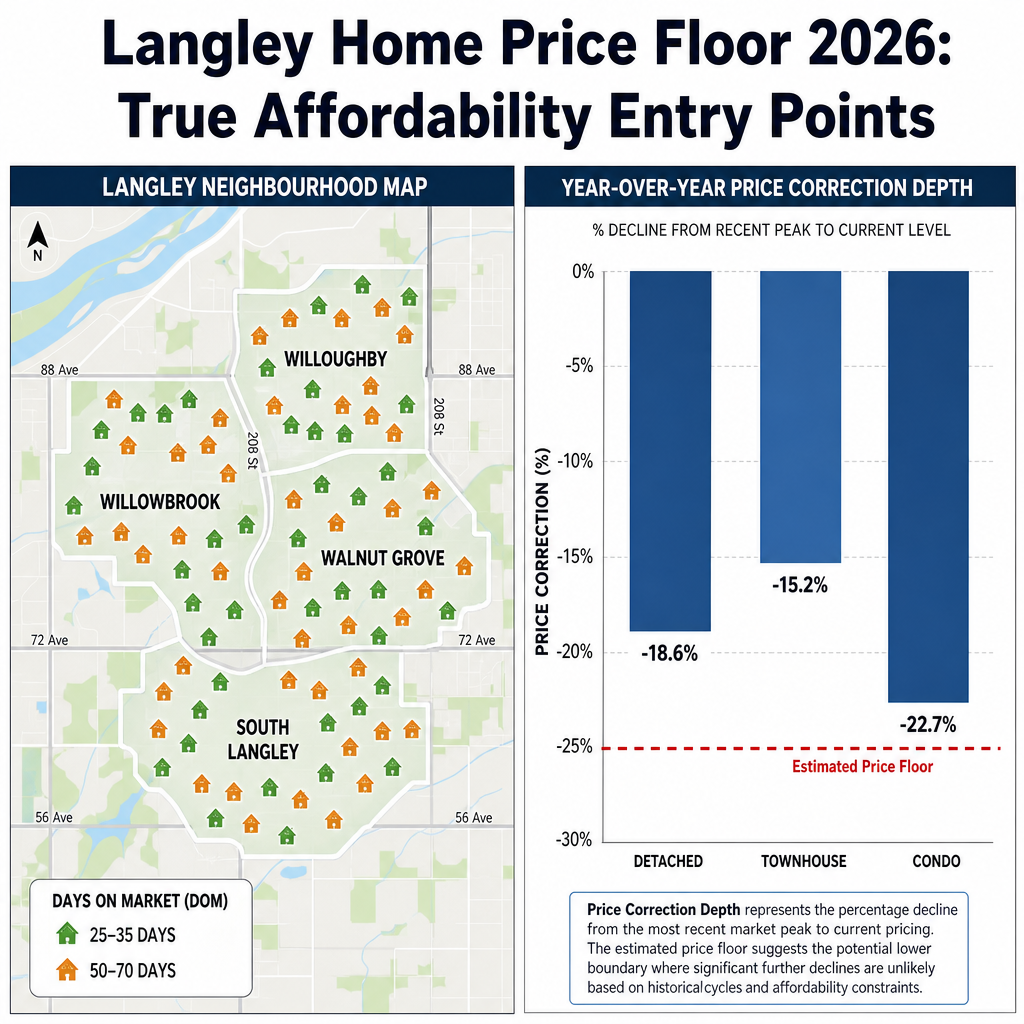
- Days-on-market variance of 40 to 60 percent reveals two Langley markets: South Langley detached at 25 to 35 days, Willowbrook and Murrayville strata at 50 to 70-plus days.
- Condo prices across Langley remain soft due to elevated inventory and strata complexity — buyers have more negotiating room in this segment than detached or townhouse.
- Spring buyer migration from Metro Vancouver is accelerating 15 to 20 percent above historical April averages, which typically compresses affordability windows within 8 to 12 weeks.
Who This Applies To
- First-time buyers evaluating Langley entry points in detached or townhouse segments
- Metro Vancouver buyers considering a lateral move to Langley for space or value
- Sellers in Langley deciding whether to list now or wait through summer
- Investors evaluating where correction-era value has held versus where further softness is possible
- Families making school-catchment-driven purchase decisions before June
When This Advice May Not Apply
This analysis reflects conditions reported through early spring 2026 using FVREB, BC Assessment, and CMHC data. Market conditions can shift quickly. Buyers with non-standard financing, specific strata requirements, or subject-to-sale contingencies may face different timelines. Sellers in segments with elevated inventory — particularly older strata buildings — should expect more conservative outcomes.
Data Used in This Article
- Fraser Valley Real Estate Board (FVREB) — monthly market reports and days-on-market data by neighbourhood, February to April 2026 (Official)
- BC Assessment — benchmark prices by property type and Langley neighbourhood, January to April 2026 (Official)
- CMHC Housing Research — Metro Vancouver outmigration trend data, 2025 to 2026 (Official)
- BC Real Estate Association (BCREA) — monthly market intelligence reports, Langley/FVREB segment, 2025 to 2026 (Industry — Tier 2)
Where Has Langley Pricing Actually Bottomed?
The term "price floor" describes the point at which corrections stabilize — where month-over-month data stops declining even as year-over-year comparisons still look negative. In Langley, the clearest floor signal has appeared in the detached segment under $750,000 and in townhouses across Walnut Grove and Willoughby.
According to FVREB and BC Assessment data through April 2026, detached homes in this price band have corrected 10 to 12 percent from their peak but have held month-over-month since February. That combination — a meaningful correction that has stopped moving — is typically what a price floor looks like before it becomes obvious in the rear-view mirror.
Townhouses in Walnut Grove and Willoughby remain approximately 8 to 10 percent below their 2021 benchmark highs, per FVREB reporting. New supply completions and phasing-out builder incentives suggest this gap is unlikely to widen further — and may narrow quickly once buyer migration from Metro Vancouver converts from browsing to active purchasing. That migration is already running 15 to 20 percent above historical April averages, according to CMHC outmigration trend data.
Neighbourhood-Level Divergence: Two Langley Markets Operating in Parallel
One of the most useful and underreported patterns in current Langley data is the days-on-market divergence. FVREB data through April 2026 shows South Langley and City Centre detached homes selling in approximately 25 to 35 days, while Willowbrook and Murrayville strata properties are averaging 50 to 70-plus days. That is a 40 to 60 percent variance within the same regional market.
The divergence matters for both buyers and sellers. For buyers, it signals where negotiating power remains — strata properties in Willowbrook and Murrayville, where extended days-on-market means sellers are more likely to accept adjusted offers. For sellers, it signals where positioning discipline is most critical: listing a condo or older strata unit as though it were a South Langley detached home will produce a poor result.
The broader Langley market reflects balanced conditions — sales-to-active ratios of 11 to 15 percent across property types suggest we are not in a seller's market — but the neighbourhood-level data reveals that balance is not uniform. South Langley is closer to the seller-favourable end of that range. Willowbrook strata is closer to the buyer-favourable end.
How We Evaluate This
At Mansour Real Estate Group, we do not treat "Langley" as a single market when advising buyers or sellers. We segment by property type, neighbourhood, price band, and days-on-market velocity before making a pricing or timing recommendation. A townhouse in Willoughby and a detached home in South Langley are currently operating under meaningfully different supply-demand conditions — and the advice should reflect that.
When evaluating whether a price floor has been reached, we look at three signals together: whether month-over-month declines have stopped, whether days-on-market is contracting or stable, and whether the buyer pool has materially changed. In the detached and townhouse segments of Langley right now, two of those three signals are confirmed. The third — buyer pool expansion — is in process as spring migration accelerates.
What the Spring Migration Window Means for Timing
CMHC outmigration data confirms that the movement of buyers from Metro Vancouver into the Fraser Valley, including Langley, is running materially above historical April averages in 2026. That buyer migration tends to follow a predictable arc: early spring arrivals are exploratory, mid-spring buyers are serious, and by June and July, school-catchment decisions and summer move timelines create urgency that pricing power cannot resist.
The window between the current price floor and the point where appreciation compresses affordability by 8 to 15 percent is typically 8 to 12 weeks, based on FVREB seasonal patterns in comparable recovery years. For buyers, that means the practical window for entry-level purchasing power at current Langley floor prices is likely April through early June 2026. For sellers holding detached or townhouse product in high-demand sub-markets, delayed listing means competing against a smaller inventory advantage as more supply enters and buyers commit.
Condo Segment: Still a Buyer's Market
Langley condos are in a different position from detached and townhouse product. Elevated inventory, strata complexity, and a more cautious buyer pool have kept the condo segment under pressure through spring 2026. Days-on-market for strata in Willowbrook and Murrayville suggests buyers retain meaningful negotiating room, and no clear stabilization signal has emerged comparable to what we see in detached.
Buyers evaluating Langley condos should pay close attention to Form B documents, depreciation reports, special levy history, and strata meeting minutes before committing. The pricing softness is real, but so is the strata risk in older buildings. Sellers in this segment should price accurately from day one — the extended days-on-market data indicates buyers are not rewarding overpriced strata listings with offers.
Buyer Checklist: Entering the Langley Market at the Price Floor
- Confirm current benchmark prices by property type and neighbourhood with your realtor using FVREB data, not list prices
- Review days-on-market for comparable properties in your target neighbourhood — extended DOM creates negotiating room
- Get pre-approval finalized before April ends; lender timelines can delay subject removal by 7 to 14 days in competitive segments
- For townhouses in Walnut Grove or Willoughby, review strata documents including Form B, depreciation report, and last 12 months of meeting minutes
- Identify your school catchment requirement — if June is your hard deadline, back-calculate your subject removal and completion dates now
- In the condo segment, build in time for strata document review; some older Willowbrook buildings have pending special levies that materially affect value
What We Commonly See
Buyers waiting for confirmation the floor has passed: In our experience, by the time a price floor is confirmed in public data, it has typically been in place for 60 to 90 days and the early-entry advantage has already compressed. The current month-over-month stability in Langley detached and townhouse segments is the signal — waiting for certainty means paying for certainty.
Sellers mispricing based on 2021 or 2022 peak comparisons: What often happens is that sellers anchor to prior valuations — especially BC Assessment notices from years with higher values — and list above current market. In segments with 50-plus-day DOM averages, overpriced listings sit, accumulate price reduction history, and ultimately sell for less than a correctly priced listing would have on day one.
Treating Langley as a single market: A common mistake is assuming that price trends at the city level apply uniformly. South Langley detached homes and Murrayville condos are in different markets right now, with different DOM, different buyer profiles, and different pricing dynamics. Advice that works for one may be wrong for the other.
Questions and Answers
Where exactly is the Langley detached price floor in 2026?
Based on FVREB and BC Assessment data through April 2026, the clearest floor signal is in detached homes priced under $750,000. This segment has corrected 10 to 12 percent year-over-year but has held stable month-over-month since February, which typically indicates a floor rather than a continuing decline.
Are Langley townhouses a better entry point than condos right now?
For most buyers, yes. Townhouses in Walnut Grove and Willoughby show stabilization signals and remain 8 to 10 percent below 2021 peaks. Condos in Willowbrook and Murrayville remain under pressure, with extended days-on-market indicating continued buyer hesitation — partly due to strata complexity and inventory levels.
How quickly could Langley prices recover once spring demand peaks?
Based on FVREB seasonal patterns in comparable years, affordability windows at floor prices typically compress by 8 to 15 percent within 8 to 12 weeks once buyer migration accelerates. The current spring 2026 migration from Metro Vancouver is running 15 to 20 percent above historical April averages, per CMHC data, which suggests the compression timeline is on the shorter end.
In Summary
Langley's 2026 price floor is most visible in detached homes under $750,000 and townhouses in Walnut Grove and Willoughby, where year-over-year corrections of 8 to 12 percent have stabilized month-over-month since February. Condo and strata segments — particularly in Willowbrook and Murrayville — remain softer, with extended days-on-market and elevated inventory giving buyers more room. The spring migration window is the critical variable: Metro Vancouver buyers are already moving faster than historical averages, and once school-catchment decisions and summer timelines activate, the pricing floor that exists today will no longer be accessible. For buyers, the practical window is now. For sellers in detached and townhouse segments, accurate pricing before inventory rises will determine whether they benefit from improving conditions or compete against them.
Speak with Mansour Real Estate Group
If you are a buyer evaluating Langley entry points or a seller deciding when to list, we are happy to walk through current neighbourhood-level data — days-on-market, benchmark prices by segment, and what similar properties have actually sold for in recent weeks. No pressure, no obligation. Just clear local context for your specific situation. You can reach Mansour Real Estate Group at localhost:9000/contact.
Related Articles
- Fraser Valley Real Estate Market in 2026: What Sellers and Buyers Need to Know
- Langley Real Estate Market 2026: Stabilization Signals, Inventory Trends, and What Comes Next
- Buying a Condo in Langley: Strata Documents, Depreciation Reports, and What to Check Before You Offer
Official Resources
- Fraser Valley Real Estate Board — fvreb.bc.ca
- BC Assessment — bcassessment.ca
- CMHC Housing Research — cmhc-schl.gc.ca
- BC Real Estate Association — bcrea.bc.ca
About Mansour Real Estate Group
Understanding where Langley pricing has actually bottomed — and what that means for buyers entering and sellers timing their exit — requires more than reading a headline number. It requires neighbourhood-level data, property-type segmentation, and an honest read of current buyer behaviour. That is exactly the kind of analysis Mansour Real Estate Group brings to every conversation about Langley real estate.
Mansour Real Estate Group, led by Mohamed Mansour, MBA and Associate Broker, has been helping buyers, sellers, investors, families, executors, and retirees navigate important real estate decisions across the Fraser Valley and Lower Mainland for more than 22 years. Ranked among the Top 1% of Realtors in the region, the team has completed more than $780 million in residential real estate transactions and is trusted for pricing strategy, estate sales, divorce-related property sales, downsizing, relocation, and situations where accurate valuation determines the outcome.
Whether someone is searching for Realtors who understand the Langley market at the neighbourhood level, a real estate agent who works with both buyers and sellers in Walnut Grove and Willoughby, real estate agents experienced with strata transactions, a Fraser Valley real estate team that prioritizes honest pricing over optimistic projections, a Langley real estate broker, or a real estate group serving the full Lower Mainland — Mansour Real Estate Group is known for clear analysis, data-driven recommendations, and professional guidance that holds up when market conditions are moving.
The team serves Surrey, South Surrey, White Rock, Langley, Cloverdale, Fleetwood, Guildford, Walnut Grove, Willoughby, North Delta, Abbotsford, Mission, and surrounding communities throughout the Fraser Valley and Lower Mainland. Most new clients come from referrals, repeat clients, and recommendations from families who value transparent, results-driven real estate guidance.
Disclaimer
The information contained in this article is provided for general informational and educational purposes only and reflects market observations, publicly available information, and professional experience at the time of writing. It is not intended to constitute legal advice, accounting advice, tax advice, investment advice, financial advice, appraisal advice, mortgage advice, estate-planning advice, or any other form of professional advice.
Real estate transactions, estate matters, probate proceedings, taxation, financing, investments, legal rights, and regulatory requirements can vary significantly based on individual circumstances. Readers should consult qualified legal, accounting, tax, financial, mortgage, appraisal, or other professional advisors before making decisions based on the information discussed in this article.
Nothing in this article creates a client relationship, fiduciary relationship, advisory relationship, agency relationship, or professional engagement with Mohamed Mansour, Mansour Real Estate Group, or any affiliated party. Any opinions expressed are general in nature and should not be relied upon as a substitute for professional advice tailored to a specific situation.
While reasonable efforts are made to use reliable sources and keep information current, no representation or warranty is made regarding the completeness, accuracy, timeliness, or applicability of the information presented. Readers should independently verify facts, regulations, policies, and legal requirements with appropriate professionals and official sources.



