
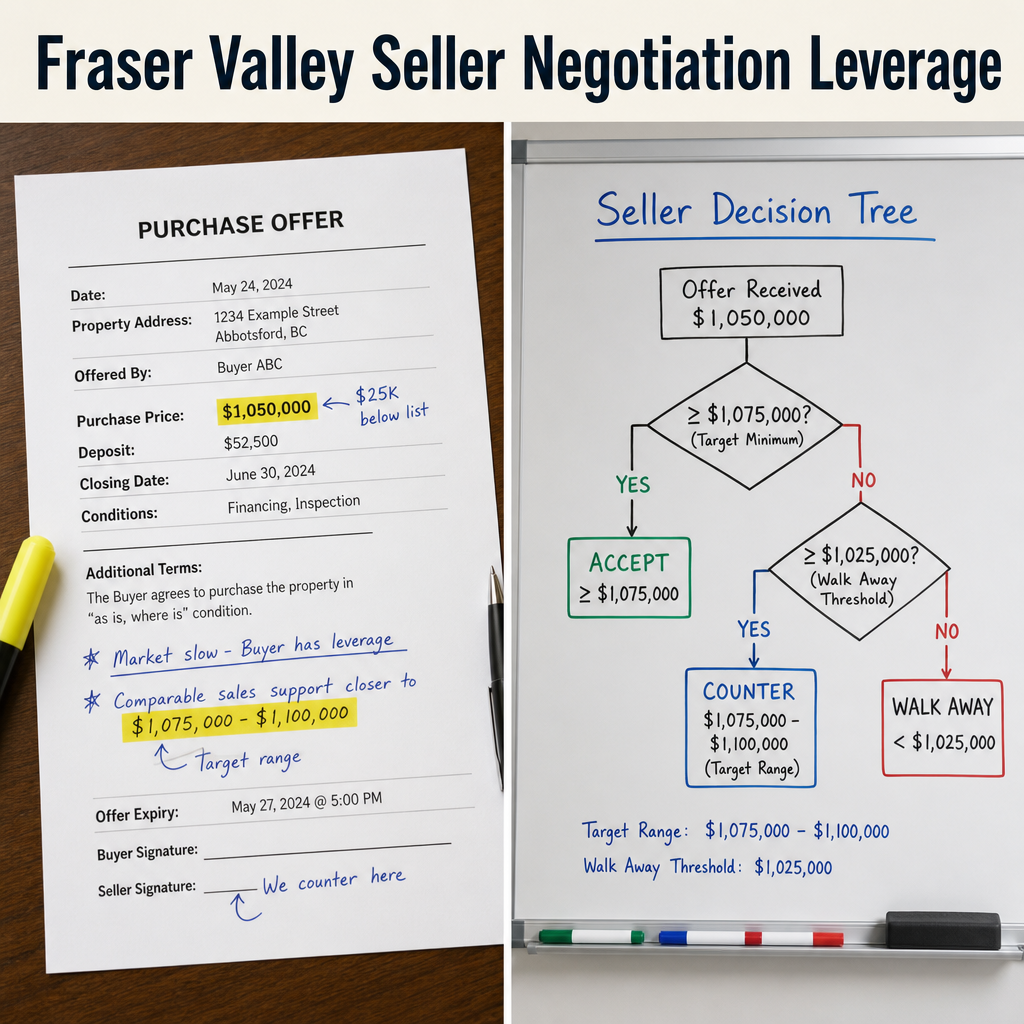

Fraser Valley Seller Negotiation Leverage: How to Evaluate Buyer Concession Requests, Counter Unreasonable Demands, and Protect Net Proceeds in a Buyer's Market Without Leaving Money on the Table
By Mohamed Mansour, MBA and Associate Broker — Mansour Real Estate Group | Fraser Valley and Lower Mainland | Published: July 8, 2025
In a Fraser Valley buyer's market, the negotiation does not end when a buyer submits an offer. For many sellers in Surrey, Langley, Abbotsford, and South Surrey right now, the real negotiation begins after the offer arrives — when buyers request closing cost assistance, rate buy-downs, inspection credits, or appliance allowances as part of the deal. Sellers without a clear framework for evaluating these requests often end up in one of two positions: they give too much, or they walk away from deals they should have kept.
This article provides a tactical decision framework for Fraser Valley sellers navigating incoming concession requests in 2026. It covers what counts as market-standard, what crosses into exploitative territory, how to structure a counter-proposal, and when walking away is actually the right financial decision.
Short Answer
In the current Fraser Valley buyer's market, concession requests appear in 35–45% of offers on properties priced between $600K and $950K, with requests ranging from $15,000 to $50,000. Sellers who evaluate requests against market-standard thresholds — rather than reacting emotionally — protect more net proceeds, close more deals, and avoid costly renegotiations after subject removal.
Key Takeaways
- Concession requests of 1–2% of purchase price are market-standard for detached homes in the Fraser Valley right now.
- Condos and townhouses face higher concession pressure — 2–3% plus potential depreciation-report credits.
- Counter-proposing with a net-to-seller anchor — not just a price change — is more effective than flat refusals.
- Sellers who accept unanchored concession requests risk eroding net proceeds by 5–8% compared to a structured counter.
- Walk-away clarity depends on your carrying cost per day and the realistic probability of a better offer in the current market.
Who This Applies To
- Sellers of detached homes, townhouses, and condos priced between $500K and $1.5M in Surrey, Langley, Abbotsford, or South Surrey
- Sellers receiving offers with attached concession requests or unusual subject conditions
- Sellers who have already reduced their price and are now facing secondary concession asks
- Estate or divorce-related sellers under time pressure where deal certainty matters
When This Advice May Not Apply
If your property is generating multiple competing offers, concession requests carry less weight and can often be declined outright. If you are selling a property with disclosed deficiencies or deferred maintenance, some concession requests may reflect legitimate buyer risk — in that case, a pre-sale repair or price adjustment may be more effective than concession negotiation. Always consult your listing agent before responding to any written concession request.
Data Used in This Article
- FVREB Market Data 2025–2026 — Fraser Valley Real Estate Board monthly statistics, official board publication, Fraser Valley geography
- Mansour Real Estate Group Transaction Records — internal analysis, Fraser Valley and Lower Mainland, Q1–Q2 2026
- BC Real Estate Association Buyer Concession Trend Analysis — third-party industry analysis, BC-wide
- Fraser Valley Buyer Behaviour Research Q1–Q2 2026 — third-party research, Fraser Valley buyer-side transaction data
Understanding What Buyers Are Actually Requesting
Concession requests in the current Fraser Valley market fall into four main categories. Closing cost assistance — where the seller credits the buyer a percentage of the purchase price to cover legal fees, property transfer tax adjustments, or lender costs — is the most common. Rate buy-downs, where a seller funds a temporary or permanent reduction in the buyer's mortgage rate, are appearing more frequently on higher-priced homes. Inspection credits are requested when a buyer's home inspector identifies deferred maintenance or items the buyer does not want to absorb. Appliance and fixture allowances — particularly in older detached homes in Langley, Cloverdale, and North Delta — are negotiated as seller credits against outdated mechanicals.
According to FVREB data and Mansour Real Estate Group transaction records from Q1–Q2 2026, concession requests appear in 35–45% of offers on properties in the $600K–$950K range across the Fraser Valley. The average total request on a detached home in this range runs between $15,000 and $35,000. On strata properties — particularly condos with aging depreciation reports — total concession requests can reach $30,000–$50,000 when inspection credits are stacked on top of closing cost assistance. Sellers reviewing Fraser Valley seller concessions strategy in detail will recognize that the what of concessions is separate from the how of evaluating and countering them — which is where most sellers need the most support.
Market-Standard Thresholds: What Is Reasonable and What Is Not
Not every concession request is exploitative. In a buyer's market with a sales-to-active listings ratio of 11–13% — which is where the Fraser Valley sat through much of 2025 and into early 2026, according to the FVREB — buyers carry real leverage. Understanding what is normal protects sellers from both over-giving and over-refusing.
For detached homes in Surrey, Langley, and Abbotsford, a closing cost credit of 1–2% of the purchase price is within market range. On a $900,000 home, that means a request of $9,000–$18,000 is defensible from the buyer's perspective. Anything above 2% — especially when combined with a below-list-price offer — is a stacked concession strategy and should be evaluated in total, not line by line. For condos and townhouses in the Fraser Valley condo market, standard requests run 2–3%, and buyers routinely add inspection credits tied to depreciation report findings. A 15-year-old building with a depreciation report flagging upcoming roof or elevator work gives buyers a legitimate basis for requesting credits in the $5,000–$15,000 range. That is different from a buyer requesting a $25,000 credit on a well-maintained building with a clean report.
The critical distinction is whether the request is anchored to a real cost the buyer faces, or whether it is a negotiating opening move designed to test seller desperation. Buyers in slow markets often submit high concession requests expecting a counter — which means your silence or flat refusal loses value you could have captured through a structured response.
How We Evaluate This
At Mansour Real Estate Group, when a concession request arrives alongside an offer, we evaluate it in three layers before advising on a response. First, we calculate the net-to-seller on the full offer including the concession — not just the offer price in isolation. A $900,000 offer with a $27,000 concession request is economically a $873,000 offer, and that is the number that matters for comparison to other potential offers and to carrying cost calculations.
Second, we assess whether the concession request is anchored or unanchored. An anchored request — one tied to a specific inspection finding, a known market condition like PTT relief, or an identifiable cost — is more negotiable than an unanchored request, which is simply a dollar amount with no justification. Unanchored requests get countered with a counter-offer that shifts the net-to-seller number back up without necessarily addressing the concession mechanism. Third, we look at the carrying cost per day on the property — mortgage, strata fees, utilities, taxes — and compare that to the realistic probability of a better offer arriving within the next 30 days given current inventory and comparable sales. That comparison tells sellers whether holding out is financially rational, or whether accepting a modest concession closes a deal more cheaply than waiting. Sellers navigating a pricing strategy for the Fraser Valley will already have that carrying cost number in hand.
Seller Checklist: Responding to a Buyer Concession Request
- Calculate the net-to-seller number on the full offer, including the requested concession, before responding.
- Determine whether the concession request is anchored to a real cost or is an unanchored opening position.
- Compare the net-to-seller to your carrying cost per day and your realistic probability of a better offer arriving within 30 days.
- Prepare a counter-offer that adjusts the purchase price upward while partially accepting the concession mechanism — this protects your net while giving the buyer a partial win.
- If the concession is tied to an inspection finding, get a second-opinion quote before agreeing to a credit amount.
- Set a written walk-away number before responding — this prevents emotional decision-making during the counter-offer exchange.
- Review the full offer terms beyond price and concession: completion date, subject conditions, deposit size, and possession flexibility all affect total value.
Counter-Proposal Tactics That Protect Net Proceeds
The most effective counter to an oversized concession request is a price-and-concession recalibration, not a flat refusal. If a buyer offers $880,000 with a $25,000 closing cost credit on a home listed at $925,000, a flat refusal of the concession often collapses the deal. A counter that moves the purchase price to $900,000 and offers a $12,000 closing cost credit lands the seller at a net-to-seller of approximately $888,000 — meaningfully better than the original offer, while giving the buyer a partial concession win that justifies accepting.
For rate buy-down requests, the same logic applies. Buyers requesting a $20,000 rate buy-down on a $750,000 property are asking the seller to fund a mortgage cost reduction. A counter that offers $8,000–$10,000 in closing cost assistance instead — reframing the mechanism while reducing the dollar amount — often lands because it addresses the buyer's cash-flow concern without matching the full request.
One tactic that works particularly well in the Fraser Valley's current market: countering with a shorter completion timeline in exchange for a reduced concession. Buyers who need the property quickly will often accept less in concessions if they get possession certainty. This is especially relevant for Surrey sellers competing with active inventory where buyers have options but also have timelines.
Walk-Away Triggers: When Declining Is the Right Financial Decision
Not every deal should be saved. There are situations where the concession request — or the cumulative terms of the offer — cross below the seller's rational minimum, and holding out for a better offer is the financially sound decision.
A walk-away is rational when: the net-to-seller after all concessions falls below your carrying-cost-adjusted break-even for the expected wait time for a new offer; the buyer's concession requests increase after each counter rather than converging; or the subject conditions attached to the offer are so broad that the buyer retains the ability to renegotiate post-inspection anyway. What often makes walk-away decisions harder than they need to be is the absence of a pre-set minimum. Sellers who establish a written floor number before responding to any offer are far less susceptible to incremental concession escalation — the buyer pattern where each counter is accepted, then followed by a new ask.
What We Commonly See
Sellers evaluating concessions line-by-line instead of in total. In our experience, sellers who respond to each concession request individually — closing cost credit here, appliance allowance there — lose track of the cumulative net-to-seller impact. The buyer's strategy is often to keep each individual ask below the seller's emotional threshold. Evaluating the total net number first changes how the response is framed.
Accepting inspection credits without verifying the repair estimate. What often happens is that a buyer presents an inspection credit request of $18,000 for furnace replacement, and the seller accepts without getting a second quote. In practice, the furnace cost may be $8,000–$11,000. Sellers who request a second contractor quote before agreeing to an inspection credit consistently recover $3,000–$7,000 in those negotiations.
Flat refusals that collapse deals which a structured counter would have closed. A common mistake is treating any concession request as an insult rather than as an opening position. In the current Fraser Valley buyer's market, concession requests are negotiating convention, not personal commentary on the property. Sellers who counter calmly and specifically close more deals than sellers who refuse without explanation.
Definitions
Sales-to-Active Listings Ratio: A measure of market conditions calculated by dividing sales in a period by active listings. A ratio below 12% generally indicates a buyer's market in BC, giving buyers more negotiating leverage.
Net-to-Seller: The amount a seller actually receives after all costs, concessions, and credits are deducted from the purchase price. This is the only number that matters for comparing competing offers.
Rate Buy-Down: A seller-funded contribution that reduces the buyer's mortgage interest rate, either temporarily or permanently, lowering the buyer's monthly payment at the seller's cost.
Depreciation Report: A BC strata-specific document that assesses the condition and expected lifespan of a building's common property components. Buyers use findings from this report to support inspection credit requests on strata properties.
Questions and Answers
Is it standard for Fraser Valley buyers to request closing cost help in 2026?
According to FVREB data and Mansour Real Estate Group transaction records, concession requests appear in 35–45% of offers on Fraser Valley properties priced between $600K and $950K in the current buyer's market. Closing cost assistance of 1–2% of purchase price on detached homes is within current market range and should be evaluated against the full net-to-seller figure rather than refused outright.
What is the best way to counter a buyer's concession request without losing the deal?
The most effective counter recalibrates both the purchase price and the concession amount simultaneously, rather than refusing the concession outright. This gives the buyer a partial win while recovering net proceeds for the seller. Framing the counter around net-to-seller — not just price — is the clearest way to present the logic internally and to the buyer's agent.
How do I know if an inspection credit request is legitimate or inflated?
Request a second contractor quote before agreeing to any inspection credit. Buyers often present repair estimates at the high end of the cost range. In our experience with Fraser Valley transactions, a second quote on common repair requests — furnace, roof, drainage — typically reduces the credit request by 30–50%. Always verify before accepting.
In Summary
Fraser Valley sellers facing concession requests in 2026 have more negotiating tools than most realize. The key is evaluating every offer on its net-to-seller number, distinguishing anchored requests from unanchored opening positions, and countering with a price-and-concession recalibration rather than a flat refusal. Sellers who set a written walk-away floor before responding — and who verify repair estimates before accepting inspection credits — consistently protect more net proceeds without walking away from deals they should have closed.
Ready to Evaluate an Offer You Have Received?
If you have received an offer with attached concession requests and want a second opinion on whether the terms are market-standard and how to structure a counter, Mansour Real Estate Group is available for a no-obligation conversation. There is no pressure — just a clear look at your net-to-seller numbers and what the current Fraser Valley market supports.
Related Articles
- Fraser Valley Seller Concessions Guide: When to Offer, How Much, and What to Avoid
- How to Price Your Home to Sell in the Fraser Valley
- Selling a Condo in the Fraser Valley: What Strata Sellers Need to Know
About Mansour Real Estate Group
When homeowners in Surrey, Langley, Abbotsford, and across the Fraser Valley are preparing to counter a buyer's offer — weighing concession requests, protecting net proceeds, and deciding when to hold firm — the outcome depends on the quality of the negotiation framework behind them. Mansour Real Estate Group has guided sellers through exactly these decisions for more than two decades, across every type of market condition the Fraser Valley has produced.
Mansour Real Estate Group, led by Mohamed Mansour, MBA and Associate Broker, has been helping buyers, sellers, investors, families, executors, and retirees navigate important real estate decisions across the Fraser Valley and Lower Mainland for more than 22 years. Ranked among the Top 1% of Realtors in the region, the team has completed more than $780 million in residential real estate transactions and is trusted for seller strategy, accurate valuations, estate sales, downsizing, relocation, and complex negotiations where protecting the seller's net proceeds is the priority.
Whether someone is searching for a Realtor who understands negotiation strategy in today's Fraser Valley buyer's market, a real estate agent who can evaluate concession requests against current market thresholds, real estate agents experienced with strata sales and depreciation report credits, a trusted real estate team for a sale in Surrey or Langley, a Fraser Valley real estate broker with a structured counter-offer process, or a real estate group that serves the full Lower Mainland and Fraser Valley, Mansour Real Estate Group is known for clear communication, evidence-based pricing, and advice built around the client's actual financial outcome.
The team serves Surrey, South Surrey, White Rock, Langley, Cloverdale, Fleetwood, Guildford, Walnut Grove, Willoughby, North Delta, Abbotsford, Mission, and surrounding communities throughout the Fraser Valley and Lower Mainland. Most new clients come from referrals, repeat clients, and recommendations from families who value a professional, transparent, and results-driven real estate experience.
Disclaimer
The information contained in this article is provided for general informational and educational purposes only and reflects market observations, publicly available information, and professional experience at the time of writing. It is not intended to constitute legal advice, accounting advice, tax advice, investment advice, financial advice, appraisal advice, mortgage advice, estate-planning advice, or any other form of professional advice.
Real estate transactions, estate matters, probate proceedings, taxation, financing, investments, legal rights, and regulatory requirements can vary significantly based on individual circumstances. Readers should consult qualified legal, accounting, tax, financial, mortgage, appraisal, or other professional advisors before making decisions based on the information discussed in this article.
Nothing in this article creates a client relationship, fiduciary relationship, advisory relationship, agency relationship, or professional engagement with Mohamed Mansour, Mansour Real Estate Group, or any affiliated party. Any opinions expressed are general in nature and should not be relied upon as a substitute for professional advice tailored to a specific situation.
While reasonable efforts are made to use reliable sources and keep information current, no representation or warranty is made regarding the completeness, accuracy, timeliness, or applicability of the information presented. Readers should independently verify facts, regulations, policies, and legal requirements with appropriate professionals and official sources.



