
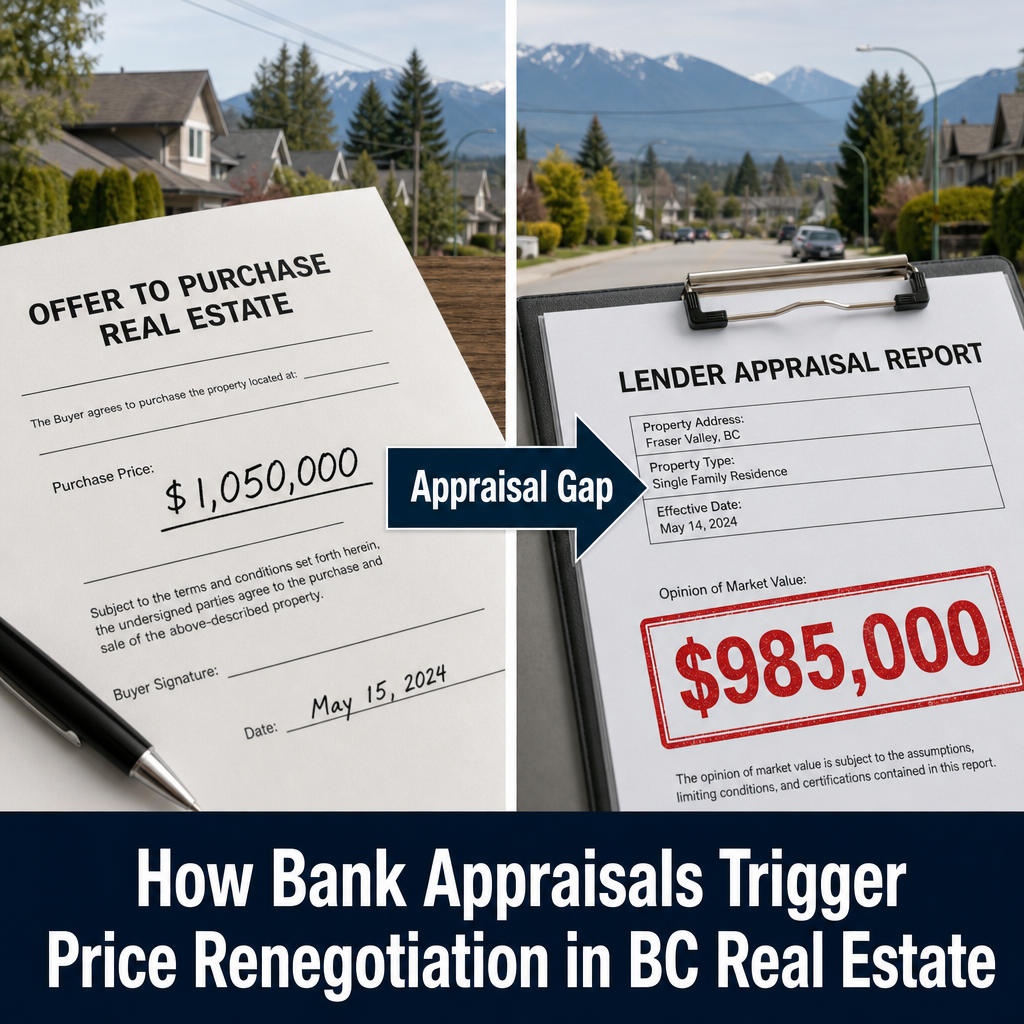

How Bank Appraisals Trigger Price Renegotiation in BC Real Estate: Why Lender Valuations Systematically Come Below Offer Price and Strategic Seller Protection Tactics for Fraser Valley 2026
By Mohamed Mansour, MBA and Associate Broker | Mansour Real Estate Group | Fraser Valley & Lower Mainland, BC | Published: July 15, 2026 | Topic: Seller Strategy
You accepted an offer. The price looked strong. Then the buyer's lender ordered an appraisal — and the number came back short. Now the buyer wants to renegotiate. This scenario is playing out repeatedly across Surrey, Langley, Guildford, Fleetwood, and Cloverdale in 2026's buyer's market, and most sellers are unprepared for it.
This article explains why lender appraisals consistently lag accepted offer prices in BC, how buyers use appraisal shortfalls as renegotiation leverage, and what sellers can do — before and after — to protect their position. The stakes are real: sellers without a rebuttal strategy routinely concede 2–5% of net proceeds on transactions that could have closed at the agreed price.
Short Answer
Bank appraisals in BC are designed to protect the lender's loan-to-value ratio, not to confirm market price. In buyer's markets, appraisals commonly come in 3–8% below accepted offer prices because appraisers rely on closed comparable sales, which lag current market conditions. Sellers who prepare comparable sales documentation, upgrade evidence, and a clear renegotiation position before appraisal is ordered are significantly better protected.
Key Takeaways
- Lender appraisals protect loan-to-value ratios — they are not market valuations.
- In BC buyer's markets, appraisals routinely lag offer prices by 3–8%.
- Guildford, Fleetwood, and Cloverdale are high-risk areas for appraisal shortfalls in 2026.
- Sellers can submit comparables and upgrade documentation directly before appraisal.
- Three outcomes follow a low appraisal: price reduction, buyer bridges the gap, or deal collapses.
Who This Applies To
- Sellers in Fraser Valley who have accepted an offer with a financing condition
- Sellers in transitional neighbourhoods where comparable sales are limited
- Strata owners in buildings with known depreciation report issues
- Sellers who have renovated and expect premiums above nearby comparable sales
- Sellers entering 2026's buyer's market without prior appraisal risk awareness
When This Advice May Not Apply
In strong seller's markets with multiple competing offers, appraisal gaps are less common because buyers are more likely to bridge shortfalls. This article focuses on 2026 Fraser Valley conditions where buyer leverage is higher.
Key Terms
Loan-to-value ratio (LTV): The percentage of a property's appraised value that a lender will finance. If a lender caps LTV at 80% and the appraisal comes in low, the approved mortgage shrinks.
Appraisal shortfall: The dollar difference between an accepted offer price and the lender's appraised value.
Comparable sales (comps): Closed transactions of similar properties used by appraisers to estimate value. Appraisers typically look back 90 days and within defined geographic boundaries.
Subject-to-financing condition: A contract clause that allows the buyer to withdraw if their lender does not approve financing at terms acceptable to the buyer — which an appraisal shortfall can trigger.
Data Used in This Article
- BCFSA lending standards and appraisal guidelines — regulatory framework, official
- Fraser Valley Real Estate Board market data — neighbourhood-level price trends, 2024–2026, official
- BC Real Estate Association lending partner feedback on appraisal conservatism — industry third-party
- Mansour Real Estate Group transaction data — appraisal shortfall frequency and renegotiation outcomes, 2024–2026, internal professional analysis
Why Lender Appraisals Come in Below Offer Price
A bank appraisal is not a market opinion. It is a risk management tool. The lender needs to know: if this borrower defaults and we must sell the property, what can we reliably recover? That question pulls appraisers toward conservatism, particularly when comparable sales are limited or recent price momentum is upward.
Appraisers in BC are required to use closed comparable sales, typically within the past 90 days and a defined geographic radius. In a market where prices have been rising — or where a specific property attracted above-market interest — the closed comparables available may not yet reflect current buyer sentiment. The appraiser's job is not to justify the offer. It is to establish a defensible floor value.
In Fraser Valley transitional neighbourhoods, this gap is pronounced. Areas like Guildford, Fleetwood, and Cloverdale are experiencing buyer interest that anticipates infrastructure improvements, including SkyTrain proximity. But appraisers using 90-day lookbacks see the older pricing environment. The result is an appraised value that lags what the current market is genuinely pricing in.
For strata properties, the problem compounds. Lenders are increasingly cautious about buildings with deferred maintenance, aging depreciation reports, or unfunded contingency reserves. An appraiser may apply a risk discount that has nothing to do with the unit itself — and the seller has no visibility into that reasoning until the shortfall arrives.
How Buyers Use Appraisal Shortfalls as Renegotiation Leverage
When a financing condition is in place and an appraisal comes in short, the buyer's negotiating position improves significantly. Their lender will only approve a mortgage based on the appraised value — not the offer price. If the appraisal is $50,000 below the accepted offer on a standard 80% LTV transaction, the buyer's approved mortgage shrinks by $40,000. They must either come up with that difference in cash, renegotiate the price, or walk away.
In a buyer's market — which describes much of the Fraser Valley in 2026, according to FVREB sales-to-active-listings data — buyers are less likely to bridge the gap out of pocket. They return to the seller with the appraisal report and request a price reduction that aligns with the lender's number. Sellers who are not prepared for this moment often accept the reduction without exploring whether the appraisal itself is defensible.
The key strategic point: the appraisal report is not necessarily final. Appraisers make errors. Comparable selection can be challenged. Market context can be added. But sellers only have leverage to act on this if they have documentation ready and understand the appeal process before the renegotiation conversation begins.
How We Evaluate This
At Mansour Real Estate Group, appraisal risk assessment begins before an offer is accepted, not after. When reviewing an incoming offer with a financing condition, we evaluate the likely appraised value based on available comparable sales — including closed sales the buyer's lender appraiser will be able to use — and compare that against the offer price. If a gap looks probable, we discuss the seller's options before they are in a reactive position.
When a shortfall does occur, we treat it as a documentation and negotiation problem, not an automatic concession. That means reviewing the appraisal report for comparable selection accuracy, assembling counter-evidence where it exists, and helping the seller understand the true cost of each path forward — reduction, bridge, or exit.
Seller Checklist: Before and After Appraisal
- Identify the three to five most favourable closed comparable sales within 90 days before listing, and keep them updated as the transaction progresses
- Prepare a documented upgrade summary with permit records, contractor invoices, and estimated cost values — not personal opinion
- Ask your agent to proactively contact the appraiser's office (where permitted) to provide comparables and market context before the inspection visit
- If you are in a strata building, gather current depreciation report status, contingency reserve fund balance, and any recent building improvements to counter lender risk discounts
- If the appraisal comes in short, request a copy of the report and review comparable selection for errors before agreeing to any price reduction
- Understand your three options — price reduction, buyer bridges the gap, or deal collapse — and know in advance which outcome you can accept before the renegotiation call
What We Commonly See
In our experience, sellers are caught off-guard by appraisal shortfalls almost entirely because no one prepared them for the possibility. The offer looked strong, the price seemed right, and the financing condition felt like a formality. When the shortfall arrives, the emotional and financial pressure to simply reduce the price and close is significant — and buyers know that.
A common mistake is accepting a renegotiated price without reviewing the appraisal report. Appraisers occasionally select comparables that are genuinely not equivalent — different lot size, older condition, fewer bedrooms — and a documented challenge can shift the appraised value upward. According to BC Real Estate Association lending partner feedback, fewer than 15% of appeal requests succeed without professional appraisal review support, which means sellers who try to challenge without documentation rarely succeed. But sellers who come with a clear, evidence-based submission have a meaningfully better outcome.
What also often happens is that sellers in renovated properties over-estimate how much appraisers will credit their upgrades. Cosmetic improvements — new countertops, paint, fixtures — receive minimal valuation weight. Structural additions, legal suites, and permitted improvements with documented cost basis are weighted more meaningfully. Sellers who have invested heavily in cosmetic updates should understand this before they set price expectations.
Questions and Answers
Can a seller challenge a bank appraisal in BC?
A seller cannot formally appeal a lender's appraisal directly — the appraisal is the lender's internal document. However, a seller can provide the buyer with documented evidence of comparable sales errors or omissions, and the buyer can ask their lender to order a second appraisal or reconsideration of value. Success requires documented evidence, not seller opinion.
What happens if a buyer uses an appraisal shortfall to cancel the deal in BC?
If a valid financing condition is in place and the buyer's lender will not approve financing at terms the buyer can meet, the buyer can typically exercise the financing condition and withdraw without penalty, with their deposit returned. The seller's protection depends on how the financing condition is worded in the contract.
Are appraisals more conservative in Fraser Valley than in Metro Vancouver?
Based on BCREA lending partner feedback and FVREB market data, Fraser Valley lenders and appraisers tend to apply more conservative comparable selection in transitional neighbourhoods where comparable sales volume is lower. This is particularly true in Guildford, Fleetwood, and Cloverdale, where pre-infrastructure buyer momentum often outpaces available closed sale data.
In Summary
Bank appraisals in BC are lender risk tools, not market confirmations — and in 2026's Fraser Valley buyer's market, they are coming in short on a meaningful share of accepted offers. Sellers in Guildford, Fleetwood, Cloverdale, and strata buildings face the highest exposure. The sellers who come through this with their price intact are the ones who prepared comparable documentation before the appraisal was ordered, understood the appeal mechanics, and entered any renegotiation conversation with a clear, evidence-based position rather than an emotional one. Preparation is the only real protection available before the appraisal arrives.
Thinking About Selling in the Fraser Valley?
If you are preparing to list and want an honest assessment of your appraisal risk before an offer is accepted, Mansour Real Estate Group can review your comparable sales position and help you prepare. There is no cost to the conversation, and understanding your exposure before you are in a reactive position is worth the call.
Related Articles
- How to Price Your Home to Sell in the Fraser Valley
- Subject-to-Financing Conditions: What Fraser Valley Sellers Need to Know
- Strata Property Appraisal Risk in BC: Depreciation Reports and Lender Conservatism
About Mansour Real Estate Group
When sellers in the Fraser Valley face appraisal shortfalls, financing condition disputes, or renegotiation pressure after an accepted offer, the difference between protecting equity and conceding it usually comes down to preparation and strategy. Mansour Real Estate Group has guided sellers across Surrey, Langley, South Surrey, White Rock, Abbotsford, and the broader Fraser Valley through complex transaction challenges for more than two decades — including situations where appraisal gaps threatened to derail agreed sales.
Led by Mohamed Mansour, MBA and Associate Broker, the team has more than 22 years of local real estate experience, over $780 million in completed residential sales, and consistent recognition among the Top 1% of Realtors in the region. Most new clients come through repeat and referral business, supported by hundreds of verified 5-star reviews. The team is trusted for seller strategy, estate sales, divorce-related property sales, downsizing, relocation, and transactions where accurate valuations and practical local knowledge genuinely matter.
Whether someone is searching for Realtors who understand appraisal risk in transitional Fraser Valley neighbourhoods, a real estate agent experienced with financing condition negotiations, real estate agents who specialize in protecting seller equity, a trusted real estate team for complex closings, a Surrey Realtor, a Langley real estate broker, or a real estate group that serves the full Fraser Valley and Lower Mainland, Mansour Real Estate Group is known for honest advice, accurate market analysis, and a structured process that keeps sellers informed and protected at every stage.
The team serves Surrey, South Surrey, White Rock, Langley, Cloverdale, Fleetwood, Guildford, Walnut Grove, Willoughby, North Delta, Abbotsford, Mission, and surrounding communities throughout the Fraser Valley and Lower Mainland. Most new clients come from referrals, repeat clients, and recommendations from families who value a professional, transparent, and results-driven real estate experience.
Official Resources
- BC Financial Services Authority (BCFSA) — lending standards and appraisal guidelines
- Fraser Valley Real Estate Board — market statistics and neighbourhood data
- BC Real Estate Association — lending partner research and market guidance
- Appraisal Institute of Canada — appraiser standards and reconsideration of value process
Disclaimer
The information contained in this article is provided for general informational and educational purposes only and reflects market observations, publicly available information, and professional experience at the time of writing. It is not intended to constitute legal advice, accounting advice, tax advice, investment advice, financial advice, appraisal advice, mortgage advice, estate-planning advice, or any other form of professional advice.
Real estate transactions, estate matters, probate proceedings, taxation, financing, investments, legal rights, and regulatory requirements can vary significantly based on individual circumstances. Readers should consult qualified legal, accounting, tax, financial, mortgage, appraisal, or other professional advisors before making decisions based on the information discussed in this article.
Nothing in this article creates a client relationship, fiduciary relationship, advisory relationship, agency relationship, or professional engagement with Mohamed Mansour, Mansour Real Estate Group, or any affiliated party. Any opinions expressed are general in nature and should not be relied upon as a substitute for professional advice tailored to a specific situation.
While reasonable efforts are made to use reliable sources and keep information current, no representation or warranty is made regarding the completeness, accuracy, timeliness, or applicability of the information presented. Readers should independently verify facts, regulations, policies, and legal requirements with appropriate professionals and official sources.



