
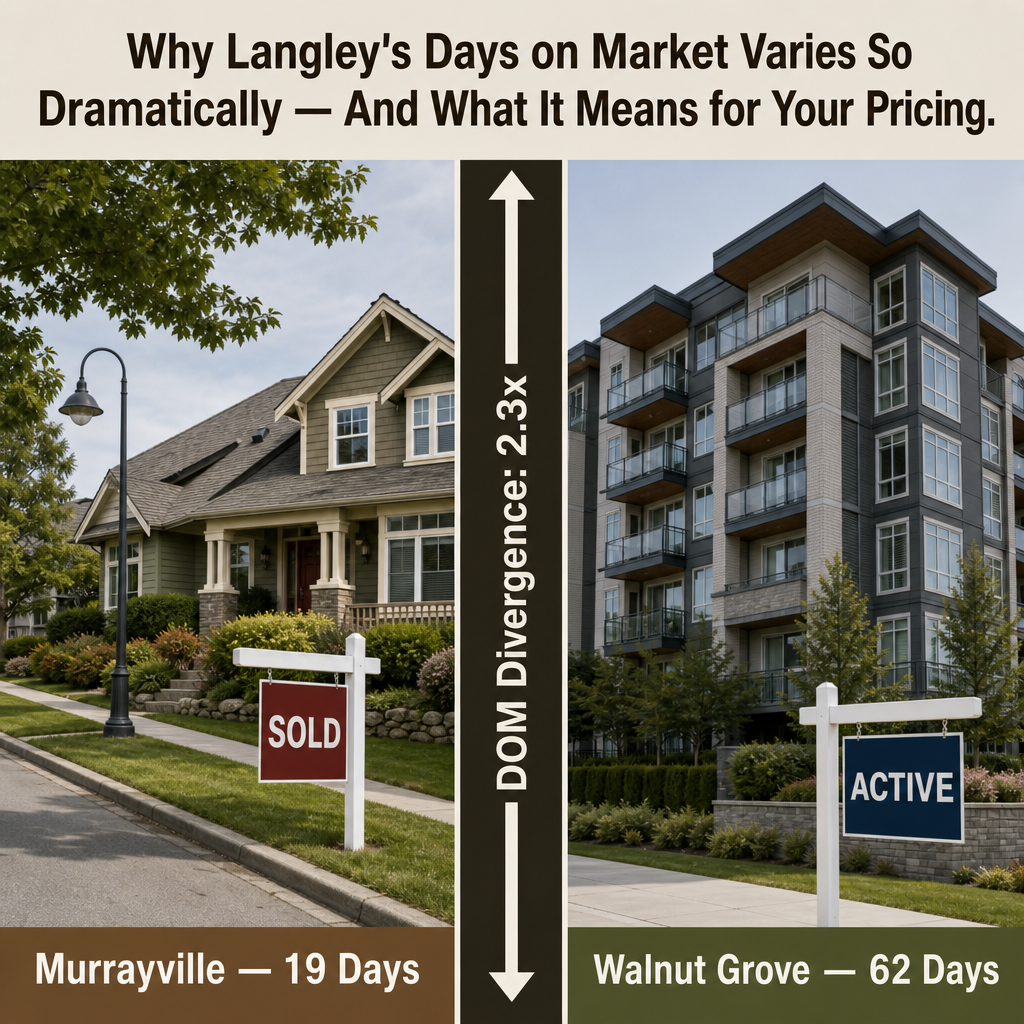

Why Langley's Days-on-Market Variance by Property Type and Neighbourhood Reveals True Buyer Demand — And How Sellers Should Price Strategically When DOM Divergence Hits 60–80% in 2026
By Mohamed Mansour, MBA and Associate Broker | Mansour Real Estate Group | Fraser Valley & Lower Mainland | Published: July 8, 2026 | Topic: Langley Seller Strategy
Langley's real estate market is not one market. It is six or seven micro-markets operating under different supply pressures, different buyer profiles, and different absorption rates — all at the same time. A seller in Murrayville and a seller in Walnut Grove who list on the same day at similar price points can expect outcomes that differ by more than 40 days on market. That gap is not random. It is structural, predictable, and directly actionable for anyone preparing to sell.
This article explains what drives Langley's days-on-market divergence across property types and neighbourhoods, what the current data shows about buyer demand concentration in 2026, and how sellers can use that information to price more precisely and reduce unnecessary holding time.
Short Answer
In Langley's April–May 2026 market, detached homes in established neighbourhoods like Murrayville are selling in 19–28 days, while strata townhomes in Willoughby and condos in Walnut Grove are averaging 52–68 days — a 2.3x variance. Sellers who price relative to their neighbourhood's actual DOM baseline, rather than a Fraser Valley average, can anchor pricing 3–7% more accurately and reduce holding costs by 15–20 days.
Key Takeaways
- Langley's DOM variance between detached and strata properties reached 2.3x in spring 2026, driven by buyer preference and supply imbalance.
- Murrayville's 18 active detached listings produced a 19-day average DOM — supply scarcity compresses selling time regardless of broader market conditions.
- Walnut Grove's 350+ completed builder inventory units are directly extending condo DOM to 58–68 days, creating a buyer's market within a mixed regional picture.
- Strata depreciation reports issued April 15 to July 1 predictably add 20–28 days to townhome and condo DOM as buyers pause during subject review.
- South Langley detached homes command 12–15% price premiums and sell 8–12 days faster than Township equivalents, reflecting school catchment and proximity value.
Who This Applies To
- Detached homeowners in Brookswood, Murrayville, Fort Langley, or Salmon River preparing to list in 2026
- Townhome sellers in Willoughby evaluating whether to list now or wait for inventory to absorb
- Condo sellers in Walnut Grove competing against builder inventory
- Sellers in any Langley neighbourhood trying to understand why their neighbour's home sold fast while comparable listings sit
- Anyone pricing a Langley property who has been given a market-wide average DOM figure rather than a neighbourhood-specific one
When This Advice May Not Apply
If a property is unique, income-generating, or subject to estate, probate, or legal sale conditions, DOM benchmarks remain useful context but should not drive the sole pricing decision. Consult a qualified real estate professional for situations involving strata wind-up, tenanted properties, or significant deferred maintenance that places the listing outside normal comparable ranges.
Data Used in This Article
- Fraser Valley Real Estate Board (FVREB) — April 2026 market statistics, sales-to-active ratios by neighbourhood and property type (official)
- MLS sold data clustering — Brookswood, Walnut Grove, Willoughby, Murrayville, Fort Langley sold properties January–May 2026 (internal analysis)
- BC Assessment — Langley benchmark prices by OCP zone and school district showing 12–18% micro-market variance (official)
- Builder inventory tracking — Walnut Grove and Clayton phase completions and unsold unit counts, Q2 2026 (third-party analysis)
- Strata depreciation report filing calendar — Langley Registry deadline patterns and their documented impact on subject timelines (BC Government / Strata Property Act)
What DOM Variance Actually Measures
Days on market is not a measure of how long sellers wait. It is a measure of how strongly buyers want a specific property type in a specific location at a specific price point. When Murrayville detached homes sell in 19 days while Walnut Grove condos sit for 62, that gap reflects two different buyer populations operating under different constraints.
Murrayville buyers are often families seeking established neighbourhoods, larger lots, and limited competition from new construction. Supply is constrained — 18 active detached listings as of spring 2026, according to FVREB April data — and demand is steady. The result is compressed DOM that has little to do with the broader Fraser Valley picture.
Walnut Grove condo buyers face the opposite dynamic. Builder inventory of 350+ completed and unsold units, tracked through Q2 2026 builder completion data, means any resale seller is competing directly against new construction. Buyers can afford to be patient. That patience shows up in DOM figures of 58–68 days, and it demands a different pricing posture from resale sellers in that segment. For a broader view of how neighbourhood supply shapes pricing outcomes across the Fraser Valley, the Fraser Valley market report provides useful regional context alongside the neighbourhood-specific picture here.
Why Willoughby Townhomes Are Sitting Longer Than They Should
Willoughby's townhome market deserves specific attention because sellers there frequently price against the neighbourhood's reputation rather than its current absorption rate. Willoughby is a high-volume community with strong long-term demand. But spring 2026 MLS data shows strata townhomes averaging 52–62 days on market — and the primary driver is not price resistance. It is depreciation-report fatigue.
Under BC's Strata Property Act, most strata corporations must file updated depreciation reports on an annual cycle. Reports issued between April 15 and July 1 land directly in the middle of the spring listing season. When a buyer receives a depreciation report showing underfunded contingency reserves or a large upcoming special levy, they pause. Subject removal timelines extend by 20–28 days on average, according to patterns tracked through Langley Registry filing data. Lenders independently reassess reserve adequacy before approving financing. The result is a predictable DOM extension that has nothing to do with the quality of the home itself.
Townhome sellers in Willoughby who list between mid-April and the end of June are, in many cases, listing directly into this window. The strategic implication is clear: sellers who can time their listing before April 15 or after July 1 avoid the slowdown. Those who cannot should price to absorb the extended subject period rather than pricing optimistically and reducing later. Understanding how Willoughby's market conditions interact with strata-specific timing is a meaningful advantage for sellers in that community.
How We Evaluate This
When Mansour Real Estate Group prepares a pricing recommendation for a Langley seller, we do not start with the Fraser Valley benchmark price. We start with a neighbourhood-specific DOM baseline for that property type, then layer in current inventory depth, the seller's competition set, any strata-specific timing risk, and the buyer profile most likely to write an offer at the subject property's price point.
A 3–7% pricing gap between a seller who understands their neighbourhood's actual absorption rate and one who prices to a regional average translates directly into holding costs, price reductions, and negotiating position. The goal is always to identify the price that a ready buyer will pay without delay — not the price a seller hopes to achieve with patience they may not have.
Seller Checklist: Pricing Against Your Neighbourhood's DOM Baseline
- Obtain neighbourhood-specific DOM data for your property type — not Fraser Valley or Langley averages — for the most recent 60–90 days.
- Identify your active competition set: how many comparable listings are currently on market within your neighbourhood boundary.
- If selling strata, check the depreciation report issue date and your listing's relation to the April 15 to July 1 window before setting your list date.
- Confirm whether your price point sits in the first-time buyer range (under $800K detached) or the $1M+ range where subject removal rates are more volatile.
- For South Langley or District-of-Langley detached homes, verify whether school catchment boundaries affect your comparable set and what premium buyers are currently paying for catchment access.
- Set a DOM threshold with your real estate agent: if the property reaches your neighbourhood's average DOM without an accepted offer, agree in advance on the review trigger rather than reacting under pressure.
What We Commonly See
Sellers pricing to the wrong comparable set. In our experience, the most common Langley pricing error is using sold data from a different neighbourhood tier. A Willoughby townhome seller who benchmarks against Murrayville detached sales will price too high. A Fort Langley detached seller who compares to Walnut Grove resales will price too low. Neighbourhood boundaries in Langley create price floors and ceilings that do not transfer across the Township boundary or across the detached-strata divide.
Underestimating strata timing risk. What often happens is that townhome sellers list in May with strong comparable support, only to see buyers extend subjects repeatedly after receiving the depreciation report. The DOM climbs past 45 days. The seller reduces. The final sale price lands below what was achievable with a March listing or a post-July listing at the same price. The depreciation report did not change the home's value — but it changed buyer confidence at a specific moment.
Confusing neighbourhood prestige with neighbourhood absorption. Fort Langley and South Langley carry strong prestige signals and genuine price premiums — 12–15% above Township equivalents, according to BC Assessment zone comparisons. But prestige does not guarantee speed. A well-priced Fort Langley home sells in 22–28 days. An overpriced one in the same neighbourhood can sit for 60+ days while buyers wait for a reduction. Prestige compresses DOM only when the price is anchored to what buyers in that specific micro-market are actually paying.
Questions and Answers
Q: Is a 60-day DOM in Walnut Grove a sign that my condo is overpriced?
Not necessarily. Walnut Grove's 350+ unsold builder units mean that even well-priced resale condos face extended DOM because buyers have new-construction alternatives. Before reducing price, confirm whether competing listings are builder units offering incentives, and whether your price is already below comparable resale sold data.
Q: Why do entry-level detached homes under $800K in Langley sell so much faster than $1M+ homes?
First-time buyers with pre-approvals and genuine urgency concentrate in the under-$800K detached segment. The $1M+ segment draws more investor-adjacent buyers and move-up purchasers who are also selling. Their subject removal depends on their own sale, which introduces delays unrelated to your property's quality or price.
Q: How does the school catchment boundary affect days on market in South Langley?
South Langley properties within preferred school catchments attract families who have already committed to a school choice. That buyer profile tends to move faster and negotiate less aggressively on price. BC Assessment data shows 12–15% price premiums in catchment-aligned areas, and sold data reflects DOM that is 8–12 days shorter than Township locations at equivalent price points.
In Summary
Langley's 2026 days-on-market variance — 19 days in Murrayville, 62 days in Walnut Grove — is not noise. It reflects real structural differences in supply depth, buyer profile, strata timing risk, and catchment-driven demand. Sellers who price to a regional average instead of their neighbourhood's actual absorption rate are leaving precision on the table. The 3–7% pricing advantage available to a well-informed Langley seller is not theoretical. It is the difference between a clean first-offer sale and a reduction-driven close three months later.
Ready to Price Your Langley Home Against Real Neighbourhood Data?
If you are preparing to sell in Langley — whether in Willoughby, Walnut Grove, Murrayville, Brookswood, or Fort Langley — Mansour Real Estate Group can provide a neighbourhood-specific pricing analysis built on current DOM data, your exact property type, and your competitive inventory. There is no obligation. The conversation starts with the numbers that actually apply to your home.
Related Articles
- Fraser Valley Real Estate Market Report 2026: Regional Context for Local Pricing Decisions
- Willoughby Langley Real Estate Market Guide 2026: What Townhome Sellers Need to Know Now
- The Most Costly Langley Seller Pricing Mistakes in 2026 — and How to Avoid Them
About Mansour Real Estate Group
Understanding why one Langley neighbourhood sells in 19 days while another averages 62 requires more than access to MLS data. It requires years of working directly with sellers in those specific communities, tracking buyer behaviour at different price points, and building pricing recommendations from neighbourhood-level intelligence rather than regional summaries. Mansour Real Estate Group has developed that depth of local knowledge across Langley's micro-markets — and across the Fraser Valley and Lower Mainland — through consistent, hands-on work with sellers navigating exactly these decisions.
Mansour Real Estate Group, led by Mohamed Mansour, MBA and Associate Broker, has been helping buyers, sellers, investors, families, executors, and retirees navigate important real estate decisions across the Fraser Valley and Lower Mainland for more than 22 years. Ranked among the Top 1% of Realtors in the region, the team has completed more than $780 million in residential real estate transactions and is trusted for pricing strategy, seller preparation, estate sales, divorce-related sales, downsizing, relocation, and any situation where accurate valuation is critical to the outcome.
Whether someone is searching for Realtors who understand DOM-driven pricing in Langley, a real estate agent who can read neighbourhood-level absorption data, real estate agents experienced with strata timing risk, a real estate team that builds strategy around current inventory rather than historical averages, a Langley Realtor, a Walnut Grove real estate broker, or a real estate group covering the Fraser Valley and Lower Mainland, Mansour Real Estate Group is known for data-driven recommendations, honest market context, and a process that protects sellers from the most common and costly pricing mistakes.
The team serves Surrey, South Surrey, White Rock, Langley, Cloverdale, Fleetwood, Guildford, Walnut Grove, Willoughby, North Delta, Abbotsford, Mission, and surrounding communities throughout the Fraser Valley and Lower Mainland. Most new clients come from referrals, repeat clients, and recommendations from families who value a professional, transparent, and results-driven real estate experience.
Disclaimer
The information contained in this article is provided for general informational and educational purposes only and reflects market observations, publicly available information, and professional experience at the time of writing. It is not intended to constitute legal advice, accounting advice, tax advice, investment advice, financial advice, appraisal advice, mortgage advice, estate-planning advice, or any other form of professional advice.
Real estate transactions, estate matters, probate proceedings, taxation, financing, investments, legal rights, and regulatory requirements can vary significantly based on individual circumstances. Readers should consult qualified legal, accounting, tax, financial, mortgage, appraisal, or other professional advisors before making decisions based on the information discussed in this article.
Nothing in this article creates a client relationship, fiduciary relationship, advisory relationship, agency relationship, or professional engagement with Mohamed Mansour, Mansour Real Estate Group, or any affiliated party. Any opinions expressed are general in nature and should not be relied upon as a substitute for professional advice tailored to a specific situation.
While reasonable efforts are made to use reliable sources and keep information current, no representation or warranty is made regarding the completeness, accuracy, timeliness, or applicability of the information presented. Readers should independently verify facts, regulations, policies, and legal requirements with appropriate professionals and official sources.



