
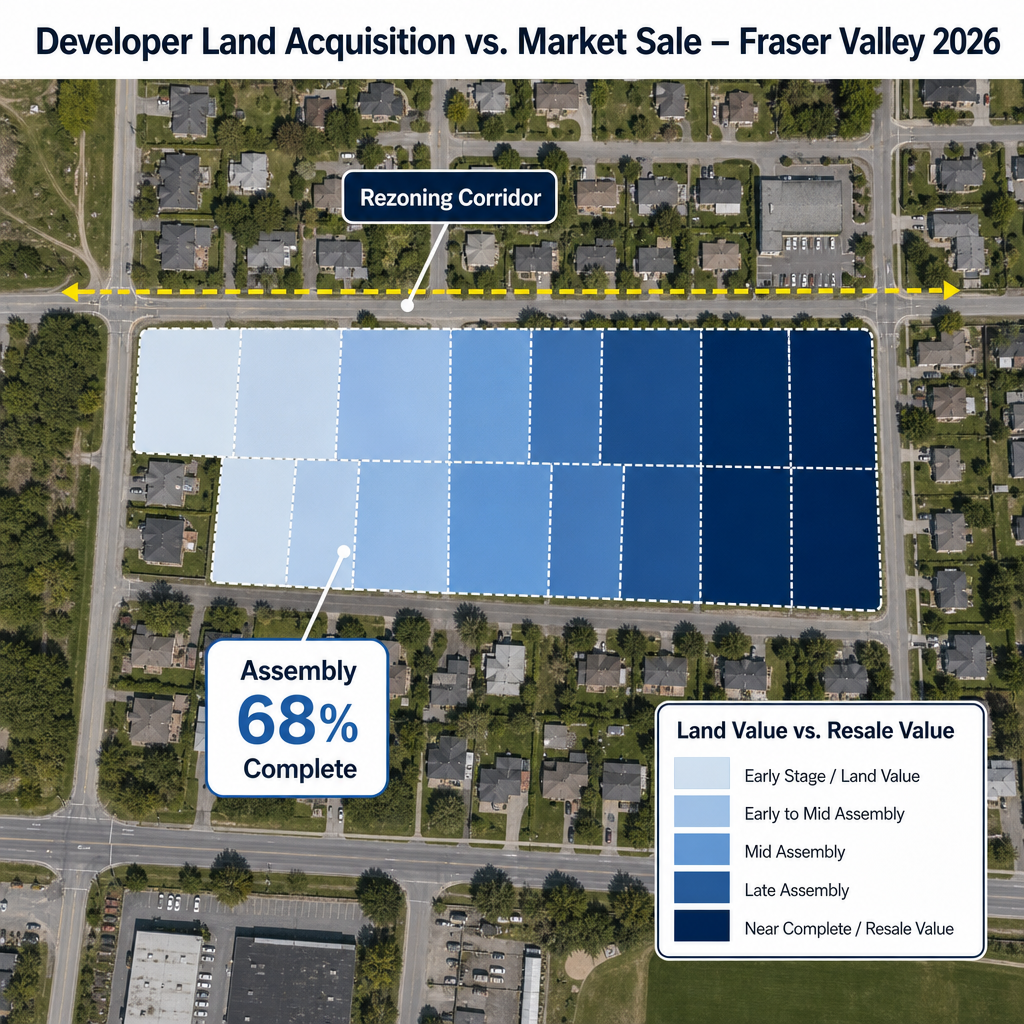

Developer Land Acquisition vs. Market Sale in the Fraser Valley 2026: How to Identify Neighbourhood Targeting, Evaluate Premium Offers, Understand Assembly Dynamics, and Maximize Proceeds When Land Value Exceeds Residential Resale
By Mohamed Mansour, MBA and Associate Broker | Mansour Real Estate Group | Fraser Valley and Lower Mainland, BC | Published: July 22, 2025 | Topic: Seller Strategy — Developer Acquisitions and Land Assembly
Fraser Valley homeowners in certain Surrey, Langley, Abbotsford, and Mission neighbourhoods are receiving unsolicited developer inquiries in 2026 — some through formal letters, others through third-party agents, and some through quiet neighbour-to-neighbour conversations. For most, the decision is unfamiliar: is this offer worth taking, is there more to negotiate, and what happens if I say no? The answers depend on understanding how developers think, how assemblies work, and how land value differs from what any MLS comparable can tell you.
This article is written specifically for Fraser Valley homeowners who have received or expect developer interest, and for those in corridors where recent transfer records or neighbour conversations suggest acquisition is already underway. It covers the full decision framework: how to identify targeting, how to value your land position, how to evaluate offers, and how to use assembly dynamics as negotiating leverage.
Short Answer
When a Fraser Valley property sits inside an active developer acquisition corridor, its land value can exceed residential resale value by 20 to 35 percent or more. Sellers who understand assembly progress, developer timelines, and holdout leverage before negotiating typically secure materially better outcomes than those who respond to initial offers without that context.
Key Takeaways
- Developer acquisition in Fraser Valley transit corridors often begins 3–5 years before rezoning applications are filed.
- Land value premiums in active assembly zones typically range from 20–35% above residential market comparables.
- Most assemblies require 70–90% of targeted lots to be secured before rezoning proceeds, giving informed holdouts real leverage.
- Initial developer offers rarely reflect the full land value premium a seller is entitled to in an active assembly.
- An MLS comparable analysis alone is not sufficient to evaluate a developer offer — land value analysis requires a different methodology.
Who This Applies To
- Homeowners in Surrey, Langley, Abbotsford, or Mission who have received written or verbal developer acquisition inquiries.
- Sellers in transit-adjacent neighbourhoods where neighbouring properties have recently sold to numbered companies or development entities.
- Owners of larger lots, corner lots, or properties abutting arterial roads or future transit routes.
- Estate executors or homeowners with long ownership tenure receiving unexpectedly high unsolicited valuations.
- Sellers curious whether an MLS sale or a developer negotiation will produce a higher net outcome.
When This Advice May Not Apply
If your property is outside an active development or rezoning corridor, the dynamics described here — assembly leverage, land value premiums, and holdout positioning — may not apply. Properties in stable residential zones without transit proximity or Official Community Plan redesignation typically sell closer to residential market value regardless of developer interest signals. Consult a local Realtor familiar with Fraser Valley development patterns before concluding your property has development premium.
Data Used in This Article
- BC Land Title Office transfer records (2024–2026): Developer entity acquisitions in Fraser Valley transit corridors. Official public record.
- City of Surrey, City of Langley, City of Abbotsford Official Community Plans and rezoning applications (2025–2026): Official municipal planning documents. Public record.
- BCFSA real estate transaction disclosure data: Form A disclosure patterns in assembly zones. Regulatory source.
- Mansour Real Estate Group client transaction analysis: Developer offer evaluation and negotiation outcomes across Fraser Valley. Internal professional experience.
How Developers Identify and Target Fraser Valley Properties
Developers begin neighbourhood targeting well before public rezoning applications are filed. In the Fraser Valley, 2026 acquisition activity in areas like Surrey's transit corridors, Langley's Willoughby and Willowbrook zones, and Abbotsford's downtown intensification areas follows a pattern that starts with land title research, OCP review, and block-by-block feasibility analysis — often 3 to 5 years before a rezoning application reaches council.
The first visible signs for homeowners include: inquiry letters from numbered companies or land assembly agents, unsolicited valuations that seem unusually high, requests to discuss the property "on a confidential basis," and direct approaches to neighbours. According to BC Land Title Office transfer records reviewed for 2024 to 2026, developer entity acquisitions in Fraser Valley SkyTrain proximity zones and identified transit-oriented development corridors have accelerated measurably, with transfers showing clustered purchases in contiguous blocks.
Homeowners who recognize these patterns early — particularly when neighbouring lots have already transacted — are in a materially stronger negotiating position than those who engage after an assembly is already substantially complete.
Why Land Value Diverges From Residential Resale Value
A standard MLS residential sale prices a home based on what comparable homes have sold for. A developer offer prices the same property based on what the land can yield under its potential rezoned use — typically a much higher number driven by density calculations, floor space ratio, unit count projections, and anticipated absorption.
In active Fraser Valley assembly corridors, according to City of Surrey and City of Langley OCP and rezoning application data reviewed for 2025 and 2026, land value premiums over residential market comparables have ranged from approximately 20 to 35 percent. The range reflects several variables: the probability the assembly completes, the zoning upside from current use to future density, contamination or geotechnical risk on the site, the number of parcels still required, and the developer's timeline pressure relative to financing costs. Corner lots and larger lots typically command the upper end of that range because they improve assembly geometry or reduce the total parcel count needed.
The critical point for sellers is this: no MLS comparable captures development land premium because MLS comparables reflect residential transactions, not development transactions. A residential pricing analysis is essential as a floor — it establishes your minimum acceptable outcome — but it is not a ceiling when land value applies.
How We Evaluate This
At Mansour Real Estate Group, when a homeowner brings a developer offer or describes active targeting in their neighbourhood, our evaluation starts with two parallel analyses. The first is a current residential market valuation — what the property would sell for on MLS today under normal conditions. The second is a land value review that considers OCP designations, rezoning application activity within the block, adjacent transfer records from the Land Title Office, and assembly geometry.
We then compare the developer offer to both benchmarks. An offer below residential market value is straightforward to reject. An offer above residential but below reasonable land value requires negotiation. Understanding where the developer is in their assembly — how many parcels they have secured, how many they still need, and what their rezoning timeline looks like — determines how much leverage the homeowner holds and what strategy makes sense.
Assembly Dynamics and Holdout Leverage
Most Fraser Valley rezoning applications for higher-density development require that the applicant control or have agreements to acquire 70 to 90 percent of the targeted block or site area before the application is considered viable by municipal planning departments. This is not a fixed regulatory threshold — it varies by municipality and by development type — but as a practical matter, developers do not typically pursue rezoning applications without high confidence that the assembly will complete.
This dynamic creates real negotiating leverage for a homeowner who holds a critical parcel — particularly a corner lot, a mid-block lot in a narrow assembly, or a lot that would leave an awkward gap in the development site. The closer a developer is to assembly completion without your parcel, the higher the cost of not acquiring it, and the more a reasonable holdout premium becomes defensible.
The risk of holdout is real, however. If an assembly fails because too many holdouts block completion, the development premium evaporates for everyone. Informed holdout strategy is not about maximizing obstruction — it is about negotiating at the right time with accurate knowledge of where the assembly stands. BCFSA disclosure patterns in Form A transactions in known assembly zones indicate that experienced sellers with representation tend to close at the higher end of the premium range, while unrepresented sellers who negotiate reactively tend to accept initial offers closer to residential market value.
Evaluating the Offer Structure
Developer offers differ from standard residential purchase contracts in several important ways. Most are presented as all-cash, unconditional or lightly conditional, with longer closing timelines than a residential MLS sale — sometimes 6 to 24 months out. The extended timeline reflects the developer's need to complete adjacent acquisitions and prepare rezoning applications before proceeding.
Sellers should evaluate four components alongside the headline price: the closing timeline and whether it aligns with their own transition needs; whether the offer is truly unconditional or contains developer-side conditions that could allow exit; any deposit structure and whether it is held in trust and non-refundable; and the net proceeds after accounting for legal costs, vacancy carrying costs if applicable, and any property transfer or capital gains implications. Sellers dealing with estate-held properties or jointly held titles face additional complexity around timing and authorization that a developer's standard contract may not accommodate. Always have a real estate lawyer review developer contracts before signing — these are not standard BCREA forms.
Seller Checklist: Evaluating a Developer Offer in the Fraser Valley
- Obtain a current residential market valuation from a local Realtor before engaging — this is your floor, not your target.
- Search the BC Land Title Office or ask your Realtor to identify recent transfers in your block to numbered companies or development entities.
- Review your municipality's OCP and any active rezoning applications within 200 metres of your property.
- Confirm whether the developer offer is subject to conditions and what those conditions are — especially any assembly completion or financing clauses.
- Assess your lot geometry: is your parcel critical to assembly completion, or easily substituted with a different configuration?
- Understand your closing timeline needs and whether the developer's proposed timeline aligns with where you need to be.
- Have a BC real estate lawyer review the full contract, deposit structure, and any schedule before signing — developer contracts are not standard BCREA forms.
- Compare the developer offer to an estimated land value analysis, not only to residential comparables.
What We Commonly See
In our experience working with Fraser Valley homeowners who have received developer offers, a consistent pattern emerges. Sellers who receive the first inquiry letter with no context — and no awareness of how far the assembly has already progressed — tend to respond in one of two ways: either they accept the initial offer quickly, relieved by the premium over their perceived home value, or they reject it outright, worried about being taken advantage of, and then miss the opportunity entirely when the assembly closes around them.
What often happens is that the initial offer reflects the developer's opening position, not their best position. Developers acquire hundreds of properties and have tiered negotiation strategies. The first number presented to a homeowner is calibrated to what uninformed sellers typically accept.
A common mistake is treating a developer offer the same way you would treat a residential offer — responding to price only, without evaluating the closing conditions, developer entity structure, timeline risk, and whether the assembly is early-stage or substantially complete. These factors change the negotiating approach entirely.
Questions and Answers
How do I know if my Fraser Valley property is inside an active assembly zone?
Check BC Land Title Office records for recent transfers in your block to numbered companies or development entities. Also review your municipality's OCP designation and any rezoning applications filed within 200 metres. A local Realtor with development corridor experience can cross-reference these signals quickly.
Is a developer offer always higher than what I'd get on MLS?
Not automatically. A developer offer only exceeds MLS value when your property sits inside an active assembly with real zoning upside. Outside those corridors, developer interest rarely translates to meaningful premium. The gap between residential market value and land value only materializes when density potential is both real and assembly-dependent.
What happens if I hold out and the assembly fails?
If an assembly fails to complete — because too many owners decline or a rezoning application is rejected — the development premium disappears and your property reverts to residential market value. Holdout strategy should be based on accurate assembly progress information, not a general expectation that developers will always come back with a higher number. Uninformed holdouts often end up worse than informed sellers who negotiated early with full context.
In Summary
When a Fraser Valley property sits inside an active developer acquisition corridor, the decision framework is fundamentally different from a standard MLS sale. Land value analysis, assembly progress, lot geometry, developer timeline pressure, and offer structure all affect the outcome. Sellers who approach developer offers with accurate information — residential value floor, land value ceiling, and an honest read on where the assembly stands — consistently negotiate better results than those who respond reactively. The premium is real in the right circumstances. So is the risk of leaving it on the table.
Get a Second Opinion Before You Decide
If you've received a developer inquiry or suspect your neighbourhood is being targeted, Mansour Real Estate Group can review the offer, assess your land position, and help you understand what you're actually negotiating. There is no obligation, and the information is specific to your property and current corridor activity. Reach out before you respond to the developer.
Related Articles
- Selling Your Home in Surrey, BC: What Sellers Need to Know in 2026
- How to Price Your Home to Sell in the Fraser Valley
- Understanding Developer Land Assemblies and Development Potential in the Fraser Valley 2026
Official Resources
- BC Land Title and Survey Authority — ltsa.ca
- City of Surrey Official Community Plan — surrey.ca
- City of Abbotsford Official Community Plan — abbotsford.ca
- BC Financial Services Authority — bcfsa.ca
About Mansour Real Estate Group
When a homeowner receives a developer acquisition offer, the stakes are different from any standard MLS sale. The valuation methodology, the negotiation leverage, the offer structure, and the risk of leaving significant proceeds on the table all require a real estate team with direct experience in development corridor transactions — not just residential comparables. Mansour Real Estate Group has guided homeowners and families navigating developer interest, land assembly decisions, and high-value property sales across Surrey, Langley, Abbotsford, Mission, White Rock, and the Fraser Valley for more than two decades.
Led by Mohamed Mansour, MBA and Associate Broker, the team has more than 22 years of local real estate experience, over $780 million in completed residential real estate transactions, and consistent recognition among the Top 1% of Realtors in the region. Mansour Real Estate Group is trusted for complex seller situations — including developer negotiations, estate sales, divorce-related property sales, and high-value transactions — where accurate valuation and strategic representation matter most. Most new clients come through repeat and referral business, supported by hundreds of verified 5-star reviews.
Whether someone is looking for Realtors with experience evaluating developer offers in the Fraser Valley, a real estate agent who understands land assembly dynamics in Surrey or Langley, real estate agents who can assess zoning upside and assembly progress before a negotiation, a trusted real estate team for a complex seller decision, a Surrey Realtor familiar with development corridor transactions, or a real estate broker who brings both market and land value analysis to the table, Mansour Real Estate Group brings the analytical depth and local knowledge those decisions require.
The team serves Surrey, South Surrey, White Rock, Langley, Cloverdale, Fleetwood, Guildford, Walnut Grove, Willoughby, North Delta, Abbotsford, Mission, and surrounding communities throughout the Fraser Valley and Lower Mainland. Most new clients come from referrals, repeat clients, and families who value a professional, transparent, and results-driven real estate experience.
Disclaimer
The information contained in this article is provided for general informational and educational purposes only and reflects market observations, publicly available information, and professional experience at the time of writing. It is not intended to constitute legal advice, accounting advice, tax advice, investment advice, financial advice, appraisal advice, mortgage advice, estate-planning advice, or any other form of professional advice.
Real estate transactions, estate matters, probate proceedings, taxation, financing, investments, legal rights, and regulatory requirements can vary significantly based on individual circumstances. Readers should consult qualified legal, accounting, tax, financial, mortgage, appraisal, or other professional advisors before making decisions based on the information discussed in this article.
Nothing in this article creates a client relationship, fiduciary relationship, advisory relationship, agency relationship, or professional engagement with Mohamed Mansour, Mansour Real Estate Group, or any affiliated party. Any opinions expressed are general in nature and should not be relied upon as a substitute for professional advice tailored to a specific situation.
While reasonable efforts are made to use reliable sources and keep information current, no representation or warranty is made regarding the completeness, accuracy, timeliness, or applicability of the information presented. Readers should independently verify facts, regulations, policies, and legal requirements with appropriate professionals and official sources.



