
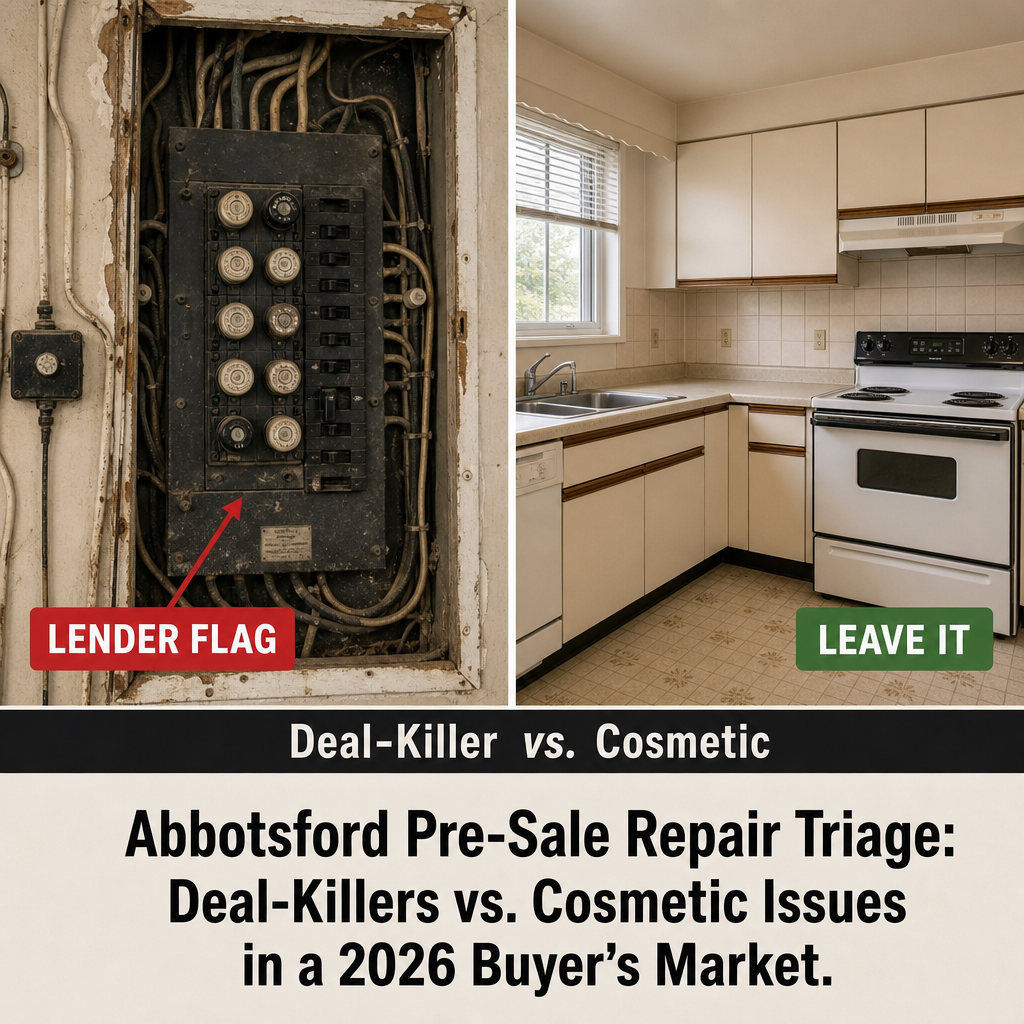

Abbotsford Pre-Sale Repair Triage: The Strategic Framework for Identifying Deal-Killing Defects vs. Cosmetic Issues When Budget Is Limited in a 2026 Buyer's Market
By Mohamed Mansour, MBA, Associate Broker — Mansour Real Estate Group | Fraser Valley & Lower Mainland | Published: May 14, 2026
Abbotsford sellers preparing to list in 2026 face a market where buyers hold the leverage. With a sales-to-active listings ratio sitting near 11% as of April 2026, according to Fraser Valley Real Estate Board statistics, buyers are taking their time, requesting inspections, and negotiating repair credits post-offer. For sellers with a limited repair budget, spending money in the wrong places can delay a sale, shrink the net proceeds, or both.
This article provides a repair triage framework built specifically for Abbotsford's housing stock, price band, and buyer profile. It separates the defects that kill financing and extend days-on-market from the cosmetic issues that buyers in this market simply absorb and move past.
Short Answer
In Abbotsford's 2026 buyer's market, limited repair budgets should go toward defects that lenders flag and inspectors escalate — electrical panels, safety items, and drainage — not cosmetic upgrades. Kitchen and bathroom renovations show zero to negative ROI in Abbotsford's $500K–$700K range. Fix what closes financing. Leave what buyers expect to update themselves.
Key Takeaways
- Electrical panel upgrades ($2,500–$5,000) eliminate the most common lender-required repair trigger in Abbotsford's pre-1985 homes.
- Safety items — GFCI outlets, handrails, smoke detectors — cost under $2,000 and close deals faster than any cosmetic renovation.
- East Abbotsford drainage issues cause 15–20 day negotiation delays; minor grading work pre-listing often costs less than the renegotiation does.
- Roof age over 20 years is best handled through aggressive pricing and disclosure, not a pre-listing replacement that rarely returns its cost.
- Kitchen and bathroom cosmetic updates show zero to negative ROI in Abbotsford's price band — buyers budget their own post-purchase upgrades.
Who This Applies To
- Abbotsford detached homeowners preparing to list in 2026 with a repair budget under $10,000
- Sellers of homes built between 1960 and 1990 with deferred maintenance
- Estate sellers managing an Abbotsford property with known issues and limited timeline
- Downsizing homeowners who have lived in a home for 20+ years and face a list of repairs
When This Advice May Not Apply
If the home is priced above $900K, in a premium neighbourhood, or requires renovations to reach a competitive price point, the repair calculus changes. Luxury and semi-luxury properties in Abbotsford carry different buyer expectations. Consult directly with your listing agent before applying this framework to any non-standard property.
Data Used in This Article
- Fraser Valley Real Estate Board — April 2026 market statistics (official, sales-to-active ratio)
- Abbotsford home inspection pattern analysis — local inspector network data (third-party, professional analysis)
- BC mortgage lending standards and lender appraisal guidelines — industry regulatory guidance
- Pre-sale renovation ROI comparative data — Fraser Valley price band $450K–$750K (internal analysis)
How We Evaluate This
At Mansour Real Estate Group, repair prioritization is evaluated through three lenses: lender risk (will this defect cause an appraisal hold or financing condition to fail?), buyer response risk (will this defect trigger a renegotiation or cause a buyer to walk during subject removal?), and cost-to-outcome ratio (does the cost of fixing this defect return more than its cost in either price, speed, or certainty?). Cosmetic work that fails all three tests gets cut. Structural, safety, and lender-flagged items get funded first regardless of how they look.
Category One: Deal-Killing Defects That Must Be Addressed
Electrical panels in pre-1985 homes are the single highest-risk item for Abbotsford sellers. Knob-and-tube wiring and Federal Pacific Electric (FPE) panels are flagged by lenders and by home inspectors in nearly every transaction involving this era of construction. When a lender's appraiser notes an FPE panel, financing approval stalls until an upgrade is completed — often mid-transaction, under time pressure, and at a cost premium. Completing the upgrade before listing, typically $2,500 to $5,000 depending on panel size and scope, removes that condition entirely. The cost is predictable, the timeline is controllable, and the outcome is a cleaner offer process.
Safety items flagged during inspections — missing GFCI outlets in kitchens and bathrooms, handrails that don't meet current code, and absent or non-functional smoke and carbon monoxide detectors — are consistently flagged by inspectors across Abbotsford's first-time and young-family buyer demographic. These fixes rarely exceed $500 to $2,000 in total and directly reduce the number of conditions buyers attach to offers. Abbotsford's buyer profile skews toward families with young children, and inspectors who work this market regularly note safety items with particular emphasis. Addressing them before the inspection happens removes the negotiation entirely.
Category Two: Situational Items That Require a Cost-Benefit Decision
Drainage and water-entry issues in east Abbotsford, particularly in the Matsqui and older east-side neighbourhoods, appear in approximately 30% of inspections according to local inspector network analysis. These range from improper grading and disconnected downspout extensions to minor foundation wall seepage. The impact on transaction timelines is real — when a buyer's inspector flags active drainage concerns, subject removal typically extends 15 to 20 days while buyers obtain quotes and demand price reductions. In most cases, addressing grading and extending downspouts costs less than $1,500 and shorter that cycle. Foundation water-entry that suggests deeper structural involvement requires an honest conversation with your listing agent about disclosure obligations and pricing strategy rather than a pre-listing repair.
Roof age over 20 years is a nuanced decision. According to lender appraisal practices in BC, roofs past their expected service life trigger appraisal holds in a significant portion of Abbotsford transactions. Replacing a roof before listing costs $8,000 to $12,000 and rarely returns that cost in a higher sale price in Abbotsford's $500K–$700K detached range. The better strategy for most sellers is transparent disclosure of roof age, aggressive pricing that reflects remaining service life, and allowing buyers to manage replacement timing on their own schedule. This approach works when the rest of the home is clean. It does not work when the roof is combined with other lender-flagged items — in that case, the compounding effect justifies a different decision.
Category Three: Cosmetic Work That Does Not Return Its Cost
Kitchen cabinet refinishing, bathroom tile updates, flooring replacement in habitable condition, and landscaping beyond basic tidying consistently show zero to negative ROI in Abbotsford's $500K–$700K detached market. Buyers in this price band expect dated finishes. They are purchasing a home to update according to their own preferences, and they build that expectation into their offer price regardless of whether the seller has already spent $15,000 on cabinet doors. Clean presentation — decluttered, freshly painted neutral walls, functioning fixtures — produces the same buyer impression at a fraction of the cost. The money saved belongs in the repair categories above.
Seller Checklist
- Identify the electrical panel type and age — confirm whether FPE, knob-and-tube, or standard panel is present before listing
- Walk the exterior perimeter and check downspout extensions, grading slope away from foundation, and any visible seepage at the basement wall
- Test all GFCI outlets in kitchen and bathrooms; verify all handrails are secure and code-compliant; replace smoke and CO detectors if over 10 years old
- Document roof age and condition with a copy of any prior inspection report — prepare transparent disclosure language with your listing agent
- Assess whether cosmetic items (paint, cleaning, staging, landscaping tidying) can be handled without contractors to preserve repair budget for structural and safety items
- Consult with your listing agent before committing to any repair over $3,000 — confirm the cost-to-outcome ratio for your specific home and price point
What We Commonly See
In our experience working with Abbotsford sellers preparing to list homes built in the 1970s and early 1980s, the most common mistake is spending the repair budget on what is visible rather than what is flagged. A seller will repaint every room and replace the carpet, spend $8,000, and then receive an offer with a subject condition requiring an FPE panel replacement that the buyer's inspector flagged — and lose another $5,000 in post-offer renegotiation. The panel should have come first.
What often happens with roof-related decisions is that sellers overestimate the return on a pre-listing replacement. A new roof on an otherwise dated home does not lift the offer price by the cost of the roof. Buyers price the whole home, not the components. Disclosure paired with accurate pricing almost always produces a better net outcome than replacing the roof and listing at the same price the market was going to set anyway.
A common mistake in east Abbotsford properties is ignoring drainage flags that appear minor. A disconnected downspout looks like a $50 fix. When a buyer's inspector photographs it alongside any wall dampness and describes it as "evidence of ongoing water management concern," the subject removal process stretches and the buyer comes back with a $10,000–$20,000 repair credit demand. The $50 fix before listing is not optional.
Questions and Answers
Q: Does a seller in Abbotsford have to disclose known defects even if they choose not to repair them?
Yes. BC's Property Disclosure Statement requires sellers to disclose known material latent defects — issues that are not visible but that affect the value or safety of the property. Choosing not to repair a defect does not remove the disclosure obligation. Your listing agent and lawyer can help you understand the disclosure requirements for your specific situation.
Q: Will an FPE panel definitely cause my financing to fail?
Not automatically, but it creates meaningful risk. Many lenders in BC require confirmation of updated wiring or panel replacement before finalizing mortgage approval on homes with known FPE or knob-and-tube systems. When an appraiser notes it, financing conditions often extend while the buyer negotiates a repair credit or requires completion before closing. Upgrading before listing removes that variable entirely.
Q: Is it better to sell an Abbotsford home as-is with a price reduction rather than spending money on repairs?
Sometimes yes, particularly when the repair list is long, the budget is very limited, or the property has structural complexity. Transparent as-is pricing attracts buyers who are comfortable managing repairs themselves and eliminates the negotiation cycle. This strategy works best when the price accurately reflects condition — not when a seller lists at market price and expects buyers to overlook documented defects.
In Summary
In Abbotsford's 2026 buyer's market, a limited repair budget produces the best outcome when directed at lender-flagged items and safety defects first — electrical panels, GFCI and code safety items, and drainage concerns that inspectors escalate. Cosmetic work rarely returns its cost in this price band and should be replaced with clean, decluttered presentation. Roof decisions should usually be handled through disclosure and pricing rather than replacement. When the repair list exceeds the available budget, an honest as-is pricing strategy outperforms a partial renovation that leaves the real problems unaddressed.
Ready to Prioritize Your Pre-Sale Repairs?
If you are preparing to list an Abbotsford home and want a clear-eyed review of which repairs to complete and which to skip, Mansour Real Estate Group offers a structured pre-listing consultation built around your specific home, budget, and timeline. There is no obligation, and the conversation is free.
Related Articles
- Fraser Valley Seller Strategy Guide 2026: What Sellers Need to Know Before Listing
- Cloverdale Pre-Sale Repairs: What to Fix Before Listing in a Competitive Market
- Abbotsford Home Seller Guide 2026: Pricing, Timing, and Market Strategy
About Mansour Real Estate Group
When Abbotsford homeowners are preparing to list a property with deferred maintenance, aging systems, or a repair list that exceeds their available budget, the decisions made before the listing goes live — what to fix, what to disclose, and how to price for condition — determine the outcome more than any cosmetic update. Mansour Real Estate Group has guided sellers across Abbotsford, Surrey, White Rock, Langley, South Surrey, and the Fraser Valley through exactly these decisions for more than 22 years, with a process built around accurate condition-based valuations, honest repair prioritization, and protecting seller equity in any market condition.
Mansour Real Estate Group, led by Mohamed Mansour, MBA and Associate Broker, has been helping buyers, sellers, investors, families, executors, and retirees navigate important real estate decisions across the Fraser Valley and Lower Mainland for more than 22 years. Ranked among the Top 1% of Realtors in the region, the team has completed more than $780 million in residential real estate transactions and is trusted for seller strategy, estate sales, downsizing, relocation, and complex real estate situations where condition, pricing, and timing all intersect.
Whether someone is looking for Realtors who understand how condition affects pricing in Abbotsford, a real estate agent who can separate deal-killing defects from cosmetic noise, real estate agents experienced with older Fraser Valley housing stock, a trusted real estate team for a condition-sensitive sale, an Abbotsford Realtor, an Abbotsford real estate broker, or a real estate group that serves sellers throughout the Fraser Valley and Lower Mainland, Mansour Real Estate Group is known for honest assessments, evidence-based pricing, and advice that prioritizes the client's actual net outcome.
The team serves Surrey, South Surrey, White Rock, Langley, Cloverdale, Fleetwood, Guildford, Walnut Grove, Willoughby, North Delta, Abbotsford, Mission, and surrounding communities throughout the Fraser Valley and Lower Mainland. Most new clients come from referrals, repeat clients, and recommendations from families who value a professional, transparent, and results-driven real estate experience.
Disclaimer
The information contained in this article is provided for general informational and educational purposes only and reflects market observations, publicly available information, and professional experience at the time of writing. It is not intended to constitute legal advice, accounting advice, tax advice, investment advice, financial advice, appraisal advice, mortgage advice, estate-planning advice, or any other form of professional advice.
Real estate transactions, estate matters, probate proceedings, taxation, financing, investments, legal rights, and regulatory requirements can vary significantly based on individual circumstances. Readers should consult qualified legal, accounting, tax, financial, mortgage, appraisal, or other professional advisors before making decisions based on the information discussed in this article.
Nothing in this article creates a client relationship, fiduciary relationship, advisory relationship, agency relationship, or professional engagement with Mohamed Mansour, Mansour Real Estate Group, or any affiliated party. Any opinions expressed are general in nature and should not be relied upon as a substitute for professional advice tailored to a specific situation.
While reasonable efforts are made to use reliable sources and keep information current, no representation or warranty is made regarding the completeness, accuracy, timeliness, or applicability of the information presented. Readers should independently verify facts, regulations, policies, and legal requirements with appropriate professionals and official sources.



